Confronting Extractivism & Corporate Power
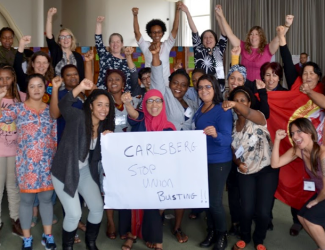
Women human rights defenders (WHRDs) worldwide defend their lands, livelihoods and communities from extractive industries and corporate power. They stand against powerful economic and political interests driving land theft, displacement of communities, loss of livelihoods, and environmental degradation.
Why resist extractive industries?
Extractivism is an economic and political model of development that commodifies nature and prioritizes profit over human rights and the environment. Rooted in colonial history, it reinforces social and economic inequalities locally and globally. Often, Black, rural and Indigenous women are the most affected by extractivism, and are largely excluded from decision-making. Defying these patriarchal and neo-colonial forces, women rise in defense of rights, lands, people and nature.
Critical risks and gender-specific violence
WHRDs confronting extractive industries experience a range of risks, threats and violations, including criminalization, stigmatization, violence and intimidation. Their stories reveal a strong aspect of gendered and sexualized violence. Perpetrators include state and local authorities, corporations, police, military, paramilitary and private security forces, and at times their own communities.
Acting together
AWID and the Women Human Rights Defenders International Coalition (WHRD-IC) are pleased to announce “Women Human Rights Defenders Confronting Extractivism and Corporate Power”; a cross-regional research project documenting the lived experiences of WHRDs from Asia, Africa and Latin America.
We encourage activists, members of social movements, organized civil society, donors and policy makers to read and use these products for advocacy, education and inspiration.
-
"Women Human Rights Defenders confronting extractive industries: an overview of critical risks and Human Rights obligations" is a policy report with a gender perspective. It analyses forms of violations and types of perpetrators, quotes relevant human rights obligations and includes policy recommendations to states, corporations, civil society and donors.
-
"Weaving resistance through action: Strategies of Women Human Rights Defenders confronting extractive industries" is a practical guide outlining creative and deliberate forms of action, successful tactics and inspiring stories of resistance.
-
The video “Defending people and planet: Women confronting extractive industries” puts courageous WHRDs from Africa, Asia, and Latin America in the spotlight. They share their struggles for land and life, and speak to the risks and challenges they face in their activism.
-
Challenging corporate power: Struggles for women’s rights, economic and gender justice is a research paper outlining the impacts of corporate power and offering insights into strategies of resistance.
Share your experience and questions!
◾️ How can these resources support your activism and advocacy?
◾️ What additional information or knowledge do you need to make the best use of these resources?
Thank you!
AWID acknowledges with gratitude the invaluable input of every Woman Human Rights Defender who participated in this project. This project was made possible thanks to your willingness to generously and openly share your experiences and learnings. Your courage, creativity and resilience is an inspiration for us all. Thank you!
Related Content
Juhi
Juhi es una entusiasta de las tecnologías. Posee una licenciatura en Ingeniería Informática de la Universidad Tecnológica de Gujarat y formación de posgrado en Telecomunicaciones Inalámbricas y Gestión de Proyectos del Instituto Universitario Humber. Apasionada de la resolución de problemas y de mantenerse a la vanguardia en el panorama tecnológico en constante evolución, Juhi se ha encontrado recorriendo diversas industrias como técnica en Tecnologías de la Información. Ha tenido oportunidad de aplicar sus competencias técnicas en distintos entornos, siempre abrazando los nuevos desafíos con entusiasmo. Más allá de los códigos y los circuitos, le encantan las aventuras de la vida. Explorar nuevos lugares y culturas es para ella una bocanada de aire fresco. Ya sea que se trate de descubrir alguna joya oculta en la ciudad, de probar algún plato exótico o de embarcarse en algún deporte de aventura, Juhi siempre está predispuesta a vivir nuevas experiencias.
Hospital | Content Snippet FR
Hôpital
« C’est peut-être le moment de repenser à ce à quoi peut ressembler une révolution. Peut-être qu’elle ne ressemble pas à une marche de personnes handicapées en colère dans les rues. Peut-être ressemble-t-elle plutôt à un monde qui s’immobilise parce que tous les corps qui le composent sont épuisés – parce qu’il faut donner la priorité aux soins avant qu’il ne soit trop tard. »- Johanna Hedva
Les hôpitaux sont des institutions, des sites vivants du capitalisme, et ce qui se joue lorsque quelqu’un est censé se reposer est un microcosme du système lui-même.
Les institutions sont conçues pour nous séparer de nos systèmes de soins – nous nous retrouvons isolé.e.s dans des structures rigidement hiérarchisées, et nous avons souvent l’impression que les soins nous sont imposés plutôt que donnés ou pris dans le cadre d’une conversation. Les soins institutionnels, du fait de leur intégration dans la demande capitaliste, sont cloisonnés : une personne s’occupe de votre jambe et uniquement de votre jambe, une autre s’occupe de votre tension artérielle, etc.
La photographe Mariam Mekiwi a dû subir une opération le mois dernier et documenté le processus. Ses portraits d’environnements aseptisés – néons blancs, rangées et rangées de structures répétitives – dans une palette de couleurs délavées reflètent un lieu vidé de toute vie et de tout mouvement. C’était l’une des façons pour Mariam de garder son esprit vivant. C’était une forme de protestation à l’intérieur des limites d’une institution avec laquelle elle devait s’engager.
Les photos forment le portrait de quelque chose d’incroyablement vulnérable, car regarder quelqu’un·e vivre l’effondrement de son propre corps est toujours un rappel sacré de notre propre fragilité. C’est aussi un rappel de la fragilité de ces systèmes de soins, qui peuvent nous être refusés pour de multiples raisons – allant du manque d’argent au fait de ne pas être dans un corps considéré comme suffisamment précieux, un corps peut-être trop féminin, trop homosexuel ou trop brun.
Des soins vécus comme désincarnés et solitaires, susceptibles d’être révoqués à tout moment, ne nous aident pas à nous épanouir. Et c’est très différent de la façon dont les êtres humains se comportent réellement lorsqu’iels prennent soin les un.e.s des autres. À quoi ressemblerait notre monde si nous nous engagions à démanteler les structures capitalistes actuelles qui entourent notre santé? À quoi ressemblerait-il, si nous le réimaginions radicalement?
Cristina Bautista
« Si nous nous taisons, ils nous tuent, et si nous parlons [ils nous tuent] aussi. Alors parlons. » - Cristina Bautista, 2019
Défenseuse infatigable des droits du peuple Nasa, Cristina s’est exprimée haut et fort contre la violence à l’égard de sa communauté. Dans un discours devant les Nations Unies, elle appelait à protéger les vies des femmes autochtones et à les impliquer dans différents domaines de la vie. En 2017, Cristina était membre du Bureau des Nations Unies pour les droits humains des personnes autochtones. Le Fonds de contributions volontaires des Nations Unies pour les populations autochtones lui a octroyé une subvention en 2019.
« J’aimerais mettre en lumière la situation actuelle du peuple autochtone en Colombie, le meurtre de leaders autochtones, la répression de la contestation sociale. Au lieu d’aider, l’accord de paix a renforcé la guerre et l’exploitation de territoires sacrés en Colombie… Actuellement, nous travaillons en tant que femmes, dans presque toutes les nations autochtones, à un avenir meilleur pour nos familles. Je ne veux pas voir plus de femmes vivre dans ces conditions en milieu rural. Il nous faut des opportunités qui permettent aux femmes autochtones de participer à la vie politique, à l’économie, à la société et à la culture. J’acquiers une réelle force aujourd’hui, en voyant toutes ces femmes ici, et en voyant que je ne suis pas seule. » - Cristina Bautista, 2019
Cristina a été assassinée le 29 octobre 2019, ainsi que quatre autres membres de la garde autochtone désarmée, dans une attaque potentiellement menée par des membres de « Dagoberto Ramos », un groupe dissident FARC.
D’après Global Witness, « le nombre d’assassinats de leaders communautaires et sociaux·les a terriblement augmenté en Colombie au cours de ces dernières années ».
« La communauté nasa a prévenu à maintes reprises les autorités au sujet des menaces qui pèsent sur leur sécurité. Malgré les efforts déployés par les gouvernements colombiens successifs, les peuples autochtones continuent de faire face à d'importants risques, surtout les dirigeants communautaires ou religieux comme Cristina Bautista.» - Point presse des Nations Unies, 1er novembre 2019
Meztli Omixochitl Sarabia Reyna
Sakine Cansiz
Michelle D'Cruz
Michelle est une féministe d'Asie du Sud-Est qui aime concerterer pour rassembler des gens et susciter des conversations en faveur du changement social et du partage des connaissances féministes, à travers l'art, la poésie, la musique et les jeux. Forte d'une expérience en plaidoyer digital et en développement de stratégies de communication, elle a contribué à des initiatives en matière de droits digitaux, de recherche sur les droits humains et de création de coalitions de la société civile dans toute l'Asie du Sud-Est. Elle est titulaire d'une licence de droit de l'Université nationale de Singapour, aime se balader dans des rues au hasard de la ville et apprécie un peu trop le café.
CREDITS | Content Snippet EN
Credits
|
Co-editeurices Création graphique et illustration Stratège des communications Editrice de la langue arabe Responsable de la traduction
Relecture |
Traduction arabe
Relecture
Relecture |
Ayanda Denge
“I am a wonder… Therefore I have been born by a mother! As I begin to stutter, my life has been like no other…” - Ayanda Denge (read the whole poem below)
As a committed and fervent social justice activist, she fought for the rights of sex workers, trans persons, and for those of people living with HIV and AIDS. She was also a motivational speaker on cancer awareness, and campaigned for affordable and social housing, especially for poor and working-class people. Ayanda stood tall as a mountain against different and often abusive faces of discrimination.
“Being transgender is not a double dose, but it’s a triple dose of stigmatisation and discrimination. You are discriminated against for your sexual identity, you are discriminated against for your work, and you are discriminated against for your HIV status.” - Ayanda Denge, 2016
She was acting chairperson at the Sex Workers Education and Advocacy Taskforce (SWEAT) and also worked as an Outreach Coordinator at Sisonke, a national sex workers’ movement in South Africa.
“From us, from our regional head office, to SWEAT where I sit on the board, to Sisonke, a movement of sex workers in Cape Town. We all amalgamate, we have one cry and it’s a cry that is recognised internationally by international sex workers. We want decriminalisation of sex work.” - Ayanda Denge, 2016
She lived in the Ahmed Kathrada House, which was being occupied by the Reclaim the City campaign for social housing. In 2018, Ayanda was elected house leader. On 24 March 2019, she was stabbed to death in her room. The year prior, another resident was killed.
Reclaim the City draws a connection between the safety of the house residents and the Provincial Government withholding electricity and the human right to water:
“We cannot separate the safety of women and LGBTQI people living in the occupation from the refusal by the Western Cape Provincial Government to turn the electricity and water back on at Ahmed Kathrada House.
The house is pitch black at night. We need lights to keep each other safe. It is as if the Province wishes to punish poor and working class people, whose only crime is that we needed a home. While they may disagree with our reasons for occupying, they should be ashamed of themselves for putting politics before the safety and dignity of residents of this city.
Rest in Peace comrade Ayanda Denge, we shall remember you as we carry the torch forward in the struggle for decent well-located housing.”
Poem by Ayanda:
I am a wonder…
Therefore I have been born by a mother!
As I begin to stutter,
My life has been like no other.
Born in pain
Nourished by rain
For me to gain
Was living in a drain.
As I shed a tear
I stand up and hold my spear.
Voices echo, do not fear
Challenges within a year,
Challenges of hurt are on my case;
Community applauds as they assume I have won my race;
But in reality my work strides at a tortoise pace;
On bended knee I bow and ask for grace.
For the Lord
Is my Sword;
To remind humanity
That he provides sanity.
Why Lord am I this wonder?
The Lord answers me with the rain and thunder,
For questioning my father
Who has in the book of lambs
A name called Ayanda.
From the streets my life was never sweet
The people I had to meet;
At times I would never greet;
Even though I had to eat;
I’d opt to take a bow
Rather than a seat
Listen to the poem in Ayanda’s voice
“For my life represents that of a lotus flower, that out of murky and troubled waters I bloomed to be beautiful and strong...” - Ayanda Denge, watch and listen
Tributes:
“Ayanda, I want to say to you that you are still a survivor, in our hearts and minds. You are gone but you are everywhere, because you are love. How beautiful it is to be loved, and to give love. And Ayanda, that is the gift that you have given us. Thank you for all of the love, we truly did need you. Going forward, I promise to you that we will all commit to continue with the struggle that you have dedicated so much energy and your time to. And we will commit ourselves to pursuing justice in this awful ending to your life.” - Transcript of a message, in a farewell Tribute to Ayanda
“Ayanda was an activist by nature. She knew her rights and would not mind fighting for the rights of others. For me, it was no shock that she was involved with many organizations and it was known that she was a people’s person. It did not need to be the rights of LGBTI but just the rights of everyone that she stood for.” - Ayanda’s sister
Mia Manuelita Mascariñas-Green
.
Nahia Sediqi
Debbie Stothard
During her 38-year career, Debbie Stothard, has worked with diverse communities and activists to engage states, IGOs and other stakeholders throughout Asia, Africa, Europe, and the Americas on human rights and justice. Her work is focused on the thematic priorities of business and human rights, atrocity prevention, and women’s leadership. Accordingly, she has either facilitated or been a resource person at nearly 300 training events in the past 15 years. Most of these were grassroots-oriented workshops delivered in the field, focused on human rights advocacy, economic literacy and business and human rights, and transitional justice and atrocity prevention. Her work in transitional justice and atrocity prevention has mainly focused on Burma/Myanmar, however she has provided advice on responses to other country situations around the world.
During 1981 – 1996, Debbie worked as a crime reporter, student organizer, policy analyst, academic, government advisor and food caterer in Malaysia and Australia while volunteering for human rights causes. In 1996, she founded ALTSEAN-Burma which spearheaded a range of innovative and empowering human rights programs. This includes ALTSEAN’s ongoing intensive leadership program for diverse young women from Burma, which in the past 22 years, has helped strengthen and expand women’s leadership in conflict-affected zones. She served as a member of the Board of the International Federation for Human Rights (FIDH) for 9 years as Deputy Secretary-General (2010-2013) and Secretary-General (2013 – 2019) during which she promoted the mission and profile of FIDH at approximately 100 meetings and conferences per year.
Sexting Like a Feminist: Humor in the Digital Feminist Revolution | Title Snippet AR
الصياغات النسوية للرسائل النصّية ذات المحتوى الجنسي: الدُّعابة الجنسانيّة في فضاء الثورة النسوية الرقمية
تشينيلو أونوالو
ترجمة مايا زبداوي
Trupti Shah
Imma Sala
Jemimah Naburri-Kaheru
Jemimah Naburri-Kaheru est une stratège internationale accomplie en matière de ressources humaines à impact profond dans la région de la Corne de l'Afrique. Jemimah était auparavant responsable régionale des ressources humaines et du bureau de l'Initiative stratégique pour les femmes dans la Corne de l'Afrique (SIHA) . Son influence s’est étendue jusqu’à la direction des ressources humaines de plus de 70 employé·e·s régionaux·ales, alors que l'organisation connaissait une croissance rapide, avec une augmentation de 40 % de ses revenus annuels. Tout au long de sa carrière, Jemimah a orchestré avec succès des efforts de recrutement, introduit des systèmes de performance basés sur le mérite, de même que supervisé les relations avec les employé·e·s et les politiques RH. Elle a joué un rôle central dans le soutien aux stratégies mondiales de personnel. Avec une formation universitaire en Études de Développement de l'Université de Makerere (Ouganda) et un Master en Gestion des Ressources Humaines, Jemimah est évidemment engagée envers le développement professionnel. Sa contribution à des effectifs hautement performants et à un leadership international en matière de ressources humaines la positionne comme un atout inestimable dans toute entreprise mondiale.
Rosa Helena Bernal Pinto
Brenda Salas Neves
Brenda Salas Neves is a feminist queer strategist born and raised in the southern Andes. They organize to shift narratives and mobilize resources to support racial and climate justice movements around the world. They have produced media projects to uplift migrant power and rise against U.S. military intervention across Latin America, with Deep Dish TV and the Portland Central America Solidarity Committee. They are a proud member of the Audre Lorde Project and a graduate of the United World Colleges (UWC) movement.
Upasana Agarwal
Upasana Agarwal
Upasana es unx ilustradorx y artista no binarie de Calcuta, India. Su obra explora narrativas identitarias y personales, que empean restos o evidencias visuales de los contextos con los que trabaja. Le atraen especialmente los diseños en patrones que, para ellx, comunican verdades complejas sobre el pasado, el presente y el futuro. Cuando Upasana no está ilustrando, organiza y dirige un centro de arte comunitario queer y trans de la ciudad.