Confronting Extractivism & Corporate Power
Women human rights defenders (WHRDs) worldwide defend their lands, livelihoods and communities from extractive industries and corporate power. They stand against powerful economic and political interests driving land theft, displacement of communities, loss of livelihoods, and environmental degradation.
Why resist extractive industries?
Extractivism is an economic and political model of development that commodifies nature and prioritizes profit over human rights and the environment. Rooted in colonial history, it reinforces social and economic inequalities locally and globally. Often, Black, rural and Indigenous women are the most affected by extractivism, and are largely excluded from decision-making. Defying these patriarchal and neo-colonial forces, women rise in defense of rights, lands, people and nature.
Critical risks and gender-specific violence
WHRDs confronting extractive industries experience a range of risks, threats and violations, including criminalization, stigmatization, violence and intimidation. Their stories reveal a strong aspect of gendered and sexualized violence. Perpetrators include state and local authorities, corporations, police, military, paramilitary and private security forces, and at times their own communities.
Acting together
AWID and the Women Human Rights Defenders International Coalition (WHRD-IC) are pleased to announce “Women Human Rights Defenders Confronting Extractivism and Corporate Power”; a cross-regional research project documenting the lived experiences of WHRDs from Asia, Africa and Latin America.
We encourage activists, members of social movements, organized civil society, donors and policy makers to read and use these products for advocacy, education and inspiration.
-
"Women Human Rights Defenders confronting extractive industries: an overview of critical risks and Human Rights obligations" is a policy report with a gender perspective. It analyses forms of violations and types of perpetrators, quotes relevant human rights obligations and includes policy recommendations to states, corporations, civil society and donors.
-
"Weaving resistance through action: Strategies of Women Human Rights Defenders confronting extractive industries" is a practical guide outlining creative and deliberate forms of action, successful tactics and inspiring stories of resistance.
-
The video “Defending people and planet: Women confronting extractive industries” puts courageous WHRDs from Africa, Asia, and Latin America in the spotlight. They share their struggles for land and life, and speak to the risks and challenges they face in their activism.
-
Challenging corporate power: Struggles for women’s rights, economic and gender justice is a research paper outlining the impacts of corporate power and offering insights into strategies of resistance.
Share your experience and questions!
◾️ How can these resources support your activism and advocacy?
◾️ What additional information or knowledge do you need to make the best use of these resources?
Thank you!
AWID acknowledges with gratitude the invaluable input of every Woman Human Rights Defender who participated in this project. This project was made possible thanks to your willingness to generously and openly share your experiences and learnings. Your courage, creativity and resilience is an inspiration for us all. Thank you!
Related Content
Snippet FEA Environments Of Shelter (ES)
Metzineres proporciona los siguientes tipos de apoyo, conocidos como
Entornos de Cobijo:
Y aura-t-il des événements préalables au Forum cette fois-ci ?
Des partenaires mondiaux et régionaux nous ont déjà communiqué certaines idées de rassemblements préalables au Forum, dont nous vous ferons part sous peu.
Si vous projetez d’organiser une réunion avant le Forum, n’hésitez pas à nous le faire savoir !
Plusieurs belles choses ont émergé du Forum des féminismes noires (BFF, selon son acronyme anglais), qui avait été organisé en 2016 par un Groupe consultatif et financé par l’AWID. À l’issue de ce BFF, certaines organisations indépendantes ont ainsi pu voir le jour, telles ques des organisations féministes noires au Brésil. Bien que le BFF n’aura pas lieu cette année, nous nous engageons à partager certains apprentissages clés avec toute personne intéressée à poursuivre le travail d'organisation féministe noire.
Vina Mazumdar
Como activista, no trabajo con ninguna agrupación, organización o movimiento en este momento, ¿aun así debería completar la encuesta?
No. Valoramos tu trabajo, pero no estamos buscando respuestas de personas a título individual por el momento.
Snippet FEA Occupation’s kitchen Instagram (FR)
Campagne publicitaire d'Ocupação 9 de Julho :
Les Femmes Maintiennent les Soins | Les Soins Soutiennent la Vie | La Vie Soutient l'Économie | Qui s'Occupe des Femmes ? | Pas Une de Moins1 | Ensemble | Déjeuner du Dimanche
1Nenhuna a menos se traduit littéralement par « pas une femme de moins » ou « ni una menos » en espagnol - un célèbre slogan féministe en Amérique latine qui a émergé en Argentine en réponse à l'augmentation de la violence sexiste.
Orouba Barakat
Où et quand se tiendra le prochain Forum de l'AWID ?
Le 14e Forum international de l'AWID aura lieu du 20 au 23 septembre 2021 à Taipei, Taiwan.
Les droits des femmes et l’égalité de-s genre-s – La rubrique ‘Point de mire’ sur TheGuardian.com
Maria Auxiliadora Escalante Diaz
Comment puis-je accéder à l’enquête?
L’enquête est disponible sur KOBO, une plateforme en source libre de collecte, gestion et visualisation de données. Pour y participer, il vous suffit de cliquer ici sur le lien de l’enquête et de suivre les indications pour répondre aux questions.
Snippet FEA EoS The Howl (FR)

Le hurlement
Participation et activisme
Leyla Yıldızhan (Deniz Fırat)
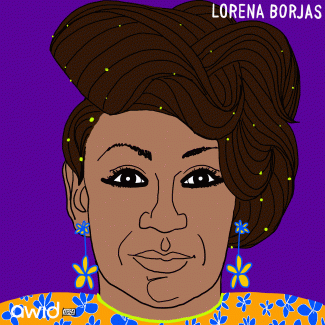
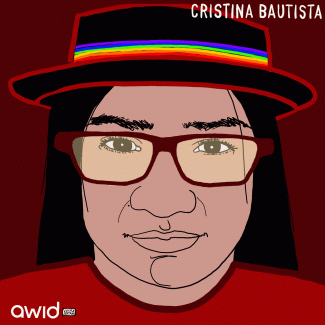
Remembering: A Tribute to WHRDs no longer with us
AWID honors feminists and Women Human Rights Defenders (WHRDs) who have died and whose contributions to the advancement of human rights are very much missed.
Celebrating Activists and WHRDs
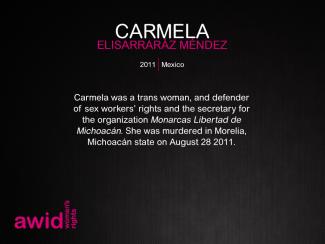
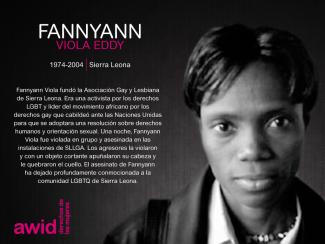
AWID’s WHRD Tribute is a photo exhibition featuring feminist, women’s rights and social justice activists from around the world who are no longer with us.
The Tribute was first launched in 2012, at AWID’s 12th International Forum, in Turkey. It took shape with a physical exhibit of portraits and biographies of feminists and activists who passed away. The initiative was described by Forum participants as being a unique, moving and energizing way to commemorate our collective history.
At the 13th International Forum in Brazil, we honored activists and WHRDs with a mural unveiling ceremony in four languages, a dance performance and a Brazilian ritual.
In between the events, the Tribute lives as an online gallery that is updated every year as part of the 16 Days Campaign Against Gender Based Violence (25 November – 10 December).
Contributions from all over the world
Since 2012, through our annual Tribute to Women Human Rights Defenders (WHRDs) no longer with us, over 400 feminists and WHRDs from 11 regions and 80 countries have been featured.
AWID would like to thank the families and organizations who shared their personal stories and contributed to this memorial. We join them in continuing the remarkable work of these women and forging efforts to ensure justice is achieved in cases that remain in impunity.
Visit the WHRD Tribute online exhibit
The violence and threaths against WHRDs persist
In addition to paying homage to these incredible activists, the Tribute particularly sheds light on the plight of WHRDs who have been assassinated or disappeared.
One third of those featured in the Tribute were activists who have been murdered or disappeared in suspicious circumstances. They were specifically targeted for who they were and the work they did to challenge:
- State power
- Heteronormativity
- Fundamentalisms
- Corporations
- Patriarchy
- Organized Crime
- Corruption
- Militarization…
Women like Agnes Torres, from Mexico, was killed because of her gender identity and sexual orientation; or Cheryl Ananayo, an environmental activist from the Philippines was assassinated as she struggled against a mining company; or Ruqia Hassan, a Syrian independent journalist and blogger killed for her criticism of ISIS. And so many others.
With the WHRD Tribute, we bring them all into our collective memory and carry their legacy of struggle as our torch in the feminists’ and women’s rights movements. We recognize that security, safety and self-care must be a priority in all our political agendas. And we call on to governments and international bodies to collectively address violence against feminists and WHRDs.
We believe this is a critical step to ensure the sustainability of our movements for gender equality, women’s rights, and justice for all.
Noxolo Nogwaza
How many questions are in the survey?
There are 47 questions in total, of which 27 are mandatory* and the remaining 20 are optional. The majority of questions are multiple-choice. We invite you to respond to all the questions.
Snippet FEA What if we perceived land (EN)
What if we perceived land and Nature not as private property to exploit, but as a whole to live in, learn from, and harmoniously coexist with? What if we repaired our relationships with the land and embraced more sustainable alternatives that nurture both the planet and its communities?
Nous Sommes la Solution (We Are the Solution, NSS) is one of many women-led movements striving to do this. This is their story.