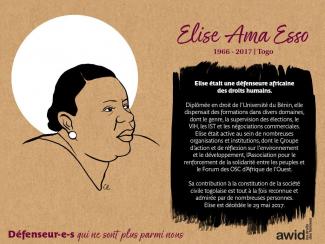
Elise Ama Esso

In September 2016, the 13th AWID international Forum brought together in Brazil over 1800 feminists and women’s rights advocates in a spirit of resistance and resilience.
This section highlights the gains, learnings and resources that came out of our rich conversations. We invite you to explore, share and comment!
One of the key takeaways from the 2016 Forum was the need to broaden and deepen our cross-movement work to address rising fascisms, fundamentalisms, corporate greed and climate change.
With this in mind, we have been working with multiple allies to grow these seeds of resistance:
And through our next strategic plan and Forum process, we are committed to keep developing ideas and deepen the learnings ignited at the 2016 Forum.
AWID Forums started in 1983, in Washington DC. Since then, the event has grown to become many things to many peoples: an iterative process of sharpening our analyses, vision and actions; a watershed moment that reinvigorates participants’ feminisms and energizes their organizing; and a political home for women human rights defenders to find sanctuary and solidarity.
En nombre del Consejo Directivo escribo para expresar nuestra más profunda gratitud, valoración y respeto por Hakima Abbas y Cindy Clark, nuestras extraordinarias codirectoras ejecutivas durante los últimos cinco años, que están dejando sus cargos para que se renueve el liderazgo de AWID en el momento en que entramos en un nuevo plan estratégico y una nueva fase de nuestra vida organizacional. En forma consistente ellas pusieron en práctica los mejores principios del liderazgo organizacional feminista y de la ética del cuidado al mismo tiempo que nos guiaban durante uno de los momentos más impredecibles y turbulentos de la historia mundial reciente: la sindemia de COVID-19 y la espiral político global descendente que le siguió. Ellas sostuvieron a AWID, a nuestro personal y a nuestro Consejo Directivo con firmeza, con suavidad y con amor mientras todxs atravesamos de diversas formas los impactos de esa situación. Nunca perdieron de vista la visión y la misión de AWID al responder con respeto y de manera estratégica a distintos cambios que surgieron, uno de ellos nada menos que la cancelación del Foro AWID.
El Consejo Directivo decidió darle prioridad en primera instancia a un proceso de búsqueda interno, reconociendo el gran potencial que existe en el equipo actual de AWID. Esperamos completar la transición para fines de 2022. Hakima y Cindy dejarán sus cargos en distintos momentos y facilitarán una transición fluida para los nuevos liderazgos.
Es difícil para el Consejo y para otrxs que han trabajado de cerca con ellas y que las aman ver a Cindy y a Hakima alejarse de AWID. De todos modos, tengan la certeza de que el Consejo de AWID está liderando el proceso de transición reconociendo plenamente las marcas hermosas, inspiradoras e indelebles que dejarán Hakima y Cindy como parte de nuestra historia de 40 años; recibiendo con los brazos abiertos el próximo paso en la incorporación de los nuevos liderazgos y apoyándolos; e inspirándonos a todxs a obrar aún mejor en este momento de la vida de AWID.
Las transiciones organizacionales importantes nunca son simples ni fáciles. A veces son forzadas, están más allá del control de todxs, son tensas e incluso destructivas. Como yo, ustedes habrán visto ejemplos de esa clase de transiciones. Otras veces las necesidades y aspiraciones del personal están en sintonía con las de la organización. Aunque nosotrxs no elegimos ni deseamos que Cindy y Hakima dejen AWID, su decisión y la entrada de AWID en su próximo plan estratégico y en una nueva década de su existencia están en una misma sintonía. Lo mejor de todo es que estamos en las manos maravillosas, súper competentes, creativas y feministas del personal y del Consejo Directivo de AWID.
Les agradecemos, queridos Movimientos Feministas, su confianza en AWID. También les pedimos que nos apoyen en nuestra transición de liderazgos en los próximos meses. Sigamos construyendo, profundizando y fortaleciendo las conexiones entre nosotrxs tal como lo hemos hecho en estos últimos 40 años.
Por favor manténganse en contacto para que les contemos más acontecimientos concretos y actualizaciones. En las próximas semanas volverán a saber de nosotrxs.
Con solidaridad y amor feministas,
Margo Okazawa-Rey
Presidenta del Consejo Directivo de AWID
Sí, aún así deseamos saber de ustedes aunque no hayan recibido financiamiento en los tres, dos o cualquiera de los años comprendidos entre 2021 y 2023.

Chaque année à l’AWID, nous visons à renouveler et enrichir les points de vue et expériences que reflète notre Conseil d’administration (CA) en accueillant de nouvelles et nouveaux membres.
Nous sommes actuellement à la recherche de personnes pour servir des mandats d’une durée de trois ans au Conseil de l’AWID à compter du début de l’année 2023. Il s’agit d’une occasion de contribuer à la gouvernance de notre organisation et d’intégrer un groupe extraordinaire de féministes du monde entier.
Merci de nous aider à identifier des candidatures de féministes à la fois réfléchi·e·s et audacieux·ses pour l’élection d’ici le 29 juillet 2022.
Merci de partager également cette invitation à candidatures au sein de vos réseaux !
Nous recherchons avant tout des candidat·e·s engagé·e·s en faveur de la mission de l’AWID capables de faire le lien entre les luttes locales et mondiales. Ces personnes seront également en mesure de nous aider à tirer, avec attention, le meilleur parti du positionnement et des atouts de l’AWID dans un contexte en constante évolution. Les candidat·e·s doivent être disposé·e·s à assumer les fonctions et endosser les responsabilités juridiques du CA de l’AWID, dans l’intérêt supérieur de l’organisation.
Il s’agit d’une fonction bénévole qui nécessite une implication et un engagement tout au long de l’année. Les membres du CA doivent s'engager à consacrer au moins 10 à 15 jours par an à des rencontres en personne et virtuelles, et à contribuer à d'autres communications.
Nous souhaitons que notre CA reflète la diversité sous toutes ses formes, et particulièrement en ce qui concerne l’identité de genre, l’orientation sexuelle, l’âge, le lieu géographique et le milieu socio-économique. Nous recherchons, enfin, des membres de CA ayant une expérience dans l’un des principaux domaines de travail de l’AWID.
Candidat·e·s bénéficiant d'une expérience de travail aux intersections des droits des femmes/de la justice de genre et :
Candidat·e·s originaires des régions suivantes :
Le Conseil d’administration joue un rôle clé dans la définition de l’orientation stratégique de l’AWID et le soutien de notre organisation dans l’accomplissement de sa mission, en cohérence avec le monde dans lequel nous vivons et les besoins de nos mouvements.
Les membres du CA contribuent au fonctionnement de l’organisation de diverses manières : ils et elles apportent une expérience d’autres espaces, des perspectives de divers secteurs des mouvements féministes et un savoir-faire conséquent dans des domaines pertinents alignés sur la stratégie de l’AWID.
Les candidat·e·s qui seront finalement élu·e·s intégreront le CA de l'AWID en 2023 et nous accompagneront dans le lancement de notre nouveau plan stratégique dirigé par les nouvelles co-directrices exécutives de l'AWID, ainsi que dans la planification de notre prochain Forum international.
(Vous pouvez déposer votre candidature ou celle d’une autre personne, avec son consentement.)
Merci de partager également cette invitation à candidatures au sein de vos réseaux !
Merci d’avance de nous aider à trouver nos prochain·e·s merveilleux·ses membres du Conseil d’administration, qui soutiendront l’AWID lors des étapes à venir !
Nous demandons ces données pour faciliter l’examen des réponses, éviter les doublons et pouvoir vous contacter si votre groupe n’a pas pu terminer le questionnaire et/ou vous répondre si vous avez des doutes ou des questions. Des informations sur la manière dont nous utilisons les informations personnelles collectées lors de notre travail sont disponibles ici.
Tous nos processus de changement reposent sur les relations que nous établissons dans des espaces comme les forums de l'AWID, où l'on danse ensemble, où l'on fait ressortir son humour, sa vraie personnalité, où l'on raconte des histoires. C'est ce qui fait la différence.
- Nicky Mcintyre, États-Unis
THE TURTLE'S RAGE tells the story of a mysterious man, whose life has been molded by flight, expulsion, life in exile and the failed return to Palestine. The film is composed of a daughter's search for answers from her father.

"I have been subjected to sexual violence, physical injuries and other forms of violence while protesting at the frontlines. But I will never stop until we achieve complete civilian rule in Sudan. We must stop militarization of the state. Our bodies should not be treated as battlegrounds any longer."
Said Amal*, a 23 years old woman protester.**
During the last 4 years women led the revolution in Sudan. Their leadership wasn't just on streets, but they were the power driving the consistent resistance at all levels. Women and young feminists became the alerted consciousness of the Sudanese change and democratization movement. Since the first protest against the former regime in Aldmazein town in the conflict area of Blue Nile on December 13th, 2018, young school girls were the voices demanding the end of the rule of the 30 years dictatorship of military and Muslim Brotherhood.
The feminist movement led by young women aging 16 to 35, has established a revolution within the revolution in Sudan in the last 4 years of non stop revolution. The strong voices of young women occupying spaces on streets, social media, civil society and political organizations were high enough to reshape the public opinion and challenge social norms. Discussions of sexual and gender based violence and taboos of domestic violence and male dominant decisions making process became mainstream debates for the first time in Sudan history. Women Football teams appointed spokeswomen for resistance committees, and women led professional unions are part of the manifestation of the new wave of feminist movement in Sudan. Young women identifying as feminist proudly and publicly is the most important achievement in a country ruled by fundamentalist Islam for 3 decades. Young men supporting feminist activism, and identifying as feminist is another progress worth noting.
This progress is not cost free, it is also not perfect. Feminist activists, groups and activists face the same challenges we expect in a conservative, and conflict affected contexts. But the impact of the young feminists movement in Sudan is worth of looking up to. Overcoming internal boundaries of diverse cultures, religions, and conflicts history is a challenge, but young feminists in Sudan seems to work hard to bridge the gaps. Creation of feminist schools in Darfur and Kordofan is something that makes the work of young feminists in Sudan a unique journey worth to learn from.
The young women leading these efforts and the women groups working on the ground cannot be mentioned here due to several security concerns under the current military coup. But their resilience, strength and courage is one for the history books. The audacious young women leading resistance on streets, behind screens, and working in different professions and activism fields are shaping the future of Sudan. The young feminists in Sudan are creating new spaces for a feminist narratives and discourses to restructure the distribution of power at political, economical and social aspects.
Despite the immense violence, reemergence of fundamentalist Islam, militarization and shrinking civic spaces, feminist activists in Sudan remain rooted in their sisterhood. They remain a great inspiration for the feminist movements globally.
Nazik Awad
* Amal is a pseudonym used to protect the young activist quoted.
** Sudan is living under constant revolution since 2018. A new wave started after the military coup on October 25th 2021.
We will analyze the survey responses, derive insights and trends, and present the results during the 15th AWID International Forum in Bangkok, and online, in December 2024. Register to attend the Forum here!
We are monitoring this and other risks carefully, and will publish comprehensive health and safety information when the registration opens, so you could make an informed decision. In addition, the hybrid format is designed to provide a meaningful engagement experience to the participants who will prefer not to travel or are not able to travel.
Un réseau complexe et mouvant d’acteur·rice·s antidroits exerce aujourd’hui une influence croissante dans les espaces internationaux et nationaux, ainsi qu’au niveau des politiques locales. Les antidroits pénètrent les espaces multilatéraux de collaboration entre pays, dans le but de les transformer et les saboter de l’intérieur. C’est en s’appropriant le langage des droits et de la justice pour travestir leurs véritables intentions qu’ils et elles parviennent à acquérir une certaine légitimité.
Ce rapport est le deuxième d’une série sur les droits humains, produite par l’Observatoire sur l’universalité des droits (OUR). Outre une analyse des principales parties antidroits, de leurs discours, stratégies et impacts, ce rapport inclut des nouvelles féministes pleines d’inspiration et des exercices de renforcement des connaissances qui nous permettront d’assurer notre résistance collective.
Les conséquences sur nos droits sont déjà importantes, mais il est encore possible de réagir. Nous pouvons toutes et tous participer à la résistance face aux programmes antidroits et récupérer nos droits.
Rejoignez l’appel à l’action collective dès aujourd’hui!