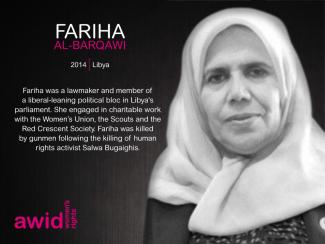
Fariha Al Berkawi
Over the past few years, a troubling new trend at the international human rights level is being observed, where discourses on ‘protecting the family’ are being employed to defend violations committed against family members, to bolster and justify impunity, and to restrict equal rights within and to family life.
The campaign to "Protect the Family" is driven by ultra-conservative efforts to impose "traditional" and patriarchal interpretations of the family, and to move rights out of the hands of family members and into the institution of ‘the family’.
Since 2014, a group of states have been operating as a bloc in human rights spaces under the name “Group of Friends of the Family”, and resolutions on “Protection of the Family” have been successfully passed every year since 2014.
This agenda has spread beyond the Human Rights Council. We have seen regressive language on “the family” being introduced at the Commission on the Status of Women, and attempts made to introduce it in negotiations on the Sustainable Development Goals.
AWID works with partners and allies to jointly resist “Protection of the Family” and other regressive agendas, and to uphold the universality of human rights.
In response to the increased influence of regressive actors in human rights spaces, AWID joined allies to form the Observatory on the Universality of Rights (OURs). OURs is a collaborative project that monitors, analyzes, and shares information on anti-rights initiatives like “Protection of the Family”.
Rights at Risk, the first OURs report, charts a map of the actors making up the global anti-rights lobby, identifies their key discourses and strategies, and the effect they are having on our human rights.
The report outlines “Protection of the Family” as an agenda that has fostered collaboration across a broad range of regressive actors at the UN. It describes it as: “a strategic framework that houses “multiple patriarchal and anti-rights positions, where the framework, in turn, aims to justify and institutionalize these positions.”
Development financing has specific threats and opportunities for women's and all people’s human rights. Transformative development financing and policies can make an important contribution to the systemic changes that are needed to ensure the respect, protection and fulfillment of women’s human rights.
2015 is an important year for the FfD process. The Third International Conference on FfD took place from 13-16 July 2015 in Addis Ababa, Ethiopia and governments are finalising the post-2015 development agenda including agreements on how the new Sustainable Development Goals will be financed.
The current stage of the FfD process is an important opportunity to establish a financing framework that will ensure effective financing for the implementation of the post 2015 agenda and the Sustainable Development Goals (SDGs). It is also an opportunity to address the structural conditions, and systemic changes needed, for the full implementation of other agendas and commitments such as Human Rights Conventions, and the Beijing Platform for Action.
Over the last 13 years, women’s rights and feminist organizations have actively engaged in the FfD process.
Ven a conocer a Aura Roig, activista feminista visionaria, antropologa y directora-fundadora de la cooperativa Metzineres.
Dedicó las últimas dos décadas a la investigación, el diseño y la implementación de políticas con perspectivas de reducción de daños, derechos humanos y feminismo interseccional.
Después de experimentar y aprender de comunidades que usan drogas a través del mundo, volvió a Barcelona y creó la Xarxa de Dones que Usen Drogues (la Red de Mujeres que Usan Drogas, XADUD). XADUD era un espacio de apoyo mutuo y de solidaridad con la lucha por los derechos de los grupos marginalizados que, más tarde, se convirtió en la cooperativa Metzineres.
Actualmente, Aura está trabajando para expandir el modelo Metzineres y brindar apoyo a grupos más grandes, al mismo tiempo que documenta ampliamente su prolífico viaje y aprendizaje.
Si vous êtes de passage à Sao Paulo, au Brésil, visitez l'Occupation 9 de Julho et prenez un repas collaboratif. Vous pouvez aussi acheter leurs produits dans leur boutique en ligne depuis l'étranger.
Visitez la boutique en ligne de l'Association des Femmes Afro-Descendantes du Cauca du Nord où vous pouvez trouver de superbes produits faits à la main.
Il existe plusieurs façons de soutenir Metzineres : vous pouvez faire un don financier, offrir du matériel et des services, proposer une formation, un atelier ou une activité (pour plus d'informations, cliquez ici).
Sí, por favor. El mundo ha cambiado desde 2021, y te invitamos a proponer una actividad que refleje tus realidades y prioridades actuales.
我們會盡快宣布。敬請關注!
您不必成為AWID會員即可參加,但是AWID會員可以獲得折扣的註冊費以及許多其他好處。
詳細瞭解如何成為AWID成員 (in English)
We are living in a world where the destruction of Nature fuels our current global economy. |
Even in times of climate crisis, governments continue to encourage large-scale agriculture industries to expand. These activities poison the land, threaten biodiversity, and destroy local food production and livelihoods. Meanwhile, while women produce the majority of our food in the world, they own almost none of the land. |
|
What if we perceived land and Nature not as private property to exploit, but as a whole to live in, learn from, and harmoniously coexist with? What if we repaired our relationships with the land and embraced more sustainable alternatives that nurture both the planet and its communities? Nous Sommes la Solution (We Are the Solution, NSS) is one of many women-led movements striving to do this. This is their story. |
|
Una comunidad en línea desarrollada para y por las jóvenes feministas que trabajan por los derechos humanos de las mujeres, la igualdad de género y la justicia social en todo el mundo.
FRIDA: proporciona financiamiento a iniciativas lideradas por jóvenes feministas. Busca fortalecer la capacidad de las organizaciones de jóvenes feministas para obtener recursos para su trabajo e incrementar los compromisos de donantes y aliados con la dotación de fondos para el activismo joven feminista.
En esta plataforma podrás encontrar información y recursos sobre cómo proteger la universalidad de los derechos en espacios internacionales y regionales de derechos humanos.
Visita la página (en inglés)
Sitio obligado para conocer las respuestas urgentes emprendidas para proteger a las defensoras de los derechos humanos y encontrar herramientas y recursos en apoyo del trabajo y el bienestar de las defensoras.
La Iniciativa Mesoamericana de Mujeres Defensoras de Derechos Humanos es una iniciativa regional creada para prevenir, responder, documentar y dar a conocer todos los casos de violencia ejercida contra las defensoras de los derechos humanos en la región mesoamericana.
La Coalición es una red de recursos y promoción para la protección y el apoyo a las mujeres defensoras de los derechos humanos en todo el mundo.
Visita la página (en inglés)
Una coalición de organizaciones feministas, por los derechos de las mujeres, por las mujeres y el desarrollo, y de organizaciones de base y por la justicia social que trabajan para interpelar y dar nuevo marco la agenda global para el desarrollo.
Visita la página (en inglés)
El rol del Grupo consiste en garantizar una participación pública efectiva de los grupos no gubernamentales de mujeres en los procesos normativos de la ONU sobre el desarrollo sostenible, la agenda posterior a 2015 y los asuntos ambientales.
Visita la página (en inglés)
Una alianza de organizaciones y redes de mujeres que promueve el avance de la igualdad de género, el empoderamiento de las mujeres y sus derechos humanos en los procesos de la ONU referidos al financiamiento para el desarrollo.
Visita la página (en inglés)
การลงทะเบียนจะเริ่มขึ้นช่วงต้นปี 2567 เราจะประกาศวันที่ในการเปิดให้ลงทะเบียนและค่าลงทะเบียนเร็วๆนี้ การลงทะเบียนจะครอบคลุมการเข้าร่วมฟอรัม รวมถึงอาหารเที่ยง ขนม และอาหารเย็นภายในงานหนึ่งมื้อ (อาหารเช้าจะถูกจัดเตรียมไว้ที่โรงแรม)
如有其他疑問,請使用我們的聯繫表,然後從下拉選單中選擇「第14屆AWID論壇」。
AGROECOLOGY AND FOOD SOVEREIGNTY AS RESISTANCE |
Today, large-scale industrial food production uses single-crop plantations, genetically modified organisms and other pesticides that destroy the land and knowledge of local communities. |
Agroecology is a resistance to corporate-driven agriculture. It prioritizes smaller scale agriculture, multiple crops and diversified food production, and the centering of local knowledge and practices. Agroecology goes hand-in-hand with demands for food sovereignty, or the “right of peoples to healthy and culturally appropriate food produced through ecologically sound and sustainable methods, and their right to define their own food and agriculture systems”(Via Campesina, Declaration of Nyéléni).
The role of women, indigenous and rural communities and people of color from the Global South is absolutely essential when it comes to food systems. Feminist agroecologists are working to dismantle oppressive gender roles and systems of patriarchy embedded within food production. As shown by the heroines of NSS, they are generating a liberatory agroecology by strengthening community resilience, empowering women peasants and farmers, and preserving local traditions, territories, and knowledge of food-producing communities.
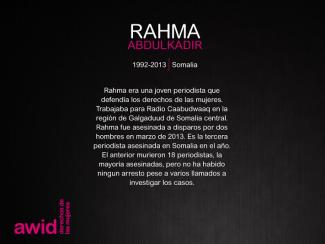
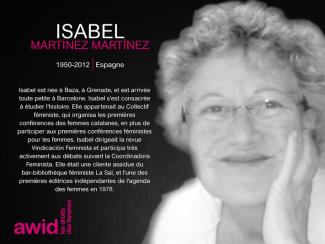
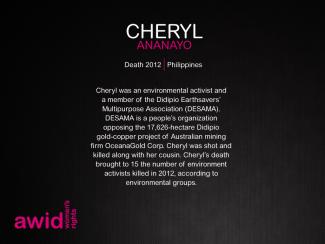
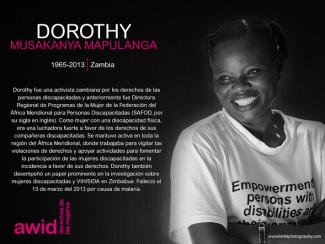
These 21 Women Human Rights Defenders (WHRDs) worked as journalists and more widely in the media sector in Mexico, Colombia, Fiji, Libya, Nepal, United States, Nicaragua, Philippines, Russia, Germany, France, Afghanistan, and the United Kingdom. 17 of them were murdered and in one case the cause of death is still unclear. On this World Press Freedom Day, please join us in commemorating the life and work of these women by sharing the images below with your colleagues, friends and networks using the hashtags #WPFD2016 and #WHRDs.
The contributions of these women were celebrated and honoured in our Tribute to Women Human Rights Defenders (WHRDs) Who Are No Longer With Us.
Please click on each image below to see a larger version and download as a file


