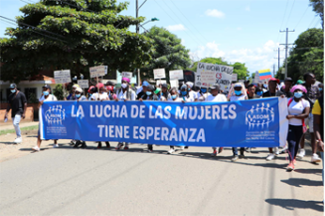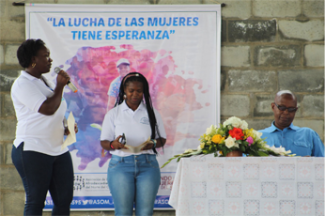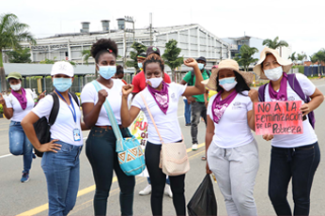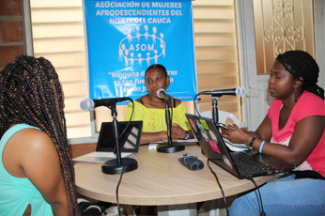
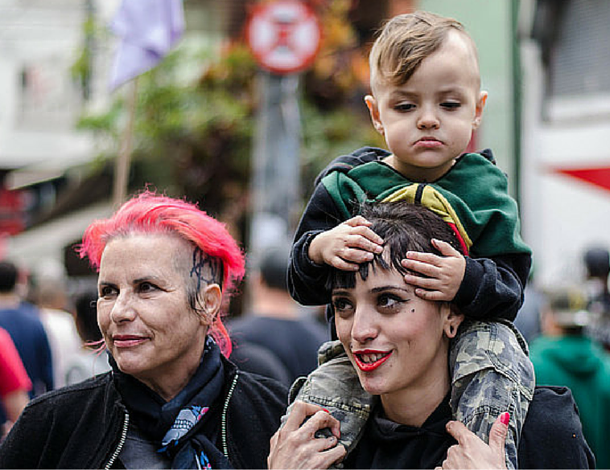
Flickr/Leonardo Veras (CC BY 2.0)

Protection of the Family

The Issue

Over the past few years, a troubling new trend at the international human rights level is being observed, where discourses on ‘protecting the family’ are being employed to defend violations committed against family members, to bolster and justify impunity, and to restrict equal rights within and to family life.

The campaign to "Protect the Family" is driven by ultra-conservative efforts to impose "traditional" and patriarchal interpretations of the family, and to move rights out of the hands of family members and into the institution of ‘the family’.

“Protection of the Family” efforts stem from:

  • rising traditionalism,
  • rising cultural, social and religious conservatism and
  • sentiment hostile to women’s human rights, sexual rights, child rights and the rights of persons with non-normative gender identities and sexual orientations.

Since 2014, a group of states have been operating as a bloc in human rights spaces under the name “Group of Friends of the Family”, and resolutions on “Protection of the Family” have been successfully passed every year since 2014.

This agenda has spread beyond the Human Rights Council. We have seen regressive language on “the family” being introduced at the Commission on the Status of Women, and attempts made to introduce it in negotiations on the Sustainable Development Goals.


Our Approach

AWID works with partners and allies to jointly resist “Protection of the Family” and other regressive agendas, and to uphold the universality of human rights.

In response to the increased influence of regressive actors in human rights spaces, AWID joined allies to form the Observatory on the Universality of Rights (OURs).  OURs is a collaborative project that monitors, analyzes, and shares information on anti-rights initiatives like  “Protection of the Family”.

Rights at Risk, the first OURs report, charts a map of the actors making up the global anti-rights lobby, identifies their key discourses and strategies, and the effect they are having on our human rights.   

The report outlines “Protection of the Family” as an agenda that has fostered collaboration across a broad range of regressive actors at the UN.  It describes it as: “a strategic framework that houses “multiple patriarchal and anti-rights positions, where the framework, in turn, aims to justify and institutionalize these positions.”
 

Related Content

Snippet FEA NSS has a vision of an Africa (ES)

“Nous Sommes la Solution tiene una visión de una África donde, en solidaridad, las mujeres rurales involucradas en la toma de decisiones puedan cultivar, procesar, vender y consumir productos de la agricultura familiar preservando el medio ambiente, para un desarrollo sostenible, armonioso y duradero”.

English title

This is a French article

- created from the French site

Je ne suis pas en mesure de soumettre une proposition écrite, acceptez-vous d’autres formats?

Dans le cadre de notre engagement en faveur de l’accessibilité dans tous les aspects du Forum de l’AWID, nous acceptons les formats audio/vidéo pour tous les individus/organisations/groupes qui ne peuvent soumettre de candidature écrite. Si vous décidez d’envoyer votre proposition sous format audio/vidéo, nous vous prions de bien vouloir répondre aux questions dans le même ordre, telles que détaillées dans le Formulaire de proposition d’activité.

Pour soumettre un fichier audio/vidéo, merci de nous contacter via notre formulaire de contact en choisissant « Proposition d'activité » comme sujet de votre message.

Contactez-nous


Quelles sont les langues officielles de l’enquête WITM?

À l’heure actuelle, l’enquête est disponible sur KOBO en français, anglais, arabe, espagnol, portugais et russe. Vous pouvez choisir votre langue au début du questionnaire.

Snippet FEA Objectives NSS - Traditional Knowledge (FR)

LES SAVOIRS TRADITIONNELS

Brown hands with yellow seeds in the palms
Utiliser et promouvoir les savoirs et pratiques traditionnels transmis de génération en génération, qui soutiennent la souveraineté alimentaire et la préservation des semences paysannes

L’activisme au Moyen-Orient et en Afrique du Nord

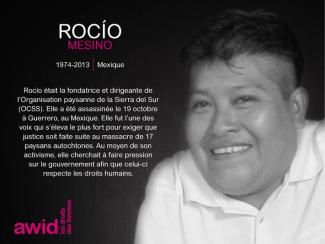
Notre hommage en ligne met à l’honneur cinq défenseuses des droits humains assassinées au Moyen-Orient ou en Afrique du Nord. Ces défenseuses étaient avocates ou militantes et ont œuvré pour les droits des femmes ou pour les droits civils. Leur mort met en évidence les conditions de travail souvent difficiles et dangereuses dans leurs pays respectifs. Nous vous invitons à vous joindre à nous pour commémorer la vie, le travail et l’activisme de ces femmes. Faites circuler ces mèmes auprès de vos collègues et amis ainsi que dans vos réseaux et twittez en utilisant les hashtags #WHRDTribute et #16Jours.


S'il vous plaît cliquez sur chaque image ci-dessous pour voir une version plus grande et pour télécharger comme un fichier 

[scald=2457:sdl_editor_representation]


Que comprennent les frais d’inscription ?

Les frais d’inscription au Forum de l’AWID pour tou-te-s les participant-e-s couvrent : 

  • Accès complet aux quatre jours du Forum 
  • Déjeuners et pauses café/thé pendant les journées du Forum 
  • Documentation
  • Traduction simultanée lors des sessions plénières et quelques sessions/activités sélectionnées en petits groupes (anglais, français, espagnol et langue locale) 
  • Participation au dîner/à la fête de célébration 
  • Application mobile avec programme final et fonction “chat” intégrée 
  • Service WiFi gratuit dans les locaux du Forum  
  • Accueil à l’aéroport et transport hôtel-site-hôtel. 


Our group did not receive external funding between 2021 and 2023, should we still fill out the survey?

Yes, we still want to hear from you regardless of whether you received funding in all three, two or only one of the years between 2021 and 2023.

Snippet FEA Get Involved Story 2 (EN)

GET INVOLVED!

You can follow Nous Sommes la Solution
on Facebook and support their work by donating here.

WHRDs from Sub-Saharan Africa

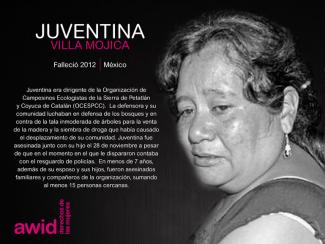
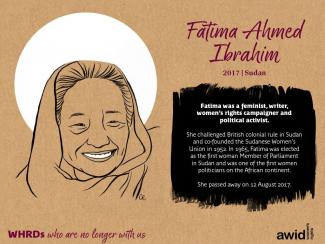
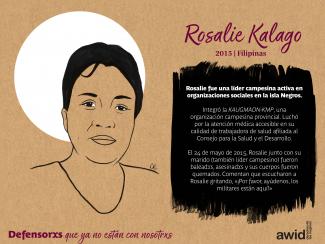
In our 2015 Online Tribute to Women Human Rights Defenders No Longer With Us we are commemorating four women from Sub-Saharan Africa, three of whom were murdered due to their work and/or who they were in their gender identity and sexual orientation. Their deaths highlight the violence LGBT persons often face in the region and across the globe. Please join AWID in honoring these women, their activism and legacy by sharing the memes below with your colleagues, networks and friends and by using the hashtags #WHRDTribute and #16Days. 


Please click on each image below to see a larger version and download as a file


Je ne suis pas en mesure d’assister au Forum en personne, de quelle autre façon puis-je participer?

Plus qu’un simple évènement, le Forum de l’AWID s’inscrit dans notre voyage d’exploration des réalités féministes, qui offre de nombreux espaces où se réunir, en ligne et hors ligne, afin d’échanger, discuter, élaborer des stratégies et co-créer des réalités féministes.

Apprenez-en plus sur l’aventure des réalités féministes et sur tout ce qui se passera en amont du Forum. Et restez à l'écoute pour ne pas manquer les annonces post-Forum ! 

Nous explorons actuellement les possibilités de participer virtuellement au Forum et veillerons à vous partager l'information lorsque nous saurons ce que nous sommes en mesure de vous proposer.

Nos solicitan el nombre de la agrupación, organización o movimiento que está respondiendo la encuesta, así como nuestra información de contacto, ¿por qué?

Solicitamos estos datos para facilitar el análisis de las respuestas, para evitar duplicaciones y para contactar a su organización en caso de que no hayan podido completar el cuestionario o de que tengan dudas u otras preguntas. Puedes consultar más detalles acerca de cómo utilizamos la información personal que recolectamos a través de nuestro trabajo aquí.

Snippet FEA argentina history cooperatives (ES)

Argentina tiene una larga historia de cooperativas autogestionadas y lugares de trabajo controlados por lxs trabajadorxs.

En 2001, el país vivió una de las peores crisis económicas de su historia.

Como respuesta a la recesión y como forma de resistencia y resiliencia, lxs trabajadorxs de todo el país comenzaron a ocupar sus lugares de trabajo.

La Cooperativa Textil Nadia Echazú fue la primera cooperativa creada por y para personas trans y travesti en busca de autonomía económica y condiciones de vida dignas.

Proporciona oportunidades de trabajo, acceso a la seguridad social, ingresos sostenibles y derechos económicos para las comunidades a las que sirve.

Research methology

Over eight years, we did four global surveys and built a research methodology.

In 2013, we published three global reports. These reports confirm that women’s rights organizations are doing the heavy lifting to advance women’s rights and gender equality by using diverse, creative and long-term strategies, all while being underfunded.

Our 2010 global survey showed that the collective income of 740 women’s organizations around the world totaled only USD 104 million. Compare this with Greenpeace International, one organization with a 2010 budget of USD 310 million1. Imagine the impact these groups could have if they were able to access all the financial resources they need and more?

AWID’s WITM research has catalyzed increased funding for women’s rights organizing. WITM research was a driving force behind the Catapult crowdfunding platform, which has raised USD 6.5 million for women’s rights. The Dutch Government cited WITM research as a reason for its unprecedented MDG 3 Fund of EU 82 million. WITM research has also led to the creation of several new funds: FRIDA – The Young Feminist Fund, the Indigenous Women’s Fund, Fundo Elas, the Mediterranean Women’s Fund and the Rita Fund.

Funding trends analyses

While the WITM research has shed important light on the global funding landscape, AWID and partners have identified the need to dig deeper, to analyze funding trends by region, population and issue. In response, organizations are now using AWID’s WITM research methodology to do their own funding trends analyses. For example, in November 2013, Kosova Women’s Network and Alter Habitus – Institute for Studies in Society and Culture published Where is the Money for Women’s Rights? A Kosovo Case Study.

At the same time, AWID continues to collaborate with partners in Where is the Money for Indigenous Women’s Rights (with International Indigenous Women’s Forum and International Funders for Indigenous Peoples) and our upcoming Where is the Money for Women’s Rights in Brazil? (with Fundo Elas).

Several organizations have also conducted their own independent funding trends research, deepening their understanding of the funding landscape and politics behind it. For example, the South Asian Women’s Fund was inspired by AWID’s WITM research to conduct funding trends reports for each country in South Asia, as well as a regional overview. Other examples of research outside of AWID include the collaboration between Open Society Foundations, Mama Cash, and the Red Umbrella Fund to produce the report Funding for Sex Workers Rights, and the first-ever survey on trans* and intersex funding by Global Action for Trans* Equality and American Jewish World Service.