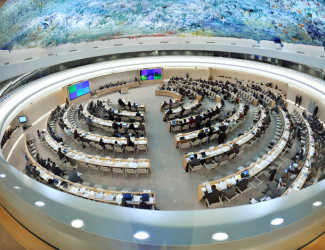
Jean-Marc Ferré | Flickr (CC BY-NC-ND 2.0)
A general view of participants at the 16th session of the Human Rights Council in Geneva, Switzerland.

Análisis Especiales

AWID es un organización feminista internacional de membresía, que brinda apoyo a los movimientos que trabajan para lograr la justicia de género y los derechos de las mujeres en todo el mundo.

Consejo de Derechos Humanos (CDH)

El Consejo de Derechos Humanos (CDH) es el cuerpo intergubernamental del sistema de las Naciones Unidas responsable de la promoción y protección de todos los derechos humanos en todo el mundo. El HRC se reúne en sesión ordinaria tres veces al año, en marzo, junio y septiembre.  La La Oficina del Alto Comisionado para los Derechos Humanos (ACNUDH) es la secretaría del Consejo de Derechos Humanos.

El CDH  trabaja de la siguiente forma:

  • Debate y aprueba resoluciones sobre cuestiones mundiales de derechos humanos y el estado de los derechos humanos en determinados países

  • Examina las denuncias de víctimas de violaciones a los derechos humanos o las de organizaciones activistas, quienes interponen estas denuncias representando a lxs víctimas.

  • Nombra a expertos independientes que ejecutarán los «Procedimientos Especiales» revisando y presentado informes sobre las  violaciones a los derechos humanos desde una perspectiva temática o en relación a un país específico

  • Participa en discusiones con expertos y  gobiernos respecto a cuestiones de derechos humanos.

  • A través del Examen Periódico Universal, cada cuatro años y medio, se evalúan los  expedientes de derechos humanos de todos los Estados Miembro de las Naciones Unidas

Aprende más sobre el CDH


La Sesión actual - CDH44

Se está llevarando a cabo en Ginebra, Suiza del 30 de junio al 17 de julio de 2020.

AWID trabaja con socios feministas, progresistas y de derechos humanos para compartir conocimientos clave, convocar diálogos y eventos de la sociedad civil, e influir en las negociaciones y los resultados de la sesión.

Con nuestrxs socixs, nuestro trabajo será:


◾️ Monitorear, rastrear y analizar actores, discursos y estrategias anti-derechos y su impacto en las resoluciones

◾️ Desarrollar conjuntamente una labor de promoción conjunta para contrarrestar a los actores anti-derechos y debatir más a fondo las conclusiones del Informe de Tendencias de OUR de 2017

◾️ Apoyar, coordinar y desarrollar de manera colaborativa el Caucus feminista emergente en el CDH


Contenido relacionado

Snippet - WITM To share - ES

Para compartir tu experiencia con el financiamiento de tu organización.

2014: Intergovernmental preparatory process for the 3rd FfD Conference is launched

Launch of the Intergovernmental preparatory process for the 3rd Financing for Development Conference, October 2014

  • A preparatory process, co-facilitated by Ambassador George Wilfred Talbot of Guyana and Ambassador Geir O. Pedersen of Norway, was put in place to lead discussions ahead of the 3rd FfD conference to be held in Addis Ababa, Ethiopia in July 2015.
  • As part of the preparations, two rounds of substantive informal sessions were held at the UN headquarters in New York to provide input to the drafting sessions of the outcome document.
  • The WWG on FfD was re-activated with the aim of bringing feminist and women’s rights perspectives to the discussions and deliberations ahead of and during the 3rd International FfD Conference. AWID, Development Alternatives with Women for a New Era (DAWN) and the Feminist Task Force (FTF) are currently acting as co-facilitators of the group.
  • The WWG on FfD’s submitted two oral statements during the first round, and written input to the second round of substantive informal sessions, which highlighted that gender inequality was not visible, nor was the inclusion of other types of discrimination and inequalities. The WWG’s submission highlights gender power relations and the intersections with other categories such as race, disability, ethnicity, age, wealth and sexual identity, which underpin the unequal distribution of opportunities and resources in societies around the world.
  • Civil society organizations raised concerns about the space for their engagement in the two substantive informal sessions, including the risk that civil society space to engage in negotiations on the outcome document in January 2015 might be constricted. 

Snippet FEA ASOM’s activists in encounters (ES)

 
Black woman in a white headscarf and gray t-shirt, she is smiling and is holding a vessel above her head
People demonstrating and holding a long blue poster
Black woman speaking in a mic, there is a black girl standing next to her and a man sitting at the table
Photo of five black women in the front on a demonstration, wearing facemasks and holding posters
Photo of three women sitting around the table and talking in mics.

Activistas de ASOM en encuentros, desfiles y eventos

Snippet - WITM Why now_col 1 - EN

Why should I take it now?

A monochromatic orange illustration of a woman with curly hair with her hand on her chin. She seems to inquisitive or posing a question.

Feminist, women’s rights, gender justice, LBTQI+ and allied movements around the world are at a critical juncture, facing a powerful backlash on previously-won rights and freedoms. Recent years have brought the rapid rise of authoritarianism, violent repression of civil society, criminalization of women and gender-diverse human rights defenders, escalating war and conflict in many parts of our world, continued perpetuation of economic injustices, and the intersecting health, ecology and climate crises.

Junio 2015

Sesiones adicionales para redactar el Documento Final de Adís Abeba

  • Del 1 al 5 de junio de 2015 se realizaron sesiones adicionales para continuar avanzando en la redacción del Documento Final.
  • Del 15 al 19 de junio, en la sede de la ONU tuvo lugar la ya planificada Tercera Sesión Redactora del Documento Final de la Conferencia.

Para saber más sobre este proceso, puedes consultar la CSO Hitchhiker’s Guide (en inglés).

Snippet FEA Aura Roig (FR)

Venez rencontrer Aura Roig, militante féministe visionaire, anthropologue, directrice et fondatrice de la coopérative Metzineres.

Elle a consacré les deux dernières décennies à la recherche, à la conception et à la mise en place de politiques de soutien aux personnes qui se droguent, basées sur la réduction des méfaits, les droits humains et le féminisme intersectionnel.

Après avoir expérimenté et appris des communautés qui consomment des drogues dans le monde entier, elle est retournée à Barcelone pour créer la Xarxa de Dones que Usen Drogues (le Réseau des Femmes qui Consomment des Drogues, XADUD). XADUD était un espace d'entraide et de solidarité avec la lutte pour les droits des groupes marginalisés, qui plus tard deviendra la coopérative Metzineres.

Aujourd'hui, Aura travaille à étendre le modèle Metzineres pour prendre en charge des groupes plus grands, tout en documentant de manière approfondie son parcours et son apprentissage prolifiques.

Feminist Realities Magazine

Description
Feminist realities are the living, breathing examples of the worlds we know are possible.
Add to stories
On

Snippet - WITM Our objectives - EN

Our research objectives

1

Provide AWID members, movement partners and funders with an updated, powerful, evidence-based, and action-oriented analysis of the resourcing realities of feminist movements and current state of the feminist funding ecosystem.

2

Identify and demonstrate opportunities to shift more and better funding for feminist organizing, expose false solutions and disrupt trends that make funding miss and/or move against gender justice and intersectional feminist agendas.

3

Articulate feminist visions, proposals and agendas for resourcing justice.

Quels sont quelques-uns des débats et des sujets controversés ?

Snippet FEA Occupation’s kitchen Instagram 2 (EN)

Occupation’s kitchen campaign:

Women sustain Care | Care Sustains Life | Life Sustains Economy | Who takes care of women?  | Not one less1 | Together | Sunday lunch

1Nenhuna a menos literally translates as “not one woman less” or “ni una menos” in Spanish - a famous feminist slogan in Latin America that emerged in Argentina as a response to increasing gender-based violence.

Who we are & what we do

We are excited to share our new Strategic Plan (2023-2027) with the world. AWID will make an announcement to inform our community and members very soon.


The Association for Women's Rights in Development (AWID) is a global, feminist, membership, movement-support organization.

For 40 years, AWID has been a part of an incredible ecosystem of feminist movements working to achieve gender justice and women’s human rights worldwide.

Our vision

GGAADD | Flickr (CC BY-SA 2.0) - modified

AWID envisions a world where feminist realities flourish, where resources and power are shared in ways that enable everyone, and future generations, to thrive and realize their full potential with dignity, love and respect, and where Earth nurtures life in all its diversity.

Our mission

Our mission is to support feminist, women’s rights and gender justice movements to thrive, to be a driving force in challenging systems of oppression, and to co-create feminist realities.


Our tactics

We advance our work through these tactics:

Influencing, advocacy and campaigning

We collaboratively leverage our access, power, resources and relationships to strategically influence policy and practice. We aim to advance feminist agendas through our work with policy makers, funders and activists in regional and global spaces. We also work to influence feminist and women’s rights movements to centre historically oppressed movements as part of efforts to strengthen our collective power and influence.

Convening and connecting

We use our convening power to facilitate dialogue and strategize on key issues. We connect our members and allies with one another, sharing and exchanging resources, ideas and action across relevant issues. We organize and facilitate spaces to strengthen and engage across movements, to imagine and envisage new futures, to develop effective influencing tactics and to co-create powerful agendas and processes.  

Solidarity and bridge-building

We work to mobilize our members and the movements we support to strengthen collective action in solidarity with feminist causes and defenders at risk. We build partnerships, engage in active listening and ongoing, long-term, solidarity. We work with defenders to build a body of knowledge and support networks of solidarity on protection and wellbeing.

Arts and creative expression

We recognize the unique and strategic value of cultural and creative strategies in the struggle against oppression and injustice. We work with artists who centre feminist voices and the narratives of historically oppressed communities. In this emerging tactic, we see art and creative expression helping us envision a world where feminist realities continue to flourish and be celebrated. 


Marcha da Mulheres negras - 2016

Our initiatives

Our initiatives work at the intersections of the sites of change we work to address, the movements we prioritize, and the tactics we use​:

Advancing Universal Rights and Justice

We monitor, document and make visible how anti-rights actors are operating and colluding in multilateral spaces and support feminist, women’s rights and gender justice movements and allies to counter their influence and impact.

Building Feminist Economies

Working on extractivism, tax justice and corporate accountability, we build knowledge on corporate power and influence; advocate for corporate accountability and equitable distribution of wealth; and amplify feminist proposals for just economies. 

Resourcing Feminist Movements

We develop accessible, action-oriented analysis on the state of resourcing for feminist movements. We aim to influence funders’ policies and practices, deepen and sustain funding for feminist social change, and support movements’ needs and strategies. 

In addition to the impact we aim to have in the world, AWID is expressly committed to strengthening our own organizational learning and resilience in order to further strengthen global feminist movements. 


Our donors

Thank you!

Without the generous funding and support from our donors, our work would not be possible

Wellspring Philanthropic Fund
Ford Foundation
Open Society Foundations
 
Sida
Government of The Netherlands
Foundation For A Just Society
 
 
Disability Rights Advocacy Fund
   

Why should I consider responding to the survey?

There are many reasons why your response to the WITM survey matters. The survey offers the opportunity to share your lived experience of mobilizing funding to support your organizing; claim your power as an expert on how money moves and who it reaches; and contribute to collective and consistent advocacy to funders moving more and better funding. Over the last two decades, AWID’s WITM research has proven to be a key resource for activists and funders. We wholeheartedly invite you to join us in its third iteration to highlight the actual state of resourcing, challenge false solutions, and point out how funding must change for movements to thrive and meet the complex challenges of our times.

我無法提交書面提案,是否接受其他格式呢?

作為對AWID論壇各方面可訪問性承諾的一部分,我們接受那些無法提交書面申請的個人/組織/團體提交自己的音頻或視頻等。

如果您選擇以音頻/視頻格式提交提案,請按照相同的順序回答活動申請表格中詳細的問題。

若您要提交音頻/視頻文件,請與我們聯繫,選擇“論壇活動徵集”作為電子郵件的主題。

聯繫我們