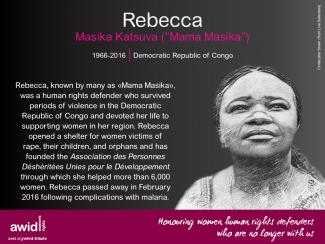
Rebecca Masika Katsuva
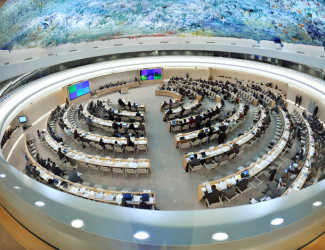
The Human Rights Council (HRC) is the key intergovernmental body within the United Nations system responsible for the promotion and protection of all human rights around the globe. It holds three regular sessions a year: in March, June and September. The Office of the UN High Commissioner for Human Rights (OHCHR) is the secretariat for the HRC.
Debating and passing resolutions on global human rights issues and human rights situations in particular countries
Examining complaints from victims of human rights violations or activist organizations on behalf of victims of human rights violations
Appointing independent experts (known as “Special Procedures”) to review human rights violations in specific countries and examine and further global human rights issues
Engaging in discussions with experts and governments on human rights issues
Assessing the human rights records of all UN Member States every four and a half years through the Universal Periodic Review
AWID works with feminist, progressive and human rights partners to share key knowledge, convene civil society dialogues and events, and influence negotiations and outcomes of the session.
لقد كان منتدى جمعية حقوق المرأة في التنمية دائمًا مساحة لا تخجل من النقاشات الصعبة والمطلوبة بشدة. نحن نرحب بهذه المشاركات عندما يتمكن المنظمون/ات بعناية من توفير الاحترام والأمان في المساحة للمشاركين/ات.
英文、法文、西班牙文和中文
نحن ندرك تمامًا العقبات العملية والضغوط العاطفية المرتبطة بالسفر الدولي، وخاصة من الجنوب العالمي. تعمل جمعية حقوق المرأة في التنمية مع TCEB (مكتب تايلاند للمؤتمرات والمعارض) لدعم المشاركين/ات في المنتدى في الحصول على التأشيرات. سيتم توفير المزيد من المعلومات حول هذه المساعدة للحصول على التأشيرة عند التسجيل، بما في ذلك معلومات الاتصال الخاصة بمكان وكيفية التقديم.
Contenido relacionado
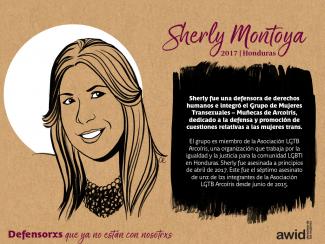
Organización Mundial Contra la Tortura: Honduras: Asesinato de Sherly Montoya, integrante del Grupo de Mujeres Transexuales “Muñecas de Arcoíris”
我們屆時會於網站上公告徵選結果。
Como podrás o no saber, AWID está celebrando su 40º aniversario en 2022 y, para festejarlo, se eligieron los lemas «Reunir, sembrar e irrumpir». En honor a esta ocasión, hemos invitado a lxs afiliadxs, aliadxs y al personal de AWID a escribir sus propias «Cartas de Amor a los Movimientos Feministas». En conjunto, hemos encendido una constelación de movimientos feministas. Nos mantengamos cerca mientras forjamos el viaje y seguimos reuniéndonos, sembrando y desmantelando.
Nota sobre nuestra Colección de Cartas de Amor
Todas estas cartas de amor fueron escritas por activistas que están compartiendo sus diversas experiencias en los movimientos feministas. Algunas pueden incluir contenido delicado o complejo sobre abuso sexual, violencia sexual, conflictos, exclusión, entre otras piezas potencialmente perturbadoras o provocadoras. Aunque las cartas están llenas de amor, cuídate al leerlas.

您若持有下列國家的護照,可免簽入境台灣到台北參與論壇活動(請留意持免簽可停留的天數各國不同):
安道爾、澳大利亞、奧地利、比利時、保加利亞、汶萊、加拿大、智利、克羅埃西亞、賽普勒斯、捷克、丹麥、愛沙尼亞、 史瓦濟蘭、芬蘭、法國、德國、希臘、瓜地馬拉、海地、宏都拉斯、匈牙利、冰島、愛爾蘭、以色列、義大利、日本*、韓國、拉脫維亞、列支頓斯登、立陶宛、盧森堡、馬爾他、馬歇爾群島、摩納哥、荷蘭、紐西蘭、尼加拉瓜、挪威、帛琉、巴拉圭、菲律賓、波蘭、葡萄牙、羅馬尼亞、俄國、聖馬利諾、斯洛伐克、斯洛維尼亞、西班牙、瑞典、瑞士、吐瓦魯、英國、美國、梵蒂岡城國、貝里斯、多明尼加、馬來西亞、諾魯、聖克里斯多福及尼維斯、聖塔露西亞、聖文森和格瑞納丁、新加坡。
未持有上述國家護照的人士來台北須申請簽證。
請留意:
在您完成論壇註冊手續後,無論您國籍為何,應會收到與論壇參與相關的一組號碼,用於申請來台灣的電子簽證。
論譠開放報名的時間我們會另行通知。
Et si nous ré-imaginons différentes manières de prendre soin de nos communautés?
Et si l'économie n'était pas basée sur le profit d’une petite élite mais sur notre bien-être individuel et collectif, et celui de la Nature?
Les histoires que vous allez découvrir portent sur les collectifs créés par et pour les personnes historiquement et actuellement exclues, privées de leurs droits et déshumanisées par l'État et la société.
Voici les histoires des féministes qui centrent les soins dans l’économie.
📅Lundi 11 mars
🕒16 h 30 - 18 h HNE
Organisateurs : AWID, IJSC et NAWI
🏢 Church Center des Nations Unies, 777 United Nations Plaza, New York, 11e étage
(Interprétation en français et en espagnol disponible)
It is a community hub, where one can take courses and train in creative income-generation activities like local hairdressing, cooking and artmaking. Children can also enjoy cultural and educational activities. The MSTC doesn't work alone. It collaborates with institutions and art collectives to produce cultural, athletic and educational experiences, alongside critical access to health care. Since its inception, this participatory project has been led and carried out by mostly women, under the leadership of Afro-Brazilian activist Carmen Silva, who was once a homeless person herself.