Contenu lié
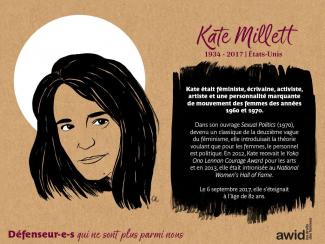
TV5Monde: Kate Millett, décès d'une féministe qui combattait avec caresses et plaisir

In September 2016, the 13th AWID international Forum brought together in Brazil over 1800 feminists and women’s rights advocates in a spirit of resistance and resilience.
This section highlights the gains, learnings and resources that came out of our rich conversations. We invite you to explore, share and comment!
One of the key takeaways from the 2016 Forum was the need to broaden and deepen our cross-movement work to address rising fascisms, fundamentalisms, corporate greed and climate change.
With this in mind, we have been working with multiple allies to grow these seeds of resistance:
And through our next strategic plan and Forum process, we are committed to keep developing ideas and deepen the learnings ignited at the 2016 Forum.
AWID Forums started in 1983, in Washington DC. Since then, the event has grown to become many things to many peoples: an iterative process of sharpening our analyses, vision and actions; a watershed moment that reinvigorates participants’ feminisms and energizes their organizing; and a political home for women human rights defenders to find sanctuary and solidarity.
En nuestra lucha por la justicia de género, económica, social y ambiental, en la paz, lxs feministas sabemos que no existe una sola receta para el éxito sino una gama de posibilidades que pueden y hacen que sucedan los cambios.
El menú de opciones es tan diverso como lo son nuestros movimientos y las comunidades en las que vivimos y luchamos.
Antes de atrevernos a presentar algunas de las formas en que lxs feministas nos imaginamos un mundo diferente, aquí están los principios que sostienen nuestras propuestas:
Creemos que no existe un modelo único aplicable a todxs y que todxs tienen derecho a reivindicar la construcción de ese otro mundo posible, como lo expresa el lema del Fondo Mundial..
Esto incluye el derecho a participar en la gobernabilidad democrática y de influir sobre el propio futuro, en el ámbito político, social y cultural.
La autodeterminación económica permite que los pueblos controlen sus recursos naturales y los utilicen de manera colectiva o para los fines que ellos mismos decidan. Además, la autonomía económica de las mujeres es fundamental para mitigar la naturaleza a menudo cíclica de la pobreza y la falta de educación, seguridad y protección.
El principio de la igualdad sustantiva o de facto forma parte de la Convención sobre la Eliminación de Todas las Formas de Discriminación contra las Mujeres (CEDAW) y de otros instrumentos internacionales de derechos humanos. Es fundamental para el desarrollo y para lograr una economía justa ya que afirma que todos los seres humanos nacen libres e iguales.
La no discriminación forma parte intrínsecamente del principio de igualdad que garantiza que a nadie se le nieguen sus derechos por factores como la raza, el género, el idioma, la religión, la orientación sexual, la identidad de género, las opiniones políticas o de otra clase, el origen nacional o social, la propiedad o el nacimiento.
La dignidad intrínseca de todas las personas sin distinción alguna debe ser afirmada y respetada. Si bien los Estados tienen la responsabilidad de garantizar el uso de los máximos recursos de que disponen para la realización de los derechos humanos, la reivindicación de los derechos y la dignidad configura sobre todo un espacio clave para las luchas de la sociedad civil y la movilización popular.
Este principio, que se ejerce mediante esfuerzos organizados para transformar instituciones injustas, guía la recuperación del equilibrio entre «participación» (entrada) y «distribución» (salida) cuando se ha violado cualquiera de esos dos principios.
Implica ponerle un límite a toda acumulación monopólica de capital y otros abusos de la propiedad. Este concepto se apoya en un modelo económico que gira en torno a la ecuanimidad y la justicia.
Para que se produzcan cambios, necesitamos redes feministas fuertes y diversas. Necesitamos movimientos que construyan solidaridad desde lo personal hacia lo político, desde lo local a lo global, y viceversa.
La construcción de poder colectivo a través de los movimientos sociales ayuda a convertir la lucha por los derechos humanos, la igualdad y la justicia en una fuerza política para el cambio que no puede ser ignorada.
«Únicamente los movimientos pueden crear cambios sostenidos a niveles que las políticas y las leyes solas no pueden alcanzar»
Para leer más sobre este tema, consulta Batliwala, S: 2012 «Cambiando el mundo: Conceptos y prácticas de los movimientos de mujeres», 2da edición. AWID.
Las Realidades Feministas proclaman y personifican la esperanza y el poder.
Las encontramos en todo lo que nos muestra que existen otras formas de vivir, de pensar y de hacer, desde las expresiones cotidianas que se evidencian en cómo nos relacionamos con otrxs hasta los sistemas alternativos de gobernanza y de justicia. Las realidades feministas son formas de resistencia a sistemas de poder como el patriarcado, el capitalismo y la supremacía blanca.
Son propuestas poderosas que nos orientan hacia la idea de lo que es posible y nos muestran cómo los procesos de organización feminista están abriendo caminos hacia la justicia en movimientos y comunidades de todo el mundo.
Descargar la revista completa (PDF)

Para reivindicar o seu poder como especialista sobre o estado dos recursos de movimentos feministas;
Contenu lié
TV5Monde: Kate Millett, décès d'une féministe qui combattait avec caresses et plaisir

Contestant la prémisse que l'économie d'un pays doit toujours «grandir ou mourir», les propositions de décroissance démystifient le rôle central d’une croissance mesurée par l'augmentation du produit intérieur brut (PIB).
Le modèle de la décroissance propose une transition vers des niveaux de production et de consommation plus faibles et durables. En substance, il s’agit de restreindre l’espace économique pour laisser plus de latitude à la coopération humaine et aux écosystèmes.
Les perspectives féministes sur la théorie et la pratique de la décroissance soutiennent qu'il est également nécessaire de redéfinir et de reconnaître la valeur du travail rémunéré et non rémunéré, sur le marché comme dans le secteur des soins aux personnes. Ceci contribuerait à surmonter les stéréotypes de genre traditionnels, les écarts de salaires en vigueur et les inégalités de revenus qui dévalorisent le travail réalisé dans le domaine des soins.

Un an seulement après sa fondation, les membres de Nadia Echazú ont commencé à travailler dans la haute couture et ont organisé un défilé de mode dans l'historique hôtel Bauen.
Elles ont montré cinq modèles et quelques travailleuses de la coopérative textile ont même défilé avec leurs propres créations.
C'était révolutionnaire non seulement parce qu'elles concevaient des alternatives à la mode grand public, mais aussi parce qu'elles créaient des vêtements accessibles et inclusifs pour les corps trans et travesti.
Il n'y a pas d'économies féministes sans vêtements qui nous font nous sentir incroyables et confortables!
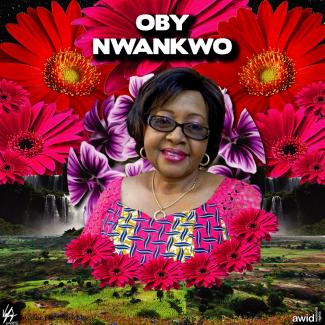
With a legal career spanning more than 30 years, Oby was known across Africa and around the world as a champion for gender justice and human rights.
She founded and served as Executive Director of the Civil Resource Development and Documentation Centre (CIRDDOC), a Nigerian NGO which sponsors trainings and network-building activities for members of civil society, parliamentarians and other key stakeholders to promote human rights, good governance and access to justice and rule of law.
Oby is remembered fondly by activists in Nigeria as an “extraordinary activist who displayed energy and passion towards the fight for gender equality and gender justice in Nigeria and across Africa.”
Les ultraconservateurs ont développé un certain nombre d’arguments relatifs aux droits humains sur le plan international, lesquels instrumentalisent la religion, la culture, la tradition et la souveraineté nationale dans le but de porter atteinte aux droits liés au genre et à la sexualité. Les acteurs anti-droits s’éloignent de plus en plus d’un langage explicitement religieux.
Nous constatons de plus en plus fréquemment que des acteurs rétrogrades – qui dénigraient auparavant le concept des droits humains – tentent désormais de le récupérer et de le manipuler pour atteindre leurs objectifs.
Ce discours émergent qui prospère actuellement semble inoffensif, mais il fonctionne comme un cadre général abritant de multiples positions patriarcales et anti-droits.
Le thème de la « protection de la famille » est donc un exemple particulièrement parlant de l’évolution de la stratégie de certains acteurs rétrogrades que utilisent désormais un plaidoyer holistique et intégré.
L’argumentaire sur la « protection de la famille » est utilisé pour déplacer le sujet de droits humains de l’individu vers des institutions déjà puissantes.
Il prône également une conception unitaire, hiérarchique et patriarcale de la famille qui suppose une discrimination à l’égard des formes familiales situées en dehors de ces limites rigides. Il tente également d’atténuer l’importance actuellement accordée à la reconnaissance et à la protection des droits des membres vulnérables de la famille pour privilégier la non-discrimination, l’autonomie et l’absence de violence dans le contexte des rapports familiaux.
Le Saint-Siège et un certain nombre de groupes chrétiens de défense des droits cherchent à s’approprier la notion de droit à la vie pour servir leur lutte contre l’avortement. En introduisant la doctrine religieuse conservatrice dans le langage des droits humains, ils soutiennent l’idée qui veut que le droit à la vie, tel qu’énoncé dans la Déclaration universelle des droits de l’homme et dans le Pacte international relatif aux droits civils et politiques, s’applique dès le moment de la conception.
Aucun des instruments universels relatifs aux droits humains ne vient étayer ce discours. Pourtant, c’est une stratégie attrayante pour les acteurs anti-droits dans la mesure où le droit à la vie ne peut être violé en aucune circonstance et qu’il constitue une norme juridiquement contraignante.
Les acteurs anti-droits utilisent un certain nombre d’arguments dans leur campagne pour porter atteinte aux droits sexuels. Ils soutiennent que les droits sexuels n’existent pas ou qu’il s’agit de « droits nouveaux » nuisibles aux enfants et à la société et/ou que ces droits sont en opposition avec la culture, la tradition ou le droit national.
Dans le cadre onusien, les conservateurs plaident contre le droit à une éducation sexuelle complète (ESC) en attaquant ce concept à plusieurs niveaux. Ils prétendent que l’ESC viole les « droits parentaux », qu’elle nuit aux enfants et qu’il s’agit d’un endoctrinement idéologique plutôt que d’une forme d’éducation. Ils affirment également que cette éducation sexuelle complète est imposée aux enfants, aux parents et aux Nations Unies par de puissants lobbyistes qui cherchent à tirer profit des services qu’ils fournissent aux enfants et aux jeunes.
Les tentatives visant à invalider les droits relatifs à l’orientation sexuelle et à l’identité de genre prolifèrent. Les ultraconservateurs font valoir le fait que l’application des principes et du droit relatifs aux droits humains – qui existent pourtant depuis longtemps – consiste en fait à créer de « nouveaux droits ». Ils prétendent enfin que le contenu des droits devrait varier radicalement parce que ceux-ci devraient être interprétés à l’aune de la « culture » ou des « particularismes nationaux ».

Les organisations de la droite chrétienne se mobilisent depuis longtemps contre les droits reproductifs, aux côtés du Saint-Siège et d’autres alliés anti-droits. Elles affirment souvent que les droits reproductifs sont en fait une forme de contrôle de la population imposée par l’Occident aux pays du Sud global. Paradoxalement, ce discours émane le plus souvent d’acteurs issus des États-Unis et de l’Europe occidentale, dont beaucoup travaillent activement pour exporter leur rhétorique et leurs politiques fondamentalistes.
Ces acteurs rétrogrades reprennent également des arguments « scientifiques » élaborés par des groupes de réflexion ultraconservateurs et citent des sources usant de méthodologies de recherche peu fiables pour montrer que l’avortement a de nombreux effets secondaires psychologiques, sexuels, physiques et relationnels.
Les acteurs anti-droits visent à promouvoir le concept de « protection de la famille », mais ils tentent également de créer une nouvelle catégorie de « droits parentaux » à laquelle les normes existantes relatives aux droits humains ne donnent aucun fondement.
Paradoxalement, ce discours tente de dévoyer les systèmes de protection des droits dont les enfants jouissent par principe, tels qu’énoncés dans la Convention relative aux droits de l’enfant, pour renforcer les droits des parents à exercer un contrôle sur leurs enfants et à limiter leurs droits.
Les acteurs anti-droits tentent de plus en plus fréquemment de s’approprier et de subvertir les références et les arguments défendus par les défenseuses des droits humains, et notamment la notion de violence contre les femmes (VCF).
Dans le cadre de la Commission sur la condition de la femme ainsi que dans d’autres espaces, ces acteurs utilisent notamment la technique rhétorique suivante : ils abordent la violence contre les femmes comme un cadre dans lequel il est possible d’intégrer des arguments hostiles aux droits reproductifs et de nature patriarcale.
Les ultraconservateurs, par exemple, défendent l’idée qui veut que les relations intimes entre partenaires qui ne sont ni hétéronormatives ni traditionnelles constituent un facteur de risque de violence. Ils soulignent que les pères sont nécessaires à la protection des familles contre la violence.
Le Saint-Siège se livre à une critique incessante du genre, de l’« idéologie du genre », des « radicaux du genre » et de la théorie du genre. Les acteurs anti-droits interprètent souvent le terme « genre » comme un code caché pour parler des droits des personnes LGBT*Q. La droite religieuse utilise le concept de genre comme un outil transversal qui relie beaucoup de ses thèmes de prédilection. De plus en plus souvent, les opposant-e-s acharné-e-s à ces notions de genre se braque sur les questions relatives à l’identité de genre et aux droits des personnes trans*.
À l’heure actuelle, un certain nombre d’ultraconservateur utilisent la rhétorique de la complémentarité des sexes. Leur argumentaire est structuré autour de l’hypothèse de la différence entre les sexes : les hommes et les femmes sont censés jouer des rôles différents mais complémentaires dans le mariage et la vie familiale, mais aussi dans leur engagement dans la vie communautaire, politique et économique.
La référence aux rôles « naturels » vise à rejeter fondamentalement le caractère universel des droits humains en matière d’égalité et de non-discrimination.
Cet argument est également utilisé pour justifier les violations de ces droits par les États et les acteurs non étatiques. Il contribue en outre au non-respect de l’obligation faite aux États de lutter contre les préjugés et les pratiques fondés sur des rôles stéréotypés attribués aux hommes et aux femmes.
Ce discours suggère que les gouvernements nationaux sont injustement ciblés par les organes des Nations Unies ou par d’autres États agissant par l’intermédiaire de l’ONU. Il s’agit d’une tentative de déplacer le sujet des droits humains de l’individu ou de la communauté marginalisée qui subit une violation de ses droits vers une institution puissante et/ou rétrograde, à savoir l’État, dans le but de justifier des exceptions nationales aux droits universels, voire de soutenir l’impunité des États.
Les acteurs anti-droits ont récupéré la rhétorique de la liberté de culte pour justifier les violations des droits humains. Mais les ultraconservateurs se réfèrent à la liberté de culte d’une manière qui contredit frontalement l’objectif de ce droit humain et est en opposition fondamentale avec le principe de l’universalité des droits.
Le raisonnement avancé est que la liberté de culte est menacée et compromise par la protection des droits humains, en particulier de ceux liés au genre et à la sexualité.
Selon l’argument central des conservateurs, le droit à la liberté de culte est destiné à protéger une religion plutôt que la liberté des personnes d’avoir ou de ne pas avoir de croyances religieuses.
Pourtant, en vertu du droit international relatif aux droits humains, le droit protège les croyants plutôt que les croyances, et le droit à la liberté de religion, de pensée et de conscience comprend le droit de ne pratiquer aucune religion ou de ne pas adhérer à une croyance, mais aussi celui de changer de religion ou de conviction.
Les acteurs anti-droits utilisent communément des tactiques fondées sur les références à la culture et aux traditions pour saper les droits humains, dont le droit à l’égalité. Présentée comme monolithique, statique et immuable, la culture apparaît souvent comme une réalité en totale contradiction avec les « normes occidentales ».
Dans les débats politiques internationaux, les acteurs anti-droits font allusion à la culture pour saper l’universalité des droits : ils préconisent un relativisme culturel qui éclipse ou limite les revendications en matière de droits. Ces acteurs font également un usage rétrograde de la notion de droits culturels, qui repose sur une représentation volontairement faussée du concept de droit humain. Les États doivent veiller à ce que les pratiques traditionnelles ou culturelles ne soient pas détournées pour justifier certaines violations du droit à l’égalité.
Le droit relatif aux droits humains prévoit en effet l’égalité d’accès, de participation et de contribution à tous les aspects de la vie culturelle pour tous et toutes, y compris les femmes, les minorités raciales et religieuses ainsi que les personnes dont le genre et la sexualité sont non conformes.
Les acteurs anti-droits engagés dans les espaces politiques internationaux manipulent de plus en plus fréquemment les références à l’universalité des droits humains fondamentaux pour inverser le sens de l’universalité des droits.
Plutôt que d’utiliser le terme universel pour décrire l’ensemble des droits humains indivisibles et interdépendants, les ultraconservateurs délimitent et décrivent un sous-ensemble de droits humains « véritablement fondamentaux ».
Les autres droits considérés comme des « droits nouveaux » et facultatifs, seraient donc laissés à la discrétion des États. Cette rhétorique est particulièrement efficace dans la mesure où le contenu de la catégorie des droits véritablement universels reste implicite, ouvrant ainsi la porte à des variations dans l’interprétation.
Télécharger le chapitre complet (en anglais)
Solidarity Network
ان جمعية حقوق المرأة في التنمية ممتنة للعديد من الأشخاص الذين/ اللواتي ساعدت أفكارهم/ن، تحليلاتهم/ن ومساهماتهم/ن على تصميم استطلاع "أين المال" على مدار السنوات.
نشكر جزيل الشكر أعضاء/ عضوات AWID والنشطاء/ الناشطات الذين/ اللواتي شاركوا/ن في استشارات استطلاع "أين المال؟" وقاموا/ن بتجربة الاستطلاع وأعطونا بسخاء من وقتهم/ن وتحليلاتهم/ن وقلوبهم/ن.
نقدر بشكل عميق الحركات النسوية، الحلفاء/ الحليفات والصناديق النسوية بمانقدر بشكل عميق الحركات النسوية، الحلفاء/ الحليفات والصناديق النسوية وهنا بعض منها وليس جميعها: Black Feminist Fund, Pacific Feminist Fund, ASTREA, FRIDA Young Feminist Fund, Purposeful, Kosovo Women's Network, Human Rights Funders Network, CEECCNA Feminist Fund e PROSPERA, على بحثكم/ن الرائع عن وضع التمويل، تحليلكم/ن الدقيق والمناصرة المستمرة لتمويل وقوة أكبر وأفضل للحركات النسوية وتنظيمات العدالة الجندرية في جميع السياقات.
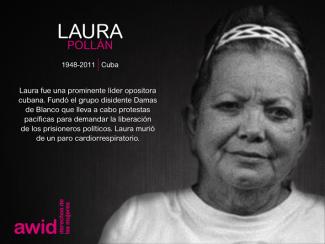
Laura fue una abogada y líder activista que luchó valientemente por la descriminalización del trabajo sexual en Irlanda.
Es recordada como «una combatiente por la libertad de lxs trabajadorxs sexuales, una feminista, una madre para su hija y una amiga necesaria para mucha gente».
Laura promovió el reconocimiento de las personas de la industria del sexo como trabajadorxs merecedorxs de derechos. Presentó demandas por la descriminalización, e inició una revisión judicial en la Corte Suprema de Belfast respecto de las provisiones que criminalizan la compra de servicios sexuales. Declaró que su intención era llevar el caso a la Corte Europea de Derechos Humanos.

News compilation regarding AWID's work and organization.
Press kits and statements
| Impunity for violence against women defenders of territory, common goods, and nature in Latin America March 16, 2018 |
Rural women's resistance to closing civic space March 15, 2018 |
|
| Empowering rural women in mining affected environments March 13, 2018 |
Feminist Perspectives on Accountability March 13, 2018 |
Gender Perspectives on Corporate Accountability March 12, 2018 |