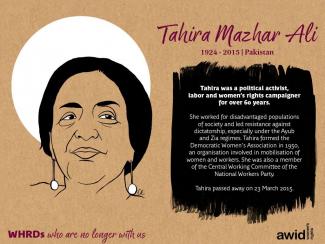
Tahira Mazhar Ali
Over the past few years, a troubling new trend at the international human rights level is being observed, where discourses on ‘protecting the family’ are being employed to defend violations committed against family members, to bolster and justify impunity, and to restrict equal rights within and to family life.
The campaign to "Protect the Family" is driven by ultra-conservative efforts to impose "traditional" and patriarchal interpretations of the family, and to move rights out of the hands of family members and into the institution of ‘the family’.
Since 2014, a group of states have been operating as a bloc in human rights spaces under the name “Group of Friends of the Family”, and resolutions on “Protection of the Family” have been successfully passed every year since 2014.
This agenda has spread beyond the Human Rights Council. We have seen regressive language on “the family” being introduced at the Commission on the Status of Women, and attempts made to introduce it in negotiations on the Sustainable Development Goals.
AWID works with partners and allies to jointly resist “Protection of the Family” and other regressive agendas, and to uphold the universality of human rights.
In response to the increased influence of regressive actors in human rights spaces, AWID joined allies to form the Observatory on the Universality of Rights (OURs). OURs is a collaborative project that monitors, analyzes, and shares information on anti-rights initiatives like “Protection of the Family”.
Rights at Risk, the first OURs report, charts a map of the actors making up the global anti-rights lobby, identifies their key discourses and strategies, and the effect they are having on our human rights.
The report outlines “Protection of the Family” as an agenda that has fostered collaboration across a broad range of regressive actors at the UN. It describes it as: “a strategic framework that houses “multiple patriarchal and anti-rights positions, where the framework, in turn, aims to justify and institutionalize these positions.”
Tous nos processus de changement reposent sur les relations que nous établissons dans des espaces comme les forums de l'AWID, où l'on danse ensemble, où l'on fait ressortir son humour, sa vraie personnalité, où l'on raconte des histoires. C'est ce qui fait la différence.
- Nicky Mcintyre, États-Unis

We’ve been together for over 20 years and how deeply I’ve treasured your love and support. It is interesting to think that you too are a similar age to AWID - both trying to figure out how to engage and support the community on a similar timeline. To the mothers in the movement, your leadership and guidance has been unmatched. I think of Prudence Mabele, Kate Thompson, Darien Taylor, Patricia Perez, Martha Tholanah, Deloris Dockery, Iris De La Cruise, Doris Peltier, Cecilia Chung and so many more. While not perfect (as none of us are), you always put your community first and champion the inclusion of ALL women living with HIV in feminist spaces.
I love the way you have held me when no one else has been able to, but more importantly how we hold each other. While you understand stigma, discrimination, violence and pain, you also understand joy, love and forgiveness. As feminists living with HIV, we are glorious and powerful in our intersectionality. We understand that feminism includes and is led by communities - our Black, Brown and Indigenous sisters, communities who are trans and gender diverse, sex workers, queer/lesbian, those who have been incarcerated, and those who use drugs - as set out in the GIPA (Greater Involvement of People Living with HIV) principles. Your feminism is all encompassing. We talk about the hard issues and about criminalized communities, because as people living with HIV, we ourselves are criminalized.
I would be remiss if I didn’t send special love to the young women living with HIV, the heartbeat of the movement. I see you Kia Lebejia, Keren Dunaway, Liz Onyango, Faith Ona, Sara Thapa Maga, Doreen Moraa, Yana Panfilova and millions of others incredible activists living with HIV. You are the power that will continue to propel us forward and allow us to be seen as important in mainstream feminst movements. Thank you for taking our movement further to ALWAYS include trans and gender diverse folks, to talk about the links between climate change and sexual and reproductive health and rights.
I love, love, love, love you so much. For better or for worse, let’s move forward together because this is our community - this is my community.
With love,
Jessica Whitbread
THE TURTLE'S RAGE tells the story of a mysterious man, whose life has been molded by flight, expulsion, life in exile and the failed return to Palestine. The film is composed of a daughter's search for answers from her father.
A conversation on international advocacy and global governance
✉️ By registration only. Register here
📅 Friday, March 14, 2025
🕒 2.30pm EST
🏢 Blue Gallery, The Blue Building, 222 East 46th Street
🎙️Facilitated by: Anissa Daboussi, Manager, Advancing Universal Rights and Justice team
Organizer: SRI, AWID
We are monitoring this and other risks carefully, and will publish comprehensive health and safety information when the registration opens, so you could make an informed decision. In addition, the hybrid format is designed to provide a meaningful engagement experience to the participants who will prefer not to travel or are not able to travel.

¿Cómo comienza un movimiento?
los fantasmas nos expulsan de una casa, una familia, y una nación
llegamos fatigadas a un espacio (a veces un domicilio real) pero fundamentalmente a un estado de ser
precedidas por una estrella fugaz
quizás nuestra llegada no está acompañada por la fatiga,
quizás está acompañada por el miedo
quizás nuestra llegada no está acompañada por el miedo
quizás está acompañada por la rabia
ante cuestiones que siguen repitiéndose:
una puñalada en el corazón (léase pena)
una bala en la espalda (léase traición)
desapariciones forzadas
cuerpos sentenciados por el matrimonio, la desfiguración y la fatiga crónica,
sin embargo, llegamos, nos reunimos, susurramos, hablamos y lloramos.
Así es como nuestros movimientos comienzan cuando llegamos unas a otras
Nos convertimos en semillas,
Así es como nuestros movimientos comienzan cuando nos plantamos unas a otras
Convirtiéndonos en flores, a veces solo espinas, a veces frutas,
somos el oasis de las otras
para cantar por las batallas
para preparar remedios
para ubicar los rostros de nuestras amantes, la forma de sus sonrisas, el sonido de su risa
el secreto de convertir los silencios en lenguaje
las detalladas instrucciones de las brujas
nuestro movimiento es para todas nosotras,
cuando llegamos como semillas con el propósito de florecer.
Sara AbuGhazal
www.badiya.blog
Un réseau complexe et mouvant d’acteur·rice·s antidroits exerce aujourd’hui une influence croissante dans les espaces internationaux et nationaux, ainsi qu’au niveau des politiques locales. Les antidroits pénètrent les espaces multilatéraux de collaboration entre pays, dans le but de les transformer et les saboter de l’intérieur. C’est en s’appropriant le langage des droits et de la justice pour travestir leurs véritables intentions qu’ils et elles parviennent à acquérir une certaine légitimité.
Ce rapport est le deuxième d’une série sur les droits humains, produite par l’Observatoire sur l’universalité des droits (OUR). Outre une analyse des principales parties antidroits, de leurs discours, stratégies et impacts, ce rapport inclut des nouvelles féministes pleines d’inspiration et des exercices de renforcement des connaissances qui nous permettront d’assurer notre résistance collective.
Les conséquences sur nos droits sont déjà importantes, mais il est encore possible de réagir. Nous pouvons toutes et tous participer à la résistance face aux programmes antidroits et récupérer nos droits.
Rejoignez l’appel à l’action collective dès aujourd’hui!
Boil them down to communications language preferences
AWID no ofrece descuentos para grupos, pero sí ofrece descuentos en la inscripción a sus afiliadxs. (Haz clic aquí para obtener más información sobre cómo sumarte a la membresía)
We’re beginning a new year--2023. COVID-19 continues to infect and re-infect many, many people around the world. We are witnessing the resurgence of right-wing and fascist governments, even in places we may not have expected like Sweden. War, armed conflict, and dramatic increase in militarization, militarism, and military spending are enabling the unbridled capital accumulation by the few, with participation of seemingly “strange” alliances locking arms, both visibly and invisibly, where economic and political elites of the Global North and Global South are benefitting beyond our wildest imagination. In the meanwhile, our people and the natural environment pay enormous costs and suffer all the expected and unexpected consequences.
As all of you and all of us at AWID know, feminists in multiple movements around the world are resisting and organizing against multiple faces of tyranny, creating alternative structures, implementing grassroots strategies, and building transnational alliances. We are generating joy, inspiring one another, singing, and dancing within and against the prevailing culture of killing and cynicism that seems to have engulfed so much of the world.
We--Staff and Board--of AWID are prepared and inspired more than ever before to face challenges by strengthening our relationships with our members and organizational partners, meeting and getting to know those who we are yet to meet and do what we do best: support the global feminist movements. Although we were sad facing the departures of our beloved former Co-Eds Cindy and Hakima, our wonderful new Co-EDS Faye and Inna along with committed and creative staff have embraced the moment that encapsulates both opportunities and threats.
For sure, all of us at AWID and all our movement folks know: As the Caribbean US poet and activist June Jordan wrote to the South African women activists during the height of the apartheid regime, “We are the ones we have been waiting for”!
In the African Commission and the Inter-American System, anti-rights actors push essentialist notions of culture and gender to hamper progress on rights and undermine accountability. As we see, anti-rights actors are exerting influence in regional human rights systems, as well as international spaces.
Related content
AfriCOG's security forum: Eva Ayiera on key drivers of Kenya's security threats (Video)