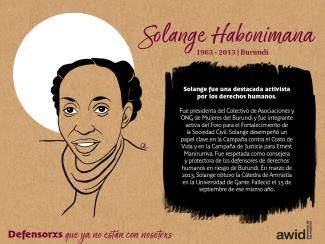
Solange Habonimana
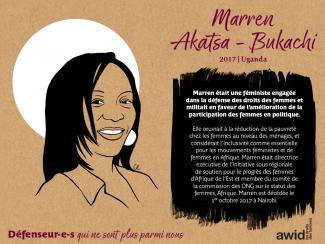
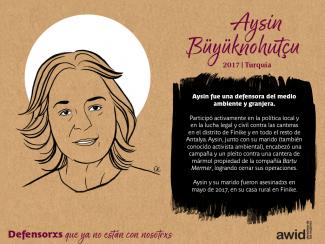
L’hommage se présente sous forme d’une exposition de portraits d’activistes du monde entier qui ne sont plus parmi nous qui ont lutté pour les droits des femmes et la justice sociale.
Cette année, tout en continuant à convoquer la mémoire de celleux qui ne sont plus parmi nous, nous souhaitons célébrer leur héritage et souligner les manières par lesquelles leur travail continue à avoir un impact sur nos réalités vécues aujourd’hui.
49 nouveaux portraits de féministes et de défenseur·e·s viennent compléter la gallerie. Bien que de nombreuses des personnes que nous honorons dans cet hommage sont décédé·e·s du fait de leur âge ou de la maladie, beaucoup trop d’entre iels ont été tué·e·s à cause de leur travail et de qui iels étaient.
Visiter notre exposition virtuelle
Les portraits de l'édition 2020 ont été illustrés par Louisa Bertman, artiste et animatrice qui a reçu plusieurs prix.
L’AWID tient à remercier nos membres, les familles, les organisations et les partenaires qui ont contribué à cette commémoration. Nous nous engageons auprès d’elleux à poursuivre le travail remarquable de ces féministes et défenseur·e·s et nous ne ménagerons aucun effort pour que justice soit faite dans les cas qui demeurent impunis.
« Ils ont essayé de nous enterrer. Ils ne savaient pas que nous étions des graines » - Proverbe mexicain
Le premier hommage aux défenseur-e-s des droits humains a pris la forme d’une exposition de portraits et de biographies de féministes et d’activistes disparu·e·s lors du 12e Forum international de l’AWID en Turquie. Il se présente maintenant comme une gallerie en ligne, mise à jour chaque année.
Depuis, 467 féministes et défenseur-e-s des droits humains ont été mis·es à l'honneur.
Mientras estés en São Paulo, Brasil, puedes visitar la Ocupação 9 de Julho y pedir una comida colaborativa. También puedes comprar sus productos en su tienda online desde el extranjero.
Visita la tienda en línea de la Asociación de Mujeres Afrodescendientes del Norte del Cauca (ASOM) donde puedes encontrar hermosos productos hechos a mano.
Hay varias formas de apoyar a Metzineres: puedes hacer una donación económica, donar materiales y servicios, o proponer una formación, un taller o una actividad (para más información, ¡ver aquí!)
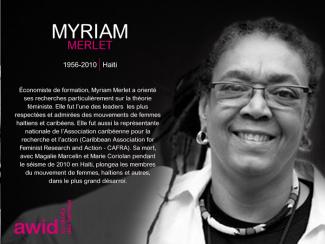
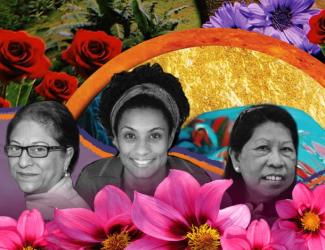
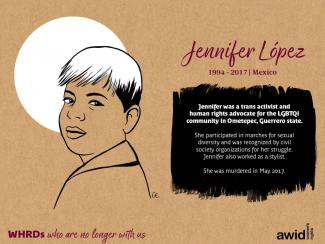
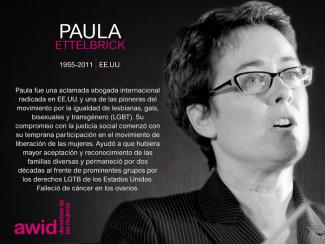
This year we are honoring 18 Women Human Rights Defenders from the Latin America and the Caribbean region. Alone 15 of those were murdered, among which 6 are journalists and 4 LGBTQI and/or sex workers’ rights defenders. Please join us in commemorating the life and work of these women by sharing the memes below with your colleagues, friends and networks and by tweeting using the hashtag #AWIDTribute.


L’enquête est disponible sur KOBO, une plateforme en source libre de collecte, gestion et visualisation de données. Pour y participer, il vous suffit de cliquer ici sur le lien de l’enquête et de suivre les indications pour répondre aux questions.

Las 3 defensoras de derechos humanos del Pacífico que honramos en el Tributo Virtual de este año trabajaron en los medios, defendieron los derechos de las personas con discapacidad y promovieron los derechos de las mujeres. Extrañamos sus contribuciones y las honramos mediante este Tributo. Únete a AWID para honrar a estas defensoras de derechos humanos, su trabajo y su legado, compartiendo los memes aquí incluidos con tus colegas, amistades y redes; y tuiteando las etiquetas #WHRDTribute y #16Días.
Por favor, haz click en cada imagen de abajo para ver una versión más grande y para descargar como un archivo.


There are 47 questions in total, of which 27 are mandatory* and the remaining 20 are optional. The majority of questions are multiple-choice. We invite you to respond to all the questions.
NOUS SOMMES LA SOLUTION
Ce kit inclut des messages types adaptés pour Twitter, Facebook LinkedIn et Instagram ainsi que des images qui peuvent être utilisées pour accompagner ces messages.
L’utilisation de ce kit est simple, il vous suffit de suivre les étapes suivantes :
Choisissez ci-dessous vos messages favoris :
Twitter
Facebook
LinkedIn
Faites correspondre vos messages préférés avec les images types adaptés pour Twitter
Rejoignez-moi au #AWIDForum, LE lieu pr se connecter ac D mouvements 2 droits D femmes & 2 justice sociale http://forum.awid.org/forum16/fr
Hâte 2 repenser les #HorizonsFéministes ac D activistes D droits D femmes & 2 la justice sociale au #AWIDForum ! http://forum.awid.org/forum16/fr
Je suis tellement ravie 2 participer au #AWIDForum en mai prochain. Nous pouvons désorms ns inscrire. Rejoignez-moi ! http://forum.awid.org/forum16/fr
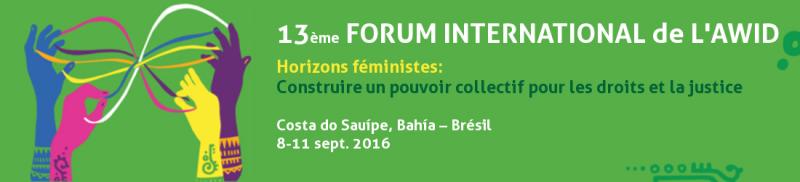
Inscriptions désormais ouvertes pour le #AWIDForum! Costa do Sauípe, Brésil, 8-11 sept. 2016 http://forum.awid.org/forum16/fr
Participez au #AWIDForum, 1 rassemblement historique mondial d'activistes 2 la justice sociale & D droits D femmes http://forum.awid.org/forum16/fr
Participez au #AWIDForum pour célébrer les acquis de nos mouvements & analyser les leçons tirées pour aller de l’avant : http://forum.awid.org/forum16/fr
#AWIDForum : bien plus qu’un simple événement, la possibilité de rompre l’oppression & faire avancer la justice http://forum.awid.org/forum16/fr
Participez au #AWIDForum pour célébrer, repenser et renouveler nos mouvements & nos réflexions. http://forum.awid.org/forum16/fr
Créons ensemble des #HorizonsFéministes. Inscrivez-vous au #AWIDForum 2016. Costa do Sauípe, Brésil http://forum.awid.org/forum16/fr
Rejoignez-nous pour ré-imaginer & co-créer des #HorizonsFéministes au #AWIDForum 2016. Inscrivez-vous: http://forum.awid.org/forum16/fr
#HorizonsFéministes: saisir l'opportunité au #AWIDForum de faire avancer nos visions pour un monde juste http://forum.awid.org/forum16/fr
Nous serons 2000 activistes D mouvements sociaux au #AWIDForum, élaborant des stratégies sur nos #HorizonsFéministes http://forum.awid.org/forum16/fr
Nous sommes bien plus qu’une lutte à enjeu unique. Rejoignez-nous au #AWIDForum: http://forum.awid.org/forum16/fr
Participez au #AWIDForum, un espace de stratégies entre mouvements et d’influence pour notre pouvoir collectif: http://forum.awid.org/forum16/fr
Mobiliser la solidarité & le pouvoir collectif à travers les mouvements sociaux au #AWIDForum: http://forum.awid.org/forum16/fr
Briser les cloisons entre nos mouvements. Ré-imaginer & co-créer nos futurs. Tou-te-s au #AWIDForum http://forum.awid.org/forum16/fr
« Etre solidaire » est un verbe. Mettons-le en action au #AWIDForum: http://forum.awid.org/forum16/fr
Les bailleurs qui s’engagent avec les mouvements sociaux & de droits des femmes au #AWIDForum: http://forum.awid.org/forum16/fr
Médias et mouvements: amplifier les #HorizonsFéministes au #AWIDForum: http://forum.awid.org/forum16/fr
Faites correspondre vos messages préférés avec les images types adaptés pour Facebook
Vous pouvez aussi envoyer ces messages via les messages privés de Twitter qui n’ont pas de limite de caractères.
Téléchargez vos images préférées pour Instagram
Si deseas guardar las respuestas y retomar la encuesta más tarde, puedes hacerlo todas las veces que lo necesites. KOBO guardará tus respuestas en la esquina superior izquierda de la página de la encuesta y recargará tu registro cuando regreses a la encuesta. Solo asegúrate de continuar desde la misma computadora y navegador.
Nous avons le plaisir de vous présenter Mariama Sonko, agricultrice rurale, éco-féministe et défenseuse des droits humains, vivant actuellement à Niaguis, une ville du sud-ouest du Sénégal.
Ayant grandi dans une famille et une communauté rurale d’agriculteur·rices, elle a été témoin du rôle essentiel des femmes dans la production alimentaire et la conservation des semences depuis son plus jeune âge, tout en étant immergée dans le travail de la terre.
Mariama défend les savoirs agricoles locaux et les pratiques paysannes depuis les années 90. En tant que mère de 5 enfants, la nourriture qu'elle cultive elle-même est la principale source de subsistance de sa famille.
Elle est actuellement présidente de Nous Sommes la Solution et s'engage à promouvoir les pratiques agroécologiques et l'agriculture familiale, à encourager la souveraineté alimentaire, la biodiversité et la préservation des semences paysannes, et à exiger un accès équitable aux ressources et à la terre à travers l'Afrique de l'Ouest.
Source: AWID’s Feminist Realities Festival Crear | Résister | Transform - Day 2/ 2ème jour/ 2º día