Left
Half
Left

Analyses Spéciales

L´AWID est une organisation féministe mondiale qui consacre ses efforts à la justice de genre, au développement durable et aux droits humains des femmes

La mémoire comme forme de résistance : un hommage

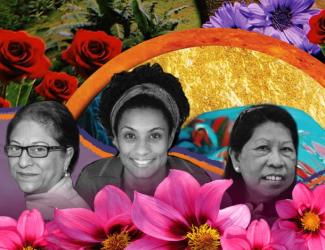
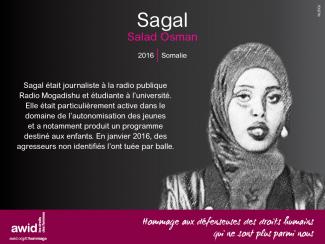
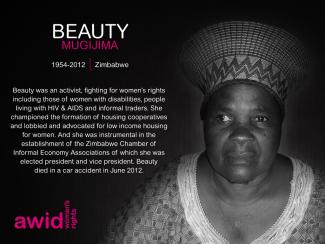
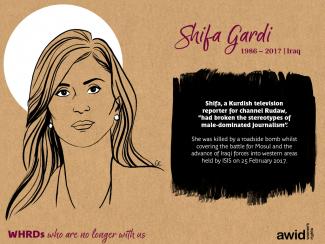
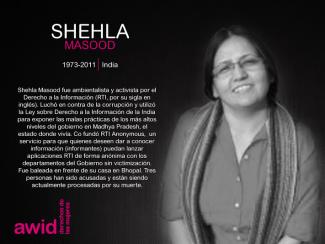
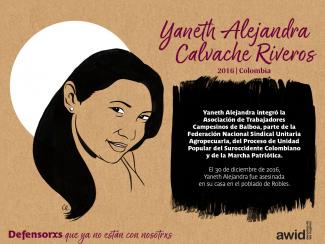
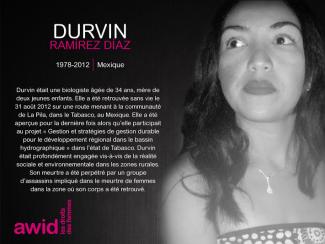
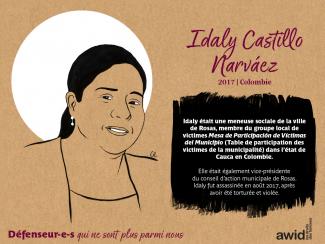
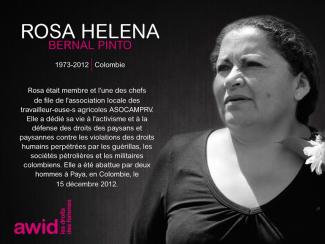
L’hommage se présente sous forme d’une exposition de portraits d’activistes du monde entier qui ne sont plus parmi nous qui ont lutté pour les droits des femmes et la justice sociale. 


En 2020, nous adoptons une démarche légèrement différente 

Cette année, tout en continuant à convoquer la mémoire de celleux qui ne sont plus parmi nous, nous souhaitons célébrer leur héritage et souligner les manières par lesquelles leur travail continue à avoir un impact sur nos réalités vécues aujourd’hui.

49 nouveaux portraits de féministes et de défenseur·e·s viennent compléter la gallerie. Bien que de nombreuses des personnes que nous honorons dans cet hommage sont décédé·e·s du fait de leur âge ou de la maladie, beaucoup trop d’entre iels ont été tué·e·s à cause de leur travail et de qui iels étaient.

Les histoires des activistes à l'honneur dans cet Hommage font vivre leur héritage et continuent d'inspirer le travail et l’action de nos mouvements.

Visiter notre exposition virtuelle

Les portraits de l'édition 2020 ont été illustrés par Louisa Bertman, artiste et animatrice qui a reçu plusieurs prix.

L’AWID tient à remercier nos membres, les familles, les organisations et les partenaires qui ont contribué à cette commémoration. Nous nous engageons auprès d’elleux à poursuivre le travail remarquable de ces féministes et défenseur·e·s et nous ne ménagerons aucun effort pour que justice soit faite dans les cas qui demeurent impunis.

« Ils ont essayé de nous enterrer. Ils ne savaient pas que nous étions des graines » - Proverbe mexicain

L'Hommage a été inauguré en 2012

Le premier hommage aux défenseur-e-s des droits humains a pris la forme d’une exposition de portraits et de biographies de féministes et d’activistes disparu·e·s lors du 12e Forum international de l’AWID en Turquie. Il se présente maintenant comme une gallerie en ligne, mise à jour chaque année.

Depuis, 467 féministes et défenseur-e-s des droits humains ont été mis·es à l'honneur.

Visiter notre exposition virtuelle

Contenu lié

Snippet - Intro CSW69_FR

#BloquerLesFascismes

#FreezeFascisms

Depuis l’adoption de la Déclaration et du programme d’action de Beijing il y a 30 ans, les groupes fascistes exercent un pouvoir et une influence croissantes dans les espaces multilatéraux, faisant reculer les acquis en matière d’égalité de genre et de protection des droits humains dans le monde.

À l’approche de la CSW69, nous co-organisons de courageuses initiatives horizontales, sur le terrain et en ligne, pour échanger des stratégies et bâtir un pouvoir féministe au-delà de Beijing+30. Notre présence collective perturbe les mécanismes d’exclusion des institutions dans ces espaces tout en soutenant les mouvements qui s’organisent autour d’alternatives féministes aux systèmes d’oppression.

Participez aux conversations du 10 au 21 mars 2025 pour, collectivement, faire de la CSW69 un espace de résistance et de solidarité.

Main image
ours web tile.png
Body

Snippet FEA Union Otras Photo Panel (ES)

Un panel de 13 personas de pie detrás de una silla de conferencia. Sobre la mesa hay hojas de papeles, micrófonos y botellas de agua. Detrás de ellos se puede ver una pared blanca y cortinas negras.

Miembrxs del sindicato OTRAS

Sainimili Naivalu

"He dado testimonio de la discriminación que vi en las calles, he sufrido burlas y abusos verbales ahí. También he hecho numerosas amistades y he conocido a mucha gente. Puede que haya peligros ahí fuera, pero soy una  sobreviviente y aquí es donde estaré por ahora." - Sainimili Naivalu

Sainimili Naivalu fue una feminista y activista por los derechos de las personas con discapacidades de la aldea de Dakuibeqa en la isla de Beqa, Fiji.

Exigió a las autoridades políticas y a otras partes interesadas que proporcionaran políticas y servicios favorables a la movilidad de las personas con discapacidad, como la construcción de rampas en pueblos y ciudades para aumentar su accesibilidad. Sin embargo, las barreras físicas no fueron las únicas que Sainimili se esforzó por cambiar. Por experiencia propia, sabía que era necesario que se produjeran cambios más complejos en las esferas sociales y económicas. Muchos de los retos a los que se enfrentan las personas con discapacidad tienen su origen en actitudes que llevan a la discriminación y al estigma.

Como sobreviviente y luchadora, Sainimili contribuyó a la creación conjunta de realidades feministas que fomentasen la inclusión y cambiasen las actitudes hacia las personas con discapacidad. Como afiliada a la Asociación de Lesiones de la Espina Dorsal de Fiji (SIA, por sus siglas en inglés) y a través del proyecto del Foro para Personas con Discapacidades del Pacífico “Pacífico Habilita”, Sainimili asistió a la formación de la Organización Internacional del Trabajo "Inicie su Negocio" en Suva, lo que le permitió transformar sus ideas en su propio negocio. Fue emprendedora en el puesto 7 del mercado de Suva, donde ofrecía servicios de manicura,  y también se encargaba del puesto del mercado de las mujeres de SIA, donde vendía artesanías, sulus y otros objetos. El plan de Sainimili era expandir su negocio y convertirse en una importante empleadora de personas con discapacidad.

Además de su activismo, también fue medallista y campeona juvenil de tenis de mesa.

Sainimili era única, con una personalidad vivaz. Siempre podías saber si Sainimili estaba en una habitación porque su risa y sus historias eran los primero que notabas. - Michelle Reddy

Sainimili falleció en 2019.

Join the Feminist Realities journey (Forum page)

Únete al viaje por las Realidades feministas

Este Foro de AWID celebrará y difundirá las realidades feministas que nos rodean en diferentes etapas de desarrollo.

Únete a nosotrxs

Framework & Theme

The theme of the 14th AWID International Forum is: “Feminist Realities: our power in action”. 

In our 14th Forum, we will celebrate and amplify Feminist Realities that are around us, in all stages of development. 

We want to make this Forum our Feminist Reality - a place where you can inhabit a different world, where you bring your victories, the solutions you have devised; what makes you feel stronger, hopeful and ready to go on. It will be different from any other convening you have previously attended. 

We urge you to join us in co-creating this world. It will be worth it!


Each Forum has a theme that reflects the needs of our membership and movements, and responds to our analysis of the current context.

The global context

Currently fascisms, fundamentalisms, authoritarianism and unfettered corporate power are gaining momentum globally. We see these threats converging with the State to shape public norms, narratives, and policies,  entrenching a culture of fear, hate and incitement to violence in public discourse. States, previously the target of advocacy and rights claims, in many cases no longer feel accountable and in some cases themselves don’t have the power to uphold rights.

This time of volatility, complexity and uncertainty requires creativity in how we organize across movements, coherence in what we demand and daring in what we propose. 

From Feminist Futures to Feminist Realities

AWID’s 2016 Forum centered on Feminist Futures and the conditions needed to bring such futures about. It was clear then, and remains evident now, the enormous challenge for many social justice movements to think outside of the current system for structural solutions. Imaginations can become narrowed from long experiences of inequality and oppression. But what we also heard then and we see all around us is that feminist movements are indeed living and promoting rights-and justice-oriented realities and solutions in big and small ways. 

Indeed we see an urgency to mobilize from a place of hope, rather than from a lowest common denominator - hope that is grounded in the certainty that across the globe, however imperfectly, are experiences and practices that embody more just ways of being in the world and that by sharing, strengthening and building on these experiences, we can help them grow their influence.

These are not impossible dreams, but lived realities. This sense of possibility is a spark to re-examine and re-appreciate the transformative dimensions in our work. 


A few examples of Feminist Realities across the globe

At AWID, we understand feminist realities as the living, breathing examples of the worlds we know are possible.  We understand these diverse feminist realities as reclamations and embodiments of hope and power. They are embedded in the multiple ways  that show us that there is a different way of living, thinking and doing-- from the daily expressions of how we live and relate to each other, to alternative systems of governance and justice. Feminist Realities resist dominant power systems such as patriarchy, capitalism, and white supremacy. 

These are powerful propositions that orient us toward a vision of what is possible, and show how feminist organizing is blazing a path toward justice in movements and communities around the world. 

  • In a deeply marginalized Black community in Jackson, Mississippi, an experiment in solidarity and cooperative economics is taking place through Cooperation Jackson. An ambitious plan to build community ownership outside of capitalist modes of production.

  • In West Africa, women farmers are resisting land grabbing and refusing industrialized agriculture projects, boldy claiming We Are The Solution, in a campaign to build agro-ecological solutions that center women farmers and their knowledges as the solutions to feed communities and mitigate climate change

  • Similarly, in India, 5,000 women have come together to develop community-based food sovereignty systems based on local knowledge, including grain and seed banks

  • Women in Mexico have created a moneyless economy project created by and for women and everyone they know. In El Cambalache everything has the same value: people exchange things they no longer need for things they want as well as knowledge, abilities and mutual aid that people would like to share. El Cambalache was built on the anti-systemic, anti-capitalist values of local social movements

  • In Rojava, Kurdish people are building democracy without the state and Kurdish women offer Jineology as a framework for challenging patriarchy, capitalism and the state, creating systems and institutions to put this framework into practice

  • In the UK, Anarcho Agony Aunts are a sex and dating advice show, covered from a feminist, antifascist, anarchist perspective. Hosts Rowan and Marijam are reclaiming space from the alt-right in giving people (mostly men) a space to ask tricky questions in a judgment-free zone. 

  • The African Feminist Judgment Project drafts and disseminates alternative judgments for important African landmark cases on a range of legal issues. At the heart of the project is propositional feminist judicial practice and alternative feminist judgments that contribute to African jurisprudence, legal practice and judicial decision-making 

  • The Usha Cooperative in India was founded when mainstream banks refused services to sex workers in Sonagachi. Sex workers self-organized to prioritize their economic concerns and set up their own financial institution. The Usha Cooperative is cooperative bank of over 20,000 sex workers and has provided over USD 4.7M in loans to 7,231 sex workers in a span of one year. With a membership entirely of sex workers, the bank provides real ownership and influence over the cooperative’s governance and management, pioneering ways for individuals and communities on the margins to build economic power on their own terms. 

  • In Puerto Rico, a community land trust is helping to transform an informal settlement around a polluted and flood prone river channel into a sustainable community. It provides a new model for improving informal settlements in cities without them then becoming unaffordable for the original residents.

  • In several Latin American countries activists are providing peer-to-peer counselling and accompaniment on medical abortion, reclaiming women´s right to decide over their bodies as well as to medical knowledgde. (for safety reasons, no links are provided.


The 14th AWID international Forum

The AWID Forum will be organized around 6 thematic anchors:

  • Resources for Communities, Movements and Economic Justice
  • Governance, accountability and justice
  • Digital Realities 
  • Bodies, pleasure and wellbeing
  • Planet and living beings
  • Feminist organizing 

Learn more about these anchors

Building on those realities, we expect the 2020 Forum to:

  • Build the power of Feminist Realities, by naming, celebrating, amplifying and contributing to build momentum around experiences and propositions that shine light on what is possible and feed our collective imaginations
  • Replenish wells of hope and energy as much needed fuel for rights and justice activism and resilience
  • Strengthen connectivity, reciprocity and solidarity across the diversity of feminist movements and with other rights and justice-oriented movements

The Forum is a collaborative process

The Forum is more than a four-day convening. It is one more stop on a movement strengthening journey around Feminist Realities that has already begun and will continue well beyond the Forum dates.

Join us on this journey!

Snippet - CSW69 - Full Calendar - EN

This image shows a full list of AWID at CSW69 activities

Snippet FEA Principles of work Transparency (FR)

Un parapluie rose

TRANSPARENCE

Sylvia Rivera

Sylvia Rivera était une militante pour les droits civiques, travestie et travailleuse du sexe.

Connue comme la drag queen de couleur de New York, Sylvia était une infatigable et féroce défenseure des marginalisé·e·s et exclu·e·s au début des années 1970, alors que le mouvement pour les « droits des gays » prenait de l’ampleur aux États-Unis.

Dans un discours bien connu prononcé pour Chistopher Street Day en 1973, Sylvia s’est exclamée, parmi une foule de membres de la communauté LGBT : 

« Vous me dites tous d’aller me cacher, la queue entre les jambes.
Je ne supporterai plus ces conneries.
On m’a battue.
On m’a cassé le nez.
On m’a jetée en prison.
J’ai perdu mon travail.
J’ai perdu mon appartement.
Tout ça pour la libération gay, et vous me traitez de la sorte?
C’est quoi votre putain de problème à tous?
Réfléchissez à ça! » 

En 1969, à l’âge de 17 ans, Sylvia a participé aux célèbres émeutes de Stonewall en jetant, paraît-il, le deuxième cocktail molotov en signe de protestation contre la descente de la police dans le bar gay de Manhattan. Elle a continué à être une figure centrale des soulèvements qui ont suivi, organisant des rassemblements et ripostant aux brutalités policières.

En 1970, Sylvia a collaboré avec Marsha P. Johnson à la création de Street Transvestite Action Revolutionaries (S.T.A.R.), collectif et organisation politique qui mettait sur pied des projets de soutien mutuel pour les personnes trans vivant dans la rue, celles et ceux aux prises avec la toxicomanie ou en détention, et spécialement pour les personnes trans de couleur et celles et ceux vivant dans la pauvreté. 

Refusant les étiquettes, Sylvia a incité les personnes du mouvement de libération gay à penser différemment, et ce, tout au long de sa vie. Elle a déclaré : 

« J’ai quitté ma maison en 1961, à l’âge de 10 ans. Je me suis démenée sur la 42e rue. Le début des années 1960 n’était pas génial pour les drag queens, les garçons efféminés ou les garçons qui se maquillaient comme on le faisait. À l’époque, on se faisait battre par la police, par tout le monde. Je n’ai pas vraiment fait mon coming out en tant que drag queen avant la fin des années 1960. C’était vraiment la débandade lorsque des drag queens se faisaient arrêter. Je me rappelle la première fois où je me suis fait arrêter, je n’étais même pas habillée entièrement en drag. Je marchais dans la rue et les flics m’ont tout simplement attrapée. Les gens maintenant prétendent que je suis une lesbienne, parce que je suis avec Julia, ce à quoi je leur je réponds : « Non, je suis juste moi. Je ne suis pas une lesbienne. » J’en ai marre d’être étiquetée. Je ne suis même pas en faveur de l’étiquette de transgenre. J’en ai marre de vivre avec des étiquettes. Je veux juste être qui je suis. Je suis Sylvia Rivera »

Par son activisme et son courage, Sylvia Rivera a présenté un miroir où se reflétait tout ce qui n’allait pas dans la société, mais aussi la possibilité d’une transformation. Sylvia est née en 1951 et décédée en 2002.

Contributors of toolkit (WITM landing page)

Nous tenons à remercier les personnes qui ont contribué à ce projet et qui ont fourni de précieux conseils :

  • Angelika Arutyunova
  • Cindy Clark
  • Kamardip Singh
  • Martin Redfern
  • Pei Yao Chen
  • Srilatha Batliwala
  • Veronica Vidal

Télécharger la Boîte à outils en PDF

El Fondo Acceso para el Foro de AWID

Nos esforzamos para hacer que el Foro de AWID sea un encuentro verdaderamente global, con participación de un conjunto diverso de movimientos, regiones y generaciones. Con este fin, AWID moviliza recursos para un Fondo Acceso (FA) limitado para ayudar a algunxs participantes con los costos de asistir al Foro. 

El 14° Foro Internacional de AWID tendrá lugar entre el 11 y el 14 de enero de 2021 en Taipei, Taiwán. 


¿Cómo será asignado el Fondo Acceso?

Para este Foro de AWID no habrá proceso de postulación​. 

Las becas del Fondo Acceso serán asignadas sólo por invitación para:

  • Dos personas por actividad seleccionada para el programa del Foro (decididas por aquellas organizaciones, grupos o individuos que organizan la actividad)
  • Participantes que se identifiquen como parte de Colectivos Prioritarios del Foro (CPF) recomendadxs por las organizaciones, redes y grupos que están creando el Foro junto con AWID. Los CPF son aquellos que consideramos que fortalecerían nuestro poder colectivo como movimientos, que no estén centrados en los movimientos feministas dominantes, y cuyas realidades feministas nos gustaría honrar, celebrar y visibilizar:
    - Feministas negrxs 
    - Feministas indígenas 
    - Feministas trans, de género no convencional e intersex 
    - Feministas con discapacidades  
    - Feministas trabajadorxs sexuales y trabajadorxs informales, incluyendo trabajadorxs migrantes 
    - Feministas afectadxs por la migración  
    - Mujeres afectadas por la política de drogas 
    - Feministas de las regiones del Foro (con el foco en el Pacífico y en China continental) 

Además, AWID va a financiar a aproximadamente 100 participantes del país anfitrión del Foro. Lxs integrantes de los Comités del Foro (Contenidos y Metodología, Acceso y Anfitrionxs así como el Grupo de Trabajo de Artistas también tendrán apoyo del Fondo Acceso.

¿Qué cubre el Fondo Acceso?

Para lxs participantes seleccionadxs, el Fondo Acceso cubrirá el costo de su:

  • Vuelo 
  • Alojamiento 
  • Visa
  • Transporte local en Taipei
  • Seguro médico de viaje 

El Fondo Acceso no cubrirá su: 

  • Inscripción al Foro, una pequeña suma de $100 dólares
  • Transporte hacia y desde el aeropuerto en su ciudad de partida 
  • Otros costos eventuales

Aparte del Fondo Acceso, ¿cómo puedo financiar mi participación en el Foro?

Hemos preparado una lista con otras ideas sobre cómo puedes financiar tu participación en el Foro de AWID en la página de Ideas sobre financiamiento. 

Más Ideas sobre financiamiento

Snippet - CSW69 On anti-rights resistance - EN

On anti-rights resistance

Body

Snippet FEA Audio Story 4 (EN)

Listen to this story here:

Yamile Guerra

Yamile Guerra was a well-known lawyer, community leader and political activist in the Santander region of Colombia.

She was actively working to resolve disputes between local communities and developers, advocating against illegal land appropriation. Yamile had occupied various political posts, including as the Secretary General for the Santander government in Bogota and also aspired for the Mayor’s Office of Bucaramanga. In the last few years of her life, Yamile became increasingly active in environmental causes, particularly in the defense of the biodiverse wetlands of Santurbán against development, a region which supplies nearly 2 million people with freshwater.

According to her family and friends, Yamile received daily threats against her life and had asked the authorities for protection. 

“She was very very aware of this issue [land litigation] and she said many times that she felt insecure.” - Alixon Navarro Munoz, journalist and friend of Guerra family

On July 20, 2019 Yamile was shot to death by two men in Floridablanca, Santander. She had just finished discussing a land dispute with them. A suspect was later arrested for her murder and admitted to being paid to carry out her assassination. According to reports, Yamile was the third member of her family to have been killed in relation to land disputes. Her father, Hernando Guerra was murdered several years previously.

Yamile’s assassination is part of a wave of violence and systematic killing of hundreds of social activists and human rights defenders in Colombia. According to the Institute for Development and Peace Studies (INDEPAZ), at the time of Yamile’s death, over 700 community leaders and human rights activists had been killed since the country signed a peace agreement in August 2016. Most were murdered for confronting illegal drug trafficking and mining operations, with indigenous people, Afro-Colombians and women human rights defenders being most at risk. 

Less than a week after Yamile’s death, thousands of Colombians marched all over towns and cities, holding up black and white photos of activists who had been killed, with signs that read: "Without leaders there can be no peace" and "No more bloodshed”.

Yamile Guerra was only 42 years old at the time of her assassination. 

FRMag - Anatomy of a survivor's story

Anatomy of a Survivor's Story

by Maryum Saifee

When you do a search for “Female Genital Mutilation” or “FGM” online, an image of four line-drawings of the female anatomy pop up next to its Wikipedia entry. (...)

Read

artwork: “Dreams” by Neesa Sunar >