Jean-Marc Ferré | Flickr (CC BY-NC-ND 2.0)
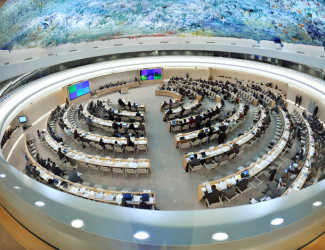
A general view of participants at the 16th session of the Human Rights Council in Geneva, Switzerland.

Analyses Spéciales

L´AWID est une organisation féministe mondiale qui consacre ses efforts à la justice de genre, au développement durable et aux droits humains des femmes

Conseil des Droits de l'Homme (CDH)

​​​​​​Le Conseil des droits de l'homme (CDH) est un organe intergouvernemental clé du système des Nations Unies, responsable de la promotion et la protection des droits humains autour du globe. Il se réunit  trois fois par an en session ordinaire, en Mars, Juin et Septembre. Le Bureau du Haut-Commissariat des Nations Unies aux Droits de l’Homme (HCDH) constitue le secrétariat pour le CDH.

Le CDH :

  • Débat et adopte des résolutions sur les questions globales des droits humains ainsi que sur la situation des droits humains dans des pays particuliers

  • Examine les plaintes des victimes de violations des droits humains et des organisations activistes, au nom des victimes de violations des droits humains

  • Nomme des experts indépendants (que l'on connaît sous le nom de « Procédures Spéciales ») pour réviser les cas de violation des droits humains dans des pays spécifiques, ainsi que pour examiner et suivre des questions globales relatives aux droits humains

  • Prend part à des discussions avec les experts et les gouvernements sur les questions de droits humains

  • Évalue les bilans des États membres de l'ONU en matière de droits humains tous les quatre ans et demi, dans le cadre de l'examen périodique universel.

En savoir plus sur le CDH


Session actuelle: CDH 44

La prochaine session du CDH a lieu à Genève, en Suisse, du 30 juin au 17 juillet 2020.

AWID travaille avec des partenaires féministes, progressistes et du domaine des droits humains pour partager nos connaissances clé, convoquer dialogues et évènements avec la société civile, et influencer les négociations et les résultats de la session.
Avec nos partenaires, notre travail consiste à :


◾️ Suivre, surveiller et analyser les acteurs, discours et stratégies anti-droits et leur impact sur les résolutions du CDH.

◾️ Co-développer un plaidoyer collectif pour contrer les acteurs anti-droits et discuter plus en détails les résultats du Rapport de tendances 2017 du OURs

◾️ Soutenir, coordoner et développer de manière collaborative le Caucus féministe qui émerge au CDH.


Contenu lié

Forum anchors (Forum page)

Points d’ancrage thématiques

Le Forum de l’AWID s’articulera autour de 6 sujets interconnectés. Ces ‘points d’ancrage’ sont centrés sur les réalités féministes. 

Explorer

Main image
cfa_header_v8.2.png
Body

Anti-Rights Tactics, Strategies, and Impacts

Chapter 5

Anti-rights actors adopt a double strategy. As well as launching outright attacks on the multilateral system, anti-rights actors also undermine human rights from within. Anti-rights actors engage with the aim of co-opting processes, entrenching regressive norms, and undermining accountability.

Photo-OP // the first anniversary of the EU signature to the Council of Europe Convention to prevent and combat gender-based violence and domestic violence, the so-called Istanbul Convention
© ALDE Group/Flickr
Photo-OP // the first anniversary of the EU signature to the Council of Europe Convention to prevent and combat gender-based violence and domestic violence, the so-called Istanbul Convention

Anti-rights actors’ engagement in international human rights spaces has a principal purpose: to undermine the system and its ability to respect, protect and fulfill human rights for all people, and to hold member states accountable for violations. Some anti-rights tactics operate from outside the UN and include delegitimization and political pressure to defund the UN, or to withdraw from international human rights agreements.  In recent years, anti-rights actors have also gained increasing influence inside the UN. Their inside tactics include training of delegates, distortion of human rights frameworks, watering down human rights agreements, infiltrating NGO committees, applying for ECOSOC status under neutral names, infiltrating youth spaces, and lobbying to place anti-rights actors in key positions.

Table of Contents

  • Institutionalization of Anti-rights Actors in UN Mechanisms
  • Opting-out and Delegitimization
  • Lowering HR Standards
  • Co-optation - Building a Parallel HR Framework
  • Exercise: Yes, they are strong, but so are we!
  • Exercise: Holding Governments Accountable
     

Read Full Chapter >

Могу ли я связаться с кем-либо, если у меня возникнут вопросы?

Если у вас есть какие-либо вопросы или сомнения, пожалуйста, свяжитесь с нами через форму здесь, указав «Опрос «Где деньги?» (WITM Survey) в качестве заголовка вашего сообщения. или напишите нам по адресу witm@awid.org

Dilma Ferreira Silva

Dilma Ferreira Silva était une activiste de premier plan des droits amazoniens qui s’est battue durant plusieurs décennies pour les droits des personnes affectées par les barrages.

Elle faisait elle-même partie des 32 000 personnes déplacées par Tucuruí, un imposant barrage hydroélectrique, construit au Brésil sous la dictature militaire de 1964-1985. 

En 2005, Dilma a été invitée à rejoindre le Mouvement des personnes affectées par les barrages (MAB) au Brésil et, en 2006, elle y a formé un collectif de femmes pour finir ensuite par devenir coordonatrice régionale du mouvement.

Évoquant son activisme, ses collègues racontent :

« Elle se distinguait très rapidement car elle n’avait jamais peur dans la lutte. » 

Dilma vivait dans la localité rurale de Salvador Allenda, à 50 kilomètres de Tucuru. Elle a dédié sa vie à mieux protéger les communautés et les territoires affectés par la construction d’énormes projets. Elle était particulièrement préoccupée par l’impact de genre de ce type de projets et plaidait pour les droits des femmes.

Lors d’une réunion d’ordre national du MAB en 2011, Dilma évoqua les femmes affectées par les barrages, soulignant :

« Nous sommes les réelles Marias, guerrières, combattantes ici, nous nous confrontons au défi de la lutte quotidienne. »    

Au cours des années suivantes, Dilma a organisé des groupes de terrain du MAB et travaillé avec les communautés pour former des coopératives paysannes qui permirent de mieux distribuer la nourriture au sein des communautés. Ensemble, elles ont amélioré la commercialisation de la pêche et développé un projet de citerne pour un accès à l’eau potable. Elle défendait aussi les agriculteurs·rices dont les terres étaient convoitées par les « grileiros » (personnes qui s’approprient les terres).

Le 22 mars 2019, à l’âge de 48 ans, Dilma, son mari et leur ami·e furent violemment assassiné·e·s. Ces trois meurtres s’inscrivirent dans une vague de violences en Amazonie contre les Movimento dos Trabalhadores Sem (mouvements des travailleurs·ses sans terre) et les activistes écologistes et autochtones.


Snippet FEA Principles of work Education and Learning (EN)

A pile of books in a pink cover and black graduation cap on top.

EDUCATION AND CONTINUOUS LEARNING

FR Editor's note

Editor's note

Feminist Realities is a warm and caring invitation, a kind of en masse-care (versus self-care) act of preservation, an invitation to archive, to take stock of all the work lest it disappear. (...)

Read

Body

La historia de Crear, Résister, Transform por Coumba Toure

Una experiencia mágica de narración feminista conducida por la feminista panafricana Coumba Toure, quien actuará en la antigua tradición de lxs griots de África Occidental.

Y nos reunimos nuevamente
Juntamos nuestras historias, nuestra fuerza
nuestras canciones
nuestras lágrimas
nuestra ira
nuestros sueños
nuestro éxito
nuestros fracasos
Y lo colocamos todo junto
en un gran cuenco para compartir
durante una luna de pensamientos
Y nos mantenemos en contacto
nos sacudimos las mentes unas a otras
nos acariciamos las almas 
mientras nuestras manos siguen atadas
y nuestros besos y abrazos están prohibidos
Sin embargo, nos hacemos más fuertes cada hora
entretejiendo juntas nuestras voces
cruzando las barreras del sonido
mientras hablamos en lenguas
 
Nuestras voces son cada vez más altas
Sabemos lo que nos diferencia de otras personas
y entre nosotras, de modo que
estamos bordando nuestras bellezas en un mosaico de pensamientos
desde nuestros aprendizajes más profundos, desde nuestros poderes
A veces nos rodea el terror
la confusión, la deshonestidad
pero nos lavamos en el océano de amor
Somos tejedoras de sueños
para vestir nuestro nuevo mundo
hilo por hilo
tan pequeñas como somos
como pequeñas hormigas construyendo nuestro movimiento
comopequeñas gotas construyendo nuestros ríos
Damos pasos hacia adelante y pasos hacia atrás
bailando nuestro camino de vuelta a la cordura
Sostenemos el ritmo de nuestros corazones: sigan
latiendo, por favor, no se detengan
Y aquí estamos, transmisoras de generosidad olvidada
gota tras gota creciendo como el océano
creciendo como el río que fluye de nuestras almas
mostrando nuestra fuerza para ser el agua
que limpiará este mundo
y nos estamos reuniendo nuevamente ¿pueden sentirnos?
Mentiría si dijera que para mí
está bien no verlas, extraño a mi gente
Extraño su contacto y
sus voces sin filtro y sin registro
Extraño nuestros susurros y nuestros alaridos
nuestros gritos de la revolución abortada
Solo queremos parir nuevos mundos
Entonces luchemos para borrar las fronteras entre nosotras
Por favor, no se detengan

AWID Community Blurb

Join our online community!

The AWID Community is an online social networking platform specifically for AWID. It is a feminist space for connection, resistance and celebration. A space for critical feminist conversations, collective power and solidarity. It is also a space for post-event dialogues, navigating difficult political learnings and community care.

Join AWID membership to be part of the AWID Community today.

Carol Thomas

Carol Thomas was a trailblazer for women’s sexual and reproductive rights in South Africa. A gifted gynecologist and founder of the WomenSpace, she practiced and advocated for non-traditional ways of delivering healthcare to women, offering services that were high quality, empathetic and accessible.

“She entered into not only the joy of pregnancies and new babies, but the anxieties of infertility and premature deliveries and female cancers, the heartbreak of miscarriages and stillbirths.” Helen Moffett

Carol thought in new paradigms that centered the needs of women with the least access to services and rights in society:

“The prevailing socio-economic environment that we find ourselves in means that women bear a disproportionate burden of disease and unemployment…As a black, previously disadvantaged woman I have a good sense of what is happening in our communities.” - Carol Thomas

Carol’s innovative and multi-award-winning social venture “iMobiMaMa” used mobile kiosks and interactive technology to connect women directly with antenatal and reproductive health services, information and support in communities all over South Africa.

Carol supported women both in wanted and unwanted pregnancies, mentoring many nurses and doctors during her lifetime.

She was also described as the go-to gynecologist “for trans folks who could have affirming care. She got it right when so many did not have the language or pronouns. Her warm blankets, listening and saying just what you needed to hear was so comforting.” -Marion Lynn Stevens

Carol Thomas was described as being at the height of her professional career when she died on 12 April 2019 of complications following a double lung transplant.

The tributes that poured in following her unexpected death referred to her as many things:

“a role model, warrior woman, innovator, dynamic leader, mould-breaker, dynamo, brilliant scientist, compassionate doctor.”

Undoubtedly, Carol Thomas will be remembered and honored for being all of this and much more.

Snippet FEA Story 1 Maps Economies of Care (ES)

Los mapas de Brasil en blanco, España en amarillo mostaza y Colombia en rosa sobre un fondo color vino o burdeos.

FRMag - My queer Ramadan

Mi ramadán queer

por Amal Amer

Rezo con mi familia por primera vez en seis años envueltx en un keffiyah que recogí de un contenedor de basura. (...)

Leer

arte: «Angels go out at night too» [Los ángeles también salen de noche], Chloé Luu >

MANGO

Jurema Araújo Portrait

Jurema Araújo is a teacher-poet from Rio de Janeiro. She contributed to the magazine Urbana, edited by the poets Brasil Barreto and Samaral (RIP) and to the book Amor e outras revoluções (Love and Other Revolutions) with several other writers. In collaboration with Angélica Ferrarez and Fabiana Pereira, she co-edited O livro negro dos sentidos (The Black Book of Senses), a creative anthology on black women’s sexuality in Brazil. Jurema is 54-years-old; she has a daughter, three dogs, a cat, and many friends.

Mango Cover

Suck it with me? 

Mango is my favorite fruit.
I open my mouth
and suck it all,
Its flesh caught between my teeth
that turn soft not to hurt it
and I press it between my tongue and the roof of my mouth,
then I take it out to suck on every part of it
with the juice running down my mouth
drenching myself in this tasty nectar
and putting it all in my mouth again
because mango is seed and honey;
it is fiber and flavor.
And when it is over, I am entranced,
honeydewed, sweetened,
my lips all wet.
Ohhh, what is mango for if not for smearing.

Chupa Comigo? 

A fruta que eu mais gosto é manga!
Porque eu abro a boca
E meto toda pra chupar!
Se os dentes a prendem
Fazem macio para não machucar
E eu pressiono entre minha língua e meu céu
Depois tiro pra sugar cada parte
Sentindo o caldo escorrer boca afora
Me molhando com esse néctar gostoso
E metendo toda na boca de novo
Pois manga é caroço e é mel,
É fiapo e sabor
E quando acaba, estou extasiada
Melada, docinha
Com os lábios molhados!
Aaahhh, manga é pra se lambuzar!


Introducing The Black Book of Senses

I’ll admit it: when Angélica and Fabi invited me to curate a collection of erotic texts by black women, I didn’t know what curatorship was. I understood the erotic well, but curatorship... I smiled, feeling shy and flattered. I think I thanked them – at least I hope I did – and thought to myself: what the fuck is it?! This fancy word I’ll have to learn the meaning of while doing it, what is it?

Now at this point, I know what it is to be a curator: it is making love with someone else’s texts, with someone else’s art, with the intention of putting a book together. And that is exactly what I did. I undressed each text of every author of this book with a literary lasciviousness. And I got involved in the words and senses of others. I was penetrated by poems I didn’t write; tales I didn’t even dare to imagine turned me upside down, messing with my feelings, with my libido. And it was a wonderful and unusual orgasm: ethereal, corporeal, sublime, at once intellectual and sensitive.
These texts pulsated like a clit hardened by desire, drenched, dripping joy in every reading. Words that swallowed me with their naughty significance, making me dive deeper into this wet universe. 

These black women went to the bottom of their arousals and turned their deepest erotic fantasies into art. These works are impregnated with each writer’s own way of experiencing sexuality: freely, blackly, for ourselves, in our own way, empowered.

I chose to spread the texts throughout different parts of the book, each one organized according to the most delicate, explosive, evident, or implicit content they presented.

To open the door to this “invulved blackessence,” we have our Preliminaries section, with texts that introduce readers to this world of delights. It is a more general, delicate caress to acknowledge the subjects addressed by the texts in the rest of the book.

Then comes the heat of Touch, addressing what the skin can feel. That energy which burns or freezes our bodies, makes our hormones explode and starts to awaken the other senses. And although there are many of us who are voyeurs, the contact of skin with a wet and warm mouth is exciting, like wandering through the softness of whomever is with you. We are seduced by the firm or gentle touch that gives us goosebumps and that lovely discomfort that runs from the neck down to the back and only stops the next day. And the warmth of the lips, the mouth, the wet tongue on the skin – oh, the tongue in the ear, hmmm – or skin on skin, clothes moving over the body, almost like an extension of the other’s hand. If there is no urgency, that wildest arousal of the pressure of a tight grab, a bit of pain – or a lot, who knows?

The Sound – or melody? – section shows us that attraction also happens through hearing: the voice, the whispers, the music that enables the connection between the bodies and can become the theme of desire. For some of us, someone with a beautiful voice would only need their vocal cords, because that harsh or heavy or melodious sound would be auditory sex. Their loud swearing or sweet words whispered in the ear would be enough to give us hair-raising shivers from neck to coccyx.

Decorative element


In Flavor, we know the tongue does a good job tasting the most hidden places and wandering through the body to delight itself. Sometimes this organ is used, boldly, to taste the other’s nectar. The idea of someone sharing their strawberry or a delicious, juicy mango through bites and licks – or licks and bites – melts us. But nothing is more delicious than tasting the caves and hills of the person you are with. Stick your tongue deep inside to taste a piece of fruit... or spend hours tasting the head of a cock in your mouth, or suck on a delicious breast to taste the nipples. This is all about memorizing someone by their Flavor.

There are texts in which the nose is what triggers desire. The Smell, my dear readers, can awaken us to the delights of desire. Sometimes we meet a person who smells so good, we want to swallow them right through our nose. When you run through the other person’s body with your nose, starting with the neck – wow, that delightfully uncomfortable shiver that runs down the spine and undresses the soul! The shameless nose then moves to the back of the neck and captures the scent of the other in such a way that in the absence of that person, smelling their same scent evokes, or conversely, invades in us olfactory memories that bring the arousing smell of that person back.

We then get to Look – for me, the betrayer of senses – in which we perceive desire from a point of “view.” It is through sight that the texts present desire and arousal, through which the other senses are brought about. Sometimes a smile is all it takes to drive us crazy. The exchange of glances? That look that says “I want you now.” That look of possession that comes to an end when you stop fucking, or not. That one is very particular; it draws the other who won’t be able to look away for long. Or the sidelong glance – when one looks away when the other turns their head, like a cat-and-mouse game? Once we are caught red-handed, there’s nothing else to do besides breaking into a wide smile.

Finally, the explosion. Wandering through All senses, the texts mix feelings that seem like an alert, so there is the greatest pleasure, that orgasm.

Of course, there is nothing explicitly separating these poems and tales. Some are subtle. Arousal engages all our senses and, most importantly, our heads. That’s where it happens, and it connects our whole body. I organized the poems according to how they came to me in each reading. Feel free to disagree! But to me, there is a sense through which desire goes and then explodes. Realizing which one it is, is delightful. 

Being able to turn arousal into art means freeing ourselves from all the prejudice, prisons, and stigma this white-centric society has trapped us in.

Every time a black writer transforms the erotic into art, she breaks these harmful racist chains that cripple her body, repress her sexuality, and turn us into the object of another’s greed. Writing erotic poetry is taking back the power over her own body and roaming fearlessly through the delights of desire for herself, for others, for life.

The literary erotic is who we are when turned into art. Here we show the best of us, our views of love drenched by pleasure, seasoned by the erogenous, spread through our bodies, and translated by our artistic consciousness. We are multiple and we share this multiplicity of sensations in words dripping with arousal. Yes, even our words drip with our sexual desire, drenching our verses, turning our sexual urges into paragraphs. To come, for us, is a breakthrough.

It is necessary to make our minds, bodies, and sexuality black, to reestablish our pleasure, and take back our orgasms. Only then will we be free. This whole process is a breakthrough, and it happens painfully. But there is happiness in finding ourselves to be very different from where we had been placed. 

I feel like I am yours, I am ours. Taste, delight yourselves, feast on these beautiful words with us. 


This text is adapted from the introductions to “O Livro Negro Dos Sentidos” [The Black Book of Senses], an erotic collection of poems by 23 black female writers.
 

Cover image for Communicating Desire
 
Explore Transnational Embodiments

This journal edition in partnership with Kohl: a Journal for Body and Gender Research, will explore feminist solutions, proposals and realities for transforming our current world, our bodies and our sexualities.

Explore

Cover image, woman biting a fruit
 

التجسيدات العابرة للحدود

نصدر النسخة هذه من المجلة بالشراكة مع «كحل: مجلة لأبحاث الجسد والجندر»، وسنستكشف عبرها الحلول والاقتراحات وأنواع الواقع النسوية لتغيير عالمنا الحالي وكذلك أجسادنا وجنسانياتنا.

استكشف المجلة

Snippet - Blog post Quote_FR

« Poursuivons notre dynamique de solidarité, d’espoir et d’imagination radicale. »

- Beijing+30 et la CSW : adopter une lecture féministe des multiples défis de notre époque

Lisez l’article ici

Mereani Naisua Senibici

Mereani Naisua Senibici, también llamada "Sua", fue, durante mucho tiempo,  integrante del movimiento de la Asociación Cristiana de Mujeres Jóvenes de Fiji (YWCA, por sus siglas en inglés).

Trabajó con diversos grupos de mujeres en entornos multirraciales, rurales y urbanos y se comprometió a apoyar y promover los derechos de las mujeres y las jóvenes.

En el YWCA de Lautoka, Sua trabajó con mujeres de ascendencia india, y se convirtió en  una figura destacada en el desarrollo del deporte y de la participación de atletas mujeres y personas trans en Lautoka.

"Sua es muy querida por lxs integrantes del YWCA de Fiji, a causa de su dedicación y apoyo persistente a todo lo que la organización se ha esforzado por hacer". - Tupou Vere

Mereani formaba parte de House of Sarah [La Casa de Sarah] (HoS, por sus siglas en inglés ), una iniciativa de la Asociación de Mujeres Anglicanas (AAW), lanzada en 2009, que tenía por objetivos tanto sensibilizar sobre los problemas relacionados con la violencia de género, como brindar apoyo a las mujeres que sufren violencia. Mereani empezó como una voluntaria comprometida y ofreció apoyo a las mujeres de todo el Pacífico.

Mereani falleció en 2019.

"Una persona  con don de gente y  una trabajadora todoterreno en el empoderamiento de las mujeres y construcción de movimientos a nivel comunitario. Descansa en paz, Sua". - Tupou Vere

Snippet - That Feminist Fire Logo (FR)

Texte blanc qui dit le titre de notre podcast en français : Notre flamme féministe