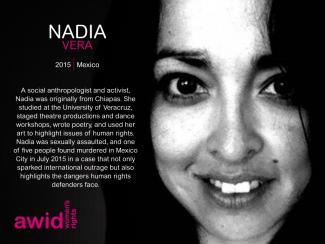
Nadia Vera

Les jeunes activistes féministes jouent un rôle crucial au sein des organisations et des mouvements pour les droits des femmes à travers le monde. Ce sont elles qui soulèvent les nouveaux problèmes auxquels les féministes sont confrontées aujourd'hui. Leur force, leur créativité et leur adaptabilité sont vitales pour assurer la viabilité des organisations féministes.
Pourtant, elles sont confrontées à toute une série d’obstacles particuliers, notamment l'accès limité au financement et au soutien, le manque de possibilités de renforcement des capacités et une augmentation considérable des agressions sur les jeunes défenseuses des droits humains. Ces obstacles entraînent un manque de visibilité qui rend leur intégration et leur participation effective au sein des mouvements pour les droits des femmes encore plus difficiles.
Le Programme d’activisme des jeunes féministes de l'AWID a été mis en place pour veiller à ce que les voix des jeunes femmes soient entendues et représentées dans le discours féministe. Nous voulons faire en sorte que les jeunes féministes aient un meilleur accès à du financement, à des opportunités de renforcer leurs capacités et aux processus internationaux.
En plus de soutenir directement les jeunes féministes, nous travaillons également avec des activistes des droits des femmes de tout âge pour élaborer des modèles et des stratégies d’organisation multigénérationnelles plus efficaces.
Nous souhaitons que les jeunes féministes puissent jouer un rôle actif dans les prises de décisions qui concernent leurs droits. Nos actions incluent :
Favoriser la mise en commun et le partage d'informations par la Plateforme de jeunes féministes. Étant donné l'importance des médias en ligne pour le travail des jeunes féministes, notre équipe a lancé la Plateforme de jeunes féministes en mai 2010. Elle a pour objectifs d’échanger des renseignements, de renforcer les capacités des membres par le truchement de webinaires et de discussions en ligne, et d'encourager la consolidation d’une communauté de jeunes féministes.
Soutenir la recherche et le renforcement des connaissances sur l'activisme des jeunes féministes, pour accroître la visibilité et l'influence de leur activisme au sein et entre les mouvements pour les droits des femmes et auprès d'autres acteurs-trices clés, tels les donateurs.
Faire la promotion de la collaboration multigénérationnelle, en explorant de meilleures façons de travailler ensemble.
Inciter les jeunes féministes à s’engager dans les processus internationaux relatifs au programme de développement, notamment ceux des Nations Unies.
S’assurer leur collaboration dans tous les domaines prioritaires de l'AWID, y compris le Forum, pour faire en sorte que leurs contributions, leurs perspectives, leurs besoins et leur activisme se traduisent dans les débats, les politiques et les programmes qui les concernent.
Cómo los movimientos resisten las agendas fascistas en relación con el cambio climático.
📅 Martes 11 de noviembre de 2025
📍 Hotel Beira Rio, Belém, Pará
Please calculate your costs of travel to Bangkok, accommodations and per diem, visa, any accessibility needs, and incidentals, on top of a registration fee that will be announced soon. Hotels in the Sukhumvit area in Bangkok range from USD$50 to $200 per night, double occupancy.
AWID members receive a discount at registration, so if you are not a member yet, we invite you to consider becoming a member and joining our global feminist community.
Un réseau complexe et mouvant d’antidroits exerce une influence croissante dans les sphères internationales et les politiques locales. Souvent soutenu·e·s par des financements d’origine imprécise, ces acteur·rice·s renforcent leur impact en créant des alliances tactiques entre thématiques, régions et croyances.
Across the world and social movements, those who want to innovate tend to feel lonely and powerless before the ‘movement status quo’. Historically, the AWID Forums have played a role in supporting these innovators by offering them a platform where their ideas and practices are welcomed and strengthened by the thoughts and actions of others – in different regions and communities – who have already explored them. Sara Abu Ghazal, Palestinian feminist in Lebanon, tells the story of what the Forums meant for a new generation of feminists in the MENA (Middle East and North Africa) region that introduced new ways of organising, new understandings of feminism and new issues to the regional women’s rights landscape.
Manifestations mondiales des mouvements pour la justice climatique.
📅 Samedi 15 novembre 2025
📍 Lieux multiples
Site web en anglais
Somos plenamente conscientes de los obstáculos prácticos y la angustia emocional asociada con los viajes internacionales, especialmente desde el Sur Global. AWID está trabajando con la Oficina de Convenciones y Exhibiciones de Tailandia para brindar apoyo a lxs participantes del Foro en la obtención de visas. En el momento de la inscripción se facilitará más información sobre esta ayuda para la obtención de visados, incluidos los datos de contacto para saber dónde y cómo solicitarla.
Follow our feminist superhero as she reclaims the narrative from anti-rights actors across the globe and saves the day, in this comic by illustrator Sophia Andreazza.

Cette politique régit toutes les pages hébergées sur le site www.awid.org, et tout autre site web géré par l'AWID, ainsi que les pages d’inscription à ces sites. Elle ne s'applique pas aux pages hébergées par des organisations autres que l'AWID auxquelles nous pouvons nous associer, et dont les politiques de confidentialité peuvent différer. Veuillez lire le document suivant pour comprendre notre politique de confidentialité concernant la nature, le but, l'utilisation et le partage de vos données personnelles collectées via ce site web.
D’une manière générale, vous pouvez naviguer sur ce site web sans nous soumettre vos informations personnelles. Cependant, dans certaines circonstances, nous vous demanderons de nous fournir certaines données personnelles.
Lorsque vous êtes sur le site web et que nous vous demandons des données personnelles, ces informations ne sont pas partagées en dehors de l’AWID.
1.1.1 Les données que vous fournissez pour obtenir des mises à jour de l'AWID :
Lorsque vous vous inscrivez pour avoir accès au site web - par exemple, que vous vous abonnez pour recevoir des courriels de notre part ou que vous demandez à devenir membre – nous vous demandons de fournir des données personnelles telles que votre nom, pays, langue, courriel pour recevoir les mises à jour. Vous nous transmettez ces informations grâce à des formulaires sécurisés et elles sont stockées sur des serveurs sécurisés.
1.1.2 Les données de paiement que vous envoyez pour devenir membre ou vous inscrire à un événement :
En devenant membre ou en vous inscrivant à des événements, vous devrez peut-être également fournir des données de paiement. L’AWID ne stocke aucune information de carte de crédit sur ses serveurs et utilise des systèmes de paiement sécurisés pour traiter ces informations.
1.1.3 Les informations facultatives que vous avez choisi de nous fournir (avec votre consentement) :
Lorsque vous communiquez avec l’AWID ou que vous fournissez des informations facultatives via des formulaires en-ligne ou utilisez le site pour communiquer avec d'autres membres, nous recueillons ces informations et toute information que vous choisissez de donner.
1.1.4 Les données que nous recueillons via des formulaires de contact ou lorsque vous communiquez directement avec nous :
Lorsque vous communiquez avec nous, nous recueillons ces données ainsi que toute autre information que vous choisissez de nous fournir.
Nous collectons et stockons également certaines autres informations concernant l'utilisation de notre site web par nos utilisateurs-trices afin que des tiers puissent nous fournir des rapports et des analyses concernant l'utilisation et les modes de navigation des utilisateurs-trices.
Pour plus d'informations sur les cookies, veuillez consulter la page suivante : www.allaboutcookies.org/fr/.
Si vous ne souhaitez pas recevoir de cookies, vous pouvez facilement modifier le paramétrage de votre navigateur web pour refuser de recevoir des cookies, ou pour demander d’être informé-e lorsque vous recevez un nouveau cookie. Cliquez ici pour voir comment procéder.
L'AWID utilise les informations collectées à propos de vous pour :
Si vous vous êtes abonné-e aux bulletins électroniques de l'AWID ou à des mises à jour par courrier électronique ou si vous êtes devenu-e membre, nous vous enverrons régulièrement des informations, ainsi qu’indiqué dans la section correspondante du site web. Vous pouvez vous désabonner à tout moment des bulletins électroniques ou des mises à jour par courriel en suivant les liens vers les informations de désabonnement incluses dans nos courriels.
L'exactitude des données vous concernant personnellement est importante pour l'AWID. Nous sommes en permanence à la recherche de moyens pour vous faciliter l’accès aux données que l'AWID conserve à votre sujet via notre site web et à la possibilité et les modifier. Si vous changez votre adresse e-mail, ou si l'une des autres informations que nous détenons est inexacte ou n’est plus d’actualité, merci de nous contacter ici.
Si vous avez consenti à ce que l’AWID utilise vos données personnelles, vous pouvez néanmoins changer d’avis à tout moment en nous contactant et en spécifiant l’autorisation que vous annulez. Veuillez noter que le retrait de votre consentement n'affecte pas la légalité des activités de traitement basées sur ce consentement avant son retrait.
Excepté dans le cas détaillé ci-dessous, l'AWID ne divulgue aucune de vos informations personnelles et ne vend ni ne loue des listes contenant vos informations à des tiers. L'AWID peut divulguer des informations quand elle a votre permission de le faire ou dans des circonstances particulières, par exemple lorsqu’elle croit de bonne foi que la loi l'exige.
Nous mettons continuellement en œuvre et mettons à jour les mesures de sécurité administratives, techniques et physiques afin de protéger vos données contre tout accès non autorisé, perte, destruction ou altération de celles-ci. Certaines des mesures de protection que nous utilisons pour protéger vos informations sont les pare-feu, le cryptage des données et les contrôles d'accès aux informations. Si vous savez, ou avez des raisons de croire, que vos informations d'identification AWID ont été perdues, volées, détournées ou autrement compromises, ou en cas d'utilisation non autorisée réelle ou suspectée de votre compte d'adhésion à l’AWID, veuillez nous contacter.
Cette politique est susceptible d’être modifiée de temps à autre. La dernière version de la politique sera postée sur notre site web, ainsi que la date de sa dernière mise à jour. En cas de modification(s) apportées à cette politique, vous recevrez une mise à jour par courriel. Au cas où vous ne seriez pas d'accord avec la politique ainsi révisée, vous aurez la possibilité d'annuler votre (vos) abonnement(s) chez nous. N’hésitez pas à nous contacter. Tous vos commentaires au sujet de cette politique sont les bienvenus !
Dernière mise à jour : mai 2019
Nous reprendrons contact avec les anciens partenaires pour nous assurer que les efforts passés sont honorés. Si vos coordonnées ont changé depuis le dernier Forum, merci de nous les communiquer afin que nous puissions vous joindre.
Cuando el trabajo de nuestros cuerpos se convierte en ganancias en las manos de los sistemas que buscamos desmantelar, no sorprende que nuestras sexualidades y placeres queden relegados una vez más a las márgenes, especialmente cuando no son lo suficientemente rentables. En muchos momentos durante la producción de este número, nos preguntamos qué sucedería si nos negáramos a dar cabida a los servicios esenciales del capitalismo.

This calendar is a gift to our global feminist community. It is our promise of future connection and movement moments in the year to come. This past year has seen unspeakable injustices. We welcome a new year full of powerful movement spirit, of hopeful solutions and strategies. For a more just world for all.
As you flip through the pages note the diversity of art from our artist members who use their work to amplify and interlink our different movements under the feminist umbrella. Do you see yourself, your movement, your communities in these pages? We encourage you to use this calendar as a practical tool to mark time and space, but also to pencil in occasions to connect with feminists and activists.
This calendar invites us to immerse ourselves in the inspiring world of feminist artistry. Each month, as it gently unfolds, brings forth the vivid artwork of feminist and queer artists from our communities. Their creations are not mere images; they are profound narratives that resonate with the experiences of struggle, triumph, and undying courage that define our collective quest. These visual stories, bursting with color and emotion, serve to bridge distances and weave together our diverse experiences, bringing us closer in our shared missions.
We have partnered with Global Voices for a special series of pieces for Pride Month 2023 (include music, video, and stories!) engaging with the intersectional issues that queer individuals and communities face around the world.
con Vandana Shiva, Dilar Dirik y Nana Akosua Hanson
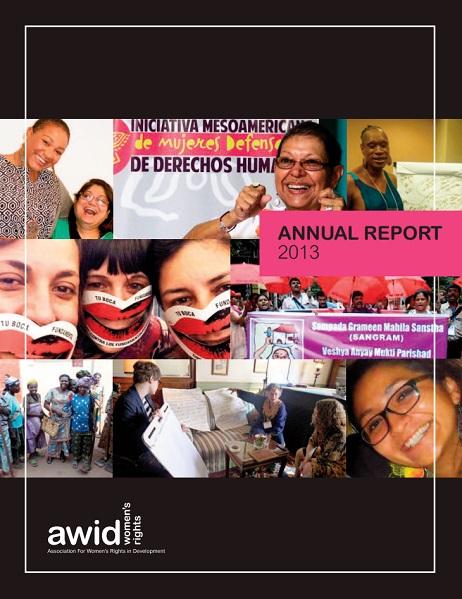
2013 marked the beginning of our 2013-2016 Strategic Plan, developed in response to the current global context. This report provides highlights of our analysis of the global context, how we position ourselves as a global feminist membership organization in this context, the outcomes we seek to achieve, and how our work is organized to achieve these outcomes.