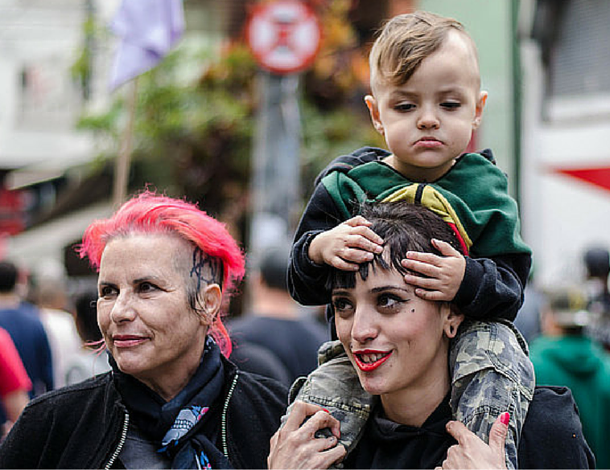
Flickr/Leonardo Veras (CC BY 2.0)

Análisis Especiales

AWID es un organización feminista internacional de membresía, que brinda apoyo a los movimientos que trabajan para lograr la justicia de género y los derechos de las mujeres en todo el mundo.

Protección de la familia

El contexto

Esta sección de análisis especial ofrece un análisis feminista crítico y acceso a los recursos clave relacionados con la «protección de la familia» en los espacios internacionales de derechos humanos.

Durante los últimos años, venimos observando una nueva y preocupante tendencia en el ámbito internacional de derechos humanos, donde se están empleando discursos sobre la «protección de la familia» para defender violaciones cometidas contra miembros de la familia, de modo de reforzar y justificar la impunidad y para coartar la igualdad de derechos en el seno de la familia y la vida familiar. 

La campaña para «proteger a la familia» es impulsada por proyectos conservadores que tienen como fin imponer interpretaciones «tradicionales» y patriarcales de familia; quitando los derechos de las manos de sus miembros para ponerlos en las de la institución «familia».

Los proyectos de «protección de la familia» tienen su origen en los siguientes fenómenos:

  • el auge del tradicionalismo,
  • el auge del conservadurismo cultural, social y religioso, y
  • posturas hostiles a los derechos humanos de las mujeres, los derechos sexuales, los derechos de las niñas y los niños y los derechos de las personas con identidades de género y orientaciones sexuales no normativas.  

Desde 2014 un grupo de estados opera como bloque en espacios de derechos humanos, bajo el nombre «Group of Friends of the Family» [Grupo de amigos de la familia], y a partir de entonces se han aprobado resoluciones sobre la «Protección de la familia» todos los años.

Esta agenda se ha extendido más allá del Consejo de Derechos Humanos (HRC, por sus siglas en inglés).  Hemos visto cómo el lenguaje regresivo sobre «la familia» se ha introducido en la Comisión de la Condición Jurídica y Social de las Mujeres (CSW, por sus siglas en inglés), y hemos asistido a intentos por incluir este lenguaje en las negociaciones sobre los Objetivos de Desarrollo Sostenible.


Nuestro enfoque

AWID trabaja con asociadxs y aliadxs para resistir conjuntamente las agendas regresivas de «Protección de la familia» y otras, y para defender la universalidad de los derechos humanos.

En respuesta a la creciente influencia de actores regresivos en los espacios de derechos humanos, AWID se ha unido con aliadxs para formar el Observatorio de la Universalidad de los Derechos (OURs, por sus siglas en inglés).  OURs es un proyecto colaborativo que monitorea, analiza y comparte información sobre iniciativas anti-derechos tales como la «Protección de la familia».

Derechos en Riesgo, el primer informe de OURs, traza un mapa de los actores que conforman el cabildeo global anti-derechos e identifica sus discursos y estrategias principales, señalando los efectos que estos discursos y estrategias están teniendo sobre nuestros derechos humanos.

El informe expone a la «Protección de la familia» como una agenda que ha promovido la colaboración entre una amplia gama de actores regresivos en las Naciones Unidas. La describe como un marco estratégico que aloja «múltiples posiciones patriarcales y anti-derechos, cuyo marco, a su vez, apunta a justificar e institucionalizar estas posiciones».
Contenido relacionado

14th AWID international Forum is cancelled (forum page)

The 14th AWID International Forum is cancelled

Given the current world situation, our Board of Directors has taken the difficult decision to cancel Forum scheduled in 2021 in Taipei. 

Read the full announcement

2019: Feminist Realities in a changing world

AWID began preparing this annual report just as the global pandemic began to unravel how we gather, organize and live our lives. It is impossible to review what we have done without COVID-19 tinting our assessment. 

Download the full 2019 Annual review


frmagazine cover eng


Co-Creating Feminist Realities is no longer just an AWID Forum theme - it is a rallying cry in response to a pandemic that has laid bare the failures of social, political and economic systems.

It is an urgently needed affirmation that there are other, more just ways of organizing our lives. During 2019 hundreds of groups shared their experiences and proposals for feminist realities with us, ranging from radical networks of community support in Latin America facilitating self-managed abortion, to practices of community-centered economies in Indonesia and community-centered food systems in India and the US, to a  re-imagination and new practice of harm-free rites of passage in Sierra Leone. These are the experiences that will chart a path forward for a “new normal”. 
Yet long histories of oppression and violence can make it difficult to imagine the possible. A key part of our work in 2019 was to spark these explorations through a toolkit AWID launched to support groups interested in unearthing the stories and aspirations that are the building blocks of feminist propositions.

While we focus on our proposals for a different world, we recognize the challenging context around us.

Through the Observatory on the Universality of Rights, Feminists for a Binding Treaty, Count Me In! and other alliances, AWID has continued to push back against unfettered corporate power and fascist and fundamentalist agendas that undermine women’s rights and gender justice. With dim prospects for transformative change through multilateral processes  and limited responsiveness from most states, we are redoubling our efforts  to ensure that feminist movements, in all their diversity, are resourced in ways that match the critical roles they play - supporting their communities, demanding rights and responding to crises. In 2019 we introduced feminist principles and approaches to ground-breaking funds like the Spotlight Initiative and the Equality Fund, and succeeded in leveraging resources through feminist reality seed grant funding from feminist funders.

As we look ahead, it is clear that the context is calling for a transformation of our organizing strategies:

  • we are learning to navigate global advocacy confined to online channels,
  • we grapple with the uncertainty of when and how we can convene in person, and
  • we use the tools at our disposal to tighten connections across local to global spheres.

AWID is embarking on a new membership model that lowers barriers to access and emphasizes opportunities for engagement and cross-member connection. We will continue to experiment with different online tools and processes for building community. Cross-movement engagement will stay at the center of our work. AWID’s actions in solidarity with oppressed movements and identities, even and especially where these are marginalized in feminist movements, are important to drive change and support broad and inclusive movements for all.

Crisis is not new to feminist and social movements.

We are resilient, we adapt, and we show up for each other. And we have to keep doing better. Thank you to all who are part of the journey with us.

Download the full 2019 Annual review

Download the full 2019 Annual review

Реалии обеспечения ресурсами и состояние финансирования феминистских движений быстро меняются – является ли этот опрос единичным?

Нет, не является. Он основан на 20-летней истории AWID по мобилизации более объемного и качественного финансирования для социальных изменений под руководством феминисток(-ов) и является третьим этапом исследования «Где деньги для феминистских организаций?». Наша цель – проводить опрос «Где деньги?» каждые 3 года.

Snippet FEA Principles of Work S4 (ES)

Cuatro manos sosteniéndose por las muñecas, formando un cuadrado.

HORIZONTALIDAD

“Where is the Money for Women’s Rights?" AWID’s WITM Toolkit (landing page intro) ES

Una nueva edición de la investigación "¿Dónde está el dinero?" está actualmente en marcha.

Obtén más información

Manual «¿Dónde está el dinero?» (WITM)

Una metodología de investigación que puedes aplicar tú mismx

Women leaders
© UN Women/Ashutosh Negi (CC BY-NC-ND 2.0) [https://creativecommons.org/licenses/by-nc-nd/2.0/]

AWID presenta este Manual WITM para apoyar a personas y organizaciones que quieran investigar por su cuenta las tendencias en el financiamiento para una región, temática o población en particular, adaptando las metodologías de investigación de AWID.


El Manual WITM de AWID es producto de diez años de experiencia. Las investigaciones de WITM y este Manual son una demostración política y práctica de los recursos y pasos necesarios para realizar investigaciones en acción de buena calidad.

Más información sobre el contexto de la metodología de la investigación WITM

El equipo WITM también ofrece apoyo técnico y político antes y durante el proceso de investigación. Te invitamos a leer el Manual y a ponerte en contacto con nosotras en fundher@awid.org si necesitas más información.

2024: Strengthening Movements, Sustaining Change

From the rising right in many countries and the flurry of funding cuts hitting hard civil society of the Global Majority, to the ongoing genocide in Gaza, the intensification of violent conflicts in Sudan, and climate crisis in many parts of our planet, we are facing real forces of fascism and a world order of impunity. This makes our opportunities to come together and build solidarity particularly valuable and imperative for our survival as a global feminist community. Of course, in 2024, the 15th AWID International Forum finally happened, and what a powerful space it was. 

Download the full 2024 Annual Report


As we look ahead, we build on the powerful calls to action made by feminists at the AWID Forum; Together we can build a world where justice, liberation and care are not aspirations but realities. 

Download the full 2024 Annual Report

Posso entrar em contacto se tiver dúvidas ou questões?

Se tiver alguma dúvida ou questão, entre em contacto connosco através deste formulário, indicando "Inquérito WITM" (WITM Survey) no título da sua mensagem. 

Snippet FEA No feminist economies without feminist unions (FR)

Pas d’économies féministes sans syndicats féministes!

Par le biais de l'organisation syndicale, Sopo, Sabrina et Linda se battent non seulement pour les droits des femmes, des travailleur·euses essentiel·les, des travailleur·euses migrant·e·s et des travailleur·euses du sexe, mais pour les droits de tous·tes les travailleur·euses .

La lutte pour mettre fin à l'exploitation des travailleur·euses est une lutte féministe. C’est pourquoi il n’y a pas d’économies féministes sans syndicats féministes.

FRMag - The Triple (FR)

Les invalides en triple : parlons sexe, chéri !

par Nandini Tanya Lallmon 

Olajumoke « Jay » Abdullahi et Kym Oliver sont des féministes révolutionnaires à plus d'un titre. (...)

Lire

illustration : « Éclose » de Titash Sen >

Isabel Marler

Biography

Isabel est une féministe du Royaume-Uni avec plus d'une décennie d'expérience de réponses féministes aux fascismes, aux fondamentalismes et aux tendances antidroits. À l'AWID, son travail se concentre sur le renforcement des connaissances. Elle a notamment dirigé la production de la série Droits en danger en collaboration avec l'Observatoire sur l'universalité des droits (OUR). Elle est titulaire d’un master en études sur le genre de l’École d’études orientales et africaines (SOAS) et a précédemment travaillé avec Women Living Under Muslim Laws (WLUML). Elle est passionnée par le travail intermouvements, la construction de connaissances centrées sur les mouvements et l’utilisation de l’expression créative pour perturber les systèmes d’oppression. En dehors du travail, Isabel est active dans divers espaces de justice liée au handicap, aux soins collectifs, à l’apprentissage et au plaidoyer.

Position
Responsable de l’initiative de Promotion des Droits Universels et de la Justice
Add to stories
Off

AWID Community Blurb - FR

Rejoignez notre communauté en ligne !

La communauté AWID est une plateforme en ligne de réseautage social conçue tout spécialement pour l’AWID. Espace féministe ayant vocation à connecter, résister et célébrer, c’est un endroit où les conversations féministes critiques, le pouvoir et la puissance du collectif et la solidarité sont à l’œuvre. Cet espace est également ouvert pour dialoguer après les différents événements, pour penser, assimiler, digérer les apprentissages politiques difficiles, et pour prendre soin de la communauté.

Devenez membre de l’AWID pour pouvoir faire partie de la Communauté AWID dès aujourd’hui.

Snippet FEA We are living in a world right (EN)

Even in times of climate crisis, governments continue to encourage large-scale agriculture industries to expand. These activities poison the land, threaten biodiversity, and destroy local food production and livelihoods. Meanwhile, while women produce the majority of our food in the world, they own almost none of the land.

What if we perceived land and Nature not as private property to exploit, but as a whole to live in, learn from, and harmoniously coexist with? What if we repaired our relationships with the land and embraced more sustainable alternatives that nurture both the planet and its communities?

Nous Sommes la Solution (We Are the Solution, NSS) is one of many women-led movements striving to do this. This is their story.

FRMag - Resistance from the Kitchen

Our arepa: Resistance from the Kitchen

by Alejandra Laprea

I live in a country of the impossible, where there are no bombs yet we are living in a war. (...)

Read

artwork: “Entretejidas” [Interwoven women] by Surmercé >