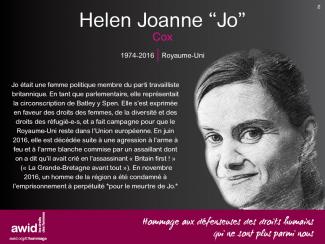
Helen Joanne "Jo" Cox

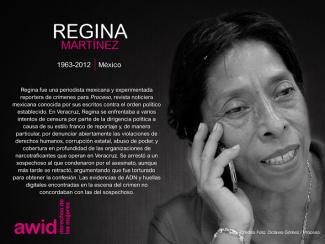
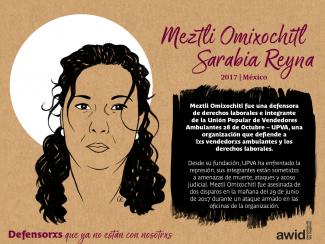
El Tributo de AWID es una exhibición de arte que honra a feministas, a activistas por los derechos de las mujeres y de la justicia social de todo el mundo que ya no están con nosotrxs.
El Tributo de este año cuenta y comparte las historias y narraciones de quienes crearon conjuntamente realidades feministas, ofrecieron visiones de alternativas a los sistemas y actores que nos oprimen, y propusieron nuevas formas de organizarnos, de movilizarnos, de luchar, de trabajar, de vivir y de aprender.
Se agregan a la galería 49 retratos nuevos de feministas y defensorxs de derechos humanos. Aunque muchxs feministas y defensorxs han fallecido debido a edad avanzada o enfermedad, muchísimxs han sido asesinadxs debido a su trabajo y por ser quienes eran.
Esta violencia creciente (de parte de Estados, empresas transnacionales, crimen organizado, sicarios no identificados, etc.) no se dirige solo a activistas individuales sino a nuestro trabajo común y a las realidades feministas.
Visita nuestra exhibición en línea
Lors retratos de 2020 fueron diseñados por la ilustradora y animadora galardonada, Louisa Bertman.
En AWID nos gustaría agradecer a las familias y organizaciones que nos compartieron sus historias personales, y así haber contribuido a este memorial. Nos unimos a ellxs para continuar el extraordinario trabajo de estxs activistas y defensorxs, y en el esfuerzo para asegurarnos de que se logre justicia en los casos que permanecen en la impunidad
"Ellos trataron de enterrarnos pero no sabían que éramos semillas."‐ Proverbio Mexicano
Primero tomó forma como una exposición física de retratos y biografías de feministas y activistas que habían fallecido, en el 12º Foro Internacional de AWID, en Turquía. Ahora vive como una galería en línea, que actualizamos cada año.
Desde 2012 hemos presentado más de 467 feministas y defensorxs.
يمكنك أن تتوقع جميع المواد الأساسية لورش العمل والعروض التقديمية: اللوحات الورقية، والأقلام والملاحظات اللاصقة، بالإضافة إلى أجهزة العرض والمعدات السمعية والبصرية. أي مواد إضافية تقع على عاتق منظمي/ات النشاط. سيكون الفريق اللوجستي التابع لجمعية حقوق المرأة في التنمية متاحًا للإجابة على الأسئلة وتقديم المشورة.
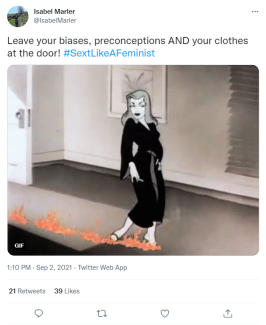
ممنوع الدخول قبل التخلّص من أي شكل من أشكال التحيّز و/أو الأحكام المُسبقة و/أو الاحتشام!
Cette année, notre hommage en ligne met à l’honneur 7 défenseuses des droits humains originaires de différents pays d'Asie du Sud et du Sud-Est. Ces défenseuses ont grandement contribué aux progrès accomplis dans le domaine des droits des peuples autochtones, des droits des femmes et du droit à l'éducation. Ces défenseuses étaient des avocates, des activistes des droits des femmes, des universitaires ou des responsables politiques. Nous vous invitons à vous joindre à nous pour commémorer la vie de ces femmes, leur travail et l’héritage qu’elles nous ont laissé. Faites circuler ces mèmes auprès de vos collègues et amis ainsi que dans vos réseaux et twittez en utilisant les hashtags #WHRDTribute et #16Jours.
S'il vous plaît cliquez sur chaque image ci-dessous pour voir une version plus grande et pour télécharger comme un fichier


Related content
The Guardian: Mexican woman who uncovered cartel murder of daughter shot dead
The Economist: Obituary: Miriam Rodríguez Martínez died on May 10th
New York Times: Gunmen Kill Mexican Activist for Parents of Missing Children
United Nations Human Rights Office of the High Commissioner: Mexico: UN rights experts strongly condemn killing of human rights defender and call for effective measures to tackle impunity

As part of our commitment to engage more deeply with artists and the practice of co-creating Feminist Realities, AWID collaborated with an Artist Working Group to advance and strengthen feminist agendas and realities in their communities and movements through their creative expression. Our intention here is to bring feminist creatives together in a powerful and brave space where they grow and live freely, and where they shatter toxic narratives to replace them with transformative alternatives.
This exhibition gathers the work of artists and collectives from across the globe, those who are actively creating the difference that we want to see in the world. These feminist creatives include Upasana Agarwal, Nicole Barakat, Siphumeze Khundayi, Katia Herrera, Ali Chavez Leeds, Colectivo Morivivi, Ika Vantiani, and the curators behind the #MeToo in China exhibition. Their voices stand strong in their refusal to accept the limitations imposed by patriarchy, and amplify their commitments to the communities they are working in and with. In their own way, each artwork represents daily acts of resistance, untold stories and identities, connections to land and ancestry, and most importantly, the solidarity that exists within and amongst feminist movements and struggles. These artists are both inspired by and inspire creative strategies of feminist resistance and initiatives that show us how we can all live in a more just world - a world that centers care and healing.
Avant d’aborder la méthodologie de recherche WITM, il est important que vous connaissiez les données de base et que vous sachiez à quoi vous attendre.
En ce qui concerne la méthodologie de recherche WITM de l’AWID, nous recommandons d’étudier toute la boîte à outils.
Bien que cette boîte à outils ait été conçue pour démocratiser la recherche WITM, il existe des contraintes en termes de capacités liées à l’expérience de votre organisation dans le domaine des ressources et de la recherche qui pourraient influencer son aptitude à utiliser cette méthodologie.
Utilisez la Fiche de travail « Êtes-vous prêts-tes ? » pour évaluer votre niveau de préparation à mener votre propre recherche WITM. Plus vos réponses aux questions de cette fiche de travail seront nombreuses, plus vous serez capable d’entreprendre votre recherche.
Avant de commencer toute recherche, nous vous recommandons de procéder à l’évaluation des liens que votre organisation a établis avec votre communauté et de la confiance qu’elle inspire.
Dans de nombreux contextes, les organisations pourraient hésiter à partager ouvertement leurs données financières avec d’autres pour des raisons diverses allant des inquiétudes que suscite la façon dont les données seront utilisées, à la crainte de la concurrence pour le financement en passant par les préoccupations au sujet des restrictions gouvernementales croissantes imposées aux organisations de la société civile.
Lorsque vous établirez des relations et que vous mènerez des recherches informelles pendant la période précédant le lancement de votre initiative, la clarté des objectifs fixés contribuera à instaurer la confiance. La transparence permettra aux personnes qui participent à la recherche de comprendre pourquoi vous recueillez des données et en quoi cela profitera à l’ensemble de la communauté.
Nous vous recommandons vivement de faire en sorte que les données soient recueillies de manière confidentielle et partagées anonymement. Cela permettra aux personnes qui participent à votre recherche de partager plus facilement avec vous des informations sensibles.
Nous vous invitons à consulter notre Fiche de travail « Êtes-vous prêts-tes ? » pour mesurer vos propres progrès.
Rejoignez la co-création du 15e Forum international de l’AWID à Bangkok, en Thaïlande.
Esta edición en alianza con Kohl: una publicación para Body and Gender Research analizará soluciones, propuestas y realidades feministas para transformar nuestro mundo actual, nuestros cuerpos y nuestras sexualidades.
Cette section vous guidera pour vous permettre d’obtenir des résultats de recherche représentatifs et fiables.
Dans cette section :
- Recueillez vos données
1. Avant le lancement
2. Lancement
3. Pendant le lancement- Préparez vos données en vue de l’analyse
1. Nettoyez vos données
2. Codifiez les réponses aux questions ouvertes
3. Supprimez les données inutiles
4. Assurez la sécurité- Créez votre rapport de synthèse
- Analysez vos données
1. Programmes statistiques
2. Éléments d’analyse suggérés
Si vous prévoyez de recueillir des données issues des demandes soumises aux institutions d’octroi de subventions, ce moment est opportun pour communiquer avec elles.
Lorsque vous recueillez ces données, réfléchissez aux types de demandes de subventions que vous souhaitez examiner. Votre cadre de recherche vous orientera sur cette question.
De plus, il n’est peut-être pas nécessaire de revoir chaque demande soumise à l’organisation. Il sera plus utile et efficace de ne passer en revue que les demandes admissibles (qu’elles aient ou non été financées).
Par ailleurs, vous pouvez aussi demander aux institutions d’octroi de subventions de partager leurs données avec vous.
Voir un modèle de lettre à envoyer aux institutions d’octroi de subventions
Votre sondage est terminée et vous avez une mine de renseignements ! Vous devez maintenant faire en sorte que vos données soient les plus exactes possibles.
Selon la taille de votre échantillon et la quantité de sondages remplis, cette étape peut être longue. Ce processus sera accéléré et gagnera en précision si vous disposez d’une bonne réserve de personnel qui a le souci du détail.
Vous aurez peut-être recueilli, en plus de vos sondages, des données issues des demandes soumises aux institutions d’octroi de subventions. Utilisez les mêmes étapes pour traiter ces données. Ne vous découragez pas si vous ne pouvez comparer les deux ensembles de données ! Les bailleurs de fonds recueillent des renseignements différents de ceux que vous aurez obtenus de vos sondages. Dans le rapport final et les produits de votre recherche, vous pouvez analyser et présenter les ensembles de données de manière distincte (données issues des sondages et des institutions d’octroi de subventions).
Il existe deux types de questions ouvertes qui exigent une codification.
Questions appelant des réponses ouvertes
Pour ces questions, vous devrez codifier les réponses afin de cerner les tendances.
Vous aurez à affronter les difficultés suivantes :
Si vous avez recours à plus d’une personne pour examiner et codifier, vous devrez vous assurer que la codification est systématique. Voilà pourquoi nous recommandons de limiter les questions ouvertes et d’être le plus précis possible si vous posez ce type de questions.
Par exemple, si vous posez cette question ouverte : « Quelles difficultés spécifiques avez-vous rencontrées cette année en matière de levée de fonds ? ».
Les réponses pourraient être : « le manque de ressources humaines » ou « pas assez de personnel ». Ces réponses peuvent être regroupées et codifiées sous une même catégories « manque de personnel ». Ceci vous permettra d’obtenir le nombre de personnes qui ont répondu de manière semblable.
Questions appelant des réponses fermées
Si vous avez proposé aux personnes répondantes de préciser leurs réponses, vous devrez procéder au « surcodage » de ces réponses.
Pour certaines questions du sondage, vous aurez peut-être proposé l’option « autre ». Lorsque cette option est offerte, on l’accompagne fréquemment d’une zone de texte où les personnes peuvent préciser leurs réponses.
Différentes méthodes de « surcodage » :
Analysez la fréquence des résultats
Pour chaque question quantitative, vous pouvez décider de retirer les 5 % ou les 1 % les plus élevés et les moins élevés afin d’éviter que des données aberrantes* ne biaisent vos résultats. Vous pouvez aussi traiter l’effet de biais en employant une moyenne médiane plutôt qu’une moyenne arithmétique. Pour calculer la médiane, il faut d’abord ordonner les données (les trier dans l’ordre ascendant). La médiane est le nombre qui se situe au point milieu. Cependant, il faut garder à l’esprit qu’il est possible que vous estimiez que les données aberrantes soient utiles. Elles vous donneront une idée de la gamme et de la diversité des personnes participant au sondage et vous choisirez peut-être de réaliser une étude de cas qui porte sur ces données aberrantes.
* Une donnée aberrante est un point de données qui est beaucoup plus grand ou beaucoup plus petit que la majorité des points de données. Par exemple, imaginons que vous viviez dans un quartier de classe moyenne avec pour voisin un millionnaire. Vous décidez de connaître l’échelle de revenu chez les familles de classe moyenne de votre quartier. Pour ce faire, vous devez retirer le revenu du millionnaire de votre ensemble de données, puisqu’il s’agit d’une donnée aberrante. Sinon, la moyenne du revenu de classe moyenne semblera beaucoup plus élevée qu’elle ne l’est en réalité.
Retirez tout le sondage concernant les répondant-e-s qui ne correspondent pas à votre population cible. Habituellement, vous les reconnaîtrez par le nom de l’organisation ou encore par leurs réponses aux questions qualitatives.
Pour assurer la confidentialité de l’information partagée par les répondant-e-s, vous pouvez à cette étape remplacer les noms des organisations par une nouvelle série de numéros d’identité et sauvegarder la codification, conservant les noms et les numéros d’identification dans un dossier distinct.
En collaboration avec votre équipe, déterminez la manière de stocker et de protéger le dossier de codification et les données.
Par exemple, les données seront-elles stockées dans un ordinateur ou un serveur protégé par mot de passe, auquel seule l’équipe de recherche aurait accès ?
Un rapport de synthèse dresse la liste de toutes les questions posées lors du sondage ainsi que les réponses obtenues en pourcentages inscrits sous chaque question. Ce document présente les résultats collectifs de toutes les réponses individuelles.
Conseils :
- Il est important d’être systématique : on doit appliquer les mêmes règles à chaque donnée aberrante lorsque l’on détermine si elle devrait demeurer ou être retirée de l’ensemble des données.
- Pour toutes les réponses ouvertes (« autre ») qui sont « surcodées », assurez-vous que la codification est en adéquation. Désignez une personne afin qu’elle vérifie la cohérence et la fiabilité des codes de façon aléatoire et qu’elle révise les codes si nécessaire.
- Si possible, tentez de toujours travailler en équipe de deux personnes afin que quelqu’un puisse vérifier le travail.
Maintenant que vos données sont nettoyées et triées, que veulent dire toutes ces informations ? Voici la partie la plus stimulante, où vous commencez à analyser pour dégager les tendances.
Est-ce qu’il existe des types de bailleurs de fonds particulièrement importants (gouvernement par rapport aux sociétés privées) ? Est-ce qu’il y a des régions qui reçoivent plus de financements ? Vos données révéleront des renseignements fort intéressants.
Échantillons plus petits (moins de 150 réponses) : peuvent être analysés en interne à l’aide d’une feuille de calcul Excel.
Échantillons plus grands (plus de 150 réponses) : peuvent être analysés en interne à l’aide d’Excel, si votre analyse se résume à compter l’ensemble des réponses, des moyennes ou d’autres analyses simples.
Si vous prévoyez des analyses plus poussées, comme des analyses à variables multiples, nous recommandons alors d’avoir recours à un logiciel statistique comme - SPSS, Stata, R (gratuit)
REMARQUE: SPSS et Stata sont dispendieux alors que R est gratuit.
Ces trois types de logiciels exigent des connaissances de la part du personnel et il n’est pas facile de les maîtriser rapidement.
Essayez de trouver des stagiaires ou du personnel temporaire, provenant notamment des universités locales. De nombreux étudiant-e-s doivent apprendre l’analyse statistique au cours de leurs programmes et ils-elles pourraient avoir un accès gratuit aux logiciels SPSS ou Stata par l’intermédiaire de l’université. Ces étudiant-e-s sauront probablement utiliser le logiciel R, qui peut être téléchargé et utilisé gratuitement.

• 2 - 3 mois
• 1 personne (ou plus) chargée de la recherche
• Traducteur(s)-trice(s), si vous voulez traduire votre sondage
• 1 personne (ou plus) pour diffuser le sondage auprès des populations choisies
• 1 personne (ou plus) chargée de l'analyse des données
• Liste d’organisations, de donateurs et d’activistes agissant à titre consultatif
• Un prix de récompense pour encourager les gens à répondre à votre sondage (optionnel)
• Une marque de reconnaissance pour vos conseillers-ères (optionnel)
• Survey Monkey
• Survey Gizmo (en anglais)
• Exemple : Enquête mondiale WITM
• Exemple de lettre aux bailleurs de fonds demandant accès aux bases de données
• Tutoriel : Simple introduction au nettoyage des données (en anglais)
• Outils de visualisation (en anglais)

✉️ Sólo invitades
📅Martes 12 de marzo
🕒2:00 p. m. - 3:30 p. m. EST
Organiza: Consorcio Observatorio de la Universalidad de los Derechos (OURs)
🏢Blue Gallery, 222 E 46th St, Nueva York
.

Merci de bien vouloir parcourir les propositions existantes avant de soumettre vos idées. Quelqu'un pourrait déjà avoir pensé à une proposition similaire! Envoyez votre proposition à contribute@awid.org.
Nous examinerons et inclurons les nouvelles propositions qui nous parviendront au fur et à mesure sur cette page Web.
Thank you to all of you who have joined us, physically or virtually, for the past four days of learning, celebrating, envisioning, dreaming and building our Feminist Futures together at the 2016 AWID Forum!
We are incredibly inspired, amazed, and re-energized by all the collective work we have done together in creating our diverse futures.