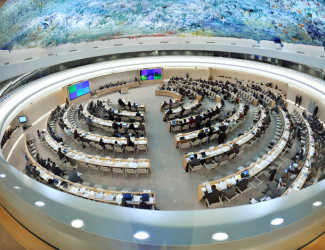
Jean-Marc Ferré | Flickr (CC BY-NC-ND 2.0)
A general view of participants at the 16th session of the Human Rights Council in Geneva, Switzerland.

Análisis Especiales

AWID es un organización feminista internacional de membresía, que brinda apoyo a los movimientos que trabajan para lograr la justicia de género y los derechos de las mujeres en todo el mundo.

Consejo de Derechos Humanos (CDH)

El Consejo de Derechos Humanos (CDH) es el cuerpo intergubernamental del sistema de las Naciones Unidas responsable de la promoción y protección de todos los derechos humanos en todo el mundo. El HRC se reúne en sesión ordinaria tres veces al año, en marzo, junio y septiembre.  La La Oficina del Alto Comisionado para los Derechos Humanos (ACNUDH) es la secretaría del Consejo de Derechos Humanos.

El CDH  trabaja de la siguiente forma:

  • Debate y aprueba resoluciones sobre cuestiones mundiales de derechos humanos y el estado de los derechos humanos en determinados países

  • Examina las denuncias de víctimas de violaciones a los derechos humanos o las de organizaciones activistas, quienes interponen estas denuncias representando a lxs víctimas.

  • Nombra a expertos independientes que ejecutarán los «Procedimientos Especiales» revisando y presentado informes sobre las  violaciones a los derechos humanos desde una perspectiva temática o en relación a un país específico

  • Participa en discusiones con expertos y  gobiernos respecto a cuestiones de derechos humanos.

  • A través del Examen Periódico Universal, cada cuatro años y medio, se evalúan los  expedientes de derechos humanos de todos los Estados Miembro de las Naciones Unidas

Aprende más sobre el CDH


La Sesión actual - CDH44

Se está llevarando a cabo en Ginebra, Suiza del 30 de junio al 17 de julio de 2020.

AWID trabaja con socios feministas, progresistas y de derechos humanos para compartir conocimientos clave, convocar diálogos y eventos de la sociedad civil, e influir en las negociaciones y los resultados de la sesión.

Con nuestrxs socixs, nuestro trabajo será:


◾️ Monitorear, rastrear y analizar actores, discursos y estrategias anti-derechos y su impacto en las resoluciones

◾️ Desarrollar conjuntamente una labor de promoción conjunta para contrarrestar a los actores anti-derechos y debatir más a fondo las conclusiones del Informe de Tendencias de OUR de 2017

◾️ Apoyar, coordinar y desarrollar de manera colaborativa el Caucus feminista emergente en el CDH


Contenido relacionado

The 2023 Feminist Calendar

Image of a calendar on a flat surface. The images decorating each month change every second: first there is a naked person sitting enjoying a hot drink in relaxation, then we see two pink hands over a blue background and finally a couple riding a motorcycle. This looks indefinitely.

AWID is a part of an incredible ecosystem of feminist movements working to achieve gender justice and social justice worldwide. With our 40th anniversary, we are celebrating all that we’ve built over these last 40 years. As a global feminist movement support organization we know that working with fierce feminisms is our way forward, acknowledging both the multiplicity of feminisms and the value of fierce and unapologetic drive for justice. The state of the world and of feminist movements calls for brave conversations and action. We look forward to working together with our members, partners and funders in creating the worlds we believe in, celebrating the wins and speaking truth to power in service of feminist movements globally.

The 2023 Feminist Calendar is our gift to movements. It features the artwork of some of our amazing AWID members.

This is the cover for the 2023 Feminist Calendar. It shows a diverse group of people of all ages embracing and holding hands.

Use it. Print it. Share it. 

Get it in your preferred language!

Select image quality

English Print Quality |  Digital Version
Français Print Quality |  Digital Version
Español Print Quality |  Digital Version
Português Print Quality |  Digital Version
عربي Print Quality |  Digital Version
Русский Print Quality |  Digital Version

Will there be pre-Forum regional, thematic or other convenings?

We believe so! It is still very early in the planning process, so please stay tuned as plans are forming.

Lorena Borjas

Lorena Borjas, una mujer trans latina y activista, vivía y trabajaba en el barrio de Jackson Heights de Queens, en la ciudad de Nueva York. En esas calles, cuidó de su comunidad durante años, defendiendo los derechos de las personas trans e inmigrantes, apoyando a lxs sobrevivientes del tráfico humano y del abuso, y haciendo campaña por los derechos de lxs trabajadorxs sexuales y de las personas que viven con VIH y SIDA.

Lorena era fuerte e incansable en su lucha por apoyar, defender y proteger a quienes son más marginalizadxs y discriminadxs por la transfobia, la misoginia y el racismo.

«Ella nos empujaba a brillar auténticamente, a  convertirnos en un grito de subversión que dice “Aquí estoy, y merezco felicidad también”.» - Cecilia Gentili, activista trans amiga de Lorena

Luego de haber enfrentado ella misma numerosos traumas y dificultades como mujer trans inmigrante y víctima de tráfico humano, recabó conocimientos y memoria emocional de la fuente de sus propias experiencias para ayudar a construir y fortalecer la comunidad de la cual era parte, y que era parte de ella. Algunas de las formas en que llevó esto a cabo fue organizando y movilizando apoyo, que abarcaba desde proveer preservativos y conectar a las mujeres trans con distintos servicios sociales, hasta armar una clínica para el testeo de VIH en su propia casa.

«Era un alma tan bella que ayudaba a otrxs, aun cuando su propio camino era difícil y doloroso como inmigrante, como inmigrante trans. Creía que la comunidad trans necesitaba amor, aceptación, y compasión, y lo daba todo.» - Luchia Dragosh, supervisora de producción de QPTV de un documental sobre Lorena

En sus más de 25 años de activismo, también fundó con Chase Strangio (abogadx y activista por los derechos trans) el Lorena Borjas Community Fund. Este fondo ayuda a lxs diferentes integrantes de su comunidad (y en especial a las personas trans) que lidian con problemas de inmigración, para evitar el ciclo de arresto-cárcel-deportación.

Lorena falleció en marzo de 2020 por complicaciones derivadas del COVID-19.

Su enorme y hermoso legado será llevado adelante a través de las calles de Queens por la red y la comunidad que ella ayudó a crear.

« Continuaremos su trabajo desde donde ella lo dejó, un trabajo que es esencial para el bienestar de “mis pájaras”, como llamaba Lorena a las chicas trans de Queens que protegía bajo su ala.» - Cecilia Gentili


Tributos:

 «Lorena nos trajo luz, cuando atravesábamos tiempos muy oscuros aquí en Nueva York. Nos trajo luz cuando tuvimos que enfrentar la epidemia del crack, cuando tuvimos que enfrentar la crisis del SIDA, cuando tuvimos que enfrentar los cambios en las políticas de inmigración.» - Cristina Herrera, fundadora y CEO de Translatina Network y amiga de Lorena

«Lorena ha hecho más que nadie que yo conozca para arrojar luz sobre la epidemia del tráfico en las comunidades transgénero y para ayudar a otras mujeres trans a escapar de la explotación.» - Lynly Egyes, representante de Borjas en nombre del Transgender Law Center

Mira un documental sobre Lorena Borjas (solo en inglés)

Lee un artículo publicado en The New Yorker sobre Lorena Borjas (solo en inglés)

Lee una nota de opinión de Cecilia Gentili publicada en The New York Times (solo en inglés)

Nos droits en danger – Rapport sur les tendances 2017 de l'OURs

Rapport

Nos droits en danger – Rapport sur les tendances 2017 de l’OURs

Le premier rapport de l’Observatoire sur l’universalité des droits (OURs) - disponible en anglais et en espagnol - compile les informations disponibles sur les tendances antidroits dans les sphères internationales. Découvrez les principaux groupes religieux, les discours et les tactiques antidroits à l’œuvre au sein de l’ONU.

Obtenir le rapport Obtenir le rapport (en anglais)

Snippet - COP30 - The People's Summit - FR

Le Sommet des peuples

Le sommet climat organisé par et pour les mouvements.

📅 12 novembre - 16 novembre 2025
📍 Université fédérale du Pará, Belém

Plus d'infos ici

Site web en anglais

Cookies

We’re committed to protecting your privacy, so here we explain how we use cookies on our website.

If you have any questions, please get in touch via the form on our contact page.

What are cookies?

A cookie is a small data file downloaded by your web browser (for example Chrome or Internet Explorer) and stored on your computer. They are downloaded automatically when you visit websites. Cookies are used to perform essential tasks on a website, to record how people use a website and to gather data for marketing.

How we use cookies

We provide essential information on our website to millions of people every year. To do this, we have to manage our website effectively and to reach out to more people who need our support and information. Cookies are a small, but essential way to make all this happen. We use cookies to:

  1. To measure how people use our website. This helps us understand how well different sections of our website are performing. It also helps us track numbers of visitors and helps us ensure our website is robust and works well for every single one of the millions of people who use it.
  2. To record actions so that the website will work well for you. For example, our online shop uses cookies to record items that you place in your shopping basket. We also use cookies in our online donations process and in other tools such as our online breath test.
  3. We also record actions so we can reach people more effectively. This works by using a cookie to remember what pages you have visited so we can tailor our marketing messages based on your interests.

Change your cookie settings

You can update your cookie preferences by clicking on the button below.

Cookie Settings

In addition, most browsers allow you to manage cookies saved on your device – just go to the help section of your browser. To learn more about cookies and how to manage them, visit the ICO website.

Your rights

Cookies never record your credit card details or easily identifiable personal data such as your name and address. You have every right to refuse to accept cookies from our website.

If you disable cookies you will still be able to access nearly all the information on our website. But please remember that this may affect some functionality.

How to disable cookies

You can disable cookies by changing your settings in your web browser or you can use the incognito option on Google Chrome. To find out more about your browser settings, visit the relevant support page below:

Cookies used by this site

Soy parte de un fondo o donante individual. ¿Cómo puedo apoyar al Foro de AWID?

Te invitamos a que te pongas en contacto con nosotrxs para explorar formas de colaborar de manera más significativa con el Foro.

Cristina Bautista

« Si nous nous taisons, ils nous tuent, et si nous parlons [ils nous tuent] aussi. Alors parlons. »  -  Cristina Bautista, 2019

Cristina Bautista était membre de la communauté autochtone du peuple Nasa, qui vit dans la région nord du Cauca en Colombie. Elle participait à la résistance en tant que leader, défenseuse des droits fonciers, travailleuse sociale et gouverneure de la réserve autochtone Nasa de Tacueyó.

Défenseuse infatigable des droits du peuple Nasa, Cristina s’est exprimée haut et fort contre la violence à l’égard de sa communauté. Dans un discours devant les Nations Unies, elle appelait à protéger les vies des femmes autochtones et à les impliquer dans différents domaines de la vie. En 2017, Cristina était membre du Bureau des Nations Unies pour les droits humains des personnes autochtones. Le Fonds de contributions volontaires des Nations Unies pour les populations autochtones lui a octroyé une subvention en 2019. 

« J’aimerais mettre en lumière la situation actuelle du peuple autochtone en Colombie, le meurtre de leaders autochtones, la répression de la contestation sociale. Au lieu d’aider, l’accord de paix a renforcé la guerre et l’exploitation de territoires sacrés en Colombie… Actuellement, nous travaillons en tant que femmes, dans presque toutes les nations autochtones, à un avenir meilleur pour nos familles. Je ne veux pas voir plus de femmes vivre dans ces conditions en milieu rural. Il nous faut des opportunités qui permettent aux femmes autochtones de participer à la vie politique, à l’économie, à la société et à la culture. J’acquiers une réelle force aujourd’hui, en voyant toutes ces femmes ici, et en voyant que je ne suis pas seule. » - Cristina Bautista, 2019

Cristina a été assassinée le 29 octobre 2019, ainsi que quatre autres membres de la garde autochtone désarmée, dans une attaque potentiellement menée par des membres de « Dagoberto Ramos », un groupe dissident FARC.  

D’après Global Witness, « le nombre d’assassinats de leaders communautaires et sociaux·les a terriblement augmenté en Colombie au cours de ces dernières années ». 

« La communauté nasa a prévenu à maintes reprises les autorités au sujet des menaces qui pèsent sur leur sécurité. Malgré les efforts déployés par les gouvernements colombiens successifs, les peuples autochtones continuent de faire face à d'importants risques, surtout les dirigeants communautaires ou religieux comme Cristina Bautista.» - Point presse des Nations Unies, 1er novembre 2019

Visionnez le discours de Cristina Bautista d’août 2019 où elle dénonce de précédents assassinats de membres de la garde autochtone (en espagnol)

Snippet Kohl - Plénière: La révolution sera féministe — ou il n’y aura pas de révolution

Plénière: La révolution sera féministe — ou il n’y aura pas de révolution

Avec Manal Tamimi, Bubulina Moreno, Karolina Więckiewicz et Anwulika Ngozi Okonjo..

YOUTUBESOUNDCLOUD (anglais)

Snippet - COP30 - Resistance Hubs Section Column 1 - EN

As world leaders gather in Brazil, it’s vital that feminist movements especially from the Global Majority have autonomous spaces to gather, strategize, and disrupt.

These Hubs challenge the elitism of climate talks, center lived experiences, and aim to build collective power across borders. They offer a critical counterbalance to top-down, often exclusionary international negotiations. The Hubs aim to foster community-driven solutions, amplify feminist demands, and ensure that feminist principles of care and solidarity shape the climate agenda. It’s not just about being present at COP30, it’s about reshaping the conversation on climate justice on feminist terms.

Privacy and cookies - before 25 Apr 2023

AWID Privacy Policy, Your rights to privacy and cookies

This policy governs all pages hosted at www.awid.org, and any other websites under the control of the AWID (the “Website”) and registrations for these sites. It does not apply to pages hosted by organisations other than AWID, to which we may link and whose privacy policies may differ. Please read the following policy to understand our privacy policy regarding nature, purpose, using and sharing of your personal identifiable information that is collected via this website.

1. Types of information collected on this site

Generally, you can browse this website without submitting your personal information to us. However, in some circumstances, we will ask for your personal information.

1.1 Information you provide to us

When you are on the website and are asked for personal information, you are sharing that information only with AWID.

1.1.1 The information you provide to get updates from AWID:

When you register to use the website – for example, subscribe to receive emails from us or apply to become a member - you provide us with the mandatory information about you like Name, country, language to receive email updates and email address. This information is provided by you through secure forms and is stored on secure servers.

1.1.2 The payment information you provide to become member or registering for a paid event:

Also, while becoming a member or registering for events, you may need to provide payment information. AWID doesn’t store any credit card information on its servers and uses payment gateway to process the payment information.

1.1.3 The optional information you chose to give us as AWID member (with consent)

When you communicate with AWID, provide optional information through forms on the website or use the site to communicate with other members, we collect information about your communication and any information you choose to provide.

1.1.4 Information you provide us through contact forms or when you directly communicate with us

When you communicate with us, we collect your communication and any other information you choose to provide us.

1.2 Information that is automatically collected (third party cookies)

In addition, when you interact with the Website, our servers may keep an activity log that does not identify you individually (“Non-Personal Information”). Generally, we collect the following categories of Non-Personal Information:

  • We may collect certain demographic data such as age and gender as part of collecting personal information;
  • We collect and store certain device information about your computer, mobile device, or other device that you use to access the Website. This information may include IP address, geolocation information, unique device identifiers, browser type, browser language, and other transactional information;
  • We automatically log certain usage information about your use of the Website. This information includes a reading history of the pages you view. We use this information to provide you with a more customized experience on the Website;
  • We collect and store additional “traffic data” such as time of access, date of access, software crash reports, session identification number, access times, and referring website addresses; and
  • We collect and store your search terms and search results.
  • We also collect and store certain other information regarding our users’ use of the Website so that third parties may provide us with reports and analysis regarding usage and browsing patterns of the Website.

For more information about cookies, please see www.allaboutcookies.org.

If you do not wish to receive cookies you can easily modify your web browser to refuse cookies, or to notify you when you receive a new cookie, see how here.

2. Use of information collected on this website

AWID uses the information we collect about you to:

  • Better understand how you are using our website and what we could do to improve your experience.
  • Communicate with you via email to share resources and analysis in the field of women's rights, connect with you and provide opportunities to engage with our work, keep you updated about developments at AWID and with our partners.
  • Comply with our legal obligations to:
    • Detect and prevent fraud, spam, abuse, security incidents, and other harmful activity.
    • Conduct security investigations and risk assessments.
    • Verify or authenticate information provided by you (such as to verify your authorization to act as an agent on behalf of a nonprofit organization).
    • Conduct checks against databases and other information sources, to the extent permitted by applicable laws.
    • Resolve any disputes with any of our users or customers and enforce our agreements with third parties.
    • Enforce our Terms of Use and other policies.

3. Distribution of information

If you have subscribed to AWID´s e-newsletters or email updates or you have become a member, we will send you regular communications as specified in the relevant area of the website. You are able to unsubscribe from any of the e-newsletters or email updates at any time by using the unsubscribe information provided in our emails.

4. Accessing, changing and removing information

The accuracy of your individual identifying information is important to AWID. We are always looking for ways to make it easier for you to review and correct the information that AWID maintains about you through our website. If you change your email address, or if any of the other information we hold is inaccurate or out of date, please write to us here.

  • Where you have provided AWID with consent to use your personal data, you can withdraw it any time by sending us a communication and specifying which consent you are withdrawing. Please note that the withdrawal of your consent does not affect the lawfulness of any processing activities based on such consent before its withdrawal.
  • Where applicable, you may also have a right to receive a machine-readable copy of your personal data. If you would like to have a copy of the personal data we hold on you or if you think that we hold incorrect personal data about you, please write to us.
  • You also have the right to ask us to delete your personal data or restrict how it is used. There may be exceptions to the right to erasure for specific legal reasons which, if applicable, we will set out for you in response to your request.
  • At any time, regardless of applicable law, you may object to us processing your personal information for direct marketing purposes. You may, at any time, ask AWID to cease processing your data for these direct marketing purposes by Contacting Us.


5. Sharing information

Except as explained below, AWID will not disclose any of your personally identifiable information, and will not sell or rent lists containing your information to third parties. AWID may disclose information when it has your permission to do so or under special circumstances, such as when it believes in good faith that the law requires it.

6. Information security

We are continuously implementing and updating administrative, technical, and physical security measures to help protect your information against unauthorized access, loss, destruction, or alteration. Some of the safeguards we use to protect your information are firewalls and data encryption, and information access controls. If you know or have reason to believe that your AWID membership credentials have been lost, stolen, misappropriated, or otherwise compromised or in case of any actual or suspected unauthorized use of your AWID membership account, please contact us through on Contact Us.

7. Changes to this policy & Contacting us

This policy may change from time to time. The changed policy will be posted on this website and Last updated date at the end of the policy will be updated. There will be an email update sent to you for the revised policy and if you do not agree with the revised policy, you will have the option to cancel you registration(s) with us. You can also write to us here. We welcome your feedback!

Last updated: May 2019

CFA 2023 - Hybrid like never before: in person - EN

Hybrid like never before

For the first time, the AWID Forum offers three modes of participation

In-person

Participants will come together in Bangkok, Thailand. We can’t wait!

Ayanda Denge

“I am a wonder… Therefore I have been born by a mother! As I begin to stutter, my life has been like no other…” - Ayanda Denge  (read the whole poem below)

Ayanda Denge was a transwomxn, sex worker, activist, poet. She was Xhosa, from Port Elizabeth in the Eastern Cape of South Africa. After travelling through different cities of the country, she moved to Cape Town. 

As a committed and fervent social justice activist, she fought for the rights of sex workers, trans persons, and for those of people living with HIV and AIDS. She was also a motivational speaker on cancer awareness, and campaigned for affordable and social housing, especially for poor and working-class people. Ayanda stood tall as a mountain against different and often abusive faces of discrimination. 

“Being transgender is not a double dose, but it’s a triple dose of stigmatisation and discrimination. You are discriminated against for your sexual identity, you are discriminated against for your work, and you are discriminated against for your HIV status.” - Ayanda Denge, 2016

She was acting chairperson at the Sex Workers Education and Advocacy Taskforce (SWEAT) and also worked as an Outreach Coordinator at Sisonke, a national sex workers’ movement in South Africa. 

“From us, from our regional head office, to SWEAT where I sit on the board, to Sisonke, a movement of sex workers in Cape Town. We all amalgamate, we have one cry and it’s a cry that is recognised internationally by international sex workers. We want decriminalisation of sex work.” - Ayanda Denge, 2016

She lived in the Ahmed Kathrada House, which was being occupied by the Reclaim the City campaign for social housing. In 2018, Ayanda was elected house leader. On 24 March 2019, she was stabbed to death in her room. The year prior, another resident was killed.

Reclaim the City draws a connection between the safety of the house residents and the Provincial Government withholding electricity and the human right to water: 

“We cannot separate the safety of women and LGBTQI people living in the occupation from the refusal by the Western Cape Provincial Government to turn the electricity and water back on at Ahmed Kathrada House.

The house is pitch black at night. We need lights to keep each other safe. It is as if the Province wishes to punish poor and working class people, whose only crime is that we needed a home. While they may disagree with our reasons for occupying, they should be ashamed of themselves for putting politics before the safety and dignity of residents of this city.

Rest in Peace comrade Ayanda Denge, we shall remember you as we carry the torch forward in the struggle for decent well-located housing.”

Poem by Ayanda: 

I am a wonder…
Therefore I have been born by a mother!
As I begin to stutter,
My life has been like no other.
Born in pain
Nourished by rain
For me to gain
Was living in a drain.
As I shed a tear
I stand up and hold my spear.
Voices echo, do not fear
Challenges within a year,
Challenges of hurt are on my case;
Community applauds as they assume I have won my race;
But in reality my work strides at a tortoise pace;
On bended knee I bow and ask for grace.
For the Lord
Is my Sword;
To remind humanity
That he provides sanity.
Why Lord am I this wonder?
The Lord answers me with the rain and thunder,
For questioning my father
Who has in the book of lambs
A name called Ayanda.
From the streets my life was never sweet
The people I had to meet;
At times I would never greet;
Even though I had to eat;
I’d opt to take a bow
Rather than a seat

Listen to the poem in Ayanda’s voice

“For my life represents that of a lotus flower, that out of murky and troubled waters I bloomed to be beautiful and strong...” - Ayanda Denge, watch and listen 


Tributes: 

“Ayanda, I want to say to you that you are still a survivor, in our hearts and minds. You are gone but you are everywhere, because you are love. How beautiful it is to be loved, and to give love. And Ayanda, that is the gift that you have given us. Thank you for all of the love, we truly did need you. Going forward, I promise to you that we will all commit to continue with the struggle that you have dedicated so much energy and your time to. And we will commit ourselves to pursuing justice in this awful ending to your life.” - Transcript of a message, in a farewell Tribute to Ayanda

“Ayanda was an activist by nature. She knew her rights and would not mind fighting for the rights of others. For me, it was no shock that she was involved with many organizations and it was known that she was a people’s person. It did not need to be the rights of LGBTI but just the rights of everyone that she stood for.” - Ayanda’s sister
 

Crear | Résister | Transform: A Walkthrough of the Festival! - smaller snippet EN

Crear | Résister | Transform: 
A Walkthrough of the Festival!

As heteropatriarchal capitalism continues to force us into consumerism and compliance, we are finding that our struggles are being siloed and separated by physical as well as virtual borders.

Read more

Snippet - COP30 - Feminist Economic Alternatives Brief - EN

📖 Feminist Economic Alternatives Brief

A tool for feminist activists at COP30 fighting for transformative, equitable and community-centred solutions to address the climate crisis.

Download the Brief

Também disponível em português

Sin trabajadorxs domésticxs no hay economía de los cuidados

Un Manifiesto

Como movimientos feministas y sindicales, juntxs en solidaridad, articulamos los siguientes puntos como una visión colectiva de las economías de los cuidados con los derechos de lxs trabajadorxs domésticxs como eje central.

Nuestro manifiesto responde a un contexto complejo:

El trabajo doméstico y de cuidado estuvo en la primera línea de fuego durante y después de la pandemia de COVID-19, al proporcionar los medios para sobrellevar las múltiples crisis globales que se intersectan. El Banco Mundial, el Fondo Monetario Internacional y otras instituciones multilaterales también reconocen la importancia del trabajo doméstico y de cuidados para el sostenimiento de la economía. Sin embargo, vemos que esta atención adopta un enfoque utilitarista (es decir, el trabajo de cuidados contribuye a sostener a la economía "productiva") centrado en el lucro, sin reconocer los cuidados como un derecho humano y un bien público, ni prestar atención a lxs trabajadorxs que realizan la mayor parte de este trabajo.

El manifiesto está disponible en inglés, francés, español, amárico y tailandés.

Descargar el manifiesto completo

CFA 2023 - Call for Activities is live- EN

The Call for Activities is Live!

The Deadline to submit activities has been extended to February 1st, 2024


In the spirit of the Forum’s theme, we invite a diversity of activity topics and formats that:

  • Facilitate genuine connection and interaction among participants
  • Foster healing and regeneration in various forms, as individuals, as communities and as movements
  • Inspire and challenge us to thrive together as communities and movements