AWID es un organización feminista internacional de membresía, que brinda apoyo a los movimientos que trabajan para lograr la justicia de género y los derechos de las mujeres en todo el mundo.
Confrontando al extractivismo y al poder corporativo
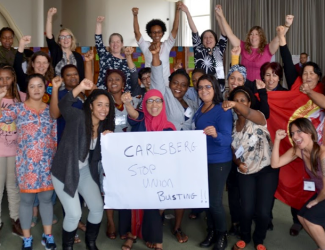
Defensoras de derechos humanos de todo el planeta defienden sus tierras, medios de subsistencia y sus comunidades ante las industrias extractivas y el poder corporativo. Ellas hacen frente a fuertes intereses económicos y políticos que promueven el robo de tierras, el desplazamiento de comunidades, la pérdida de los medios de subsistencia y la degradación del medioambiente.
¿Por qué resistir a las industrias extractivas?
El extractivismo es un modelo económico y político de desarrollo que mercantiliza la naturaleza y prioriza la ganancia por sobre los derechos humanos y el medioambiente. Arraigado en la historia colonial, refuerza las desigualdades sociales y económicas tanto a nivel local como global. Muchas veces, las mujeres negras, rurales e indígenas son las más afectadas por el extractivismo, y además son notablemente excluidas de la toma de decisiones. Desafiando estas fuerzas patriarcales y neocoloniales, las mujeres se alzan en defensa de los derechos, las tierras, las personas y la naturaleza.
Riegos críticos y violencia específica de género
Las defensoras que enfrentan a las industrias extractivas, experimentan una diversidad de riesgos, amenazas y violaciones, incluidas la criminalización, la estigmatización, la violencia y laintimidación. Sus historias dan cuenta de marcados aspectos de violencia sexual y de género. Entre los perpetradores se incluyen autoridades estatales y locales, las corporaciones, la policía, el ejército, las fuerzas paramilitares y de seguridad privada, y en algunos casos, sus propias comunidades.
Actuar juntxs
AWID y la Coalición Internacional de Mujeres Defensoras de Derechos Humanos (WHRDIC por su sigla en inglés) tienen el placer de anunciar «Defensoras de derechos humanos confrontado al extractivismo y al poder corporativo»; un proyecto interregional de investigación que documenta las experiencias vividas por las defensoras de Asia, África y América Latina.
Alentamos a activistas, integrantes de movimientos sociales, la sociedad civil organizada, donantes y responsables de políticas públicas, a leer y utilizar estas producciones para el trabajo de incidencia, con fines educativos y como fuente de inspiración:
AWID reconoce con gratitud las invaluables contribuciones de cada Defensora de Derechos Humanos que ha sido parte de este proyecto. Esta guía ha sido posible gracias su generosidad y apertura al compartir sobre sus experiencias y lecciones. Su coraje, creatividad y resiliencia son una inspiración para todxs nosotrxs. ¡Muchas gracias!
Contenido relacionado
AWID Community Jobs board - ES
Bolsa de Empleos Comunitaria
¿Estás buscando trabajo? Una de las ventajas de unirse a la Comunidad AWID es tener acceso a nuestra bolsa de empleos co-creada por la comunidad. Podrás explorar nuevas oportunidades y también tendrás la oportunidad de compartir vacantes y convocatorias de propuestas con todos los miembros.
Nadine fue un ejemplo para muchxs por su trabajo en apoyo de las mujeres y lxs más vulnerables de su comunidad. Estaba comprometida con ayudar a l pobres, especialmente a las personas sin techo.
Aunque su muerte se informó como accidente, la familia Ramaroson, encabezada por su padre, André Ramaroson, llevó adelante una investigación que arrojó evidencias de que había sido asesinada. Se informó que había muerto en un accidente fatal ocurrido entre Soanierano - Ivongo y Ste Marie, una historia que fue desmentida por su familia. Ella había recibido numerosas amenazas de muerte por sus audaces posiciones políticas. Su caso todavía está en la corte de Antananarivo (la capital de Madagascar).
Snippet FEA Principles of Work Antiracism (ES)
ANTI RACISMO
Actores anti-derechos
Capítulo 4
Una red compleja de actores anti-derechos, en constante evolución, está ejerciendo cada vez más influencia en los espacios internacionales y en las políticas nacionales. Respaldados a menudo por financiaciones poco transparentes, estos actores construyen alianzas tácticas sobre distintos temas y cruzando diferentes regiones y credos para aumentar su impacto.
Estamos viendo actores fascistas y fundamentalistas que, si bien tienen un discurso nacionalista, son completamente transnacionales en lo que respecta a sus basamentos ideológicos, sus alianzas políticas y sus redes de financiamiento. En algunos casos, estos grupos están respaldados por flujos financieros poco transparentes vinculados con grandes empresas o con partidos políticos de extrema derecha. Sin embargo, también crean alianzas estratégicas, que incluyen, en algunos casos, segmentos de los movimientos feministas y por los derechos de las mujeres, y se distancian de los elementos más evidentemente extremistas para parecer más legítimos. Los actores anti-derechos también se expanden y replican su estilo de organización antiderechos (ya sea a través de campañas y grupos de presión, o de litigios estratégicos) en todo el planeta.
Índice de contenidos
CitizenGo
Alliance Defending Freedom (ADF)
Financiación de actores antiderechos
Los vínculos entre feministas trans-excluyentes y fundamentalistas cristianxs
Ejercicio: Esquematicemos el panorama
Historia de movimiento de resistencia: Catolicadas, una poderosa herramienta de comunicación para promover la igualdad de género y los derechos sexuales y reproductivos
Enciende tu fuego feminista leyendo nuestras investigaciones y publicaciones varias sobre financiamiento, defensoras de derechos humanos, construcción de movimientos, fundamentalismos, justicia económica, seguimiento y evaluación feminista y más
Rejoignez-nous en prenant part aux conversations#FreezeFascisms!
(#BloquerLesFascismes) !
Alors que nous affrontons de multiples crises dans le monde entier, nos mouvements œuvrent sans relâche à construire une influence qui dépasse les structures de pouvoir traditionnelles. La vague de décrets présidentiels américains vise à nous intimider, mais aucune idéologie fasciste, quelle que soit son ampleur, ne peut effacer notre existence et notre résistance.
Nous vous invitons à rejoindre la campagne de solidarité pour dénoncer et résister aux forces fascistes qui sapent les mouvements féministes et de justice de genre dans vos communautés !
Déclenchez des conversations au sein d’un espace courageux : partagez vos initiatives de lutte et de résistance aux fascismes à votre échelle sur la plateforme de la Communauté AWID. Pas encore membre ? Rejoignez-nous ici.
Soutenez les mouvements qui ont été touchés : relayez les collectes de fonds, les ressources disponibles, les efforts d’entraide en utilisant #FreezeFascisms #BloquerLesFascismes (nous sommes toujours sur X, Instagram, Facebook, LinkedIn, mais aussi sur Bluesky !)
Mobilisez-vous autour d’alternatives : nous avons créé une communauté de pratiques à adopter pour des alternatives économiques féministes et un financement autonome. Inscrivez-vous pour en faire partie ici(en anglais)
"He dado testimonio de la discriminación que vi en las calles, he sufrido burlas y abusos verbales ahí. También he hecho numerosas amistades y he conocido a mucha gente. Puede que haya peligros ahí fuera, pero soy una sobreviviente y aquí es donde estaré por ahora." - Sainimili Naivalu
Sainimili Naivalu fue una feminista y activista por los derechos de las personas con discapacidades de la aldea de Dakuibeqa en la isla de Beqa, Fiji.
Exigió a las autoridades políticas y a otras partes interesadas que proporcionaran políticas y servicios favorables a la movilidad de las personas con discapacidad, como la construcción de rampas en pueblos y ciudades para aumentar su accesibilidad. Sin embargo, las barreras físicas no fueron las únicas que Sainimili se esforzó por cambiar. Por experiencia propia, sabía que era necesario que se produjeran cambios más complejos en las esferas sociales y económicas. Muchos de los retos a los que se enfrentan las personas con discapacidad tienen su origen en actitudes que llevan a la discriminación y al estigma.
Como sobreviviente y luchadora, Sainimili contribuyó a la creación conjunta de realidades feministas que fomentasen la inclusión y cambiasen las actitudes hacia las personas con discapacidad. Como afiliada a la Asociación de Lesiones de la Espina Dorsal de Fiji (SIA, por sus siglas en inglés) y a través del proyecto del Foro para Personas con Discapacidades del Pacífico “Pacífico Habilita”, Sainimili asistió a la formación de la Organización Internacional del Trabajo "Inicie su Negocio" en Suva, lo que le permitió transformar sus ideas en su propio negocio. Fue emprendedora en el puesto 7 del mercado de Suva, donde ofrecía servicios de manicura, y también se encargaba del puesto del mercado de las mujeres de SIA, donde vendía artesanías, sulus y otros objetos. El plan de Sainimili era expandir su negocio y convertirse en una importante empleadora de personas con discapacidad.
Además de su activismo, también fue medallista y campeona juvenil de tenis de mesa.
Sainimili era única, con una personalidad vivaz. Siempre podías saber si Sainimili estaba en una habitación porque su risa y sus historias eran los primero que notabas. - Michelle Reddy
Incarnations Transnationales | Note des éditeurices
Des mots perdus
Chinelo Onwualu
Ghiwa Sayegh
« Lorsque nous avons désespérément besoin de changement, comme c’est le cas dans la maladie et l’insurrection, notre langage se vide de sa complexité et se réduit à l’essentiel... Mais à mesure que la maladie et la révolution persistent, le langage fabriqué en elles et à leur sujet s’approfondit, laisse entrer plus de nuances, absorbé par l’expérience profondément humaine qu’est de rencontrer de ses propres limites sur le site de la fin du monde. » Johanna Hedva
Lorsque nous avons commencé à imaginer un tel numéro avec Nana Darkoa, à l’approche du festival Crear | Résister | Transform : un festival dédié aux mouvements féministes ! de l’AWID, nous sommes parti·e·s d’une question qui relève davantage d’une observation de l’état du monde – un désir de déplacer le terrain : pourquoi nos sexualités et nos plaisirs continuent-ils d’être apprivoisés et criminalisés, alors même qu’on nous répète sans cesse qu’ils n’apportent ni valeur ni progrès? Nous sommes arrivé·e·s à la conclusion que lorsqu’elles sont incarnées, quelque chose dans nos sexualités va à l’encontre d’un ordre mondial qui continue à se manifester par des contrôles aux frontières, des apartheids vaccinaux, un colonialisme d’occupation, un nettoyage ethnique et un capitalisme rampant. Pouvons-nous donc parler du potentiel perturbateur de nos sexualités? Pouvons-nous encore le faire lorsque, pour être financé·e·s, nos mouvements sont cooptés et institutionnalisés?
Lorsque notre travail incarné devient un profit entre les mains de systèmes que nous cherchons à démanteler, il n’est pas étonnant que nos sexualités et nos plaisirs soient une fois de plus relégués à la marge – surtout lorsqu’ils ne sont pas assez rentables. À plusieurs reprises au cours de la production de ce numéro, nous nous sommes demandé ce qui se passerait si nous refusions de nous plier aux services essentiels du capitalisme. Mais pouvons-nous oser poser cette question, lorsque nous sommes épuisé·e·s par le monde? Peut-être que nos sexualités sont si facilement rejetées parce qu’elles ne sont pas considérées comme des formes de soins. Peut-être que ce dont nous avons besoin, c’est de réimaginer le plaisir comme une forme de soin radical – un soin qui est également anticapitaliste et anti-institutionnel.
Alors que nous entrons dans notre deuxième année complète de pandémie mondiale, notre approche des incarnations transnationales a dû se concentrer sur un seul constat politique : prendre soin est une forme d’incarnation. Et parce qu’à l’heure actuelle, une grande partie de notre travail se fait sans tenir compte des frontières entre nous et en nous-mêmes, nous sommes toustes incarné·e·s de manière transnationale – et nous échouons toustes. Nous ne parvenons pas à prendre soin de nous-mêmes et, plus important encore, à prendre soin les un·e·s des autres.
Cet échec n’est pas de notre fait.
Beaucoup de nos parents considéraient le travail comme une transaction, quelque chose à donner en échange d’une compensation et d’une garantie de soins. Et bien que cet échange n’ait pas toujours été respecté, nos parents ne s’attendaient pas à ce que leur travail les comble. Iels avaient leurs loisirs, leurs passe-temps et leurs communautés pour cela. Aujourd’hui, nous, leurs enfants, qui avons été conditionné·e·s à penser que notre travail est intimement lié à notre passion, n’avons pas de telles attentes. Nous considérons le travail et les loisirs comme une seule et même chose. Pour un trop grand nombre d’entre nous, le travail en est venu à incarner tout notre être.
Cependant, le capitalisme hétéropatriarcal ne nous valorise pas, et encore moins notre travail ou nos sexualités. C’est un système qui ne fera qu’exiger toujours plus, jusqu’à votre mort. Et quand vous mourrez, il vous remplacera par quelqu’un·e d’autre. L’attente d’être en ligne 24 heures sur 24 signifie que nous ne pouvons tout simplement pas nous échapper du travail, même lorsque nous le souhaitons. Cette commercialisation du travail, qui le dissocie de la personne, a infiltré tous les aspects de nos vies et se perpétue même dans les milieux les plus féministes, les plus radicaux et les plus révolutionnaires.
Les attentes capitalistes ont toujours été particulièrement pernicieuses pour les corps qui ne correspondent pas à leur idéal. Et celleux qui cherchent à consolider leurs pouvoirs ont utilisé la pandémie comme une occasion de cibler les femmes, les minorités sexuelles et toustes celleux qu’iels considèrent comme des moins que rien.
Ce numéro spécial existe à cause, et certainement en dépit, de cela.
Presque tous les contributeur·ice·s et membres du personnel se sont surpassé·e·s. Chaque article est le fruit d’une passion, mais aussi d’un incroyable épuisement. De manière très concrète, ce numéro est une incarnation du travail transnational – et dans le monde numérique dans lequel nous vivons, tout travail est devenu un travail transnational. Alors que nous devons faire face à de nouvelles frontières qui ne brisent pas un ordre ancien mais le réifient, nous avons fait l’expérience directe, aux côtés de nos contributeurs, de la façon dont le capitalisme épuise nos limites – comment il devient difficile de construire des arguments cohérents, en particulier lorsque ceux-ci sont soumis à une date limite. Nous avons collectivement perdu les mots – parce que nous sommes perdu·e·s pour les mondes.
Se sentir perdu et seul dans le monde du capitalisme hétéropatriarcal est exactement la raison pour laquelle nous devons réévaluer et repenser nos systèmes de soins. À bien des égards, nous avons transformé ce numéro en une mission visant à trouver du plaisir dans les soins. Parce qu’il est devenu plus difficile de construire des arguments cohérents, les moyens visuels et créatifs sont passés au premier plan. Nombreux·ses sont celleux qui, ayant l’habitude d’écrire, se sont tourné·e·s vers ces médias pour produire des connaissances et couper court au brouillard mental qui nous a toustes enveloppé·e·s. Nous avons fait intervenir d’autres voix, en plus de celles que vous avez entendues au festival, afin d’ouvrir de nouvelles conversations et d’élargir nos horizons.
Alors que nous sommes privé·e·s de nos mots, il est de notre devoir politique de continuer à trouver des moyens de nous maintenir et de prendre soin de nous-mêmes et des autres. Une grande partie de nos réalités actuelles tente de nous effacer et de nous déplacer, tout en continuant à exploiter notre travail. Notre incarnation, par conséquent, devient une forme de résistance; c’est le début de nous-mêmes trouvant notre voie en dehors et en dedans de nous.
Lorsqu’on effectue une recherche en ligne sur les « Mutilations génitales féminines » ou « MGF », un schéma en quatre parties sur l’anatomie des femmes apparaît à côté d’une page Wikipédia dédiée. (...)
Sylvia Rivera était une militante pour les droits civiques, travestie et travailleuse du sexe.
Connue comme la drag queen de couleur de New York, Sylvia était une infatigable et féroce défenseure des marginalisé·e·s et exclu·e·s au début des années 1970, alors que le mouvement pour les « droits des gays » prenait de l’ampleur aux États-Unis.
Dans un discours bien connu prononcé pour Chistopher Street Day en 1973, Sylvia s’est exclamée, parmi une foule de membres de la communauté LGBT :
« Vous me dites tous d’aller me cacher, la queue entre les jambes.
Je ne supporterai plus ces conneries.
On m’a battue.
On m’a cassé le nez.
On m’a jetée en prison.
J’ai perdu mon travail.
J’ai perdu mon appartement.
Tout ça pour la libération gay, et vous me traitez de la sorte?
C’est quoi votre putain de problème à tous?
Réfléchissez à ça! »
En 1969, à l’âge de 17 ans, Sylvia a participé aux célèbres émeutes de Stonewall en jetant, paraît-il, le deuxième cocktail molotov en signe de protestation contre la descente de la police dans le bar gay de Manhattan. Elle a continué à être une figure centrale des soulèvements qui ont suivi, organisant des rassemblements et ripostant aux brutalités policières.
En 1970, Sylvia a collaboré avec Marsha P. Johnson à la création de Street Transvestite Action Revolutionaries (S.T.A.R.), collectif et organisation politique qui mettait sur pied des projets de soutien mutuel pour les personnes trans vivant dans la rue, celles et ceux aux prises avec la toxicomanie ou en détention, et spécialement pour les personnes trans de couleur et celles et ceux vivant dans la pauvreté.
Refusant les étiquettes, Sylvia a incité les personnes du mouvement de libération gay à penser différemment, et ce, tout au long de sa vie. Elle a déclaré :
« J’ai quitté ma maison en 1961, à l’âge de 10 ans. Je me suis démenée sur la 42e rue. Le début des années 1960 n’était pas génial pour les drag queens, les garçons efféminés ou les garçons qui se maquillaient comme on le faisait. À l’époque, on se faisait battre par la police, par tout le monde. Je n’ai pas vraiment fait mon coming out en tant que drag queen avant la fin des années 1960. C’était vraiment la débandade lorsque des drag queens se faisaient arrêter. Je me rappelle la première fois où je me suis fait arrêter, je n’étais même pas habillée entièrement en drag. Je marchais dans la rue et les flics m’ont tout simplement attrapée. Les gens maintenant prétendent que je suis une lesbienne, parce que je suis avec Julia, ce à quoi je leur je réponds : « Non, je suis juste moi. Je ne suis pas une lesbienne. » J’en ai marre d’être étiquetée. Je ne suis même pas en faveur de l’étiquette de transgenre. J’en ai marre de vivre avec des étiquettes. Je veux juste être qui je suis. Je suis Sylvia Rivera »
Par son activisme et son courage, Sylvia Rivera a présenté un miroir où se reflétait tout ce qui n’allait pas dans la société, mais aussi la possibilité d’une transformation. Sylvia est née en 1951 et décédée en 2002.
Snippet - Podcast Intro (EN)
We are thrilled to announce the launch of AWID’s new podcast THAT FEMINIST FIRE. Our narrative series unravels over 40 years of feminist movements—and reimagines a way forward.
In our pilot season, you’ll hear five compelling stories that are part of a constellation of feminist activism today. Hosted by our very own Gopika Bashi, Deputy Director of Programmes at AWID, each episode explores unique but interconnected feminist realities that are achieving greater gender justice and human rights.
Produced by our Webby-winning podcast partner Hueman Group Media, you can subscribe toTHAT FEMINIST FIREand listen to our first episode here.
Find us on Apple Podcasts, Spotify, or wherever you get your podcasts. Share with your network! Help us spread stories that ignite our feminist fire and move us to action.
نايكي ليدان، مدافعة عن العدالة الاجتماعية وناشطة نسوية ملتزمة، تتمتع بـ 20 عامٍ من الخبرة في مجال الدفاع عن حقوق الإنسان والعدالة الصحية وتمكين المرأة، والنضال من أجل الوصول الشامل إلى الخدمات الأساسية والإدماج الاجتماعي، فضلاً عن بناء قدرات المجتمع المدني. قامت بعمل مكثف في كندا وغرب وجنوب إفريقيا وهايتي في مجال الدفاع عن الحقوق المدنية، وبناء القدرات لمنظمات المجتمع المدني، مع التأكيد على المحددات الاجتماعية للإقصاء الهيكلي. إنها تقدر مبادئ القيادة المشتركة والمساحات المعادية للاستعمار والقمع والأبوية.
السؤال الأوّل: تُعَدّين ناشطة في قضايا حقوق العابرين/ات جنسياً؛ أشعر بالفضول لمعرفة كيف عبّدتِ مسيرتك.
نشأتُ في هايتي حتّى بلغت سنّ الثامنة عشرة، ثمّ عشتُ في مونتريال لمدّة 19 عاماً. في العام 2016 عدتُ إلى هايتي معتقدة أنني سوف أعود إلى الوطن، لكن المكان تغيّر، وكان عليّ التكيّف مجدّداً. لم أُعِدْ ربط الصلات مع العائلة وأصدقاء الطفولة بالطريقة التي كنت أتوقّعها. عدت كمُغتربة مع ظروف عمل مريحة، وبقيت أشعر أنني غريبة لفترة طويلة جداً. لكن في الوقت نفسه، شعرت أنني في وطني بسبب اللغة، وحتى الصمت المألوف، وعدم اضطراري إلى تبرير غنائي لشارة إعلان تجارية – تعلمين... تلك الأمور التي نتشاركها، تلك الطاقة، تلك المساحة، وتلك الروح.
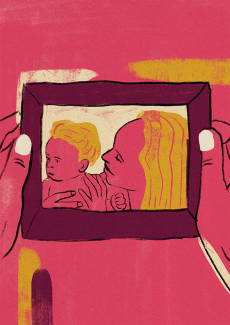
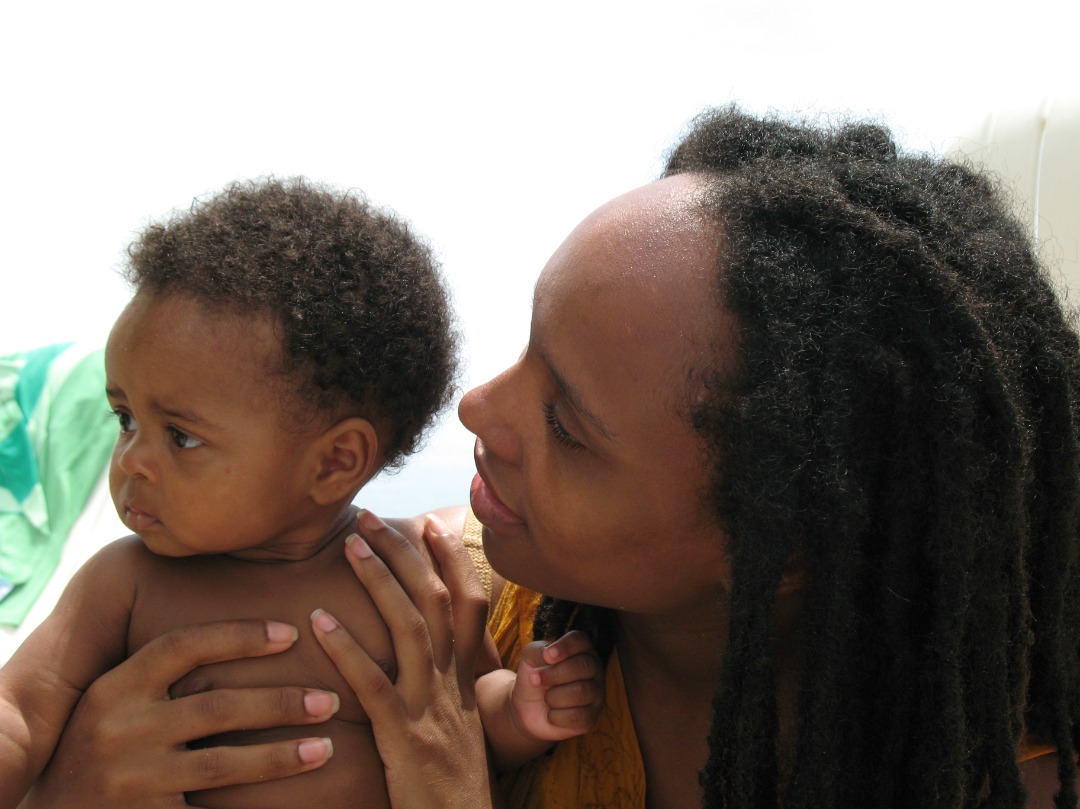
عودتي إلى حبّ الذات – أو ما أسمّيه "ولادة جديدة" – التي تتزامن مع ولادة طفلي الأوّل، وولادة نفسي، ووقوعي في حبّ حبيبتي الكويرية. (مصدر الصورة: نايكي ليدان)
ما ساعدني في ذلك هو حبّي للعمل في كافة أنحاء البلاد، وتوثيق معارف الناس. لذلك تركت مساحتى المريحة، وأصبحت مديرة قطرية لمنظّمة إقليمية كويرية. تركَّز معظم عملي على إيجاد الموارد وبناء قدرات المجتمع المدني. بنيتُ استراتيجيتي على الذهاب إلى الريف، والبحث عن كلّ المنظّمات الصغيرة، والمساعدة في بناء قدراتها وتمويلها. لم أكن مُهتمّة بالسياسيين وبمصافحتهم والتقاط الصور معهم <ضحكة>. كان لديّ حليف رائع: شارلوت جودي، الناشط الكويري الذي قُتِل قبل ثلاث سنوات في منزله. تقرّبنا كثيراً بعد حظر مهرجان أفلام أفرو كويرية في هايتي كنا نخطّط له. أحدث المهرجان ضجّة كبيرة، وأثار نقاشات عن الكويرية في كلّ مكان، لذلك قدّمني شارلوت إلى منظّمات المجتمع المدني الصغيرة، المُنتشرة في كلّ ركن من البلاد. كان عليّ أن أكون هناك لمساعدة المنظّمة (المنظّمات)، على التسجيل بشكل قانوني أو بناء خطّتها الاستراتيجية. جعلتني هذه الأعمال ناشطة كويرية، وبالتالي ناشطة في قضايا المتحوّلين/ات جنسياً. مع ذلك لا أسمّي نفسي ناشطة. إنّها كلمة ثقيلة كما تعلمين. لكنّها الصفة التي يناديك بها الناس. أعتقد أنني مجرّد عاشقة ومقاتلة <ضحكة>.
السؤال الأوّل: أخبريني عن ورشة العمل التي نظّمتها للمهرجان مع AWID. ما هو مضمونها وسياقها؟
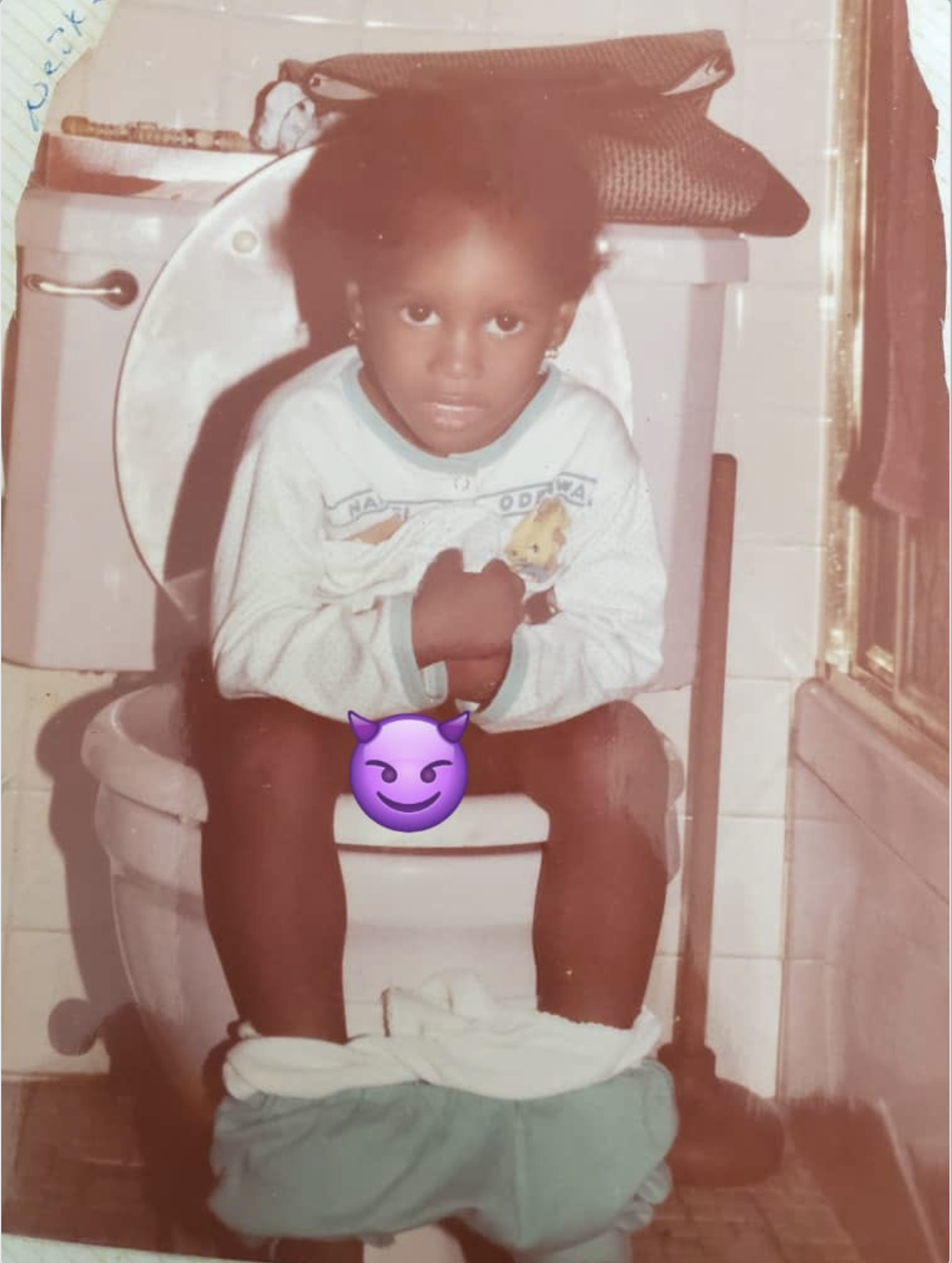
وعيي الذاتي العميق خلال سنوات طفولتي، وانخراطي في البحث عن أسباب انعدام المساواة والظلم في سنّ مُبكرة جدّاً (في الرابعة من عمري تقريباً). (مصدر الصورة: نايكي ليدان))
ا تتحدّث وسائل الإعلام الدولية عن هايتي، لكن مع وجود بيئة سياسية سيّئة فإن البيئة الاقتصادية تكون أكثر كارثية. نظراً لانتمائي إلى الطبقة الوسطى في هايتي، وتحدّثي بلغات عدّة، وامتلاكي جوازات سفر مختلفة، تردّدت بدايةً في أخذ هذه المساحة. غالباً ما أرى نفسي كجسر، لا شخص يتحدّث عن نفسه. لذلك دعوت سيمي، شابّة لامعة متحوّلة جنسياً من خارج بورت أو برنس، لتأخذ المساحة وتتحدّث عن نفسها، وترشدنا إلى واقع النساء المتحوّلات في هايتي. انتهى بنا الأمر بعقد جلسة عن النسوية غير الشمولية – أو كما أسمّيها المساحات النسوية الرسمية – وكيف أن الفتيات المتحوّلات في هايتي لا يملكن مساحات للمساهمة في التعريف عن المرأة ومشاركة واقعها. من هنا، كان مهرجان AWID فرصة لي لإعطاء مساحة للنساء اللواتي يجب أن يحصلن على فرص. أمضينا وقتاً رائعاً؛ احتسينا النبيذ أثناء جلستنا عبر الإنترنت، وشاركتنا سيمي، التي ساعدتني في إدارة الجلسة، بما يعنيه أن تكوني طفلة/ فتاة/ امرأة متحوّلة في مراحل مختلفة من حياتها، وتحدّثت عن أخطار الشارع والفقر والإقصاء والفشل في ظهورها كامرأة بعد التحوّل، وأيضاً عن انتصاراتها.
السؤال الأوّل: ما علاقة النساء المتحوّلات بالمنظّمات النسوية في هايتي؟ كيف كانت تجربتك في هذا السياق؟
لقد كانت تجربة النساء المتحوّلات صعبة، وفي الواقع مفجعة. من عدم الاعتراف بوجودهن إلى التعامل معهنّ بأسلوب جنسي مُتطرّف، فضلاً عن تعرّضهن للقتل من دون حتّى الإعلان عن هذه الحالات في الإعلام. وهو ما يعبّر عن مدى عدم الاعتراف بوجودهن، وعن كيفيّة محوهن. إنهنّ موجودات في كلّ مكان، لكن ليس في أماكن العمل، ولا في البيئات النسوية، ولا في بيئات المؤسّساتية. ولا حتّى في منظّمات مجتمع الميم. في الآونة الأخيرة فقط، ونتيجة حملات المناصرة، صحّحت بعض المنظّمات نوعاً ما هذه الوضعيّة. لكن لا يزال الأمر غير وارد في المساحات النسوية. ما زلنا مضطرّات للتعامل مع الخطاب الإقصائي القديم بـ»إنهنّ لسنا نساء. بالطبع، إذا نجحن في الظهور كنساء بعد عمليّات التحوّل...». إن ثقافة الفشل أو النجاح في التحوّل ليست إلّا محادثة عن إدارة المخاطر – إلى أي درجة ينجح التحوّل، وما الذي يعنيه لجسمكِ، والعنف الذي يلحق به. في الواقع الإقصائي للمتحوّلين/ات الذي نعيش فيه، ويُعاد إنتاجه في الكثير من المساحات النسوية، قد تُعتبر فتيات، وإلى حدّ معيّن، أولئلك اللواتي ينجحن في الظهور بما يتوافق مع الجنس الذي تحوّلن إليه. لكن ماذا عن الوقوع في الحبّ، وإجراء محادثة، وإخفاء الهوية الجنسية، والرغبة في الحصول على مظهر معيّن، أو مهنة معيّنة؟ في الحقيقة، أصبح العلاج بالهرمونات حديثاً عن الحدّ من المخاطر كما عبّرت سيمي في ورشة العمل. لكن ليس لدينا خيار العلاج الهرموني، ولا الإطار الطبي أو النظام لدعم أولئك الذين يرغبون في متابعته.
السؤال الأوّل: عندما تتحدّثين عن الطريقة التي يُنظر بها إلى الأشخاص المتحوّلين/ا جنسياً والكويريين/ات في المجتمع، يبدو أنها مشابهة لنظرة المجتمع في نيجيريا، حيث يبرز رهاب المثلية بعمق.
هايتي بلد مُعقّد للغاية وبطريقة جميلة جداً. لا يوجد شيء بسيط، كما تعلمين، لا يوجد شيء يُمكن القيام به بطريقة واحدة فقط. الهايتيون متسامحون للغاية – لكنّهم وفي الوقت نفسه يعانون من رهاب المثلية. سوف تجد مناطق في الريف، لا يعاني المقيمون فيها من رهاب المثلية على الإطلاق نظراً لوجود معابد فودو فيها، وهذه ديانة تحترم الحياة. أحد المبادئ الأساسية لديانة فودو هو عدم وجود ما هو صحيح أو خطأ. لفترة طويلة، كان الناس يعتقدون أن هايتي ملاذ ومكان حيث يعيش أناس متسامحون – نحن نتحدّث عن السبعينيات والثمانينيات وقبل انتشار فيروس نقص المناعة البشريّة، وحتّى التسعينيات. من ثمّ وقع زلزال العام 2010 وقتل نحو 300 ألف شخص، وبعدها تدفّقت كلّ هذه الأموال من جنوب الولايات المتّحدة عبر الإنجيليين لإعادة بناء البلاد والعثور على يسوع. لذلك، يُعدّ رهاب المثلية حديث النشأة في هايتي. في العمق، في روحية الثقافة، لا أستطيع القول إنّ هايتي معادية للمثليين. لكن في الحياة اليومية، من المؤكّد أن هناك عنفاً يقع على المثليين، وكذلك على النساء، والنساء الفقيرات، والنساء داكنات البشرة أيضاً، خصوصاً أنّ التمييز العرقيّ بارز جداً في منطقة الكاريبي.
السؤال الأوّل: كيف تمكّنت من إدارة الأمر؟ ما كانت استراتيجيّتك
عودتي إلى هايتي كان جزءاً من مساري الهادف نحو التخلّص من الاستعمار، وكان محاولةً منّي لموضعة حواسي وحواس عائلتي ضمن فضاءٍ يحتوي قصص التمرّد على المعيارية وعلى واقع العنصرية ضد السود. (مصدر الصورة: نايكي ليدان)
أنا أحبّ عملي حقّاً. أحبّ العمل بشكل عام. عندما وصلت، عملت بداية مع تلك المنظّمة غير الحكومية الرهيبة لكنني قمت بعمل رائع. كنت موجودة دائماً في الريف، وأتحدّث وأتعلّم من الناس والنساء. وهو ما أسعدَ قلبي لفترة طويلة لأنني أحبّ ثقافتي بشدّة، وأحبّ الأشخاص السود، والنساء السود – النساء السود المُسنّات، والأطفال السود. يملأني الأمر بروحانية. عندما كنّا في كندا، ارتاد أطفالي مدارس البيض المرموقة. لم يتحدّثوا بلغة شعب الكريول ولا الفرنسية. أمّا الآن فإنّهم يركضون بحرّية في حديقة المنزل، ويتقاتلون بلغة الكريول. أيضاً وجدت مع الأشخاص الذين قابلتهم محاور للبقاء. خلقت روابط مع الكويريين/ات وغيرهم من غريبي الأطوار مثلي. كان الأمر رائعاً حقاً. لكنّي أعاني الآن. لم أعد أشعر بالأمان في هايتي. أسبوعياً تُسجّل نحو 40 عملية خطف في بورت أو برنس – وهو وضع مستمرّ منذ العام 2018. أصبت بنوبات من القلق والذعر. لقد حان وقت الذهاب، فيما أسأل نفسي: «أين هو الوطن؟». قضيت 19 عاماً في مونتريال لكنّني لم أشعر مطلقاً بأنني في وطني. عندما غادرت، لم أفتقدها أبداً، لذلك لا أريد العودة إليها. أيضاً بكيت كثيراً مؤخّراً كوني أشعر بأنني دخلت إلى منفى ثاني.
السؤال الأوّل: كيف هي علاقتك مع المتعة والترفيه والراحة؟
علاقتي مع المتعة والترفيه والراحة مماثلة وواحدة. إنها لحظة أعيشها عندما أدلّل نفسي بحرارة الشمس على وجهي على سبيل المثال. هي المتعة والترفيه والراحة في الوقت نفسه.
المتعة: مساحتى المُفضّلة، ملاذ للاحتفال بنفسي، حيث أحفظ لنفسي القوّة والحقّ في أن أكون هادئة أو صاخبة خلال لحظات المتعة التي أختبرها. أنغمس بكلّ لحظة متعة، بما في ذلك، متعة الوحدة والصمت.
الترفيه: ركوب الدرّاجة، والمهرجانات الموسيقية، والأكل، وتذوّق النبيذ، المشاركة في رقصات الفودو الهايتية التقليدية. كلّها من ضمن الأنشطة العديدة التي أشارك فيها حالياً.
الراحة: هو ما أعيش من أجله. بما أنني شخص متفوّق وأحبّ العمل، فمن المفارقة أن أكون كسولة أيضاً. لا أحد يعلم بالأمر، لأن ما يرونه هو أنني أعمل بجدّ وبأكثر من طاقتي. إنهم لا يعرفون كيف يمكنني الانغماس في الكسل بشكل عميق وبلا تردّد.
ExploreTransnational Embodiments
This journal edition in partnership with Kohl: a Journal for Body and Gender Research, will explore feminist solutions, proposals and realities for transforming our current world, our bodies and our sexualities.
نصدر النسخة هذه من المجلة بالشراكة مع «كحل: مجلة لأبحاث الجسد والجندر»، وسنستكشف عبرها الحلول والاقتراحات وأنواع الواقع النسوية لتغيير عالمنا الحالي وكذلك أجسادنا وجنسانياتنا.