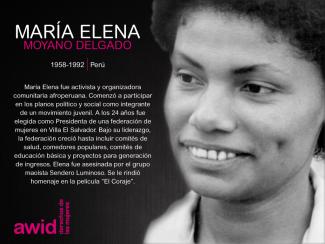
Maria Elena Moyano Delgado
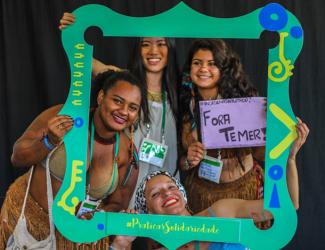
El activismo joven feminista juega un papel fundamental en las organizaciones y los movimientos por los derechos de las mujeres a nivel mundial, ya que aborda los nuevos problemas a los que las feministas se enfrentan en la actualidad. Esta fuerza, creatividad y adaptabilidad son esenciales para la sostenibilidad de la organización feminista.
A la vez, enfrentan obstáculos específicos para ejercer su activismo, como acceso limitado al financiamiento y al apoyo, falta de oportunidades de capacitación, un incremento considerable de los ataques contra las jóvenes defensoras de los derechos humanos. Esto crea una falta de visibilidad que hace más complicada su inclusión y participación efectiva en los movimientos por los derechos de las mujeres.
El programa de activismo joven feminista fue creado para garantizar que las voces de las jóvenes sean escuchadas y se vean reflejadas en el discurso feminista. Queremos garantizar que las jóvenes feministas tengan un mejor acceso al financiamiento, a las oportunidades de desarrollo de las capacidades y a los procesos internacionales.
Además de apoyar directamente a las jóvenes feministas, estamos trabajando con activistas por los derechos de las mujeres de todas las edades, con modelos y estrategias prácticas para procesos efectivos de organización intergeneracionales.
Queremos que las activistas jóvenes feministas jueguen un papel en el proceso de toma de decisiones que afectan sus derechos a través de:
Fomento de la comunidad e intercambio de información a través de la Conexión Joven Feminista. Dada la importancia de los medios virtuales para el trabajo de las jóvenes feministas, nuestro equipo lanzó la Conexión Joven Feminista en mayo de 2010 para compartir información, construir capacidades a través de seminarios web y discusiones electrónicas y para alentar la construcción de la comunidad.
Investigación y generación de conocimientos sobre el activismo joven feminista, que aumenten la visibilidad y el impacto del activismo joven feminista en los movimientos por los derechos de las mujeres y otros actores clave, como los donantes.
Promoción de procesos más efectivos de organización intergeneracional, explorando mejores formas de trabajar en conjunto.
Apoyo a la participación de las jóvenes feministas en los procesos globales de desarrollo, por ejemplo en los procesos de Naciones Unidas.
Colaboración con todas las áreas prioritarias de AWID, incluyendo el Foro, para garantizar así que las contribuciones clave de las jóvenes feministas, así como sus perspectivas, necesidades y activismo se reflejen en los debates, políticas y programas que las afectan.
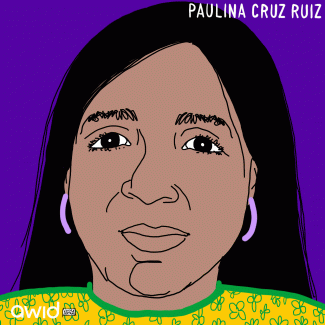
Paulina Cruz Ruiz, originaire de Rabinal dans la région de Baja Verapaz au Guatemala, était une défenseuse des droits humains au pouvoir ancestral Maya Achí (autochtone). Elle participait activement à la mobilisation et à la résistance communautaires, notamment via des mesures juridiques contre des projets miniers sur des territoires autochtones, aux effets sévères et néfastes pour leur tissu socioenvironnemental.
« Le modèle d’industrie extractive promu par le gouvernement guatémaltèque et la construction de projets de développement à grande échelle sur des terres autochtones, sans le consentement des communautés, est source de litiges constants avec les mouvements de résistance. » - Minority Rights Group International (groupe international pour les droits des minorités)
Paulina a également participé à la Marche pour la dignité, la vie et la justice, durant laquelle des milliers de guatémaltèques ont initié, le 1er mai 2019, une marche de huit jours contre la corruption et l’impunité face aux poursuites et aux assassinats de défenseur·e·s des droits humains, des terres ainsi que de leaders paysan·ne·s et autochtones.
Paulina a été assassinée le 14 septembre 2019 près de chez elle, dans le village de Xococ.
D’après Minority Rights Group International, « l’une des problématiques constantes qui affecte le plus les communautés mayas tient dans l’accroissement des activités de l’industrie minière. »
En savoir plus sur les mayas au Guatemala (en anglais)
En savoir plus sur la Marche pour la dignité, la vie et la justice (en anglais)

with Lindiwe Rasekoala, Lizzie Kiama, Jovana Drodevic, and Malaka Grant.
Un jeu de cartes pratique destiné aux collectives, qui permet d’explorer les alternatives économiques féministes et les systèmes de soins comme réponse aux crises. Pensé pour tous les mouvements qui évoluent au sein des crises climatiques mondiales, ce jeu de cartes propose de jouer et d’élaborer des stratégies en s’appuyant sur des scénarios de la vie réelle. Un moyen créatif de réfléchir aux stratégies lors de réunions, d’ateliers et de rassemblements de la communauté !
Esta política rige para todas las páginas alojadas en https://www.awid.org/ y para cualquier otro sitio web bajo el control de AWID (el «Sitio web») y para las suscripciones a estos sitios. No se aplica a páginas alojadas por otras organizaciones distintas a AWID, hacia las cuales podemos dirigir un hipervínculo y cuyas políticas de privacidad pueden ser diferentes. Por favor, lee la siguiente política para que puedas comprender nuestra política de privacidad en cuanto a su naturaleza, propósito, uso y divulgación de tu información personal e identificable que es recogida a través de este sitio web.
En general, puedes navegar este sitio web sin enviarnos información personal. Sin embargo, en algunas circunstancias, te pediremos esa información personal.
Cuando te encuentras en el sitio web y se te pide información personal, estás compartiendo esa información sólo con AWID.
1.1.1 La información que nos das para recibir actualizaciones de AWID:
Cuando te registras para usar el sitio (por ejemplo, te suscribes para recibir correos electrónicos o para solicitar membresía) nos das la información necesaria acerca de ti, como tu nombre, país, idioma, para recibir actualizaciones por correo electrónico. Nos das esta información a través de formularios seguros y es almacenada en servidores seguros.
1.1.2 La información de pago que nos das para hacerte miembrx o para anotarte en algún evento:
Además, puede ser necesario que nos des información sobre el pago cuando te haces miembrx o cuando te anotas para eventos. AWID no almacena en sus servidores ninguna información relativa a tarjetas de crédito y usa portales seguros para procesar la información relativa a pagos.
1.1.3 La información opcional que decidiste darnos (con consentimiento)
Cuando te comunicas con AWID o nos das información opcional a través de formularios en el sitio web o utilizas el sitio para comunicarte con otrxs miembrxs, recogemos información sobre tu comunicación y cualquier otra información que elijas dar.
1.1.4 Información que nos das a través de los formularios de contacto o cuando te comunicas directamente con nosotrxs
Cuando te comunicas con nosotrxs, recogemos tu comunicación y toda otra información que decidas darnos.
Además, cuando interactúas con el Sitio web, nuestros servidores pueden llevar un registro de actividad que no te identifica personalmente («Información no personal»). Por lo general, recogemos las siguientes categorías de información no personal:
Para más información sobre las cookies, por favor consulta All about cookies.
Si no deseas recibir cookies puedes cambiar fácilmente tu navegador web para que rechace las cookies o notificarte cuando recibes una nueva cookie. Puedes mirar aquí cómo hacerlo.
AWID utiliza la información que recogemos acerca de ti para:
Si te has subscrito a los boletines electrónicos de AWID o a nuestras actualizaciones por correo electrónico o si te has hecho miembrx, te enviaremos comunicaciones regularmente en la forma especificada en el área correspondiente del sitio web. Puedes cancelar la suscripción de cualquiera de los boletines electrónicos o actualizaciones de correo electrónico en cualquier momento siguiendo los pasos indicados para ello en nuestros correos.
Es importante para AWID que tu información de identificación individual sea precisa. Siempre estamos buscando cómo hacer más fácil que puedas revisar y corregir la información que AWID tiene acerca de ti en nuestro sitio web. Si cambias tu dirección de correo electrónico, o si cualquier otra información que tengamos es incorrecta o desactualizada, por favor escríbenos a esta dirección.
Con excepción de lo explicado más abajo, AWID no revelará ninguna información personal acerca de ti que sea identificable, y no venderá ni alquilará a tercerxs listados conteniendo tu información. AWID podrá revelar información cuando tenga tu permiso para hacerlo o bajo circunstancias especiales, por ejemplo cuando crea de buena fe que la ley se lo exige.
De manera permanente implementamos y actualizamos las medidas administrativas, técnicas y de seguridad física para proteger tu información de accesos no autorizados, pérdida, destrucción o alteración. Algunas de las salvaguardas que usamos para proteger tu información son cortafuegos, encriptación de datos y controles de acceso a la información. Si sabes o tiene razones para creer que tus credenciales de membresía a AWID se han perdido, han sido robadas, malversadas o comprometidas de alguna forma o en caso de que sepas o sospeches de uso no autorizado de tu cuenta de membresía a AWID, por favor ponte en contacto con nosotrxs a través de nuestra página.
Esta política puede cambiar periódicamente. La política modificada será publicada en este sitio web y al final del texto se actualizará la fecha de Última actualización. Se enviará un correo electrónico con la actualización de la política revisada y si no estás de acuerdo con ella tendrás la opción de cancelar tu suscripción o suscripciones con nosotrxs. También puedes escribirnos aquí. ¡Agradecemos tus opiniones!
Última actualización: mayo de 2019
Por primera vez, el Foro de AWID ofrece tres modos de participación:
Lxs participantes se reunirán en Bangkok, Tailandia. ¡No podemos esperar!
Mientras el capitalismo heteropatriarcal continúa forzándonos al consumismo y el acatamiento, observamos que nuestras luchas están siendo compartimentadas y separadas por fronteras tanto físicas como virtuales.
¿Cuánto sabes sobre financiamiento feminista? 📊 Pon a prueba tu conocimiento sobre la movilización de recursos para el financiamiento de la organización feminista, respondiendo al cuestionario "¿Dónde está el dinero?":
Completa el quiz en línea Descarga la versión para imprimir
Queremos expresar nuestro más sincero agradecimiento a todos los diversos grupos, colectivos y organizaciones feministas de todo el mundo que respondieron a la encuesta WITM. Su participación y sus puntos de vista han sido inestimables y enriquecerán enormemente nuestra comprensión colectiva de los recursos feministas a nivel mundial.

Ce calendrier est un cadeau que nous vous faisons à vous et aux 8 000 membres de notre communauté féministe mondiale. C’est notre promesse de moments d’activisme et de connexion pour l’année à venir. Ces derniers mois ont porté leur lot d’injustices indescriptibles. Cette année encore, continuons à cultiver la puissance du collectif, à établir des stratégies et à trouver des solutions porteuses d’espoir. Pour un monde plus juste pour toustes.
En feuilletant les pages de ce calendrier, vous remarquerez la diversité des œuvres de nos membres artistes, qui se servent de leur travail pour amplifier et relier nos différents mouvements sous le parapluie féministe. Vous retrouvez-vous dans ces pages ? Y retrouvez-vous votre mouvement, vos communautés ? Nous vous encourageons à utiliser ce calendrier utile pour marquer le temps, l’espace, mais aussi pour inscrire les possibilités d’établir des connexions avec les féministes et les activistes.
La fecha límite para proponer actividades se extiende hasta el 1ero de Febrero de 2024.
En el espíritu del tema del Foro, invitamos a proponer una diversidad de tópicos y formatos para actividades que:

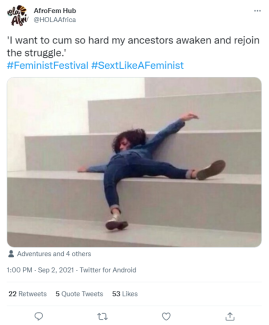
‘Quiero acabar/venirme/correrme tan fuerte que despierte a mis ancestrxs y haga que vuelvan a sumarse a la lucha’
Lisez nos recherches sur le financement, sur les défenseuses des droits humains, sur la création de mouvements, sur les fondamentalismes, la justice économique et beaucoup plus
Las realidades feministas son ejemplos palpables de los mundos justos que estamos creando conjuntamente. Existen ahora, en las múltiples formas en que vivimos, luchamos y construimos nuestras vidas.
Estas realidades feministas van más allá de la resistencia contra los sistemas de opresión, y nos muestran cómo sería un mundo sin dominación, ni explotación ni supremacía.
Estas son las historias que queremos descubrir, compartir y ampliar a lo largo de este viaje por las realidades feministas.
Creamos y difundimos alternativas: Creamos juntxs arte y expresiones creativas se centran en celebrar la esperanza, el optimismo, la sanación y la imaginación radical que inspiran las realidades feministas.
Construimos conocimiento: Documentamos, demostramos y difundimos metodologías que ayudarán a identificar las realidades feministas en nuestras diferentes comunidades.
Promovemos agendas feministas: Expandimos y profundizamos nuestro pensamiento colectivo y nuestra organización para promover soluciones y sistemas justos que encarnen valores y visiones feministas.
Movilizamos acciones solidarias: Involucramos a movimientos feministas, de derechos de las mujeres, de justicia de género y aliados para que compartan, intercambien y creen juntos realidades, narrativas y propuestas feministas en el 14º Foro Internacional de AWID.
Aunque ponemos énfasis en el proceso que lleva al Foro y en lo que ocurre después, el evento de cuatro días es un espacio importante en el que ocurre la magia que queremos crear, gracias a la energía única que despierta y a las oportunidades que se abren cuando nos reunimos.
Les dé fuerza a las Realidades Feministas al nombrarlas, celebrarlas y generar entusiasmo por las experiencias y propuestas que nos muestran de qué somos capaces, alimentando así nuestra imaginación colectiva.
Nos llene de esperanza y de energía que son combustibles tan necesarios para la resiliencia y el activismo por los derechos y la justicia
Fortalezca las conexiones, la reciprocidad y la solidaridad entre los diversos movimientos feministas, y entre ellos y otros movimientos por los derechos y la justicia
Aquí podrás leer más acerca del proceso del Foro

Comme ces tweets le montrent, sextoter comme une féministe est à la fois sexy, drôle – et chaud. Mais sans jamais perdre de vue son engagement en faveur de l’équité et de la justice.
From 27 - 30 April, 2026, AWID will be at the Women Deliver 2026 Conference, co-creating a political home with feminist and gender justice movements that is rooted in transnational care and solidarity.
In a time when fascism and militarization continue to rise globally, feminist connection and solidarity across borders is what we truly need. We are organizing multiple spaces at Women Deliver and online to connect movements with each other in conversations to build feminist agendas of solidarity and action.