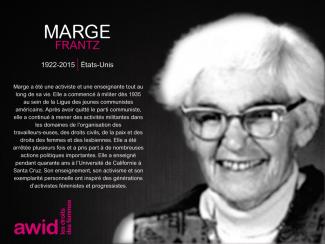
Marge Frantz
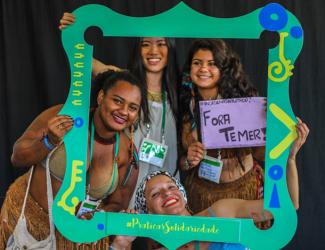
Young feminist activists play a critical role in women’s rights organizations and movements worldwide by bringing up new issues that feminists face today. Their strength, creativity and adaptability are vital to the sustainability of feminist organizing.
At the same time, they face specific impediments to their activism such as limited access to funding and support, lack of capacity-building opportunities, and a significant increase of attacks on young women human rights defenders. This creates a lack of visibility that makes more difficult their inclusion and effective participation within women’s rights movements.
AWID’s young feminist activism program was created to make sure the voices of young women are heard and reflected in feminist discourse. We want to ensure that young feminists have better access to funding, capacity-building opportunities and international processes. In addition to supporting young feminists directly, we are also working with women’s rights activists of all ages on practical models and strategies for effective multigenerational organizing.
We want young feminist activists to play a role in decision-making affecting their rights by:
Fostering community and sharing information through the Young Feminist Wire. Recognizing the importance of online media for the work of young feminists, our team launched the Young Feminist Wire in May 2010 to share information, build capacity through online webinars and e-discussions, and encourage community building.
Researching and building knowledge on young feminist activism, to increase the visibility and impact of young feminist activism within and across women’s rights movements and other key actors such as donors.
Promoting more effective multigenerational organizing, exploring better ways to work together.
Supporting young feminists to engage in global development processes such as those within the United Nations
Collaboration across all of AWID’s priority areas, including the Forum, to ensure young feminists’ key contributions, perspectives, needs and activism are reflected in debates, policies and programs affecting them.
Caroline ha estado de forma periódica en AWID; en fechas anteriores, organizó los foros de 2005 y 2008 en Bangkok y Ciudad del Cabo, y cumplió otras funciones institucionales. Antes de incorporarse a AWID, impartió clases de inglés de pregrado, luego abandonó el ámbito académico para dirigir el Festival Internacional de Cine Asiático de Toronto y trabajar en otros proyectos. En fechas más recientes, se ha desempeñado como Responsable de Operaciones en Spring Strategies. Fuera del plano laboral, Caroline generalmente puede ser hallada a su jardín, en comunión con sus queridas plantas e intentando hacer las paces con los insectos y los roedores que suelen aparecer.
Un jeu de cartes pratique destiné aux collectives, qui permet d’explorer les alternatives économiques féministes et les systèmes de soins comme réponse aux crises. Pensé pour tous les mouvements qui évoluent au sein des crises climatiques mondiales, ce jeu de cartes propose de jouer et d’élaborer des stratégies en s’appuyant sur des scénarios de la vie réelle. Un moyen créatif de réfléchir aux stratégies lors de réunions, d’ateliers et de rassemblements de la communauté !
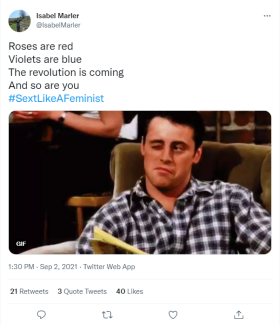
حمراء هي القلوب وزرقاء هي الهدوب هياج ستشهده الشعوب ونشوة ستُنسينا العيوب
Ekaete Judith Umoh est une défenseure internationale des droits des personnes en situation de handicap et experte en développement inclusif. Elle analyse avec finesse les questions relatives au genre, au handicap et au développement inclusif. Son rêve est d’accroître la visibilité des femmes et des filles en situation de handicap au sein du mouvement féministe international et dans tous les efforts de développement à travers le monde.
Passionnée d’activisme et de politique, Ekaete devient la première femme élue présidente de l’Association nationale des personnes en situation de handicap (Joint National Association of Persons with Disabilities, JONAPWD), au Nigéria. À ce titre, elle dirige les organisations de personnes en situation de handicap dans la lutte pour la signature de la loi nigériane sur le handicap de 2019, qu’elle défendait sans relâche depuis plus de 17 ans. Par la suite, elle rejoint CBM Global en tant que directrice nationale et joue un rôle pionnier à la tête de son équipe pendant trois ans, pour briser le cercle de la pauvreté et du handicap au Nigéria. Outre son activisme dans le domaine du handicap, Ekaete a été consultante auprès de plusieurs agences de développement, proposant son expertise technique de l’inclusion des personnes en situation de handicap dans la conception de programmes et projets.
¿Cuánto sabes sobre financiamiento feminista? 📊 Pon a prueba tu conocimiento sobre la movilización de recursos para el financiamiento de la organización feminista, respondiendo al cuestionario "¿Dónde está el dinero?":
Completa el quiz en línea Descarga la versión para imprimir
Queremos expresar nuestro más sincero agradecimiento a todos los diversos grupos, colectivos y organizaciones feministas de todo el mundo que respondieron a la encuesta WITM. Su participación y sus puntos de vista han sido inestimables y enriquecerán enormemente nuestra comprensión colectiva de los recursos feministas a nivel mundial.
Estas obras son un trabajo colaborativo de fotografías e ilustraciones realizadas por Siphumeze y Katia durante el confinamiento. Muestran narrativas negras queer de sexo y placer, bondage, sexo seguro, juguetes, salud mental y sexo, y mucho más. Fueron creadas para acompañar la antología Touch.
Alejandra se passionne pour les droits des femmes et la justice de genre. Elle rêve de créer un monde qui place le soin en son cœur, celui des personnes comme celui de la nature. Experte féministe en droits humains, elle a travaillé dans des domaines en lien avec le genre, le climat, la justice sociale et économique au sein de diverses organisations internationales. Ses domaines d’expertise comprennent le développement des connaissances et la co-création, la recherche, la facilitation et le plaidoyer. Elle est titulaire d’un master en droits humains de l’université d’Essex et a rédigé et co-élaboré de nombreuses publications, dont l’article «Enragée: Femmes et Nature». La campagne Activisme Féministe Sans Peur s’appuie sur des entretiens et des recherches menés par Alejandra.
Originaire d’Argentine, elle a vécu et travaillé dans plusieurs pays d’Europe et d’Amérique latine au cours des vingt dernières années. Alejandra aime la photographie, la mer, préparer des gâteaux avec sa fille et déguster des plats du monde entier. En tant que mère, elle met un point d’honneur à briser le cycle des schémas répétitifs transgénérationnels. Alejandra puise son énergie et son inspiration auprès des femmes extraordinaires qui font partie de sa vie, et qui vivent aux quatre coins du monde.
Lisez nos recherches sur le financement, sur les défenseuses des droits humains, sur la création de mouvements, sur les fondamentalismes, la justice économique et beaucoup plus
Nicole Barakat est une artiste queer femme de la région d’Asie du Sud-Ouest et d’Afrique du Nord, née et vivant à Gadigal (dite Sydney, en Australie). Elle emploie des processus intuitifs et d’écoute profonde visant à transformer les conditions de la vie quotidienne. Son travail fait appel à des approches non conventionnelles de la création artistique, créant des œuvres complexes qui incarnent l'amour et la patience et caractérisent les pratiques textiles traditionnelles.
AWID’s work is made possible through the financial support of a wide range of donors including multilateral and bilateral agencies, private foundations and women’s funds.
From 27 - 30 April, 2026, AWID will be at the Women Deliver 2026 Conference, co-creating a political home with feminist and gender justice movements that is rooted in transnational care and solidarity.
In a time when fascism and militarization continue to rise globally, feminist connection and solidarity across borders is what we truly need. We are organizing multiple spaces at Women Deliver and online to connect movements with each other in conversations to build feminist agendas of solidarity and action.
Please take a look at the existing propositions for inspiration before submitting your own idea. Someone might already be thinking along the same lines! Send your proposition to contribute@awid.org.
We will review and include new propositions on this webpage as they come.
Varios hombres que comparten nuestro compromiso con el feminismo y los derechos humanos de las mujeres están afiliados a AWID.
📅 Tuesday, April 28
🕒 6.30pm–9.30pm
🏢 Venue: River’s Edge, 18-31 Siddeley St
(a 5 minute walk across the river from the Melbourne Convention and Exhibition Centre)
Thank you for your enthusiasm. We're currently at capacity, but have opened a waiting list.
RSVP Required. Sign up for the waiting list!