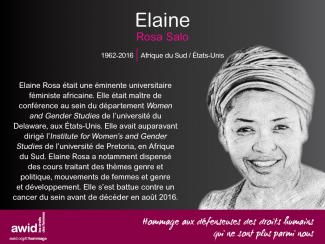
Elaine Rosa Salo
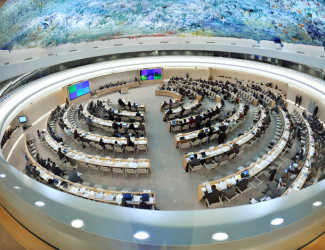
The Human Rights Council (HRC) is the key intergovernmental body within the United Nations system responsible for the promotion and protection of all human rights around the globe. It holds three regular sessions a year: in March, June and September. The Office of the UN High Commissioner for Human Rights (OHCHR) is the secretariat for the HRC.
Debating and passing resolutions on global human rights issues and human rights situations in particular countries
Examining complaints from victims of human rights violations or activist organizations on behalf of victims of human rights violations
Appointing independent experts (known as “Special Procedures”) to review human rights violations in specific countries and examine and further global human rights issues
Engaging in discussions with experts and governments on human rights issues
Assessing the human rights records of all UN Member States every four and a half years through the Universal Periodic Review
AWID works with feminist, progressive and human rights partners to share key knowledge, convene civil society dialogues and events, and influence negotiations and outcomes of the session.
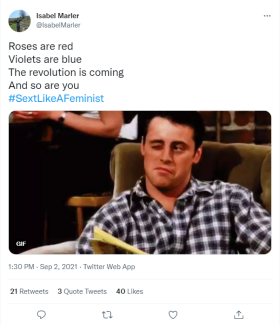
Las rosas son rojas
Las violetas son azules
Viene la revolución
Y te vienes tú
Enciende tu fuego feminista leyendo nuestras investigaciones y publicaciones varias sobre financiamiento, defensoras de derechos humanos, construcción de movimientos, fundamentalismos, justicia económica, seguimiento y evaluación feminista y más
Por primera vez, el Foro de AWID ofrece tres modos de participación:
Lxs participantes se reunirán en Bangkok, Tailandia. ¡No podemos esperar!

Nuestro Informe Anual 2013 presenta lo más destacado del trabajo que realizamos el año pasado como aporte para avanzar los derechos de las mujeres y la igualdad de género en el mundo.
El año 2013 marcó el inicio de nuestro Plan Estratégico para el período 2013-2016 que fue elaborado en respuesta al contexto mundial actual.
A continuación les acercamos los puntos destacados de nuestro análisis del contexto mundial, la posición que asumimos como organización mundial feminista y de membresía ante este contexto, los resultados que nos proponemos y cómo organizamos nuestro trabajo para alcanzarlos.
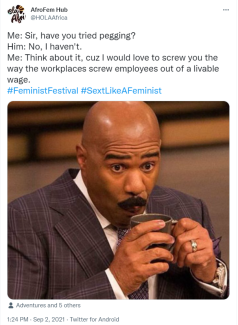
Moi : Monsieur, avez-vous essayé le pegging?
Lui : Non, madame.
Moi : Pensez-y, parce que j’aimerais bien vous baiser comme ces entreprises qui baisent leur personnel pour un salaire à peine minimum.
Du 27 au 30 avril 2026, l’AWID participera à la Conférence Women Deliver 2026, en co‑créant un espace politique avec les mouvements féministes et de justice de genre, ancré dans le care et la solidarité transnationaux.
À une époque où le fascisme et la militarisation continuent de progresser à l’échelle mondiale, la connexion féministe et la solidarité au‑delà des frontières sont plus que jamais essentielles. Nous organisons plusieurs espaces, à Women Deliver et en ligne, pour connecter les mouvements entre eux à travers des espaces de dialogue, afin de construire des agendas féministes de solidarité et d’action.
เรายินดีรับข้อเสนอกิจกรรมจากหลากหลายสาขาที่เชื่อมโยงกับแนวคิดสตรีนิยมและความยุติธรรมทางเพศ ในแบบฟอร์มใบสมัครนั้น ท่านจะสามารถทำเครื่องหมายเลือกประเด็นหลักที่เหมาะกับกิจกรรมของท่านได้ มากกว่าหนึ่งหัวข้อ

Nous avons contribué à d'importantes victoires, telles que l'élargissement du paysage du financement des droits des femmes grâce à des travaux de recherche et de plaidoyer novateurs de grande envergure. En même temps, nous avons connu des revers dévastateurs, notamment les assassinats de femmes défenseures des droits humains telles que Berta Caceres au Honduras, Gauri Lankesh en Inde et Marielle Franco au Brésil, ainsi que la montée de la mobilisation anti-droits dans les espaces voués aux droits humains.
Il y a cinq ans, nous nous sommes engagées à renforcer notre mouvement en produisant des savoirs sur les tendances des mouvements anti-droits, ainsi que sur des questions avec lesquelles les féministes s'engagent plus rarement, tels les flux financiers illicites. Nous avons mené des plaidoyers côte à côte avec nos partenaires du mouvement, renforçant ainsi l'activisme intergénérationnel et celui des jeunes féministes et élargissant la protection globale des défenseuses des droits humains. Arrivées au terme de notre plan stratégique, nous sommes fières de nos réalisations et de notre évolution en tant qu’organisation. Nous terminons l'année 2017 avec un engagement, des idées et un apprentissage renouvelés pour poursuivre la lutte à venir !
Zuhour Mahmoud is the Communication Strategist at Kohl. She is a writer and an editor, and an occasional DJ based in Berlin. Her work focuses on critical approaches to music, technology and politics and their life cycles within the digital sphere.
📅 Mardi 28 avril
🕒 6 18 h 30 – 21 h 30
🏢 Venue: River’s Edge, 18-31 Siddeley St
(à 5 minutes à pied du Melbourne Convention and Exhibition Centre, de l’autre côté de la rivière)
RSVP requis
réception pour les membres, partenaires et amis d'AWID apprenez-en plus ici !
Faits saillants de la manière dont l'AWID a contribué à la co-création et à la résistance féministes: sauvetage féministe, contrer les anti-droits, ressources, série de conversations organisées et magazine des Réalités Féministes
Tendemos a pensar en la comunicación del deseo como algo circunscrito a la intimidad de la alcoba y nuestras relaciones personales. Sin embargo, ¿podemos también pensar este tipo de comunicación como una estructura, una práctica que nutre nuestro trabajo, y cómo somos, y cómo actuamos en el mundo?
📅 27 - 28 April
From Nadi to Narrm is a two-day feminist organizing space connecting Pacific grassroots movements in Fiji to Women Deliver 2026. It brings together women, LBTQI+ people and communications in all our diversity to share lived realities and build power. Grounded in DIVA for Equality’s human rights and feminist approach, the 2-day sessions will focus on direct voices and advocacy on social, economic, ecological, gender and climate justice intersectional impacts on women and marginalized communities in Fiji.
Ritu es una tecnóloga feminista que aporta su experiencia en el sector sin fines de lucro, movida por la pasión de utilizar enfoques innovadores para encontrar soluciones tecnológicas en clave feminista. Con una maestría en Tecnología de las Aplicaciones Informáticas del Instituto de Tecnología de la India, su función en AWID abarca una diversidad de responsabilidades. Desde la supervisión de la seguridad digital y la gestión de servidores, hasta la administración de las bases de datos, pasando por el desarrollo de capacidades, la evaluación de tecnologías, la implementación de software y soluciones en la nube, Ritu vela por la resiliencia y la efectividad de la infraestructura de las tecnologías de la información de AWID. Antes de incorporarse a AWID, desempeñó un papel fundamental en la promoción de iniciativas tecnológicas en los sectores del medio ambiente y de la promoción de la salud, impulsada por su afán de aprovechar la tecnología en aras del bien social.
Más que una divertida excentricidad para explorar las sensaciones, el BDSM puede ser una forma de abordar el dolor y el trauma emocionales. Ha sido un medio de sanación sexual para mí, pues me ha permitido una forma radical de liberación.