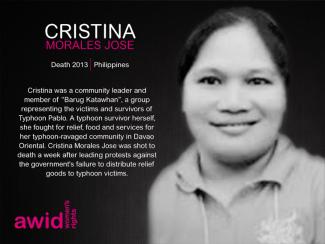
Cristina Morales Jose
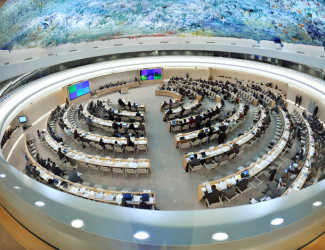
The Human Rights Council (HRC) is the key intergovernmental body within the United Nations system responsible for the promotion and protection of all human rights around the globe. It holds three regular sessions a year: in March, June and September. The Office of the UN High Commissioner for Human Rights (OHCHR) is the secretariat for the HRC.
Debating and passing resolutions on global human rights issues and human rights situations in particular countries
Examining complaints from victims of human rights violations or activist organizations on behalf of victims of human rights violations
Appointing independent experts (known as “Special Procedures”) to review human rights violations in specific countries and examine and further global human rights issues
Engaging in discussions with experts and governments on human rights issues
Assessing the human rights records of all UN Member States every four and a half years through the Universal Periodic Review
AWID works with feminist, progressive and human rights partners to share key knowledge, convene civil society dialogues and events, and influence negotiations and outcomes of the session.
نعم. ندعوكم/ن لمشاركتنا بالأمور التي تجدونها مهمة بالنسبة لكم/ن عن طريق الإجابة على الأسئلة المفتوحة في نهاية الاستطلاع.
Nous nous posons la même question et nous pensons qu'elle n’admet pas de réponse simple. Le Forum de l’AWID pourrait être, pour de nombreux participant·e·s, l'un des rares voyages internationaux qu'ils·elles effectueront au cours de leur vie. La pandémie nous a révélé les possibilités mais aussi les limites des espaces virtuels pour la construction de mouvements : rien ne vaut une rencontre en personne. Les mouvements ont besoin de connexions transfrontalières pour renforcer leur pouvoir collectif face aux menaces qui pèsent sur eux, notamment la crise climatique. Nous sommes d'avis que le prochain Forum de l'AWID pourrait ouvrir un espace stratégique afin d'organiser ces conversations et explorer les alternatives qui se posent aux voyages internationaux. L'élément hybride du Forum est une composante importante de cette exploration.
As heteropatriarchal capitalism continues to force us into consumerism and compliance, we are finding that our struggles are being siloed and separated by physical as well as virtual borders.
And with the additional challenges of a global pandemic to overcome, this divide-and-conquer strategy has been favorable for the proliferation of exploitation across many areas.
Yet, From September 1 to September 30, 2021, Crear | Résister | Transform: a festival for feminist movements! took us on a journey of what it means to embody our realities in virtual spaces. At the festival, feminist activists from across the world came together, not only to share experiences of hard-won freedoms, resistances, and cross-borders solidarities, but to articulate what a transnational form of togetherness could look like.
It is this togetherness that has the potential to defy borders, weaving a vision for a future that is transformative because it is abolitionist and anti-capitalist. Spread out over a month, across digital infrastructures that we occupied with our queerness, our resistance, and our imaginaires, the festival showed a way to deviate from the systems that make us complicit in the oppression of others and ourselves.
Though Audre Lorde taught us that the master’s tools will never dismantle the master’s house, Sara Ahmed showed us that we can misuse them. Because we had to make space for assembly, in spite of all the other demands on our time, it became possible to imagine a disruption to the reality of heteropatriarchal capitalism.
Now, if we understand assembly as a form of pleasure, then it becomes possible to make the link between transgressive pleasure and transnational/transdigital resistance. Between the kinds of pleasure that challenges borders on the one hand, and queerness, campiness, land and indigenous struggle, anti-capitalism, and anti-colonial organizing on the other.
This issue attempted to capture a sense of how the festival’s exercise in assembly took on multiple shapes and imaginations. Beyond direct collaborations with some of its speakers and dreamers, we brought on a plethora of other voices from the Global South to be in conversation with many of its themes and subjects. Below is a map of some of the festival’s panels that most inspired us.
English body
Florence was a disability rights activist who worked with several disabled women’s organizations in Uganda.
She also held the position of Chairperson of the Lira District Disabled Women Association, as well as the Lira District Women Councilors’ caucus. Trained as a counsellor for persons with disabilities and parents of children with disabilities, she supported many projects that called for greater representation of persons with disabilities.
She died of a motorcycle accident.

Да. Ваши ответы будут удалены по окончании обработки и анализа данных и будут использованы исключительно в исследовательских целях. Данные НИКОГДА не будут переданы за пределы AWID и будут обрабатываться только сотрудниками AWID и консультантками(-тами), работающими с нами над проектом «Где деньги?». Для нас ваша конфиденциальность и безопасность– приоритет. С нашей политикой конфиденциальности можно подробно ознакомиться здесь.
con Nazik Abylgaziva, Amaranta Gómez Regalado, Cindy Weisner y Lucineia Freitas
Une étudiante, une scénariste, une leader, une avocate. Les quatre femmes auxquelles nous rendons hommage ci-dessous avait toutes leur propre façon de vivre leur activisme, mais elles avaient en commun la promotion et la défense des droits des personnes lesbiennes, gaies, bisexuelles, trans*, queer et intersexes. Nous vous invitons à vous joindre à nous pour commémorer ces défenseuses, leur travail et l'héritage qu’elles nous ont laissé. Faites circuler ces mèmes auprès de vos collègues et amis ainsi que dans vos réseaux et twittez en utilisant les hashtags #WHRDTribute et #16Jours.
S'il vous plaît cliquez sur chaque image ci-dessous pour voir une version plus grande et pour télécharger comme un fichier


Nadine fue un ejemplo para muchxs por su trabajo en apoyo de las mujeres y lxs más vulnerables de su comunidad. Estaba comprometida con ayudar a l pobres, especialmente a las personas sin techo.
Aunque su muerte se informó como accidente, la familia Ramaroson, encabezada por su padre, André Ramaroson, llevó adelante una investigación que arrojó evidencias de que había sido asesinada. Se informó que había muerto en un accidente fatal ocurrido entre Soanierano - Ivongo y Ste Marie, una historia que fue desmentida por su familia. Ella había recibido numerosas amenazas de muerte por sus audaces posiciones políticas. Su caso todavía está en la corte de Antananarivo (la capital de Madagascar).

O nosso objetivo é alcançar um total de 2000 respostas, quase o dobro do último questionário WITM em 2011.
6 Women Human Rights Defenders (WHRDs) across Western and Southeastern Europe have in their lifetime researched, campaigned, participated in and advanced peace and women’s rights movements be it through political and social activism or through dance. We are grateful for the legacy they have left. Please join AWID in honoring these women, their activism and legacy by sharing the memes below with your colleagues, networks and friends and by using the hashtags #WHRDTribute and #16Days.
Please click on each image below to see a larger version and download as a file


"He dado testimonio de la discriminación que vi en las calles, he sufrido burlas y abusos verbales ahí. También he hecho numerosas amistades y he conocido a mucha gente. Puede que haya peligros ahí fuera, pero soy una sobreviviente y aquí es donde estaré por ahora." - Sainimili Naivalu
Exigió a las autoridades políticas y a otras partes interesadas que proporcionaran políticas y servicios favorables a la movilidad de las personas con discapacidad, como la construcción de rampas en pueblos y ciudades para aumentar su accesibilidad. Sin embargo, las barreras físicas no fueron las únicas que Sainimili se esforzó por cambiar. Por experiencia propia, sabía que era necesario que se produjeran cambios más complejos en las esferas sociales y económicas. Muchos de los retos a los que se enfrentan las personas con discapacidad tienen su origen en actitudes que llevan a la discriminación y al estigma.
Como sobreviviente y luchadora, Sainimili contribuyó a la creación conjunta de realidades feministas que fomentasen la inclusión y cambiasen las actitudes hacia las personas con discapacidad. Como afiliada a la Asociación de Lesiones de la Espina Dorsal de Fiji (SIA, por sus siglas en inglés) y a través del proyecto del Foro para Personas con Discapacidades del Pacífico “Pacífico Habilita”, Sainimili asistió a la formación de la Organización Internacional del Trabajo "Inicie su Negocio" en Suva, lo que le permitió transformar sus ideas en su propio negocio. Fue emprendedora en el puesto 7 del mercado de Suva, donde ofrecía servicios de manicura, y también se encargaba del puesto del mercado de las mujeres de SIA, donde vendía artesanías, sulus y otros objetos. El plan de Sainimili era expandir su negocio y convertirse en una importante empleadora de personas con discapacidad.
Además de su activismo, también fue medallista y campeona juvenil de tenis de mesa.
Sainimili era única, con una personalidad vivaz. Siempre podías saber si Sainimili estaba en una habitación porque su risa y sus historias eran los primero que notabas. - Michelle Reddy
Sainimili falleció en 2019.