
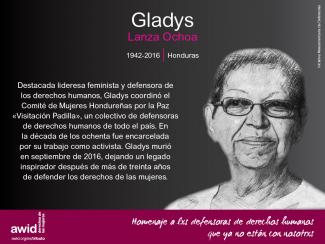
Berta Cáceres Flores
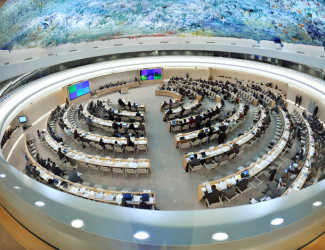
The Human Rights Council (HRC) is the key intergovernmental body within the United Nations system responsible for the promotion and protection of all human rights around the globe. It holds three regular sessions a year: in March, June and September. The Office of the UN High Commissioner for Human Rights (OHCHR) is the secretariat for the HRC.
Debating and passing resolutions on global human rights issues and human rights situations in particular countries
Examining complaints from victims of human rights violations or activist organizations on behalf of victims of human rights violations
Appointing independent experts (known as “Special Procedures”) to review human rights violations in specific countries and examine and further global human rights issues
Engaging in discussions with experts and governments on human rights issues
Assessing the human rights records of all UN Member States every four and a half years through the Universal Periodic Review
AWID works with feminist, progressive and human rights partners to share key knowledge, convene civil society dialogues and events, and influence negotiations and outcomes of the session.
Ritu est une technologue féministe qui apporte son expérience au secteur non lucratif, animée par une passion pour l'utilisation d'approches innovantes pour trouver des solutions technologiques féministes. Titulaire d'un master en technologie des applications informatiques de l'Institut indien de technologie, son rôle au sein de l'AWID couvre un large spectre de responsabilités. De la supervision de la sécurité numérique et gestion des serveurs à l'administration des bases de données, en passant par le renforcement des capacités, l'évaluation technologique, la mise en œuvre de logiciels et de solutions cloud, Ritu veille à ce que l'infrastructure informatique de l'AWID soit résiliente et efficace. Avant de rejoindre l'AWID, elle a joué un rôle central dans l'avancement des initiatives technologiques des secteurs de la promotion de la santé et de l'environnement, alimentée par son engagement à tirer parti de la technologie pour le bien social.
نرحب بالطلبات عبر مجموعة كاملة من المواضيع والتقاطعات المهمة للحركات النسوية وحركات العدالة الجندرية.
Zuhour Mahmoud es la estratega de comunicación de Kohl. Es una escritora y editora y una DJ ocasional radicada en Berlín. Su trabajo se centra en los enfoques críticos a la música, la tecnología y la política y sus ciclos de vida en la esfera digital.
Feminist Realities are the living, breathing examples of the just world we are co-creating. They exist now, in the many ways we live, struggle and build our lives.
Feminist Realities go beyond resisting oppressive systems to show us what a world without domination, exploitation and supremacy look like.
These are the narratives we want to unearth, share and amplify throughout this Feminist Realities journey.
Create and amplify alternatives: We co-create art and creative expressions that center and celebrate the hope, optimism, healing and radical imagination that feminist realities inspire.
Build knowledge: We document, demonstrate & disseminate methodologies that will help identify the feminist realities in our diverse communities.
Advance feminist agendas: We expand and deepen our collective thinking and organizing to advance just solutions and systems that embody feminist values and visions.
Mobilize solidarity actions: We engage feminist, women’s rights and gender justice movements and allies in sharing, exchanging and jointly creating feminist realities, narratives and proposals at the 14th AWID International Forum.
As much as we emphasize the process leading up to, and beyond, the four-day Forum, the event itself is an important part of where the magic happens, thanks to the unique energy and opportunity that comes with bringing people together.
Build the power of Feminist Realities, by naming, celebrating, amplifying and contributing to build momentum around experiences and propositions that shine light on what is possible and feed our collective imaginations
Replenish wells of hope and energy as much needed fuel for rights and justice activism and resilience
Strengthen connectivity, reciprocity and solidarity across the diversity of feminist movements and with other rights and justice-oriented movements
Learn more about the Forum process
We are sorry to announce that the 14th AWID International Forum is cancelled
Given the current world situation, our Board of Directors has taken the difficult decision to cancel Forum scheduled in 2021 in Taipei.
Ce fanzine collectif est issu d’une série de cercles de partage organisés en 2022, rassemblant des féministes des quatre coins du monde. Ces rencontres visaient à partager des expériences et à s’enrichir mutuellement pour découvrir comment les communautés réagissent à la crise climatique dans divers contextes locaux.
Marianne Mesfin Asfaw is a Pan-African feminist who is dedicated to social justice and building community. She has a BA in Gender Studies and International Relations from the University of British Columbia (UBC), and an MA in Gender Studies and Law from SOAS University of London. She has previously worked in academic administration and international student support, and has worked as a researcher and facilitator in feminist and non-profit spaces. She has also worked and volunteered at non-governmental organizations including Plan International in administrative roles. Prior to taking up her current role she worked in logistics and administrative support at AWID. She is from Ethiopia, was raised in Rwanda and is currently based in Tkaronto/Toronto, Canada. She enjoys reading, traveling and spending time with her family and friends. In the warmer months she can be found strolling around familiar neighborhoods in search of obscure cafés and bookstores to wander into.
On pense souvent que la communication de notre désir se cantonne à l’intimité des quatre murs de nos chambres et à nos relations personnelles. Mais est-il également possible d’envisager ce genre de communication comme étant structurelle, une pratique qui éclairerait notre travail et la manière dont nous sommes, dont nous existons dans le monde?
Cuando les líderes se reúnen en Brasil, los movimientos feministas hacemos incidencia, nos congregamos y alteramos el statu quo. Nos dirigimos, junto con otres feministas a Belém (Brasil) del 10 al 21 de noviembre de 2025. Allí continuaremos denunciando las soluciones falsas
Umyra Ahmad es una feminista de Malasia con antecedentes en incidencia política internacional y regional y educación en derechos humanos. En AWID, trabaja en la incidencia de los derechos asociados con el género y la sexualidad en las Naciones Unidas. Antes de incorporarse, se desempeñaba como oficial de programa en International Women’s Rights Action Watch Asia y el Pacífico (IWRAW, Observatorio Internacional de los Derechos de las Mujeres), donde colaboró con organizaciones regionales, nacionales y de base en el uso de mecanismos de los órganos de tratados de las Naciones Unidas como herramientas para la rendición de cuentas de los Estados y el acceso a la justicia. En Malasia, trabaja con colectivos queer y de personas refugiadas y brinda apoyo en las tareas de coordinación de diferentes iniciativas de ayuda mutua.
Plus qu’une entorse amusante pour explorer des sensations, le BDSM peut être un moyen d’aborder la douleur émotionnelle et les traumatismes. Cela a été pour moi un moyen de guérison sexuelle, offrant une forme radicale de libération.
Lisez nos recherches sur le financement, sur les défenseuses des droits humains, sur la création de mouvements, sur les fondamentalismes, la justice économique et beaucoup plus
Joanne est une féministe africaine passionnée par le démantèlement des inégalités de genre sur le continent africain. Elle a travaillé avec un certain nombre d'organisations mondiales, de médias et de think tanks, dont entre autres Amnesty International, Wrthy, le Local Development Research Institute, la BBC et la East African Community (EAC). Elle siège au sein de plusieurs conseils d'administration, dont celui de Freely in Hope, une ONG basée au Kenya et en Zambie, qui souhaite outiller les survivant·e·s et les défenseur·e·s dans leur lutte contre les violences sexuelles, et celui de Msingi Trust, un mouvement d'activistes qui se réunissent à la croisée de la foi et des droits humains. Elle est titulaire d'un master en gestion d’affaires, d'un master en politiques publiques et d'une licence en droit. Elle est accro aux livres, avec un penchant pour la fiction.
5 de la tarde, hoy.
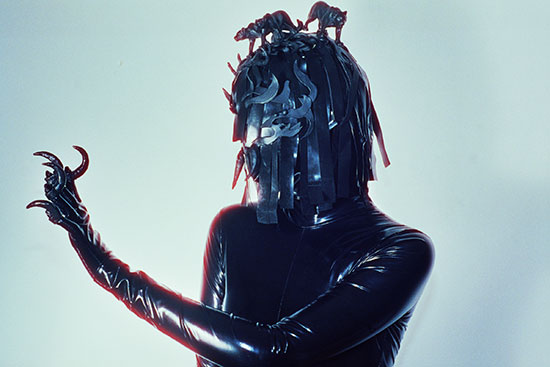

La escritura a mano de la invitación—
enroscada y brusca—
la he visto cinco veces en cinco años.
Mi cuerpo se activa,
afiebrado.
Necesito cogerme a mí misma antes.
La marea está alta esta noche y
yo
acabo/me corro.
Quiero bajar la velocidad de todo,
saborear el tiempo y el espacio, grabarlos
en la memoria.
*
Nunca he estado antes en esta parte de la ciudad.
Los lugares desconocidos me excitan,
la forma en que las extremidades y las venas
y los huesos
resisten a la descomposición,
su destino incierto.
En la puerta, lo pienso dos veces.
El vestíbulo está oscuro como el carbón
y me hace detenerme.
Del otro lado,
un portal de olor y color
se abre como una maldición
a una tarde soleada.

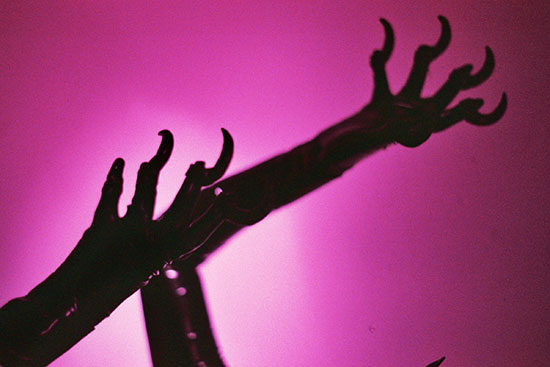
La brisa
hace bailar mi cabello,
despierta su curiosidad,
lo obliga a moverse.
Oigo chirriar la silla de ruedas,
dando forma a las sombras.
Entonces lx veo:
un rostro de lince
y un cuerpo como el mío
y me encuentro deseando a ambos
de nuevo.
La criatura me hace señas para que me acerque.
Sus gestos escriben una oración;
mientras me muevo hacia ellx
noto sus detalles:
marchitarse, carne, deleite
A su orden, la enredadera que cubre el vestíbulo
abrazando piedras tibias
serpentea hacia arriba por la pared.
Se convierte en un verbo,
«trepar»,
y me reoriento cuando sus garras apuntan
al cantero de la enredadera en el centro.
Oigo las ruedas detrás de mí,
luego ese sonido.
Reverbera
como ningún otro.
Sus largas alas negras
se elevan hacia el cielorraso
y después se lanzan hacia adelante.
La visión felina examina cada detalle,
cada cambio,
cada anhelo.
¿Puede el deseo licuar tus músculos?
¿Puede actuar más dulce que el
tranquilizante más potente?

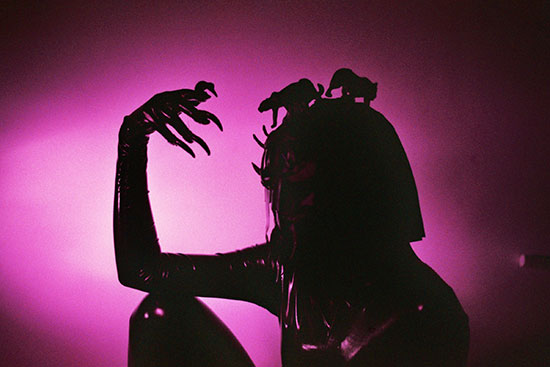
Un lince cose el mundo
a través de nuestras diferencias
tejiendo encaje alrededor de mis rodillas.
¿Puede el deseo aplastar la distancia del mundo, comprimiendo los segundos?
Se acerca todavía más,
el ojo de lince encontrando el ojo humano,
olfateando el aire,
convirtiendo al cuerpo en
urgencia.
Ellx agita sus alas.
Atizadas,
las lianas se enmarañan alrededor de mi cintura/residuo.
Su lengua adelgaza el tiempo,
moviendo los suelos,
calma, con su magia,
lo que se aviva debajo.
Veo el mundo en ti, y el mundo
está exhausto.
Entonces ellx suplica:
Déjame hacer de tí mi banquete.
Sign up to be an AWID member to connect with 9,600+ global feminist movements and co-create a range of platforms and spaces designed especially for activists and organizations from teach-ins to solidarity spaces and member mixers.
The AWID Membership community is available as an app. Download the app and start connecting with movements!
 |
 |
Veena Singh is a Fiji Islander, feminist, and woman of colour. Born and raised in a small rural town in Fiji, she draws strength from her rich mixed heritage (her mother is an Indigenous Fijian woman and her father is Fijian of Indian descent). Veena’s identity and lived experiences deeply inform her commitment to justice, equity, and inclusion. With over two decades of experience in human rights, gender equality, community development, and social inclusion, Veena is a passionate advocate for shifting power to create transformative change and for building an “economy of kindness”. Her work spans diverse areas including community development; women, peace and security; social policy; human rights; and policy advocacy.
Veena is deeply committed to advancing inclusion, peace and justice, sexual and reproductive health and rights (SRHR), climate justice, transitional justice, and human rights. She brings a wealth of experience working across grassroots networks, international organizations, and government institutions, always centering community and locally led approaches and feminist principles.
Outside of her ‘office life’, Veena is an environmental advocate, mental health champion, and writer. She is a mum to 11 cats, a saree wearer, and a lover of snail-mails and postcards. A thoughtful observer of feminist movements in Fiji and the Pacific, Veena is on a personal journey to “decolonise the mind and the self through radical self-reflection.” Above all, she is driven by a desire and dream to produce relatable, resonant writing that connects with the Pacific diaspora and amplifies voices from the margins.