L´AWID est une organisation féministe mondiale qui consacre ses efforts à la justice de genre, au développement durable et aux droits humains des femmes
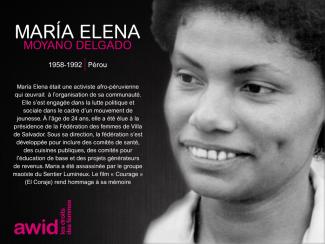
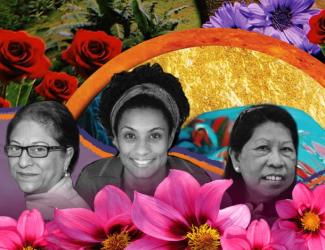
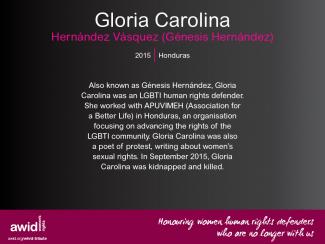
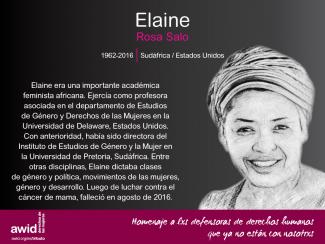
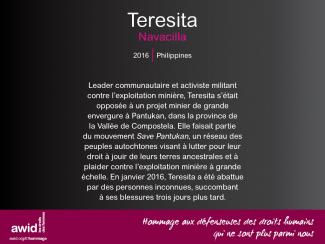
L’hommage se présente sous forme d’une exposition de portraits d’activistes du monde entier qui ne sont plus parmi nous qui ont lutté pour les droits des femmes et la justice sociale.
En 2020, nous adoptons une démarche légèrement différente
Cette année, tout en continuant à convoquer la mémoire de celleux qui ne sont plus parmi nous, nous souhaitons célébrer leur héritage et souligner les manières par lesquelles leur travail continue à avoir un impact sur nos réalités vécues aujourd’hui.
49 nouveaux portraits de féministes et de défenseur·e·s viennent compléter la gallerie. Bien que de nombreuses des personnes que nous honorons dans cet hommage sont décédé·e·s du fait de leur âge ou de la maladie, beaucoup trop d’entre iels ont été tué·e·s à cause de leur travail et de qui iels étaient.
Les histoires des activistes à l'honneur dans cet Hommage font vivre leur héritage et continuent d'inspirer le travail et l’action de nos mouvements.
Les portraits de l'édition 2020 ont été illustrés par Louisa Bertman, artiste et animatrice qui a reçu plusieurs prix.
L’AWID tient à remercier nos membres, les familles, les organisations et les partenaires qui ont contribué à cette commémoration. Nous nous engageons auprès d’elleux à poursuivre le travail remarquable de ces féministes et défenseur·e·s et nous ne ménagerons aucun effort pour que justice soit faite dans les cas qui demeurent impunis.
« Ils ont essayé de nous enterrer. Ils ne savaient pas que nous étions des graines » - Proverbe mexicain
L'Hommage a été inauguré en 2012
Le premier hommage aux défenseur-e-s des droits humains a pris la forme d’une exposition de portraits et de biographies de féministes et d’activistes disparu·e·s lors du 12e Forum international de l’AWID en Turquie. Il se présente maintenant comme une gallerie en ligne, mise à jour chaque année.
Depuis, 467 féministes et défenseur-e-s des droits humains ont été mis·es à l'honneur.
Desk research can be done throughout your research. It can assist you with framing, help you to choose survey questions and provide insights to your results.
Conducting desk research throughout your research process can assist you with framing, help you to choose survey questions and provide contextual clarity or interesting insights to your survey results, such as comparing similarities and differences between your survey results and information produced by civil society and donors.
Perhaps you notice trends in your survey data and want to understand them.
For example, your survey data may reveal that organization budgets are shrinking, but it cannot tell you why this is happening. Reviewing publications can give you context on potential reasons behind such trends.
Desk research also ensures you are building your research on the existing knowledge regarding your topic, confirming the validity and relevance of your findings.
They may be complimentary or contradictory to existing knowledge, but they must speak to existing data on the topic.
To ensure comprehensive research of the entire funding landscape related to your topic, look at a diverse set of funding sectors.
You can consider:
Women’s Funds
Private and Public Foundations
International Non-Governmental Organizations (INGOs)
Bilateral and Multilateral Agencies
Private Sector Actors
Individual Philanthropists
Crowdfunders
Include any other relevant sectors to this research.
For example, you may decide that it is also important to research local non-governmental organizations (NGOs).
Potential sources for desk research (non-exhaustive)
1. Donors’ websites and annual reports
These are direct sources of information about what funders are actually doing and generally contain information on policies and budgets. Researching this before interviewing donors can result in more focused questions and a stronger interview.
🎯 Jeu de cartes : S’organiser. Créer des stratégies. Se mobiliser.
Un jeu de cartes pratique destiné aux collectives, qui permet d’explorer les alternatives économiques féministes et les systèmes de soins comme réponse aux crises. Pensé pour tous les mouvements qui évoluent au sein des crises climatiques mondiales, ce jeu de cartes propose de jouer et d’élaborer des stratégies en s’appuyant sur des scénarios de la vie réelle. Un moyen créatif de réfléchir aux stratégies lors de réunions, d’ateliers et de rassemblements de la communauté !
CFA 2023 - Hybrid like never before: in person - ES
Híbrido como nunca antes
Por primera vez, el Foro de AWID ofrece tres modos de participación:
Participación presencial
Lxs participantes se reunirán en Bangkok, Tailandia. ¡No podemos esperar!
Crear | Résister | Transform: un recorrido por el Festival - smaller snippet
Crear | Résister | Transform: un recorrido por el Festival
Mientras el capitalismo heteropatriarcal continúa forzándonos al consumismo y el acatamiento, observamos que nuestras luchas están siendo compartimentadas y separadas por fronteras tanto físicas como virtuales.
Pensamos que la economía, el mercado, el sistema financiero y las premisas sobre las que se basan son todas áreas fundamentales para la lucha feminista.
Por eso, nuestra visión de una economía justa va más allá de promover los derechos y el empoderamiento de las mujeres en una economía de mercado, sino que busca evaluar el rol que juegan las opresiones de género en dar forma al modelo económico y ver como podemos transformarlo para garantizar la justicia de género y económica.
El proceso
No estamos comenzando de cero ni estamos solas en nuestro intento de presentar propuestas feministas para una economía justa. Muchas de nuestras propuestas ya han sido presentadas o existen en la práctica de las diversas comunidades que confrontan y desafían a los sistemas económicos dominantes basados en el mercado y el crecimiento.
También somos concientes de las limitaciones que algunas alternativas presentan para abordar las injusticias del actual sistema capitalista a escala global. No siempre las propuestas a nivel micro son la respuesta a los problemas macro, si bien representan espacios importantes de resistencia y construcción de movimientos.
Metas
Sin embargo, las alternativas feministas para una economía justa son fundamentales para socavar el sistema y para aprender a generar cambios transformadores y sistémicos. No podemos presumir de ofrecer un relato exhaustivo ni completo acerca de cómo crear un modelo económico feminista justo, o varios modelos de esa clase. Lo que sí podemos hacer es recoger elementos de diálogos con otros movimientos (sindicales, ambientales, rurales y de campesinxs) para formular propuestas que nos permitan acercanos a esa visión.
¿Qué queremos cambiar?
El modelo neoliberal que dirige la economía global ha demostrado una y otra vez su incapacidad para hacer frente a las causas estructurales de la pobreza, las desigualdades y la exclusión. Lo que en realidad ha hecho el neoliberalismo ha sido contribuir a crear y exacerbar esas injusticias.
En estas últimas tres décadas, las políticas dominantes para el desarrollo se han caracterizado por la globalización, liberalización, privatizaciones, financialización y ayudas condicionadas, y han destrozado los medios de vida de la población. El recorrido de estas políticas también ha estado marcado por la profundización de desigualdades, las injusticias con marca de género y la destrucción ambiental que el mundo ya no puede continuar soportando.
Hay quienes no dudan en sostener que el crecimiento económico, que debe ser facilitado dando plena libertad a las grandes corporaciones y empresas, puede generar y sostener una una marea alta que (con el tiempo) levante todos los barcos.
Sin embargo, la noción de desarrollo que ha prevalecido durante las últimas décadas, construida sobre la premisa de un crecimiento económico ilimitado, está atravesando una crisis ideológica.
El mito del crecimiento económico como panacea para todos nuestros problemas está perdiendo cada vez más prestigio.
Clone of Clone of Clone of Clone of Clone of Snippet - Intro WITM - ES
«¿Dónde está el dinero para las organizaciones feministas?»
¿Cuánto sabes sobre financiamiento feminista? 📊 Pon a prueba tu conocimiento sobre la movilización de recursos para el financiamiento de la organización feminista, respondiendo al cuestionario "¿Dónde está el dinero?":
Queremos expresar nuestro más sincero agradecimiento a todos los diversos grupos, colectivos y organizaciones feministas de todo el mundo que respondieron a la encuesta WITM. Su participación y sus puntos de vista han sido inestimables y enriquecerán enormemente nuestra comprensión colectiva de los recursos feministas a nivel mundial.
CFA 2023 - Call for Activities is live- ES
¡Comienza la Convocatoria para Actividades!
La fecha límite para proponer actividades se extiende hasta el 1ero de Febrero de 2024.
En el espíritu del tema del Foro, invitamos a proponer una diversidad de tópicos y formatos para actividades que:
Faciliten la conexión e interacción genuina entre lxs participantes;
Promuevan la sanación y regeneración de distintas formas, como personas individuales, comunidades y movimientos;
Nos inspiren y desafíen para florecer juntxs como comunidades y movimientos.
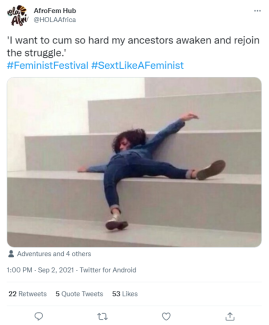
#1 - Sexting like a feminist Tweets Snippet ES
Y mi número 1: porque sabes que la cosa va en serio cuando se invoca a los poderes superiores
‘Quiero acabar/venirme/correrme tan fuerte que despierte a mis ancestrxs y haga que vuelvan a sumarse a la lucha’
La recherche de moyens alternatifs de production alimentaire fondés sur la durabilité environnementale gagne du terrain dans toutes les régions du monde. Cette quête mondiale présente une caractéristique centrale : la nécessité de mobiliser les populations rurales, en particulier les femmes, tenant compte de leurs priorités et de leurs connaissances locales par le truchement de l’agroécologie.
Définition
L’agroécologie est une façon de pratiquer l'agriculture ou de faire appel aux technologies qui ne nuit pas à l'environnement. Cette approche propose de rompre avec le modèle de développement rural hégémonique reposant sur les grandes exploitations et la monoculture qui profitent essentiellement aux entreprises agricoles et renforcent l'exclusion sociale.
Dans le contexte de l'agriculture familiale, l'agroécologie représente une forme de résistance au modèle de développement actuel et aux problèmes sociaux, culturels, environnementaux et économiques que ce modèle implique. L’agroécologie se pose en alternative face au manque d'autonomie financière des agriculteur-trice-s et symbolise une résistance face au modèle d'agroentreprises actuel.
Perspective féministe
Il se pourrait que les efforts uniquement axés sur l'agroécologie ne suffisent pas à résoudre tous les problèmes de la marginalisation et de l'invisibilité des femmes. Il est alors crucial d’adopter une perspective féministe afin d'analyser les normes associées à la notion de famille telle qu'actuellement constituée en tant qu'institution parfaite, ainsi que les normes relatives à la condition de subordination des femmes.
Plus simplement, il importe d'inclure une réflexion sur les rôles de genre socialement construits pour faire avancer le potentiel émancipateur de l'agroécologie dans ce débat.
Lisez nos recherches sur le financement, sur les défenseuses des droits humains, sur la création de mouvements, sur les fondamentalismes, la justice économique et beaucoup plus
Comme ces tweets le montrent, sextoter comme une féministe est à la fois sexy, drôle – et chaud. Mais sans jamais perdre de vue son engagement en faveur de l’équité et de la justice.
Les Etats membres et les défenseur-e-s et organisations des droits des femmes se réuniront au siège des Nations Unies à New York du 13 au 24 mars pour la 61ème édtion de la Commission de la condition de la femme, afin d’aborder le thème de l’« autonomisation économique des femmes » dans le cadre de l'objectif 5 pour le développement durable.
Alors que nous avons hâte de retrouver quelques un-e-s d'entre vous à New-York, nous souhaitons aussi impliquer celles et ceux qui ne peuvent pas être présent-e-s à la CSW et être votre porte-voix dans les espaces pertinents.
Poursuivez votre lecture pour savoir comment participer à la CSW aux côtés de l’AWID, que vous soyez sur place ou non.
Participez à une prise de contrôle artistique !
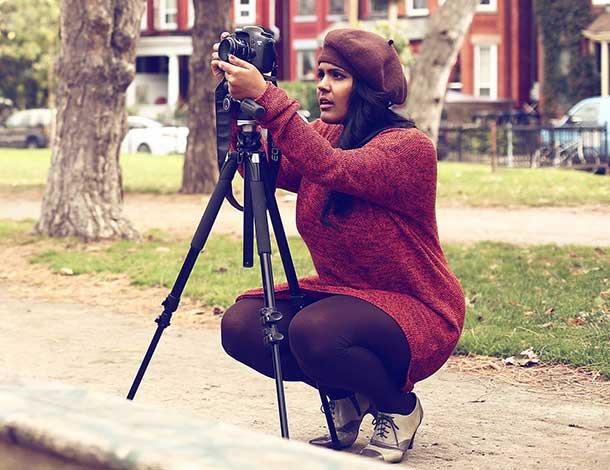
C'es un plaisir pour nous que Nayani Thiyagarajah, membre de l’AWID, assistera à la CSW cette année et qu’elle sera en charge du compte Instagram de l’AWID.
Là-bas, elle sera disponible pour rencontrer d’autres membres qui pourront éventuellement figurer sur notre Instagram. Elle explorera par ailleurs les possibilités d’inclure certain-e-s membres de l’AWID dans un court-métrage sur le thème ‘le privé est politique’, qui retracera l’histoire de la participation de Nayani à la CSW de cette année.
Nayani Thiyagarajah
Qui est Nayani?
Nayani Thiyagarajah est une directrice, productrice et écrivaine qui se consacre à porter des histoires à l’écran. Fille de la diaspora tamoule, elle appelle désormais Toronto sa ville. Pendant plus de 10 ans, Nayani a travaillé dans l’industrie des arts et de la culture. Son premier long-métrage documentaire indépendant, Shadeism: Digging Deeper (2015), fut présenté en première au Festival international du film de Zanzibar, où il obtint le Prix spécial du jury. Avec son partenaire de production Camaro West, Nayani a récemment lancé [RE]FRAME, une compagnie de production basée à Atlanta et à Toronto qui s’attache à reformuler les récits concernant les noir-e-s, les autochtones et d’autres personnes de couleur à travers des narrations portées à l’écran.
Plus sérieusement, il convient de mentionner que Nayani a un rire étrange, qu’elle est assez maladroite et qu’elle a toujours la tête dans les nuages. Pour elle, c’est une chance incroyable d’inventer des histoires pour l’écran et de s’amuser à faire croire, et de pouvoir en vivre. Elle croit en l’amour par-dessus tout.
Vous avez envie de rencontrer Nayani et d’être pris-e en compte pour figurer dans son film ?
Envoyez un e-mail à membership@awid.org en précisant dans la ligne d’objet « CSW: Prise de contrôle artistique »
Avant le 13 mars 2017
Merci d’inclure votre nom complet et votre lieu de résidence.
Vous ne pouvez pas assister à la CSW ? Exprimez-le !
Si vous êtes dans l’incapacité d’assister à la CSW61 en raison d’une interdiction de voyager, qu’elle ait été imposée par l’administration Trump ou par votre propre gouvernement, n’hésitez pas à nous faire part de votre histoire.
Envoyez-nous les messages que vous voulez voir diffusés dans les espaces des Nations Unies autour du financement, de l’impact du rétablissement de la règle du bâillon mondiale (Global Gag Rule) et de la nécessité de rejeter les fondamentalismes religieux. Vous pouvez adresser vos messages sous les formats suivants :
vidéo : elle ne devra pas durer plus de deux minutes et devra être envoyée via un partage de fichier en ligne (par exemple dropbox, google drive)
audio : il ne durera pas plus de deux minutes et sera envoyé via un partage de fichier en ligne (par exemple dropbox, google drive)
image : vous pouvez partager une photo ou une affiche de votre message
texte : il ne pourra pas faire plus de 200 mots et devra être intégré dans le corps d’un e-mail ou dans un document word
Envoyez-nous votre message !
Envoyez un e-mail à membership@awid.org, en précisant en ligne d’objet « CSW: Exprimez-le ! »
Avant le 15 mars 2017
Rencontrez d’autres membres à la CSW61
Les membres de l’AWID nous disent combien les rencontres qui se font entre membres à la CSW sont précieuses. Dans un lieu de plaidoyer tellement immense, il est utile de rencontrer et d’échanger avec les autres, y compris avec des activistes travaillant sur des questions semblables, ou venant du même pays ou de la même région. Nous reconnaissons que les rencontres sont fondamentales dans la construction des mouvements.
Vous souhaitez être mis-e-s en contact avec d’autres membres à la CSW61 ?
Envoyez un e-mail à membership@awid.org, en précisant en ligne d’objet « CSW: Membres de l’AWID »
NOTE : Veuillez nous transmettre vos coordonnées complètes (nom, pays) et nous indiquer si vous nous autorisez à communiquer votre adresse mail aux autres membres qui souhaiteraient entrer en contact à la CSW.
Prenez une photo !
Si vous participez à la CSW, partagez-nous ce que vous y voyez ! Montrez-le nous en capturant un instant qui reflète l'energie de l'espace de la CSW, que ce soit lors d'une conférence ou en dehors. Nous avons l'intention de publier vos images usr nos réseaux sociaux et de les partager sur notre site.
Vous pouvez nous envoyer :
des photographies en couleur ou en noir & blanc
avec leur titre (si vous souhaitez)
et une légende (pas plus de 100 mots) qui raconter l'histoire de votre photo.
Veuillez aussi inclure :
votre nom complet et votre pays d'origine
faites-nous aussi savoir si vous nous autorisez à partager tout ou partie de ces informations
Partagez vos images !
Envoyez un e-mail à membership@awid.org en précisant en ligne d’objet « CSW: Prenez une photo ! »
Pendant toute la CSW ou rapidement après, jusqu'au jeudi 28 mars 2017.