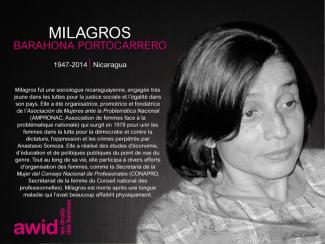
Milagros Barahona Portocarrero
Esta sección de análisis especial ofrece un análisis feminista crítico y acceso a los recursos clave relacionados con la «protección de la familia» en los espacios internacionales de derechos humanos.
Durante los últimos años, venimos observando una nueva y preocupante tendencia en el ámbito internacional de derechos humanos, donde se están empleando discursos sobre la «protección de la familia» para defender violaciones cometidas contra miembros de la familia, de modo de reforzar y justificar la impunidad y para coartar la igualdad de derechos en el seno de la familia y la vida familiar.
La campaña para «proteger a la familia» es impulsada por proyectos conservadores que tienen como fin imponer interpretaciones «tradicionales» y patriarcales de familia; quitando los derechos de las manos de sus miembros para ponerlos en las de la institución «familia».
Desde 2014 un grupo de estados opera como bloque en espacios de derechos humanos, bajo el nombre «Group of Friends of the Family» [Grupo de amigos de la familia], y a partir de entonces se han aprobado resoluciones sobre la «Protección de la familia» todos los años.
Esta agenda se ha extendido más allá del Consejo de Derechos Humanos (HRC, por sus siglas en inglés). Hemos visto cómo el lenguaje regresivo sobre «la familia» se ha introducido en la Comisión de la Condición Jurídica y Social de las Mujeres (CSW, por sus siglas en inglés), y hemos asistido a intentos por incluir este lenguaje en las negociaciones sobre los Objetivos de Desarrollo Sostenible.
AWID trabaja con asociadxs y aliadxs para resistir conjuntamente las agendas regresivas de «Protección de la familia» y otras, y para defender la universalidad de los derechos humanos.
En respuesta a la creciente influencia de actores regresivos en los espacios de derechos humanos, AWID se ha unido con aliadxs para formar el Observatorio de la Universalidad de los Derechos (OURs, por sus siglas en inglés). OURs es un proyecto colaborativo que monitorea, analiza y comparte información sobre iniciativas anti-derechos tales como la «Protección de la familia».
Derechos en Riesgo, el primer informe de OURs, traza un mapa de los actores que conforman el cabildeo global anti-derechos e identifica sus discursos y estrategias principales, señalando los efectos que estos discursos y estrategias están teniendo sobre nuestros derechos humanos.
El informe expone a la «Protección de la familia» como una agenda que ha promovido la colaboración entre una amplia gama de actores regresivos en las Naciones Unidas. La describe como un marco estratégico que aloja «múltiples posiciones patriarcales y anti-derechos, cuyo marco, a su vez, apunta a justificar e institucionalizar estas posiciones».
El financiamiento externo incluye donaciones y otras formas de financiamiento provenientes de fundaciones filantrópicas, gobiernos, donantes bilaterales, multilaterales y corporativos y de donantes individuales, ya sea que estos se encuentren radicados en tu país o en el exterior. Excluye aquellos recursos que las agrupaciones, organizaciones o movimientos generan de manera autónoma como, por ejemplo, cuotas de membresía, contribuciones voluntarias del personal, afiliadxs o adherentes, colectas comunitarias, alquiler de espacios propios o venta de servicios. Para consultar más referencias, en la propia encuesta se encuentran incluidas las definiciones de los distintos tipos de financiamiento y descripciones breves de distintos tipos de donantes.
Listen to the story here:
La recherche documentaire peut se dérouler tout au long de votre initiative. Elle peut vous aider à encadrer vos travaux, à choisir des questions de sondage et à comprendre vos résultats.
Dans cette section
- Préciser le contexte
- S’appuyer sur les connaissances existantes
- Sources éventuelles d’information pour la recherche documentaire
1. Sites Web et rapports annuels des donateurs
2. Sources d’information en ligne
La réalisation de recherches documentaires tout au long de votre initiative peut vous aider à encadrer vos travaux, à choisir les questions de sondage et à vous fournir une clarté contextuelle, tout en rehaussant votre compréhension des résultats de votre sondage. Vous pourriez notamment comparer les similarités et les différences entre les résultats de votre sondage et l’information diffusée par la société civile et les donateurs.
Il se peut que vous déceliez des tendances dans les résultats de votre sondage et que vous souhaitiez mieux les comprendre.
Par exemple, vos données de sondage pourraient révéler que les budgets des organisations diminuent, mais cela ne vous dit pas pour quelle raison cette situation se produit. L’analyse des publications vous donne un contexte et vous révèle certaines des raisons pour lesquelles ces tendances surviennent.
La recherche documentaire garantit également que vous appuyez votre recherche sur les connaissances existantes touchant à votre sujet d’intérêt, confirmant ainsi la validité et la pertinence de vos résultats.
Vos résultats pourraient être complémentaires ou contradictoires par rapport aux connaissances actuelles, mais ils doivent faire référence aux données existantes sur le sujet.
Pour que votre recherche soit complète et englobe tout le panorama du financement qui entoure votre sujet, examinez une gamme de secteurs de financement.
Vous pouvez notamment considérer :
- Les fonds pour les femmes
- Les fondations privées et publiques
- Les organisations non gouvernementales internationales (ONGI)
- Les agences bilatérales et multilatérales
- Les acteurs et actrices du secteur privé
- Les philanthropes
- Les groupes de financement participatif
Inclure tout secteur pertinent dans le cadre de référence de votre recherche.
Par exemple, vous pourriez décider qu’il est important d’effectuer des recherches sur les organisations non gouvernementales (ONG) locales.
Voici des sources directes d’information sur les actions des bailleurs de fonds qui contiennent habituellement des renseignements sur les politiques et les budgets. Si vous réalisez vos recherches avant d’interviewer les donateurs, vos questions seront mieux ciblées et vos interviews plus solides.

• 1-2 mois
• 1 personne (ou plus) chargée de la recherche
7. Synthétisez les résultats de votre recherche
“If we stay quiet they kill us and if we talk [they kill us] too. So, let’s talk.” - Cristina Bautista, 2019
A tireless defender of the rights of Nasa people, Cristina spoke strongly and loudly against the violence directed at her community. In a speech before the United Nations, she called for the protection of Indigenous women’s lives and their involvement in different spheres of life. In 2017, Cristina was a UN Human Rights Office Indigenous fellow and she was awarded a grant from the UN Voluntary Fund for Indigenous Peoples in 2019.
“I would like to bring to light the current situation of the Indigenous people in Colombia, the killing of Indigenous leaders, the repression of social protest. Instead of helping, the peace deal has increased war and the exploitation of sacred territories in Colombia… In the current situation, in almost all Indigenous nations as women we have been working to find a better future for our families. I don’t want more women from the countryside to continue living under these circumstances. We need opportunities for Indigenous women to participate in politics, in the economy, in society and in culture. Today gives me true strength, to see all these women here and that I am not alone.” - Cristina Bautista, 2019
On 29 October 2019, Cristina was murdered along with four unarmed Indigenous guards in an attack which was allegedly carried out by armed members of “Dagoberto Ramos”, a FARC dissident group.
According to Global Witness, “the murder of community and social leaders has risen dramatically in Colombia in recent years.”
“The Nasa community has repeatedly raised the alarm with the authorities about threats to their safety. Despite efforts by successive Colombian Governments, indigenous peoples continue to face great risks, especially religious or community leaders like Cristina Bautista.” - UN press briefing, 1 November 2019
Watch a speech by Cristina Bautista in August 2019 in which she denounced previous murders of Indigenous guards (Spanish only)

L’AWID est engagée en faveur de la justice linguistique, et nous regrettons que l’enquête WITM ne puisse, à l’heure actuelle, être accessible dans d’autres langues. Cependant, si vous avez besoin d’une aide à la traduction ou que vous souhaitez participer à l’enquête dans une autre langue, n’hésitez pas à nous contacter à l’adresse witm@awid.org.
Una identidad de género latinoamericana
El término travesti se trata de una identidad de género latinoamericana sin equivalente en otros idiomas, y exclusivamente femenina. Es una persona designada varón al nacer que se identifica como mujer, y siempre deben abordarse con el pronombre “ella”.
Travesti no es solo una identidad de género ubicada fuera del binarismo de género, también es una identidad cultural arraigada en los movimientos latinoamericanos. El término inicialmente fue peyorativo, pero luego fue re-apropiado como símbolo de resistencia y dignidad. Toda travesti es trans porque no se identifica con el género asignado al nacer, sin embargo no toda travesti se considera mujer trans, ya que travesti ya es una identidad de género en sí misma.
Referencia: Berkins, Lohana. (2006). Travestis: una Identidad Política . Trabajo presentado en el Panel Sexualidades contemporáneas en las VIII Jornadas Nacionales de Historia de las Mujeres/ III Congreso Iberoamericano de Estudios de Género Diferencia Desigualdad. Construirnos en la diversidad, Villa Giardino, Córdoba, 25 al 28 de octubre de 2006.
In the current context, we have identified five major threats to the struggle towards feminist just economies.
“Financialisation refers to the increasing importance of financial markets, financial motives, financial institutions, and financial elites in the operation of the economy and its governing institutions both at the national and international levels”. - Gerald Epstein
Epstein Gerald A. 2006: Financialization and the World Economy. Edward Elgar Publishing.
Financial institutions exert a strong influence over economic governance and the direction of development policy. The growing dominance of the corporate sector and international financial institutions in defining local and global public policies, has resulted in the capture of the State in the interest of capital. The current financial system, including controversial credit and debt policies, are integral to the reproduction and expansion of capital accumulation processes.
This raises important questions of how to regulate and re-think the global financial system, not only to avoid serious negative consequences of debt-driven crises,but to allow for sustainable livelihoods and the realization of economic and social rights without retrogression.
For more details, see the article by Balakrishnan and Heintz “Debt, Power, and Crisis: Social Stratification and the Inequitable Governance of Financial Markets”
For the past 20 years, trade agreements (both bilateral or multilateral) have expanded their role demonstrating increased interest in Intellectual Property Rights (IPR) to be given to corporations.
IPR has clearly benefitted transnational corporations with huge impacts on the ability of poorer nations and peoples to realize human rights, notably:
In addition, agriculture import liberalisation resulting in an influx of cheap goods jeopardise women’s self-employed farmers in poor countries and food security. Investment protection clauses included in trade agreements limit the policy space of national governments to create and enforce regulations on issues as crucial as environmental protection, labour rights, and the duration of copyrights.
Feminist movements have been, and are, at the forefront of resistance to these agreements exposing its pitfalls.
(See for example, the reactions by feminist networks around the globe to both the Transatlantic and TransPacific Trade and Investment Partnership Agreement negotiations.)
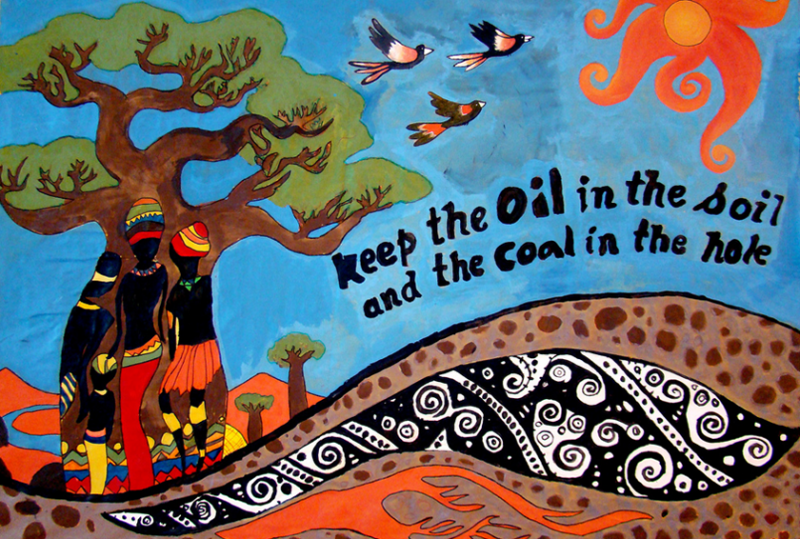
The commodification of the Earth’s resources and resulting environmental degradation and climate change produced by decades of aggressive industrialisation, plunder and extractivism of the world’s resources, have damaged biodiversity and ecological resilience. These damages are now threatening the existence of human society itself.
The international community has failed to address production and consumption patterns sitting at the root of the problem. Instead, governments –with the support of large corporations interested in making a profit - are leaning towards a “green economy” approach promoting “energy-efficient technologies” (including nuclear energy, biofuels, genetically modified organisms and geo-engineering) and carbon trade schemes as the silver bullet.
While the processes of land and resource appropriation is not new – in fact, they are central struggles in colonial histories- what is new is the advanced means by which land and natural resource wealth are becoming commodities in new markets.
International Financial Institutions play a central role in promoting land markets in developing countries. These institutions finance land reforms that enable powerful actors to use land for speculative gain in exchange of meagre promises of jobs and growth. Land-grabbing has far reaching negative impacts on local peoples’ access to essential goods and services apart from displacement and environmental degradation that are associated with it.
People who are resisting land grabbing, among them women human rights defenders, face diverse forms of violence including physical attacks and sexual abuse, on a daily basis.
This patriarchal foundation is particularly hegemonic in today’s neoliberal models.
The many ways in which political economy and development are connected to sexuality or gender is evident: think how capitalism defines what can even be characterized as labour and ties human worth to wage-labour productivity.
For the most part, women’s position in the global economy continues to be one of gender-based labour exploitation with women’s work undervalued in precarious jobs, domestic subsistence, reproduction, and in unwaged household production. Because reproductive labour has been naturalized as women's unpaid work, it has provided an immense subsidy to capitalism at the same time as a source of gender oppression and subjugation.
This situation is aggravated by the fact that as social protection mechanisms begin to dwindle, women’s care burden increases.
Further, the phenomenon of global migration spurred on by thousands of economic refugees escaping oppressive poverty across the globe is not estranged to that of capitalist gender power relations. Remittances become a major source of development financing for the families and communities, but at a major cost for women migrants who struggle to earn a living wage in their new country.
In the same vein, we have seen how patriarchal capitalist systems are using violence and oppression to maintain their status quo. Rising global expenditures in militarism and violence, both perpetrated by state and non-state actors, is increasingly used to control dissent, women’s bodies and voice and settle economic, political and social disputes.
Across the world, violence, incarceration and discrimination disproportionately targets
An intersectional analysis linking gender, race, ethnicity, age, ability, nationality, sexual orientation and gender identity, among other status is needed to challenge structural violence and its links with a capitalist global system.
A profound crisis in the current global governance system is also evident in the feeble inter-governmental agreements reached and how they often lack the most fundamental accountability mechanisms. The multilateral system that served global governance before is failing to respond to the current multiple crises. The same system continues to be deeply undemocratic, with increasing presence and power by corporations occupying the spaces where States used to be.
These threats challenge feminists to re-think our framework and strategies. To renew and reactivate our commitment to movement building with others for a just economy.
They challenge us to consider broad agendas for socio-economic transformations, from a feminist perspective, in ways that address the realities of the majority of the impoverished. Now is the time to bring about change for a just economy and to address the persistent systemic challenges.
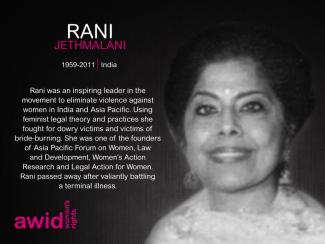
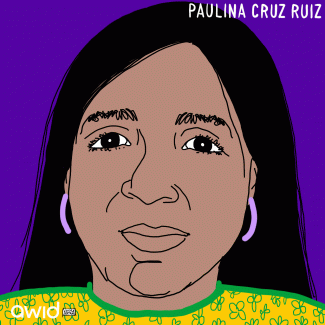
Paulina Cruz Ruiz, de la región de Rabinal, Baja Verapaz, en Guatemala, fue una autoridad ancestral Maya Achí (Indígena) y una defensora de los derechos humanos. Paulina se involucró activamente en la organización comunitaria y la resistencia, lo cual incluyó la adopción de medidas legales contra los proyectos mineros en territorios Indígenas, proyectos que afectarían y perjudicarían severamente el tejido socio ambiental.
"El modelo de industria extractiva promovido por el gobierno guatemalteco y la construcción de proyectos de desarrollo a gran escala en tierras indígenas, sin el consentimiento de la comunidad afectada, ha sido una fuente de disputas permanentes con los movimientos de resistencia". - Minority Rights Group International
Paulina también formó parte de la Marcha por la Dignidad, la Vida y la Justicia, del 1º de mayo de 2019, en la cual miles de guatemaltecxs iniciaron una marcha de ocho días contra la corrupción y la impunidad en la persecución y el asesinato de dirigentes de derechos humanos, líderes campesinxs e indígenas y defensorxs de la tierra.
Paulina fue asesinada el 14 de septiembre de 2019 cerca de su casa en la aldea de Xococ.
Según el Grupo Internacional de Derechos de las Minorías: "actualmente, uno de los principales problemas que afectan a las comunidades mayas es la creciente actividad de la industria minera".
Para leer más sobre la comunidad Maya en Guatemala
Para leer más sobre la Marcha por la Dignidad, la Vida y la Justicia
The estimated time to complete the survey is 30 minutes.
L'une des dirigeantes fondatrices de la coopérative était Lohana Berkins, une militante, défenseuse et promotrice de l'identité trans. Lohana a joué un rôle crucial dans la lutte pour les droits des personnes trans et travestis.
Grâce à sa lutte, entre autres choses, l'approbation de la loi sur l'identité de genre a été obtenue. C'est l'une des lois les plus progressistes au monde, garantissant les droits fondamentaux des personnes trans et des travestis. Désormais, les personnes peuvent changer de nom et de sexe avec un affidavit et ont accès à des soins de santé complets sans intervention/approbation judiciaire ou médicale (Outright International, 2012).
La activista y académica Soma Kishore Parthasarathy señala que existen diversas formas de pensar los bienes comunes.
En un sentido más convencional, se los entiende como recursos naturales destinados a ser usados por quienes dependen de su uso. Sin embargo, el concepto de «bienes comunes» se ha expandido para incluir recursos como los conocimientos, la herencia, la cultura, espacios virtuales e incluso el clima. Es un concepto anterior al régimen de propiedad individual y que aportó las bases para la organización social. Las definiciones que aportan las entidades gubernamentales limitan su alcance a los recursos de la tierra y materiales.
El concepto de los bienes comunes se apoya en la práctica cultural de compartir espacios de subsistencia y recursos como dones de la naturaleza, para el bien común, y para la sostenibilidad de lo que es común a todxs.
Los bienes comunes de la humanidad están cada vez más amenazados porque las naciones y fuerzas del mercado continúan colonizándolos, explotándolos y ocupándolos.
En algunos contextos favorables, los «bienes comunes» tienen el potencial de habilitar una posición de autonomía sobre todo para las mujeres bajo opresión económica desde la que pueden negociar sus múltiples necesidades y aspiraciones.
Cuando a las mujeres y a otros géneros oprimidos se les niega el acceso a los bienes comunes y la posibilidad de controlarlos, se refuerza el patriarcado.
Por eso, una economía feminista busca restaurar los derechos legítimos de las comunidades a estos recursos comunes. Esa autonomía les permite mantenerse a sí mismas al mismo tiempo que desarrollan sistemas más igualitarios de gobernabilidad y de uso de esos recursos. Una economía feminista reconoce los roles de las mujeres y les ofrece las mismas oportunidades para tomar decisiones, es decir, las coloca en igualdad de condiciones como demandantes de esos recursos.
Absolutamente; esas preguntas son opcionales y valoramos tu derecho a la anonimidad. Te pedimos que respondas la encuesta independientemente de tu decisión de compartir el nombre de tu agrupación, organización o movimiento y la información de contacto con AWID.
Only a year after it was founded, the members of Nadia Echazú started to work in haute couture and organized a fashion show in the historic Bauen Hotel.
They showcased five models and some workers of the textile cooperative walked down the runway with their own designs.
This was revolutionary not only because they were designing alternatives to mainstream fashion, but also because they were creating accessible, inclusive clothes for all trans and travesti bodies.
Feminist economies should also be about feeling amazing and comfortable in the clothes we are wearing.