AWID es un organización feminista internacional de membresía, que brinda apoyo a los movimientos que trabajan para lograr la justicia de género y los derechos de las mujeres en todo el mundo.
En septiembre de 2016, 1800 feministas y activistas por los derechos de las mujeres de todos los rincones de nuestros movimientos se congregaron en las costas de Bahia, en el 13º Foro Internacional de AWID.
En esta sección se destacan los logros, los aprendizajes y los recursos que surgieron de las ricas conversaciones mantenidas. Te invitamos a analizar, compartir y comentar.
¿Qué ha pasado desde 2016?
Uno de los aportes más importantes del Foro fue la necesidad de ampliar y profundizar nuestro trabajo entre movimientos, frente a la confluencia de los fascismos en auge, fundamentalismos, codicia corporativa y cambio climático.
Con esto en mente, AWID, en asociación con múltiples aliadxs, ha estado trabajando para que estas semillas de resistencia:
AWID se ha comprometido, mediante su próximo plan estratégico y su proceso del Foro, a continuar y profundizar las relaciones, las lecciones y los procesos iniciados en el Foro 2016 y basándonos en el momento actual.
¿Que pasa ahora?
El mundo es un lugar muy diferente de lo que era un año atrás, y seguirá cambiando en los próximos años.
El próximo Foro de AWID se realizará en la región del Pacífico Asiático (el lugar y la fecha exactos serán anunciados en 2018). Esperamos que te unas a nosotrxs.
Sobre el Foro de AWID
Los Foros de AWID comenzaron en 1983 en Washington DC. Desde entonces, el evento ha crecido hasta convertirse en muchas cosas para muchas personas: un proceso iterativo para darle forma a nuestros análisis, objetivos y acciones; un hito crucial que fortalece los feminismos de lxs participantes e infunde energías a sus procesos de organización; un hogar político donde lxs defensoras de derechos humanos encuentran un santuario y solidaridad.
Lorsqu’on effectue une recherche en ligne sur les « Mutilations génitales féminines » ou « MGF », un schéma en quatre parties sur l’anatomie des femmes apparaît à côté d’une page Wikipédia dédiée. (...)
J’ai l’intime conviction que des femmes puissantes peuvent donner à d’autres femmes la possibilité d’être puissantes, c’est pourquoi je suis ravie d’être membre de l’AWID. La visibilité que j’ai reçue en faisant partie de la Street Team de la communauté AWID a élargi mes connaissances et ma façon d’envisager le Féminisme et l’intersectionnalité. J’espère que davantage de femmes se joindront à nous et porteront des thématiques et des idées qui aideront d’autres femmes. .- Loyiso Lindani, Afrique du Sud.
Juli Dugdale was an Australian feminist who practiced intergenerational leadership rooted in principles of feminism, inclusion and equality. She was a leader, peer and mentor for many women and especially young women around the world.
Juli was a dedicated staff member, volunteer and fervent advocate for young women’s leadership with the Young Women's Christian Association (YWCA) movement for over 30 years.
She offered a strong link between the Australian movement and the World YWCA Office. Her trust in the leadership capacity of young women led to a multi-year partnership with the Australian Department of Foreign Affairs and Trade and the creation of the Rise Up manual, a global guide for young women’s transformative leadership, launched in 2018.
Juli passed away in Geneva on 12 August 2019.
Tributes:
“For those who got to work with Juli, it was a privilege. For those who didn’t, be assured that her legacy continues in the work we do every day and in the mission of the YWCA movement.” - YWCA Australia
“Juli Dugdale will forever hold a deep place in many people's hearts in the YWCA movement, especially here in Aotearoa and across the Pacific. Juli had a special relationship with the Pacific and was an incredible supporter of the young women there. She was humble, gracious, loving, caring, dedicated, passionate and had a generous heart. She embodied the YWCA's vision of 'transformative leadership' with extraordinary vision and foresight, and helped empower generations of young women leaders around the world.” - YWCA New Zealand
Snippet - Podcast Intro (EN)
We are thrilled to announce the launch of AWID’s new podcast THAT FEMINIST FIRE. Our narrative series unravels over 40 years of feminist movements—and reimagines a way forward.
In our pilot season, you’ll hear five compelling stories that are part of a constellation of feminist activism today. Hosted by our very own Gopika Bashi, Deputy Director of Programmes at AWID, each episode explores unique but interconnected feminist realities that are achieving greater gender justice and human rights.
Produced by our Webby-winning podcast partner Hueman Group Media, you can subscribe toTHAT FEMINIST FIREand listen to our first episode here.
Find us on Apple Podcasts, Spotify, or wherever you get your podcasts. Share with your network! Help us spread stories that ignite our feminist fire and move us to action.
«No adhiero al concepto de “Tercer Mundo”. Hago películas para que las personas (no importa de qué raza o color sean) puedan entenderlas. Para mí, solamente existen explotadores y explotadxs, eso es todo. Hacer una película significa tomar una posición.» - Sarah Maldoror
Sarah Maldoror, una cineasta francesa descendiente de una familia de las Indias Occidentales, fue una pionera del cine panafricano. Sus inquietudes políticas ocupaban el centro de su trabajo, junto con su permanente involucramiento en los movimientos de descolonialización.
La innovadora Sambizanga (1972), su «película revolucionaria», sigue la lucha de liberación anticolonial de lxs militantes de Angola y capta la perspectiva de una mujer en el momento histórico en que se encuentra.
«Para muchxs cineastas africanxs, el cine es una herramienta revolucionaria, una educación política para crear consciencia. Se inscribe en la evolución de un Tercer Cine, que se orienta a descolonizar el pensamiento y promover cambios radicales en la sociedad.» - Sarah Maldoror
A lo largo de su carrera, Sarah (junto con otrxs artistas africanxs y caribeñxs) cofundó, en 1956, la primera troupe de teatro negra de Francia. Realizó alrededor de cuarenta películas, incluidos importantes documentales que difundieron la vida y la obra de artistas negrxs, entre lxs cuales se encuentra su amigo y poeta, Aimé Césaire, quien le escribió:
«A Sarah Maldo
que, cámara en mano,
lucha contra la opresión, la alienación
y se planta de cara
frente a la estupidez humana.»
Sarah estaba también dedicada a lograr que las mujeres africanas se apropiaran más del proceso de filmación. En una entrevista, señaló:
«Las mujeres africanas deben estar en todos lados. Deben estar en las imágenes, detrás de la cámara, en la sala de edición, y participar en todas las etapas de la realización de una película. Ellas deben ser quienes hablen sobre sus problemas.»
Sarah dejó un legado formidable para que sea continuado.
Nacida el 19 de julio de 1929, Sarah falleció el 13 de abril de 2020 debido a complicaciones por el coronavirus.
We are excited to share our new Strategic Plan (2023-2027) with the world. AWID will make an announcement to inform our community and members very soon.
The Association for Women's Rights in Development (AWID) is a global, feminist, membership, movement-support organization.
For 40 years, AWID has been a part of an incredible ecosystem of feminist movements working to achieve gender justice and women’s human rights worldwide.
Our vision
GGAADD | Flickr (CC BY-SA 2.0) - modified
AWID envisions a world where feminist realities flourish, where resources and power are shared in ways that enable everyone, and future generations, to thrive and realize their full potential with dignity, love and respect, and where Earth nurtures life in all its diversity.
Our mission
Our mission is to support feminist, women’s rights and gender justice movements to thrive, to be a driving force in challenging systems of oppression, and to co-create feminist realities.
Our tactics
We advance our work through these tactics:
Influencing, advocacy and campaigning
We collaboratively leverage our access, power, resources and relationships to strategically influence policy and practice. We aim to advance feminist agendas through our work with policy makers, funders and activists in regional and global spaces. We also work to influence feminist and women’s rights movements to centre historically oppressed movements as part of efforts to strengthen our collective power and influence.
Convening and connecting
We use our convening power to facilitate dialogue and strategize on key issues. We connect our members and allies with one another, sharing and exchanging resources, ideas and action across relevant issues. We organize and facilitate spaces to strengthen and engage across movements, to imagine and envisage new futures, to develop effective influencing tactics and to co-create powerful agendas and processes.
Solidarity and bridge-building
We work to mobilize our members and the movements we support to strengthen collective action in solidarity with feminist causes and defenders at risk. We build partnerships, engage in active listening and ongoing, long-term, solidarity. We work with defenders to build a body of knowledge and support networks of solidarity on protection and wellbeing.
Arts and creative expression
We recognize the unique and strategic value of cultural and creative strategies in the struggle against oppression and injustice. We work with artists who centre feminist voices and the narratives of historically oppressed communities. In this emerging tactic, we see art and creative expression helping us envision a world where feminist realities continue to flourish and be celebrated.
Marcha da Mulheres negras - 2016
Our initiatives
Our initiatives work at the intersections of the sites of change we work to address, the movements we prioritize, and the tactics we use:
We monitor, document and make visible how anti-rights actors are operating and colluding in multilateral spaces and support feminist, women’s rights and gender justice movements and allies to counter their influence and impact.
Working on extractivism, tax justice and corporate accountability, we build knowledge on corporate power and influence; advocate for corporate accountability and equitable distribution of wealth; and amplify feminist proposals for just economies.
We develop accessible, action-oriented analysis on the state of resourcing for feminist movements. We aim to influence funders’ policies and practices, deepen and sustain funding for feminist social change, and support movements’ needs and strategies.
In addition to the impact we aim to have in the world, AWID is expressly committed to strengthening our own organizational learning and resilience in order to further strengthen global feminist movements.
Our donors
Thank you!
Without the generous funding and support from our donors, our work would not be possible
FRMag - Looking at me Looking at Safe Spaces
Mirándome observar los espacios seguros
por Judyannet Muchiri
En octubre del año pasado, me fui a Kenia para empezar lo que he llegado a considerar el trabajo más importante que he hecho hasta ahora. (...)
María Digna Montero était une défenseuse Garifuna (d’origine africaine et autochtone) du droit à la terre et membre de l’Organisation fraternelle noire hondurienne (OFRANEH), une organisation communautaire oeuvrant à protéger les communautés Garifunas, leurs droits, leur culture, leurs ressources et leur territoire ancestraux.
María a également enseigné dans l'école locale et été membre du groupe de travail sur l'éducation bilingue interculturelle de l'OFRANEH.
Le 12 octobre 2019, jour de la Résistance autochtone, des inconnus ont tiré à plusieurs reprises sur María, alors qu’elle se trouvait dans l’arrière-cour de sa maison.
Elle est l'une des six défenseuses Garifunas à avoir été assassinées entre septembre et octobre 2019 et selon OFRANEH, ces crimes n’ont fait l’objet d’aucune enquête de la part des autorités. Dans une déclaration officielle, l'organisation a également souligné le lien entre la violence à l’encontre des dirigeants Garifunas et le développement des industries extractives qui exploitent les ressources naturelles de leurs communautés, affirmant que cette violence s’inscrivait dans une "stratégie d'intimidation et d'expulsion systématique" menée par l'État hondurien.
“La tension accrue et les risques croissants pour la sécurité et les droits humains des dirigeants des communautés et des territoires ancestraux sont le résultat de la dépossession, du déplacement et de la criminalisation des communautés et des mégaprojets d'extraction promus par l'État en collaboration avec les entreprises nationales et internationales". - Communiqué de l'OFRANEH, 12 octobre 2019
Snippet Watch Stories (ES)
Conoce más sobre el impacto del foro a través de estas historias.
Recordando a lxs defensorxs que ya no están con nosotrxs
AWID honra a lxs feministas y defensoras de los derechos humanos que han muerto y cuyas contribuciones al progreso de los derechos humanos se echa mucho en falta.
Celebrando a lxs activistxs y las defensoras de derechos humanos
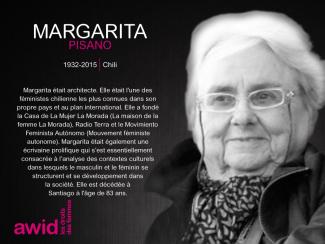
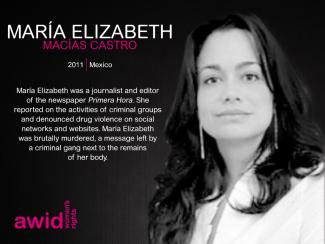
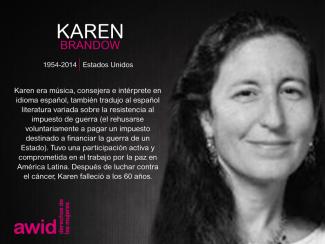
El Tributo de AWID a las defensoras de derechos humanos es una exhibición fotográfica que presenta a activistxs del feminismo, de los derechos de las mujeres y de la justicia social de todo el mundo que ya no están con nosotrxs.
El Tributo fue lanzado por primera vez en 2012, en el 12º Foro Internacional de AWID, en Turquía. Tomó la forma de una exposición física de retratos y biografías de feministas y activistxs que fallecieron. La iniciativa fue descrita por lxs participantes del Foro como una manera única, emotiva y energizante de conmemorar nuestra historia colectiva.
En el 13º Foro Internacional, en Brasil, honramos a lxs activistas y a las defensoras de derechos humanos con una ceremonia de inauguración de un mural en cuatro idiomas, un espectáculo de danza y un ritual brasileño.
Entre los eventos, el Tributo permanece como una galería en línea que se actualiza cada año como parte de la Campaña de los 16 Días de Activismo Contra la Violencia de Género (25 de noviembre al 10 de diciembre).
Contribuciones de todo el mundo
Desde 2012, a través de nuestro Tributo anual a las defensoras de derechos humanos que ya no están con nosotrxs, hemos presentado más de 400 feministas y defensorxs de 11 regiones y 80 países.
AWID quiere agradecer a las familias y organizaciones que compartieron sus historias personales y contribuyeron a este homenaje. Nos unimos a ellxs para continuar con el notable trabajo de estas mujeres y redoblar esfuerzos para asegurar que se logre justicia en los casos que permanecen en la impunidad.
La violencia y las amenazas contra las defensoras de derechos humanos persisten
Además de rendir homenaje a estxs increíbles activistas, el Tributo arroja luz sobre la gravedad de la situación de las defensoras de derechos humanos que han sido asesinadas o están desaparecidas.
Un tercio de las personas presentadas en el Tributo fueron activistas asesinadxs o están desaparecidxs en circunstancias sospechosas. Fueron atacadxs específicamente por ser quiénes eran y por haber desafiado:
El poder del Estado
La heteronormatividad
Los fundamentalismos
Las corporaciones
El patriarcado
La delincuencia organizada
La corrupción
La militarización…
Mujeres como Agnes Torres, de México, fueron asesinadas debido a su identidad de género y orientación sexual; o Cheryl Ananayo, una activista ambientalista de Filipinas que fue asesinada mientras luchaba contra una compañía minera; o Ruqia Hassan, una periodista y bloguera independiente siria asesinada por sus críticas al Estado Islámico de Iraq y Levante (EIIL, ISIS en inglés). Y muchas otras.
Con el Tributo a las defensoras de derechos humanos lxs traemos a todxs a nuestra memoria colectiva y llevamos su legado de lucha como nuestra antorcha en los movimientos feministas y por los derechos de las mujeres. Reconocemos que la seguridad y el autocuidado deben ser una prioridad en todas nuestras agendas políticas. Y hacemos un llamamiento a los gobiernos y a los organismos internacionales para que aborden colectivamente la violencia contra lxs feministas y las defensoras de derechos humanos.
Creemos que este es un paso crítico para asegurar la sostenibilidad de nuestros movimientos por la igualdad de género, por los derechos de las mujeres y por justicia para todxs.
Lorena Borjas, a trans Latina woman and activist, lived and worked in the Jackson Heights neighborhood of Queens, New York City. In those streets, she looked after her community for years, advocating for trans and immigrant rights, supporting survivors of human trafficking and abuse, campaigning for sex workers’ rights and those of people living with HIV and AIDS.
Lorena was strong and tireless in her fight to support, defend, and have the back of those most marginalized and discriminated by transphobia, misogyny and racism.
“She pushed us to shine authentically, to become a scream of subversion that says, ‘I am here, and I deserve happiness, too.’” - Cecilia Gentili, a trans activist and Lorena’s friend
Having faced numerous traumas and hardships herself, as a trans immigrant woman and victim of human trafficking, Lorena pulled knowledge and emotional memory from the well of her experiences in order to help build and strengthen the community she was part of and which was part of her. Some of the ways she did this was to organize and mobilize support ranging from providing condoms and connecting trans women to different services, to setting up an HIV testing clinic in her own home.
"She was such a beautiful soul who helped others when her journey was difficult and painful as an immigrant, as a trans immigrant. She believed the trans community needed love, acceptance, and compassion, and she gave it all.” - Luchia Dragosh, QPTV Supervising producer of a documentary about Lorena
In more than 25 years of activism, she also founded the Lorena Borjas Community Fund together with Chase Strangio (lawyer and trans rights activist). The Fund helps the many different members of her community (and especially trans persons) dealing with immigration challenges to avoid the cycle of arrest-jail-deportation.
Lorena passed away in March 2020 of complications from COVID-19.
Her enormous and beautiful legacy will be taken forward through the streets of Queens by the network and community she co-created.
“We will pick up her work where she left it, work that is essential to the well-being of “mis pajaras” as she called the trans girls of Queens under her wing.” - Cecilia Gentili
Tributes:
"Lorena brought light to us when we were living through a very dark time here in New York. She brought us light when we were dealing with the crack epidemic, when we were dealing with the AIDS crisis, dealing with changes in immigration policies." - Cristina Herrera, founder and CEO of Translatina Network and Lorena’s friend
"Lorena has done more than anyone else I know to shine a light on the epidemic of trafficking in transgender communities and to help other trans women escape exploitation." - Lynly Egyes (represented Borjas on behalf of the Transgender Law Center)