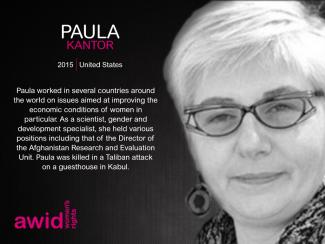
Paula Kantor
Lxs defensorxs se identifican a sí mismas como mujeres y personas lesbianas, bisexuales, transgénero, queer e intersex (LBTQI) y otrxs que defienden derechos y que debido a su trabajo en derechos humanos están bajo riesgos y amenazas específicos por su género y/o como consecuencia directa de su identidad de género u orientación sexual.
Lxs defensorxs son objeto de violencia y discriminación sistemáticas debido a sus identidades y su inclaudicable lucha por derechos, igualdad y justicia.
El Programa Defensorxs colabora con contrapartes internacionales y regionales así como con lxs afiliadxs de AWID para crear conciencia acerca de estos riesgos y amenazas, abogar por medidas de protección y de seguridad que sean feministas e integrales, y promover activamente una cultura del autocuidado y el bienestar colectivo en nuestros movimientos.
lxs defensorxs enfrentan los mismos tipos de riesgos que todxs lxs demás defensorxs de derechos humanos, de comunidades y del medio ambiente. Sin embargo, también están expuestas a violencia y a riesgos específicos por su género porque desafían las normas de género de sus comunidades y sociedades.
Nos proponemos contribuir a un mundo más seguro para lxs defensorxs, sus familias y comunidades. Creemos que actuar por los derechos y la justicia no debe poner en riesgo a lxs defensorxs, sino que debe ser valorado y celebrado.
Promoviendo la colaboración y coordinación entre organizaciones de derechos humanos y organizaciones de derechos de las mujeres en el plano internacional para fortalecer la capacidad de respuesta en relación a la seguridad y el bienestar de lxs defensorxs.
Apoyando a las redes regionales de defensorxs y de sus organizaciones, tales como la Iniciativa Mesoamericana de Mujeres Defensorxs de Derechos Humanos y la WHRD Middle East and North Africa Coalition [Coalición de Defensorxs de Derechos Humanos de Medio Oriente y África del Norte], promoviendo y fortaleciendo la acción colectiva para la protección, poniendo el énfasis en establecer redes de solidaridad y protección, promover el autocuidado y la incidencia y movilización por la seguridad de lxs defensorxs.
Aumentando la visibilidad y el reconocimiento de lxs defensorxs y sus luchas, así como de los riesgos que enfrentan, a través de la documentación de los ataques que sufren, e investigando, produciendo y difundiendo información sobre sus luchas, estrategias y desafíos.
Movilizando respuestas urgentes de solidaridad internacional para lxs defensorxs que están en riesgo a través de nuestras redes internacionales y regionales y de nuestrxs afiliadxs activxs.
Más que un simple evento, el Foro de AWID es parte de nuestro Viaje de Realidades Feministas, con muchos espacios en los cuales reunirse, en línea o en forma presencial, para compartir, discutir, elaborar estrategias, y crear conjuntamente realidades feministas.
Infórmate sobre el Viaje de Realidades Feministas y sobre todo lo que sucederá en este Viaje antes del Foro. ¡Y mantente sintonizadx para los anuncios post-Foro!
Estamos estudiando opciones para la participación virtual en el Foro, y compartiremos la información cuando sepamos qué podemos ofrecer.
Mientras les líderes se reúnen en Brasil, es fundamental que los movimientos feministas, sobre todo los de la mayoría global, contemos con espacios autónomos para encontrarnos, elaborar estrategias y trastocar.
En estos nodos interpelamos el elitismo de las conversaciones sobre el clima, nos centramos en las vivencias y apuntamos a construir el poder colectivo más allá de las fronteras. Se ofrece un contrapeso crítico a las negociaciones internacionales jerárquicas y a menudo excluyentes. En los nodos buscamos promover las soluciones nacidas de la comunidad, amplificar las demandas feministas y garantizar que los principios feministas de los cuidados y la solidaridad sean los que den forma a la agenda por el clima. No se trata únicamente de tener presencia en la COP30, se trata también de reconfigurar las conversaciones sobre la justicia climática en términos feministas.
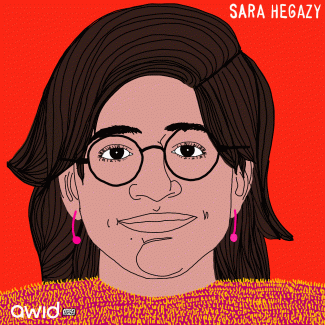
Sara Hegazy, a bold Egyptian LGBTQI+ rights activist, lived in a society where the members of her community, their bodies and lives often face lethal prejudice. The roots of Sara’s resistance were in the deconstruction of a dominant, oppressive and patriarchal system, and its anti-rights actors.
"[In Egypt], every person who is not male, Muslim, Sunni, straight, and a supporter of the system, is rejected, repressed, stigmatized, arrested, exiled, or killed. This matter is related to the patriarchal system as a whole, since the state cannot practice its repression against citizens without a pre-existing oppression since childhood." - Sara Hegazy wrote on March 6, 2020
The suppression of Sara’s voice by the Egyptian government reached its violent peak in 2017, when she was arrested for raising a rainbow flag at the Mashrou’ Leila (Lebanese band whose lead vocalist is openly gay) concert in Cairo. What followed were charges of joining an illegal group along with “promoting sexual deviancy and debauchery”.
"It was an act of support and solidarity — not only with the [Mashrou' Leila] vocalist but for everyone who is oppressed...We were proud to hold the flag. We wouldn't have imagined the reaction of society and the Egyptian state. For them, I was a criminal — someone who was seeking to destroy the moral structure of society." - Sara Hegazy
Sara was jailed for three months, where she was tortured and sexually assaulted. In January 2018, after being released on bail, she sought asylum in Canada where she was safe but imprisoned by the memories of the abuse and violence her body and soul had gone through.
"I left this experience after three months with a very intense, serious case of PTSD [post-traumatic stress disorder]. Prison killed me. It destroyed me." - Sara Hegazy told NPR
Sara took her own life on 14 June 2020, leaving a handwritten note in Arabic:
“To my siblings – I tried to find redemption and failed, forgive me.”
“To my friends – the experience [journey] was harsh and I am too weak to resist it, forgive me.
“To the world – you were cruel to a great extent, but I forgive.”
Her legacy and courage will be carried forward by those who love her and believe in what she fought for.
“To Sarah: Rest, just rest, spared from this relentless violence, this state-powered lethal patriarchy. In rage, in grief, in exhaustion, we resist.” - Rasha Younes, an LGBT rights researcher at Human Rights Watch. Read the complete text
Mashrou’ Leila’s lead vocalist sings tribute to Sara Hegazy
Tan pronto como podamos, compartiremos información sobre el programa, los espacios y la forma en que todo el mundo puede participar en su construcción, en camino hacia el Foro y durante el Foro. Sigue con atención las actualizaciones.
Alors que le capitalisme hétéropatriarcal s’acharne à nous contraindre au consumérisme et à la conformité, nous constatons que nos luttes sont cloisonnées et séparées par des frontières aussi bien physiques que virtuelles.
Avec les défis supplémentaires d’une pandémie mondiale à surmonter, cette stratégie du « diviser pour mieux régner » a favorisé l’expansion de l’exploitation dans de nombreux domaines.
Malgré tout, du 1er au 30 septembre 2021, le festival Crear | Résister | Transform : un festival dédié aux mouvements féministes ! de l’AWID nous a emmené·e·s à la découverte de ce que cela signifiait d’incarner nos réalités dans des espaces virtuels. Lors du festival, des activistes féministes du monde entier se sont réuni·e·s non seulement pour partager des expériences de libertés, de résistances et de solidarités transfrontalières durement gagnées, mais aussi pour exprimer ce à quoi pourrait ressembler une forme transnationale d’unité.
C’est précisément cette unité qui a le potentiel de dépasser les frontières, permettant de tisser une vision de l’avenir qui est transformatrice parce qu’abolitionniste et anticapitaliste. À travers des infrastructures numériques que nous avons investies avec notre queerness, notre résistance et nos imaginaires, le festival a présenté un moyen de se détourner des systèmes qui nous rendent complices de l’oppression des autres et de nous-mêmes.
Si Audre Lorde nous a appris que « les outils du maître ne détruiront jamais la maison du maître », Sara Ahmed nous a montré en revanche que nous pouvons en faire mauvais usage. Le fait d’avoir à créer un espace de rassemblement, en dépit de toutes les autres contraintes pesant sur nos emplois du temps, nous a permis d’imaginer une façon de rompre avec la réalité du capitalisme hétéropatriarcal.
Maintenant, si nous comprenons le rassemblement comme une forme de plaisir, il devient alors possible de faire le lien entre le plaisir transgressif et la résistance transnationale/transdigitale; entre les types de plaisir qui bousculent les frontières d’une part, et la queerness, la théâtralité, la lutte pour la terre et les autochtones, l’anticapitalisme et l’organisation anticoloniale d’autre part.
La présente édition a tenté de donner une idée de la manière dont l’exercice de rassemblement du festival a revêtu de multiples formes et imaginations. Au-delà des collaborations directes avec certain·e·s de ses orateurices et rêveur·se·s, nous avons fait appel à une pléthore d’autres voix du Sud mondial pour aborder plusieurs de ces sujets et thématiques. Vous trouverez ci-dessous une carte de certains des panels du festival qui nous ont le plus inspiré·e·s.
AWID está monitoreando de cerca la situación global del COVID-19 y, por ahora, prevé seguir adelante con el Foro según lo planificado.
Si en algún momento la situación exige que hagamos algo diferente, se los comunicaremos inmediatamente.
El 14° Foro Internacional de AWID está programado para realizarse del 20 al 23 de septiembre de 2021 en Taipéi.
Una herramienta para activistas feministas presentes en la COP30 que luchan por soluciones transformadoras, equitativas y comunitarias para responder a la crisis climática.

“My mission in life is not merely to survive, but to thrive; and to do so with some passion, some compassion, some humor, and some style.” - Maya Angelou
The AWID International Forum is both a global community event and a space of radical personal transformation. A one-of-a-kind convening, the Forum brings together feminist, women’s rights, gender justice, LBTQI+ and allied movements, in all our diversity and humanity, to connect, heal and thrive. The Forum is a place where Global South feminists and historically marginalized communities take center stage, strategizing with each other and allied movements, funders and policy-makers, in order to shift power, make alliances, and usher in a different, better world.
When people come together on a global scale, as individuals and movements, we generate a sweeping force. Join us in Bangkok, Thailand in 2024. Come dance, sing, dream and rise with us.
When: 2–5 December 2024
Where: Bangkok, Thailand; and online
Who: Approximately 2,500 feminists from all over the world participating in-person, and 3,000 participating virtually
Learn more about the forum:
Read our Frequently Asked Questions
with Naike Ledan and Fédorah Pierre-Louis.
A fines de 2019, la situación en Indonesia (en particular, los signos de militarización intensificada y de reacción contra los derechos LGBTQ) nos llevó a cuestionar la capacidad de AWID para sostener un ambiente razonablemente seguro y acogedor para la diversidad de participantes que esperamos reunir en el Foro.
Después de un análisis cuidadoso, en noviembre de 2019 la Junta Directiva de AWID decidió cambiar la sede del 14° Foro Internacional de AWID, de Bali a Taipéi.
Taipéi ofrece un alto nivel de capacidad logística, y resulta accesible para muchxs viajerxs (con la facilitación de un trámite de visa electrónico para conferencias internacionales).
Para más detalles:
Follow the campaign:
Join us!
Join our Membership| Join AWID Community
Stay updated
Questions?
Contact us: communications @ awid.org
Graphics based off illustrations by Vectorarte.
The AWID International Forum is both a global community event and a space of radical personal transformation. A one-of-a-kind convening, the Forum brings together feminist, women’s rights, gender justice, LBTQI+ and allied movements, in all our diversity and humanity, to connect, heal and thrive.
The Forum theme – Rising Together – is an invitation to engage with our whole selves, to connect with each other in focused, caring and brave ways, so that we can feel the heartbeat of global movements and rise together to meet the challenges of these times.
For the first time, the AWID Forum offered three modes of participation:
 |
 |
 |
|
In Person at the Queen Sirikit National Convention Centre in Bangkok, Thailand. |
Online in Virtual Space (Capacity: 3000 participants). |
Hubs Connected in Cross Border Space. |
With over 4,000 participants, 15th AWID International Forum in 2024 created a sweeping force to resist oppression towards collective healing and liberation. Keep watching this space for more forum stories and future forums updates!
The past Forums
In December 2020, the AWID board took the difficult decision to cancel the 14th AWID International Forum which had been scheduled to take place from September 20-23, 2021, in the City of Taipei.
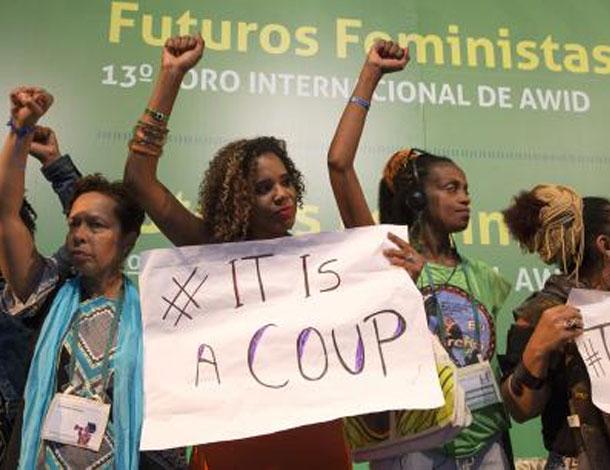
Given the complex world that we face today, the 2016 AWID Forum did not focus on a particular “issue”, but rather on creating more effective ways of working together!
Despite the challenging contexts in which the 2016 Forum took place (the Zika epidemic, a strike by Brazilian foreign-service workers, the impeachment of President Dilma Rousseff and subsequent turmoil), it succeeded in bringing together over 1800 participants from 120 countries and territories across all regions of the world.
For 96% of participants who responded to the post Forum evaluation survey, the Forum was a major source of inspiration and energy.
98% of participants considered it an important convening space for feminist movements and expressed hope that AWID continues to organize forums.
59% of Forum evaluation survey respondents declared to be very satisfied with the Forum and 34% somewhat satisfied.
Over 150 sessions were delivered in different formats on a variety of topics ranging from bodily integrity and freedoms, to gender-based violence in the workplace, to strategies for building collective power.
The first-time Black Feminisms Forum (BFF), held just before the main AWID Forum, brought together 250 Black feminists from all over the world to co-create a powerful space to build and strengthen ongoing, intergenerational, transnational connections
Download the Forum evaluation report
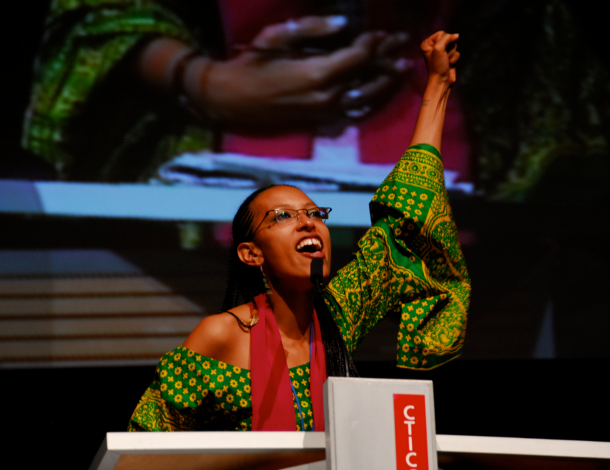
The 12th AWID Forum was the largest and most diverse AWID Forum to date, bringing together 2239 women’s rights activists from 141 countries. Of these participants, around 65% were from the Global South and close to 15% were young women under 30, and 75% attended an AWID Forum for their first time.
The Forum program focused on transforming economic power to advance women’s rights and justice and featured over 170 different kinds of sessions including feminist economics toolbox skills-building sessions, breakout sessions representing all 10 Forum themes, in-depth sessions, and solidarity roundtables.
Building on the momentum of the 2012 Forum, we transformed the website into a resource and learning Hub, which builds on the content generated by participants by featuring multi-media resources on all Forum components.
Visit the 2012 Forum web archive
Every three to four years, AWID hosts its flagship international event. It is the world’s largest event that wholeheartedly centers feminist and gender justice movements in all their diversity. It is a global gathering of feminist activists, allied movements, scholars, funders and policymakers. The Forums rotate between different regions and countries in the global South.
The Forum theme––Rising Together––is an invitation to engage with our whole selves, to connect with each other in focused, caring and brave ways, so that we can feel the heartbeat of global movements and rise together to meet the challenges of these times.
Feminist, women’s rights, gender justice, LBTQI+ and allied movements around the world are at a critical juncture, facing a powerful backlash on previously-won rights and freedoms. Recent years have brought the rapid rise of authoritarianisms, the violent repression of civil society and criminalization of women and gender-diverse human rights defenders, escalating war and conflict in many parts of our world, the continued perpetuation of economic injustices, and the intersecting health, ecological and climate crises.
Our movements are reeling and, at the same time, seeking to build and maintain the strength and fortitude required for the work ahead. We can't do this work alone, in our silos. Connection and healing are essential to transforming persistent power imbalances and fault lines within our own movements. We must work and strategize in interconnected ways, so that we can thrive together. The AWID Forum fosters that vital ingredient of interconnectedness in the staying power, growth and transformative influence of feminist organizing globally.
On September 2nd, 2021, the amazing feminist and social justice activists of AWID’s Crear | Résister | Transform festival came together not only to share resistance strategies, co-create, and transform the world, but also to talk dirty on Twitter.
The exercise was led by Nana Darkoa Sekyiamah, co-founder of the blog Adventures From The Bedrooms of African Women and author of The Sex Lives of African Women, who paired up with the Pan-Africanist digital queer womanist platform AfroFemHub, to ask the question: How can we safely and consensually explore our pleasure, desires, and fantasies via text?
I believe this is a critically important question because it looks at the larger issue of how one navigates the online world with a feminist understanding. Under capitalism, discourse around bodies and sex can be dehumanizing and distorting, and navigating sexual pleasure in virtual spaces can feel performative. So seeking out avenues where we can explore how we share our desire in ways that are affirming and enthusiastic can push back against dominant models of presentation and consumption to reclaim these spaces as sites for authentic engagement, proving that all sexting should be just that: feminist.
Plus, allowing feminist discourse to embody its playful side in online discourse helps reframe a popular narrative that feminist engagement is joyless and dour. But as we know, having fun is part of our politics, and an inherent part of what it means to be feminist.
Using the hashtag #SextLikeAFeminist, scholars and activists from all over the world chimed in with their thirstiest feminist tweets, and here are my top ten.
As these tweets show, it turns out that sexting like a feminist is sexy, funny – and horny. Yet, it never loses sight of its commitment to equity and justice.
Este año, junto con activistas feministas de todo el mundo, estaremos en la CSW68 en Nueva York .Estaremos presentes para desafiar las narrativas capitalistas y neoliberales y las falsas soluciones en torno a la pobreza, el desarrollo y la financiación. A través de eventos presenciales, transmisiones en vivo en nuestras redes sociales, un stand de exhibición y más. Nos presentamos para convocar, amplificar y apoyar las voces y la participación de nuestra membresía y aliades.
Conoce más sobre nuestro programa para este año a continuación.