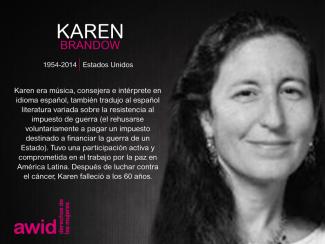
Karen Brandow
Lxs defensorxs se identifican a sí mismas como mujeres y personas lesbianas, bisexuales, transgénero, queer e intersex (LBTQI) y otrxs que defienden derechos y que debido a su trabajo en derechos humanos están bajo riesgos y amenazas específicos por su género y/o como consecuencia directa de su identidad de género u orientación sexual.
Lxs defensorxs son objeto de violencia y discriminación sistemáticas debido a sus identidades y su inclaudicable lucha por derechos, igualdad y justicia.
El Programa Defensorxs colabora con contrapartes internacionales y regionales así como con lxs afiliadxs de AWID para crear conciencia acerca de estos riesgos y amenazas, abogar por medidas de protección y de seguridad que sean feministas e integrales, y promover activamente una cultura del autocuidado y el bienestar colectivo en nuestros movimientos.
lxs defensorxs enfrentan los mismos tipos de riesgos que todxs lxs demás defensorxs de derechos humanos, de comunidades y del medio ambiente. Sin embargo, también están expuestas a violencia y a riesgos específicos por su género porque desafían las normas de género de sus comunidades y sociedades.
Nos proponemos contribuir a un mundo más seguro para lxs defensorxs, sus familias y comunidades. Creemos que actuar por los derechos y la justicia no debe poner en riesgo a lxs defensorxs, sino que debe ser valorado y celebrado.
Promoviendo la colaboración y coordinación entre organizaciones de derechos humanos y organizaciones de derechos de las mujeres en el plano internacional para fortalecer la capacidad de respuesta en relación a la seguridad y el bienestar de lxs defensorxs.
Apoyando a las redes regionales de defensorxs y de sus organizaciones, tales como la Iniciativa Mesoamericana de Mujeres Defensorxs de Derechos Humanos y la WHRD Middle East and North Africa Coalition [Coalición de Defensorxs de Derechos Humanos de Medio Oriente y África del Norte], promoviendo y fortaleciendo la acción colectiva para la protección, poniendo el énfasis en establecer redes de solidaridad y protección, promover el autocuidado y la incidencia y movilización por la seguridad de lxs defensorxs.
Aumentando la visibilidad y el reconocimiento de lxs defensorxs y sus luchas, así como de los riesgos que enfrentan, a través de la documentación de los ataques que sufren, e investigando, produciendo y difundiendo información sobre sus luchas, estrategias y desafíos.
Movilizando respuestas urgentes de solidaridad internacional para lxs defensorxs que están en riesgo a través de nuestras redes internacionales y regionales y de nuestrxs afiliadxs activxs.
Thanks to our global feminist community! From May to August 2024, nearly 1,200 organizations working for Women's rights, gender justice, and LBTQI+ equality shared their experiences in the WITM survey. The results offer a unique picture of how feminist movements are resourced and where gaps remain.
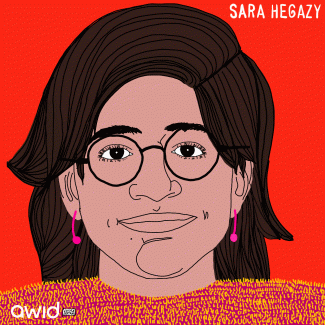
Sarah Hegazy, una audaz activista egipcia por los derechos LGBTQI+, vivía en una sociedad en la que lxs integrantes de su comunidad, sus cuerpos y sus vidas, enfrentan prejuicios letales a menudo. La resistencia de Sarah estaba arraigada en la deconstrucción del sistema dominante, opresor y patriarcal, y de sus actores antiderechos.
«[En Egipto], toda persona que no sea varón, musulmán, suní, heterosexual y partidario del sistema, es rechazada, reprimida, estigmatizada, arrestada, exiliada o asesinada. Este problema se relaciona con el sistema patriarcal en su conjunto, ya que el Estado no podría ejercer su represión contra lxs ciudadanxs, si no hubiera una opresión preexistente desde la infancia», escribió Sarah Hegazy el 6 de marzo de 2020
La supresión de la voz de Sarah por parte del gobierno egipcio alcanzó su pico más violento en 2017, cuando fue arrestada por alzar una bandera arcoíris en el recital de Mashrou’ Leila (una banda libanesa cuyo cantante principal es abiertamente gay) en El Cairo. Fue acusada de pertenecer a un grupo ilegal, y de «promover la desviación sexual y el libertinaje».
«Fue un acto de apoyo y solidaridad, no solamente con el cantante [de Mashrou’ Leila] sino con todas las personas oprimidas... Nos enorgulleció alzar la bandera. Nunca nos imaginamos la reacción de la sociedad y del Estado egipcio. Para ellos, yo era una criminal: alguien que buscaba destruir la estructura moral de la sociedad.» - Sarah Hegazy
Sarah estuvo encarcelada por tres meses, durante los cuales fue torturada y agredida sexualmente. En enero de 2018, después de ser liberada bajo fianza, pidió asilo en Canadá, donde estaba segura, pero seguía prisionera de los recuerdos del abuso y la violencia que su cuerpo y su alma habían sufrido.
«Salí de esta experiencia después de tres meses con un caso muy intenso y serio de TEPT [trastorno por estrés postraumático]. La prisión me mató. Me destruyó», dijo Sarah Hegazy a NPR.
Sarah se quitó la vida el 14 de junio de 2020, luego de dejar una nota escrita a mano en árabe:
«A mis hermanxs: traté de encontrar redención y fallé, perdónenme.
A mis amigxs: la experiencia [el viaje] fue muy dura y soy demasiado débil como para resistir, perdónenme.
Al mundo: has sido tremendamente cruel, pero perdono.»
Su legado y su coraje continuarán, llevados adelante por quienes la aman y creen en aquello por lo que Sarah luchó.
«A Sarah: Descansa, solo descansa, libre de esta violencia implacable, de este patriarcado letal impulsado por el Estado. Con rabia, con dolor, con extenuación, resistimos.» - Rasha Younes, investigadora sobre derechos LGBT de Human Rights Watch. Lee el texto completo
El vocalista de Mashrou’ Leila canta un tributo a Sarah Hegazy
La información contenida en esta comunicación es confidencial y está destinada exclusivamente la persona que lo recibe.
Esta comunicación podría contener información que es propiedad de la Asociación para los Derechos de las Mujeres y el Desarrollo (AWID, por sus siglas en inglés). Esta información no puede reproducirse ni diseminarse ni parcialmente ni en su totalidad sin el consentimiento escrito de AWID.
AWID no garantiza que la información aquí contenida sea completa o correcta. Esta comunicación no es una oferta para elaborar ningún tipo de acuerdo y no es una confirmación de ningún acuerdo descrito en este documento, a menos que el contexto indique claramente lo contrario.
AWID no está actuando en calidad de asesora de ningún acuerdo que pueda surgir de este documento, y esta comunicación no constituye una recomendación, guía o propuesta para elaborar un acuerdo.
AWID no garantiza o asegura los resultados esperados de cualquier acuerdo. Esta comunicación puede contener puntos de vista y opiniones que pueden no corresponderse con aquellos de AWID.
No tendrá derecho a utilizar la información contenida en esta comunicación con fines de llegar a cualquier tipo de propuesta de acuerdo u otro.
"Sabemos que todo está en nuestra contra y hay muy pocas posibilidades de cambiar eso. Pero creemos en la intervención y creo que tenemos una oportunidad y deberíamos usarla. Es por eso que estamos haciendo todo lo que estamos haciendo. Estamos dispuestos a presionar por cosas inauditas".
- Sopo Japaridze para OpenDemocracy
Photo @სოლიდარობის ქსელი / Solidarity Network
Participa en el Foro Internacional de AWID - un importante encuentro feminista global—, y accede a descuentos especiales para afiliadxs de AWID y puntos de entrada para el diálogo virtual. Creado en conjunto por los movimientos feministas, el Foro es un espacio único para una discusión profunda y para dejar correr la imaginación, donde desafiamos y fortalecemos nuestros procesos organizativos, donde conectamos nuestras luchas y las realidades feministas.
Nuestro poder colectivo, nuestra sabiduría y nuestro compromiso no tienen límites. Pero nuestras cuentas bancarias sí.
Las instantáneas de datos están basadas en las respuestas de 1.174 organizaciones feministas, por los derechos de las mujeres, LGBTQI+ y aliadas (en adelante «organizaciones feministas y por los derechos de las mujeres») de 128 países a ¿Dónde está el dinero para las organizaciones feministas? la encuesta de AWID.
Nuestros pensamientos acompañan a las numerosas personas de todo el mundo que se ven más afectadas por las repercusiones de la pandemia global del COVID-19, en especial, en las comunidades marginalizadas que han sido oprimidas históricamente.
Esta es una invitación destinada a artistas y activistas creativxs que quieran reunirse en un espacio virtual para conectarse, construir comunidad y apoyarse mutuamente en estos tiempos difíciles. Con este objetivo, hemos creado una comunidad de Slack nueva, para compartir en forma segura pensamientos, aprendizajes, trucos de vida, recursos, consejos, temores y ansiedades, recordatorios esperanzadores y alegres, y para charlar en general sobre cómo estamos.
Después de completar el formulario, le enviaremos una invitación personal a la comunidad.

Para quienes Slack es una herramienta nueva, y después de que se inscriban, les daremos sesiones y materiales de orientación.
Dado que aquí estamos trabajando en tres idiomas (inglés, español y francés), te pedimos que escribas en el idioma que te resulte más cómodo y utilices herramientas de traducción en línea (Google Translate u otras) para participar de las conversaciones.
La creación conjunta de nuestras realidades feministas comienza con nosotrxs mismxs y con cómo nos tratamos mutuamente. Nos esforzamos por crear y proteger espacios seguros para nuestras comunidades, tanto en línea como en forma presencial. También creemos que los espacios seguros y amigables son de propiedad y creación conjuntas. Esperamos que nuestrxs integrantes actúen de manera ética, responsable y consistente con los valores de AWID, y asuman la responsabilidad colectiva de garantizar una atmósfera de respeto y solidaridad recíprocos.
Como parte de nuestras conversaciones en curso, en Slack ofreceremos disparadores semanales, para facilitar el diálogo e inspirar los procesos artísticos en forma amable. Este puede ser un proceso introspectivo, pero para aprovechar al máximo esta comunidad, lxs invitamos a interactuar con lxs demás integrantes y compartir ideas, como parte de nuestras discusiones . La intención es invitar a la gente a responder de manera libre y gradual, escribiendo o produciendo arte como mejor lo sientan.
Esperamos mantener conversaciones relevantes y oportunas con ustedes, y, por lo tanto, apreciaremos tus sugerencias y comentarios. En general, los temas estarán centrados en las experiencias y perspectivas de artistas, escritorxs y creadorxs,que generarán un espacio donde lxs integrantes puedan describir e imaginar el clima global actual (y el que vendrá) a través de la lente de las realidades feministas.
Nous nous attachons à faire preuve de transparence, à utiliser nos ressources de manière responsable, à être équitables dans nos collaborations et à faire preuve de responsabilité et d'intégrité envers nos membres, nos partenaires, nos bailleurs de fonds et les mouvements avec lesquels nous travaillons. Nous nous engageons à réfléchir sur nos expériences, à partager ouvertement nos connaissances et à nous efforcer de modifier nos pratiques en conséquence.
Donde les organizadores de la primera línea de defensa conducen y las corporaciones rinden cuentas.
📅 Martes 11 de noviembre de 2025
📍 En línea y en la Universidade Federal do Pará, Belém
par Gabrielle Tesfaye
Quand j’ai créé mon court-métrage d’animation The Water Will Carry Us Home, mon esprit était branché sur un monde magique de résilience téméraire et de sirènes ancestrales transformant leurs cicatrices/plaies les plus profondes en une nouvelle vie. Le film se déroulant à l’époque du commerce transatlantique de l’esclavage, j’ai eu envie de montrer l’histoire de l’esclavage américain, telle qu’elle n’a jamais été racontée précédemment. Je voulais offrir à mes ancêtres la commémoration qu’iels n’ont jamais reçue, et j’avais comme motivation de m’approprier l’histoire qui continue à nous dépeindre comme des victimes désemparées. Je voulais simplement raconter la vérité. En me réappropriant et en réimaginant notre histoire et notre point de vue, je guérissais en même temps les traumatismes générationnels dont nous souffrons aujourd’hui. C’est cet important travail que font de très nombreuses femmes du continent africain et de la diaspora africaine, donnant vie à nos Réalités féministes collectives.
J’ai mené des recherches très systématiques pour la réalisation de ce film, et en consultant ce qui avait été écrit, j’ai vu ce qui ne l’avait pas été. À plusieurs reprises, j’ai eu l’impression d’être confrontée à un mur en essayant de trouver quelque chose qui n’y était pas, et c’est dans ces lacunes que j’ai pris conscience que les conteuses d’aujourd’hui comblent les vides. Les histoires les plus utiles se cachent dans l’art contemporain, dans les films et dans le folklore de la diaspora africaine.
The Water Will Carry Us Home s’est ainsi déplacé dans le monde entier, dans les cœurs de la diaspora. Le film m’a également menée ici, en tant que commissaire des projections de films africains et de la diaspora pour l’initiative de cocréation de Réalités féministes de l’AWID. En sélectionnant ces films, j’étais à la recherche d’histoires totalement uniques, crues et représentatives du pouvoir féministe en action. Avec les trois courts-métrages et le long, ces films révèlent des histoires parmi des communautés d’Afrique et de la diaspora, notamment en Éthiopie, en Ouganda, en République démocratique du Congo, en Afrique du Sud et au Kenya. Ces films présentent les femmes africaines comme elles sont réellement : autogouvernées et autonomisées par l’objectif sans filtre de leur travail.
The Water Will Carry Us Home carried itself around the world into the hearts of the Diaspora. It also led me here, as the curator of the African and Diaspora film screenings of AWID’s Co-Creating Feminist Realities initiative. Whilst curating this collection of films, I looked for stories that were completely unique, raw and representational of feminist power in action. Consisting of three shorts and one feature, they reveal stories through many communities in Africa and the diaspora, including Ethiopia, Uganda, The Democratic Republic of Congo, South Africa and Kenya. These films reposition African women as what they truly are- self governing and empowered through the unfiltered lens of their work.
« Un récit incroyablement beau, attentif et finement observateur de la connexion entre l'Afrique et sa diaspora formée par la traite transatlantique d’esclaves. L'univers visuel qu'il crée est tout simplement magnifique... un écho de la fusion des traditions spirituelles et du temps non linéaire qui montre comment nous vivons encore les moments du passé qui ont formé de « nouveaux » mondes de négritudes pour la diaspora. »
- Jessica Horn, stratège féministe panafricain·e, écrivain·e et cocréateur·rice de The temple of her skin (Le temple de sa peau)
«...vraiment unique, brut et représentatif du pouvoir féministe en action. »
- Collectif Hers is Ours (La sienne est nôtre), organisateur du Festival Outsider Moving Art & Film
Notre documentaire Women Hold Up the Sky, créé par la WoMin African Alliance, raconte l’histoire de femmes activistes en Ouganda et en République démocratique du Congo qui réclament activement leurs droits fonciers menacés localement par les mines et autres activités d’extraction. Le film expose certes la corruption liée à l’extractivisme, mais partage enfin ce qui fait tant défaut sur les écrans : la manière dont les femmes africaines de la base s’organisent activement, créent des stratégies et mènent des analyses au sein de leur communauté, pour créer des alternatives axées sur les femmes et menées par la communauté. Margaret Mapondera, de WoMin, l’explique de manière très poétique : ce sont les « gardiennes des terres, des forêts, des eaux, des rivières et des territoires; les façons selon lesquelles les femmes détiennent et transmettent leurs histoires/les histoires des femmes de notre passé et de nos avenirs; les manières à la fois puissantes et transformatrices d’être femme s’incarnent dans leurs relations entre elles, avec l’environnement et avec elles-mêmes ».
« Une œuvre cinématographique rafraîchissante et indispensable qui met en évidence les nombreuses façons dont les femmes africaines se rassemblent pour créer des alternatives dirigées par les femmes et axées sur la communauté… Le combat est engagé et les femmes en détiennent la clé. »
- Collectif Hers is Ours (La sienne est nôtre), organisateur du Festival Outsider Moving Art & Film
Pumzi, de la réalisatrice Wanuri Kahiu acclamée par la critique, établit un pont entre l’Afrique et la science-fiction en se centrant sur le climat et l’environnementalisme. Pumzi imagine un monde futuriste où l’humanité aura été contrainte de s’installer sur une autre planète. Si Pumzi semble afro-futuriste et nouveau pour l’Afrique en surface, Kahiu révèle que la science-fiction et le fantastique ont toujours existé dans les récits africains, mais qu’ils n’ont simplement jamais été reconnus. Kahiu crée un monde où les femmes cherchent les vérités et sont les héroïnes qui nous guident dans un monde nouveau, soit à l’opposé des images qui placent les femmes en tant que victimes de la guerre et de la destruction. À l’inverse, Pumzi rédige le récit de femmes africaines qui se sauvent elles-mêmes et résolvent leurs propres problèmes, qui ne s’arrêtent à aucun prix dans la poursuite des visions énigmatiques qu’elles insufflent dans leurs rêves.
« Un film de science-fiction africain pionnier, situant les femmes comme scribes du futur et ouvrant nos visions vers d'autres mondes, d'autres univers que nous pourrions occuper en tant qu'Africain·e·s - un exercice toujours important à réaliser lorsqu’on envisage les modes de sortie de crises actuelles. »
- Jessica Horn, stratège féministe panafricain·e, écrivain·e et cocréateur·rice de The temple of her skin (Le temple de sa peau)
Le seul long métrage du programme, Finding Sally, se déroule dans l’Éthiopie des années 1970, à l’époque de la Terreur rouge. Il documente l’étonnante histoire de la tante de la réalisatrice Tamara Mariam Dawit, l’activiste Sally Dawit. Le film nous raconte l’incroyable aventure de Sally, jeune et courageuse activiste qui évolue dans les années les plus violentes de l’histoire de l’Éthiopie. L’histoire de Sally révèle non seulement la gravité de l’époque, mais ses réflexions sur sa propre évolution en tant que jeune femme. Dawit a intentionnellement fait abstraction des voix d’hommes dans son film, pour se centrer sur le point de vue et le regard des femmes. L’histoire de l’Éthiopie a si souvent, et si longtemps, été racontée par des hommes que la réalisation de cette puissante histoire protège la réalité en rendant honneur au point de vue féministe. Dawit explique que « [l]es femmes pendant la révolution et la guerre ne sont souvent mentionnées qu’en tant qu’épouse de quelqu’un, ou que cuisinière ou secrétaire. Je voulais observer et montrer l’activisme autour de la révolution, uniquement à travers les mémoires et les voix des femmes ». Finding Sally démontre la réappropriation de l’histoire que réclament les cinéastes actuelles. C’est un embrasement de pouvoir féministe et de nos réalités connectées, à travers l’histoire.
« La responsabilité nous incombe, de nous souvenir de ces femmes qui nous ont précédé·e·s et de leur brillant travail, pour ne pas être oubliées comme les milliers de femmes qui l’ont déjà été en menant le bon combat. Sally est une sacrée femme, pourvu qu’elle ne soit jamais oubliée. »
- Collectif Hers is Ours (La sienne est nôtre), organisateur du Festival Outsider Moving Art & Film
Inscrivez-vous ici pour regarder ce film du 18 au 22 juin
Ces films constituent maintenant une partie importante de ma psyché. Ils me poussent à continuer à créer des alternatives puissantes vers la justice depuis l’intérieur. Ils affirment que je suis une femme dans un monde de femmes, tenant les cieux à bout de bras et construisant activement des Réalités féministes indestructibles. Ces films sont davantage que des histoires d’Africaines. Tout le monde peut s’y référer, ils sont source d’inspiration et donnent l’exemple de Réalités féministes pour nous toustes dans le monde entier.
Facebook: @AWIDWomensRights
Instagram: @awidwomensrights
Twitter ENG: @awid
Twitter ES: @awid_es
Twitter FR: @awid_fr
LinkedIn: Association for Women's Rights in Development (AWID)

The AWID Forum is just one stop in the Feminist Realities journey. Let’s travel this path together and explore our power in action!