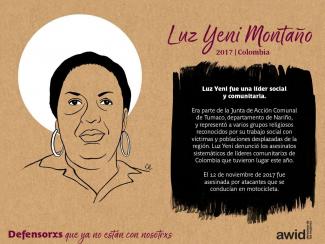
Luz Yeni Montaño

Lxs defensorxs se identifican a sí mismas como mujeres y personas lesbianas, bisexuales, transgénero, queer e intersex (LBTQI) y otrxs que defienden derechos y que debido a su trabajo en derechos humanos están bajo riesgos y amenazas específicos por su género y/o como consecuencia directa de su identidad de género u orientación sexual.
Lxs defensorxs son objeto de violencia y discriminación sistemáticas debido a sus identidades y su inclaudicable lucha por derechos, igualdad y justicia.
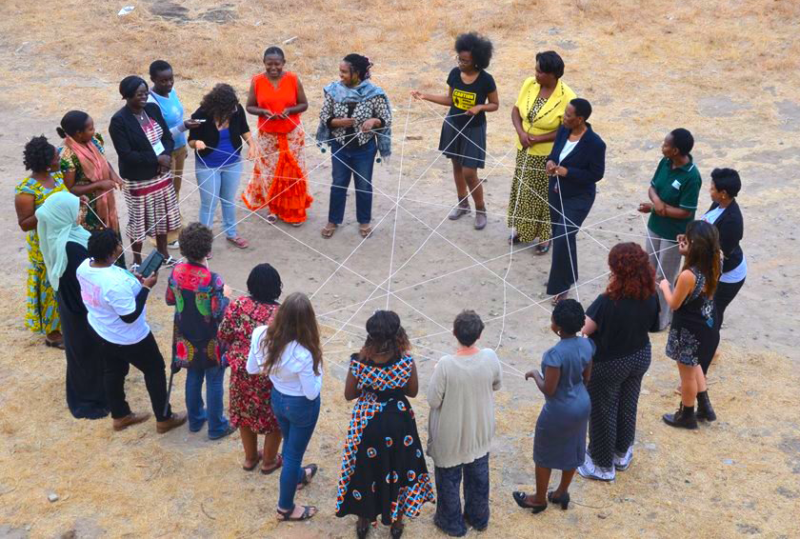
El Programa Defensorxs colabora con contrapartes internacionales y regionales así como con lxs afiliadxs de AWID para crear conciencia acerca de estos riesgos y amenazas, abogar por medidas de protección y de seguridad que sean feministas e integrales, y promover activamente una cultura del autocuidado y el bienestar colectivo en nuestros movimientos.
lxs defensorxs enfrentan los mismos tipos de riesgos que todxs lxs demás defensorxs de derechos humanos, de comunidades y del medio ambiente. Sin embargo, también están expuestas a violencia y a riesgos específicos por su género porque desafían las normas de género de sus comunidades y sociedades.
Nos proponemos contribuir a un mundo más seguro para lxs defensorxs, sus familias y comunidades. Creemos que actuar por los derechos y la justicia no debe poner en riesgo a lxs defensorxs, sino que debe ser valorado y celebrado.
Promoviendo la colaboración y coordinación entre organizaciones de derechos humanos y organizaciones de derechos de las mujeres en el plano internacional para fortalecer la capacidad de respuesta en relación a la seguridad y el bienestar de lxs defensorxs.
Apoyando a las redes regionales de defensorxs y de sus organizaciones, tales como la Iniciativa Mesoamericana de Mujeres Defensorxs de Derechos Humanos y la WHRD Middle East and North Africa Coalition [Coalición de Defensorxs de Derechos Humanos de Medio Oriente y África del Norte], promoviendo y fortaleciendo la acción colectiva para la protección, poniendo el énfasis en establecer redes de solidaridad y protección, promover el autocuidado y la incidencia y movilización por la seguridad de lxs defensorxs.
Aumentando la visibilidad y el reconocimiento de lxs defensorxs y sus luchas, así como de los riesgos que enfrentan, a través de la documentación de los ataques que sufren, e investigando, produciendo y difundiendo información sobre sus luchas, estrategias y desafíos.
Movilizando respuestas urgentes de solidaridad internacional para lxs defensorxs que están en riesgo a través de nuestras redes internacionales y regionales y de nuestrxs afiliadxs activxs.
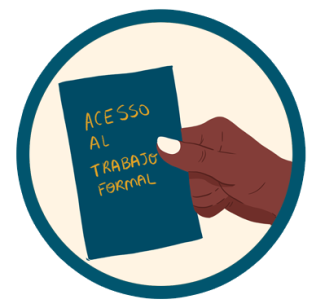
Solo el 18% de las personas trans y travestis en Argentina acceden a un trabajo formal
Los resultados de la investigación también influirán sobre tu trabajo de incidencia ya que, por ejemplo, te habrán revelado qué sectores otorgan más financiamiento y cuáles consideras que necesitan mayor formación para ejercer su rol de donantes.
En esta sección
- Desarrolla la estrategia de incidencia
- Ponte en contacto con tus redes
- Adapta la estrategia a cada sector
1. Organizaciones por los derechos de las mujeres
2. Entidades bilaterales y multilaterales
3. Fundaciones privadas
4. Fondos de mujeres
5. Sector privado y nuevos donantes
En la sección de este Manual dedicada a «Prepara el marco para la investigación», te recomendamos que pensaras en las metas que esperabas alcanzar con la investigación. Esas metas te permitirán desarrollar una estrategia de incidencia una vez que hayas completado la investigación.
Una estrategia de incidencia es un plan para difundir los resultados de la investigación de una forma tal que te permita cumplir las metas, dentro del objetivo más amplio que es hacer incidencia con sectores clave para introducir cambios positivos en cuanto a los recursos disponibles para los procesos organizativos por los derechos de las mujeres.
Cómo utilizar las metas definidas en el marco para la investigación:
De esa lista — que será lo más exhaustiva posible — elige los medios más eficientes para alcanzar tus metas. (Más abajo encontrarás ejemplos específicos de audiencias y métodos de incidencia)
Una vez que hayas desarrollado la estrategia, podrás comenzar con la difusión.
Para difundir los resultados, primero ponte en contacto con las personas/organizaciones a través de las cuales distribuiste la encuesta, y también con todas las que respondieron la encuesta y fueron entrevistadas.
No te olvides de pedirles que identifiquen quién será tu contacto en cada organización y pídeles que te confirmen una vez que hayan realizado cualquier publicación referida a tus materiales.
Esto te permitirá tener un registro de quiénes difundieron el informe pero también construir vínculos más sólidos con las organizaciones y personas con las que trabajas.
A modo de ejemplo te presentamos una lista de sectores sobre los que AWID realiza incidencia.
Para esto te resultará útil la lista de organizaciones y personas que te asesoraron durante la investigación (consultorxs). Ellxs te ayudarán a difundir el informe en distintos espacios y también podrán presentarte a nuevas organizaciones o llevarte a nuevos espacios para hacer incidencia.
Objetivos propuestos: Que las organizaciones por los derechos de las mujeres actualicen sus conocimientos acerca de las tendencias en el financiamiento; pensar colectivamente iniciativas conjuntas para la movilización de recursos utilizando los resultados de la investigación; influir sobre cómo abordan la movilización de recursos
Ejemplos de posibles métodos de incidencia:
Objetivo propuesto: Crear conciencia acerca de cómo el sector del financiamiento no está cumpliendo con sus compromisos establecidos y cómo necesita mejorar los mecanismos de apoyo para financiar los procesos organizativos por los derechos de las mujeres.
Identifica qué entidades bilaterales y multilaterales son las más influyentes en cuanto al financiamiento; esto podría incluir a las sedes locales de las embajadas.
Ejemplos de posibles métodos de incidencia:
Objetivo propuesto: Expandir la calidad y cantidad del apoyo a las organizaciones por los derechos de las mujeres.
Ejemplos de posibles métodos de incidencia:
Objetivo propuesto: Alentarlas a continuar y expandir su trabajo.
Ejemplos de posibles métodos de incidencia:
Objetivos propuestos: Incrementar su conocimiento del campo y alentar a la coherencia entre sus intereses filantrópicos y sus prácticas comerciales.
Ejemplos de posibles métodos de incidencia:
Asegúrate de adaptar las presentaciones, propuestas y aplicaciones a cada uno de los grupos a los que quieres llegar.
Insistimos en recomendarte que consultes nuestra Planilla ¿Estoy listx? para evaluar cómo has ido avanzando.

1-2 años, dependiendo de los objetivos de incidencia
• 1 persona (o más) de comunicación
• Lista de espacios para hacer publicidad de la investigación
• Lista de los blogs y revistas en línea donde se pueden publicar artículos acerca de su hallazgo de la investigación
• Lista de asesores
• Sus productos de información WITM
• Ejemplo de plan para incidencia
No, no lo es. Se basa en los 20 años de historia de AWID movilizando más y mejor financiamiento para el cambio social encabezado por los feminismos, y se trata de la tercera edición de la investigación ¿Dónde está el dinero para las organizaciones feministas? Aspiramos a repetir la encuesta ¿Dónde está el dinero? cada tres años.
Avant de prendre sa retraite, elle a occupé de nombreux postes de haut niveau, notamment celui de membre de la cour d’appel et juge en chef adjointe de l’Ouganda. Elle a été la première femme ougandaise à occuper le poste de magistrat en chef entre 1973 et 1986 et la première femme à être nommée juge à la Haute Cour de justice en 1986.
Elle fut l'une des premières femmes à recevoir le titre de chevalier pontifical de l'histoire de l'Église catholique en Afrique. Elle est morte d'une crise cardiaque.

L'économie solidaire (qui inclut l'économie coopérative et l’économie du don) est un cadre alternatif qui adopte différentes formes dans divers contextes et qui est ouvert au changement continuel.
Dans une économie solidaire, les producteurs mettent en place des processus économiques qui sont intimement liés à leurs réalités, à la préservation de l'environnement et à la coopération mutuelle.
Selon la géographe féministe Yvonne Underhill-Sem, l'économie du don est un système économique dans lequel les biens et les services circulent entre les personnes sans accord explicite de leur valeur, ou sans impliquer de réciprocité ultérieure.
Derrière le don il y a la relation humaine, la bienveillance et l'attention portée à la nurturance* de toute la société, non seulement limitée à soi-même et aux proches. Il s’agit ici de la notion du collectif.
Par exemple, dans la région du Pacifique, cette approche comprend la collecte, la préparation et le tissage de ressources terrestres et marines pour fabriquer des tapis, des ventilateurs, des guirlandes et des objets de cérémonie. Elle comprend également l'élevage du bétail et le stockage des récoltes saisonnières.
Pour les femmes, les incitations à s’engager dans des activités économiques sont diverses et multiples, allant de la réalisation d’aspirations de carrière afin de gagner de l'argent pour une vie confortable à long terme, à gagner de l'argent pour joindre les deux bouts, à rembourser une dette ou encore à échapper aux corvées de la vie courante.
Pour s’adapter aux divers environnements au sein desquels les femmes travaillent, le concept d'économie solidaire est en développement permanent et est continuellement discuté et débattu.
Nurturance : Nourriture et soins émotionnels et physiques donnés à quelqu'un.
Si vous avez des questions ou des inquiétudes, merci de nous contacter par le biais de ce formulaire, en indiquant « Enquête WITM » dans l’objet de votre message. Vous pouvez également nous écrire à witm@awid.org.
Asma was a leading Pakistani rights activist, fearless critic of the military’s interference in politics and a staunch defender of the rule of law.
She was the founding chairwoman of the Human Rights Commission of Pakistan, an independent group, and was a trustee of the International Crisis Group. She won international awards and served as the United Nations rapporteur on human rights and extrajudicial killings.
She is remembered fondly by colleagues and friends at AWID
“With her life, Asma rewrote the history that many of us were told as women. Asma changed the world. She changed it in Pakistan, and she changed it in our imaginations."

"My dreams and objectives have always been the same as those of Lohana Berkins: for the cooperative to continue standing and not to close. To continue to give this place to our travesti comrades, to give them work and a place of support"
Brisa Escobar,
president of the Cooperative
An economic system in which production and consumption patterns are based on profit using privately owned capital goods and wage labour. The system builds on individual wealth and capital accumulation at the lowest cost to the investor, with little regard for the societal costs and exploitation of the workforce - both paid and unpaid.
The conversion of land and activities related to it (like agriculture) into commodities that can be bought or sold for profit.
Institutions (like the World Bank, International Monetary Fund, or regional development banks) that provide loans to countries lacking sufficient money to cover funding shortfalls or to finance development projects. Historically, the lending policies of these institutions have been determined by economically powerful Western countries and private enterprises. Loans to low-income countries in particular typically include conditionalities that prompt economic reforms in these countries to support neo-liberalism.
A set of economic and political theories in which market forces, rather than governments, determine key aspects of the economy with governments acting to support globalized markets and the interests of capital. Neo-liberal economic policies typically include promotion of free trade, privatisation, reduced government spending on social programs, subsidies and tax exemptions for business, deregulation of financial sector and foreign investments, low taxes on the wealthy and corporations, flexible labour and weak environmental protection.
Refers to systemic and institutionalized male domination embedded in and perpetuated by cultural, political, economic and social structures and ideologies. Hetero-patriarchy in addition, is a patriarchal system that is also based on the belief that heterosexuality is the only normal and acceptable sexual orientation.

لبناء وقائع نسوية ترتكز على الأدلة عن كيف يتحرك المال ولمن يصل
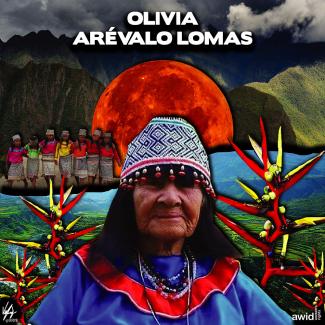
Olivia era la líder espiritual del pueblo indígena Shipibo Konibo.
Sabia mujer indígena y abuela, era conocida por practicar la medicina tradicional y cantar las canciones sagradas de su pueblo (Íkaros). Olivia Arévalo fue una activa defensora de los derechos culturales y ambientales de su pueblo. Su asesinato tuvo lugar en un contexto de conflicto territorial entre la comunidad shipibo y las empresas que quieren apropiarse de sus tierras para cultivar palma aceitera.
Integrantes de su comunidad han dicho: «Su muerte es una agresión contra toda la comunidad shipibo. Ella era la memoria viviente de su pueblo».