Jean-Marc Ferré | Flickr (CC BY-NC-ND 2.0)
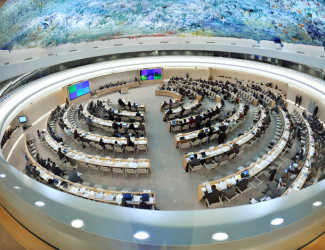
A general view of participants at the 16th session of the Human Rights Council in Geneva, Switzerland.

Análisis Especiales

AWID es un organización feminista internacional de membresía, que brinda apoyo a los movimientos que trabajan para lograr la justicia de género y los derechos de las mujeres en todo el mundo.

Consejo de Derechos Humanos (CDH)

El Consejo de Derechos Humanos (CDH) es el cuerpo intergubernamental del sistema de las Naciones Unidas responsable de la promoción y protección de todos los derechos humanos en todo el mundo. El HRC se reúne en sesión ordinaria tres veces al año, en marzo, junio y septiembre.  La La Oficina del Alto Comisionado para los Derechos Humanos (ACNUDH) es la secretaría del Consejo de Derechos Humanos.

El CDH  trabaja de la siguiente forma:

  • Debate y aprueba resoluciones sobre cuestiones mundiales de derechos humanos y el estado de los derechos humanos en determinados países

  • Examina las denuncias de víctimas de violaciones a los derechos humanos o las de organizaciones activistas, quienes interponen estas denuncias representando a lxs víctimas.

  • Nombra a expertos independientes que ejecutarán los «Procedimientos Especiales» revisando y presentado informes sobre las  violaciones a los derechos humanos desde una perspectiva temática o en relación a un país específico

  • Participa en discusiones con expertos y  gobiernos respecto a cuestiones de derechos humanos.

  • A través del Examen Periódico Universal, cada cuatro años y medio, se evalúan los  expedientes de derechos humanos de todos los Estados Miembro de las Naciones Unidas

Aprende más sobre el CDH


La Sesión actual - CDH44

Se está llevarando a cabo en Ginebra, Suiza del 30 de junio al 17 de julio de 2020.

AWID trabaja con socios feministas, progresistas y de derechos humanos para compartir conocimientos clave, convocar diálogos y eventos de la sociedad civil, e influir en las negociaciones y los resultados de la sesión.

Con nuestrxs socixs, nuestro trabajo será:


◾️ Monitorear, rastrear y analizar actores, discursos y estrategias anti-derechos y su impacto en las resoluciones

◾️ Desarrollar conjuntamente una labor de promoción conjunta para contrarrestar a los actores anti-derechos y debatir más a fondo las conclusiones del Informe de Tendencias de OUR de 2017

◾️ Apoyar, coordinar y desarrollar de manera colaborativa el Caucus feminista emergente en el CDH


Contenido relacionado

Snippet FEA Nous Sommes la Solution (EN)

The logo of We Are The Solution with green silhouettes of four rural woment

Nous Sommes la Solution is a rural women 's movement for food sovereignty in West Africa. Founded originally as a campaign against hyper-industrialized agriculture, Nous Sommes la Solution has grown into a movement of more than 500 rural women’s associations from Burkina Faso, Senegal, Ghana, Gambia, Guinea Bissau, Mali and Guinea.

Together, this women-led movement is building and strengthening food and seed sovereignty across West Africa. They feed communities, strengthen local economies, amplify the knowledge of women farmers and mitigate the devastating effects of climate change through agroecological practices. They also organize workshops, forums and community radio broadcasts to share their messages, their traditional knowledges and agroecological practices across rural communities.

In collaboration with universities and public research centers, Nous Sommes la Solution works towards restoring traditional Indigenous varieties of rice (a staple food in West Africa) and promoting local food economies based on agroecological principles, influencing national policy-making, all the while supporting women in creating farming associations and collectively owning and managing farmland.

Quelle est votre définition du financement extérieur?

Le financement extérieur inclut les subventions et autres formes de financement de la part de fondations philanthropiques, de gouvernements, de financeurs bilatéraux, multilatéraux ou d’entreprise et de donateur·rices individuel·les, qu’elles et ils soient de votre pays ou de l’étranger. Il exclut les ressources que les groupes, organisations et/ou mouvements génèrent de manière autonome (ressource en anglais), telles que les cotisations d’adhésion, contributions volontaires du personnel, de membres et/ou de soutiens, les collectes de fonds communautaires, les locations de salles et ventes de services. Les définitions des différents types de financement, ainsi que de courtes descriptions des différents bailleurs de fonds, sont incluses dans l’enquête pour une meilleure compréhension.

WHRDs from Sub-Saharan Africa

In our 2015 Online Tribute to Women Human Rights Defenders No Longer With Us we are commemorating four women from Sub-Saharan Africa, three of whom were murdered due to their work and/or who they were in their gender identity and sexual orientation. Their deaths highlight the violence LGBT persons often face in the region and across the globe. Please join AWID in honoring these women, their activism and legacy by sharing the memes below with your colleagues, networks and friends and by using the hashtags #WHRDTribute and #16Days. 


Please click on each image below to see a larger version and download as a file


Mena Mangal

Mena Mangal fue una destacada periodista de televisión, defensora de los derechos de las mujeres y asesora cultural de la Wolesi Jirga, la cámara baja del parlamento nacional de Afganistán.

Durante más de una década, trabajó para Ariana TV, el canal Lamar de lengua Pashto de Tolo TV, y para la emisora privada de televisión nacional afgana Shamshad TV. Como presentadora, Mena se enfocó en los derechos de las mujeres y en los programas de entrevistas culturales.

"La defensora de los derechos de la mujeres Wazhma Frogh dijo que Mangal "tenía una voz fuerte" y  se pronunció activamente como defensora de su pueblo".

Fuera de la pantalla, también dirigió páginas populares de redes sociales que defendían los derechos de las niñas y mujeres afganas a la educación y el trabajo. En lo que concierne a su vida privada, Mena escribió extensamente acerca de cómo había sido forzada a contraer un matrimonio arreglado en 2017, y sobre el proceso que tuvo que atravesar para poder obtener finalmente el divorcio.

En un post de Facebook, Mena escribió que estaba recibiendo amenazas de muerte de fuentes desconocidas, pero que aun así continuaría llevando a cabo su trabajo.

El 11 de mayo de 2019, Mena fue atacada por hombres armados desconocidos y asesinada a tiros a plena luz del día en un espacio público del sudeste de Kabul.

"Estamos preocupadxs por la situación actual ya que está teniendo un impacto directo en las mujeres que trabajan fuera de sus casas... Las mujeres periodistas están cambiando de profesión debido a los crecientes riesgos que enfrentan". - Robina Hamdard, defensora de los derechos de las mujeres en Kabul.

Snippet FEA What are the objectives (ES)

¿Cuáles son los Objetivos de Nous Sommes la Solution?

Is the WITM survey accessible for people with disabilities?

Yes, the survey is accessible to people with a diverse range of hearing, movement, sight, and cognitive abilities.

Research methology

Over eight years, we did four global surveys and built a research methodology.

In 2013, we published three global reports. These reports confirm that women’s rights organizations are doing the heavy lifting to advance women’s rights and gender equality by using diverse, creative and long-term strategies, all while being underfunded.

Our 2010 global survey showed that the collective income of 740 women’s organizations around the world totaled only USD 104 million. Compare this with Greenpeace International, one organization with a 2010 budget of USD 310 million1. Imagine the impact these groups could have if they were able to access all the financial resources they need and more?

AWID’s WITM research has catalyzed increased funding for women’s rights organizing. WITM research was a driving force behind the Catapult crowdfunding platform, which has raised USD 6.5 million for women’s rights. The Dutch Government cited WITM research as a reason for its unprecedented MDG 3 Fund of EU 82 million. WITM research has also led to the creation of several new funds: FRIDA – The Young Feminist Fund, the Indigenous Women’s Fund, Fundo Elas, the Mediterranean Women’s Fund and the Rita Fund.

Funding trends analyses

While the WITM research has shed important light on the global funding landscape, AWID and partners have identified the need to dig deeper, to analyze funding trends by region, population and issue. In response, organizations are now using AWID’s WITM research methodology to do their own funding trends analyses. For example, in November 2013, Kosova Women’s Network and Alter Habitus – Institute for Studies in Society and Culture published Where is the Money for Women’s Rights? A Kosovo Case Study.

At the same time, AWID continues to collaborate with partners in Where is the Money for Indigenous Women’s Rights (with International Indigenous Women’s Forum and International Funders for Indigenous Peoples) and our upcoming Where is the Money for Women’s Rights in Brazil? (with Fundo Elas).

Several organizations have also conducted their own independent funding trends research, deepening their understanding of the funding landscape and politics behind it. For example, the South Asian Women’s Fund was inspired by AWID’s WITM research to conduct funding trends reports for each country in South Asia, as well as a regional overview. Other examples of research outside of AWID include the collaboration between Open Society Foundations, Mama Cash, and the Red Umbrella Fund to produce the report Funding for Sex Workers Rights, and the first-ever survey on trans* and intersex funding by Global Action for Trans* Equality and American Jewish World Service.


Lina Ben Mhenni

« Je veux dire à tou·te·s les Tunisien·ne·s : Nous devons nous rassembler pour dire “non” à la censure et aux procès d’opinion. » - Lina Ben Mhenni (entretien de 2013)

Lina Ben Mhenni était une blogueuse, activiste et chargée de cours de linguistique tunisienne. Elle s’est exprimée haut et fort contre la censure sur Internet, a défendu la liberté d’expression ainsi que les droits des femmes et les droits humains. Lina s’est également battue pour la libération des étudiant·e·s arrêté·e·s sous l’ancien président Zine el-Abidine Ben Ali. 

« Un cyberactiviste doit aller sur le terrain, sentir ce que vivent les autres. On dit que la Révolution tunisienne est celle du Net, mais si elle n’était que ça, elle n’aurait jamais abouti ! » » Lina Ben Mhenni (article dans Ouest-France)

Elle a co-organisé en 2010 une manifestation en réaction à la suppression des médias et la censure sur Internet imposées par le gouvernement. Lina était très connue pour son blog « A Tunisian Girl » et son travail pendant la révolution tunisienne en 2011 était reconnu. Elle s’est servie de son blog pour transmettre des informations sur la révolte, partager des images documentant les manifestations, et a été parmi les rares voix qui s’élevèrent pour dénoncer les assassinats et la répression des manifestant·e·s à Sidi Bouzid. Lina était une des rares blogueuses à utiliser son vrai nom sur Internet, et non un pseudonyme pour protéger son identité. 

« Notre liberté d’expression est vraiment en danger. Je crains que nous ne soyons en train de perdre les fruits magnifiques de notre révolution : la disparition de la peur et la liberté d’expression. Nous devons continuer de nous battre pour protéger et préserver ce droit. » - Lina Ben Mhenni (entretien de 2013)

Lina n’avait que 36 ans lorsqu’elle est décédée, le 27 janvier 2020, de complications d’une maladie auto-immune. 

« La liberté, une meilleure éducation et la santé - c’est tout ce que nous voulions. Lorsque nous échouions, elle nous incitait à continuer. » Hala, l’institutrice de Lina.
 

Snippet FEA NSS uplifts and grows (FR)

Nous Sommes la Solution élève et développe le leadership des femmes rurales travaillant à des solutions africaines pour la souveraineté alimentaire.

¿Cuánto tiempo toma responder la encuesta?

El tiempo estimado para responder la encuesta es de 30 minutos.

7. Synthesize your research findings

Now that you have analyzed all your data – from your survey, interviews, desk research and potentially other sources – you can create your final product.

In this section:

Create your final product

Your final product will be the document that will summarize, analyze and criticize your data. That will be the piece that you will share with your community to present and explain your research to your audience.

At AWID, we often write a comprehensive written report that analyzes each set of data and synthesizes all of our findings, then later create smaller products, such as infographics and summaries (explained in the subsequent section “Finalize and format”).

1. Write clearly

  • Organize your data as you would like to tell a story. You can follow the order of your survey. Or you can regroup some questions to lead to your conclusion in a smooth and progressive way.
  • Adapt your language to your audience. Use universal language and avoid jargon or too technical terms.

Importance of the editor

An editor will proofread, ensure concise writing, conduct fact-checking, point out inconsistencies that need to be resolved, arrange the flow of the document and possibly suggest titles.

Your editor should preferably be someone who understands and knows your WITM work but who was not directly involved in the research. This will bring in a fresh perspective.

2. Make it pretty

  • Use the data collected to create graphs and tables. These type of visuals are a compelling way to highlight the main findings of your research and validate your analysis.

  • Source relevant images that can illustrate your report.

  • Highlight key-numbers and/or powerful testimonials.

Remember: The more accessible your product is, the more people will want to read (and share!) it.

Back to top


Gather review & inputs

At this point, you have collected all your data, analyzed it and transformed it into your final product, likely in a long report.

1. Polish your results

Before moving on to the next steps – you should share your final research product with your advisor organizations, activists, and donors.

This is a great moment to check the following points:

  • Are there any key points missing in your analysis of the present funding landscape and trends?
  • Are there any key points missing in your conclusions?
  • Are there any inaccuracies in the data that need to be corrected?
  • General suggestions on strengthening the report to achieve your goals as listed in your research framing.

Once you have inputted all feedback from your advisors, be sure to run it by your editor once more.

This will now be the final, completed version of your report.  If you intend to publish the final report in other languages, now is the time to send it for translation.

2. Facilitate the feedback

  • Your advisors are likely busy with their regular responsibilities. Be sure to request feedback within a reasonable deadline.
  • Keep your request for feedback brief and specific, so it is easy for them to respond. If you like, you can simply copy and paste the bullet points we have provided.
  • If you are publishing in multiple languages, ensure you have advisors who can also review the final translated versions of your product(s).

This is a significant contribution from your advisors. Consider offering them some form of recognition.

Back to top


Previous step

6. Conduct desk research

Next step

8. Finalize and format


Estimated time:

• 2 - 5 months

People needed:

• 1 or more research person(s)
• 1 Editor (or web-editor if you create an online product)
• Translator(s), if done in more than one language

Resource needed:

• List of advisor organizations, activists, and donors.
• Concept note (from “Frame your research” section)
• Survey topline results
• Prepared interview questions
• Interview results
• Desk research data
• All other data used in report


Previous step

6. Conduct desk research

Next step

8. Finalize and format


Ready to Go? Worksheet

Download the toolkit in PDF

Isabel Cabanillas de la Torre

Isabel Cabanillas de la Torre was a much loved young feminist artist and activist from Ciudad Juárez, Mexico, known for her beautiful and evocative hand-painted clothing with eyes being an emblematic feature in her work. Her murals transformed the run down and vacant buildings in Ciudad Juarez’s downtown, bringing life and political commentary to their walls.

Through her art and political activism Isabel sought to draw attention to the gender based violence pervasive in her hometown. She volunteered with the women’s network Mesa de Mujeres on the Citizen Observatory on Gender to monitor the performance of judges, prosecutors and public defenders on cases of femicides and other gender based violations. She was also a member of Hijas de su Maquilera Madre, a feminist collective whose name makes reference to the daughters of mothers who are maquila workers. Some of these mothers were among the first victims of femicide in the city.

Isabel’s latest project, still in progress, was an art installation to protest a Canadian company that was looking to mine copper in the Samalayuca Desert. 

On 18 January, 2020 Isabel was shot while riding her bike back home in Downtown Juárez, in what appeared to be a targeted killing, her body found beside her bike.

Isabel’s murder, sparked a new wave of outrage against femicides in the region, hundreds marched to the US-Mexico border bridge, blocking it for hours and chanting “Ni una mas” (Not one more) as feminist collectives continue to protest the murders of women throughout Mexico. In 2019 alone, 3142 women and girls were killed in Mexico, many of whom were targeted specifically because of their gender.

She loved riding her bike.

"The bike for her was a symbol of freedom. A symbol of being free in the streets." - Marisol (a friend of Isabel’s)  

Snippet FEA This is the story of the Nadia Echazú (EN)

A workplace does not have to operate on competition and profit. It does not have to exploit people for the benefit of the owner and a small elite either.

Instead, communities on the margins of formal economies are building cooperative models based on autonomy, cooperation, shared responsibility, self-management and solidarity.

Worker-controlled cooperatives and workplaces have always offered alternative ways of generating employment opportunities, income, social security and savings - while distributing revenues in more communal, sustainable and safer ways.

But it is more than an employment opportunity: it is the making of dreams into a reality, and the building of feminist economies based on solidarity and care for each other. It is about creating a world where our lives, our labor and our communities matter.

This is the story of the Nadia Echazú Textile Cooperative, the first social enterprise managed by and for travesti and trans people in Argentina.

Je ne me sens pas à l’aise à l’idée de communiquer le nom de mon groupe et nos coordonnées à l’AWID. Puis-je quand même participer à l’enquête?

Tout à fait, ces questions sont facultatives, et nous reconnaissons votre droit à l’anonymat. Merci de répondre aux questions de l’enquête, peu importe votre décision quant à la mention du nom de votre groupe, organisation et/ou mouvement et de vos coordonnées.