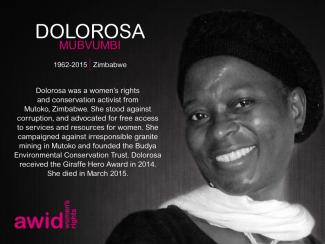
Dolorosa Mubvumbi
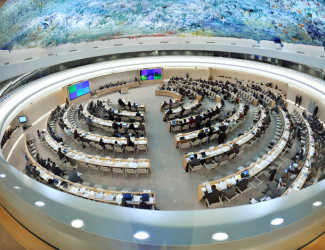
The Human Rights Council (HRC) is the key intergovernmental body within the United Nations system responsible for the promotion and protection of all human rights around the globe. It holds three regular sessions a year: in March, June and September. The Office of the UN High Commissioner for Human Rights (OHCHR) is the secretariat for the HRC.
Debating and passing resolutions on global human rights issues and human rights situations in particular countries
Examining complaints from victims of human rights violations or activist organizations on behalf of victims of human rights violations
Appointing independent experts (known as “Special Procedures”) to review human rights violations in specific countries and examine and further global human rights issues
Engaging in discussions with experts and governments on human rights issues
Assessing the human rights records of all UN Member States every four and a half years through the Universal Periodic Review
AWID works with feminist, progressive and human rights partners to share key knowledge, convene civil society dialogues and events, and influence negotiations and outcomes of the session.
Get started with these resources.
COP30 Political Education Toolbox Play the Climate Justice Organizing Deckgame
Read the Feminist Economic Alternatives Brief Download the Climate Justice Zine
Nous nous posons la même question et nous pensons qu'elle n’admet pas de réponse simple. Le Forum de l’AWID pourrait être, pour de nombreux participant·e·s, l'un des rares voyages internationaux qu'ils·elles effectueront au cours de leur vie. La pandémie nous a révélé les possibilités mais aussi les limites des espaces virtuels pour la construction de mouvements : rien ne vaut une rencontre en personne. Les mouvements ont besoin de connexions transfrontalières pour renforcer leur pouvoir collectif face aux menaces qui pèsent sur eux, notamment la crise climatique. Nous sommes d'avis que le prochain Forum de l'AWID pourrait ouvrir un espace stratégique afin d'organiser ces conversations et explorer les alternatives qui se posent aux voyages internationaux. L'élément hybride du Forum est une composante importante de cette exploration.
As heteropatriarchal capitalism continues to force us into consumerism and compliance, we are finding that our struggles are being siloed and separated by physical as well as virtual borders.
And with the additional challenges of a global pandemic to overcome, this divide-and-conquer strategy has been favorable for the proliferation of exploitation across many areas.
Yet, From September 1 to September 30, 2021, Crear | Résister | Transform: a festival for feminist movements! took us on a journey of what it means to embody our realities in virtual spaces. At the festival, feminist activists from across the world came together, not only to share experiences of hard-won freedoms, resistances, and cross-borders solidarities, but to articulate what a transnational form of togetherness could look like.
It is this togetherness that has the potential to defy borders, weaving a vision for a future that is transformative because it is abolitionist and anti-capitalist. Spread out over a month, across digital infrastructures that we occupied with our queerness, our resistance, and our imaginaires, the festival showed a way to deviate from the systems that make us complicit in the oppression of others and ourselves.
Though Audre Lorde taught us that the master’s tools will never dismantle the master’s house, Sara Ahmed showed us that we can misuse them. Because we had to make space for assembly, in spite of all the other demands on our time, it became possible to imagine a disruption to the reality of heteropatriarchal capitalism.
Now, if we understand assembly as a form of pleasure, then it becomes possible to make the link between transgressive pleasure and transnational/transdigital resistance. Between the kinds of pleasure that challenges borders on the one hand, and queerness, campiness, land and indigenous struggle, anti-capitalism, and anti-colonial organizing on the other.
This issue attempted to capture a sense of how the festival’s exercise in assembly took on multiple shapes and imaginations. Beyond direct collaborations with some of its speakers and dreamers, we brought on a plethora of other voices from the Global South to be in conversation with many of its themes and subjects. Below is a map of some of the festival’s panels that most inspired us.
Esta política rige para todas las páginas alojadas en https://www.awid.org/ y para cualquier otro sitio web bajo el control de AWID (el «Sitio web») y para las suscripciones a estos sitios. No se aplica a páginas alojadas por otras organizaciones distintas a AWID, hacia las cuales podemos dirigir un hipervínculo y cuyas políticas de privacidad pueden ser diferentes. Por favor, lee la siguiente política para que puedas comprender nuestra política de privacidad en cuanto a su naturaleza, propósito, uso y divulgación de tu información personal e identificable que es recogida a través de este sitio web.
En general, puedes navegar este sitio web sin enviarnos información personal. Sin embargo, en algunas circunstancias, te pediremos esa información personal.
Cuando te encuentras en el sitio web y se te pide información personal, estás compartiendo esa información sólo con AWID.
1.1.1 La información que nos das para recibir actualizaciones de AWID:
Cuando te registras para usar el sitio (por ejemplo, te suscribes para recibir correos electrónicos o para solicitar membresía) nos das la información necesaria acerca de ti, como tu nombre, país, idioma, para recibir actualizaciones por correo electrónico. Nos das esta información a través de formularios seguros y es almacenada en servidores seguros.
1.1.2 La información de pago que nos das para hacerte miembrx o para anotarte en algún evento:
Además, puede ser necesario que nos des información sobre el pago cuando te haces miembrx o cuando te anotas para eventos. AWID no almacena en sus servidores ninguna información relativa a tarjetas de crédito y usa portales seguros para procesar la información relativa a pagos.
1.1.3 La información opcional que decidiste darnos (con consentimiento)
Cuando te comunicas con AWID o nos das información opcional a través de formularios en el sitio web o utilizas el sitio para comunicarte con otrxs miembrxs, recogemos información sobre tu comunicación y cualquier otra información que elijas dar.
1.1.4 Información que nos das a través de los formularios de contacto o cuando te comunicas directamente con nosotrxs
Cuando te comunicas con nosotrxs, recogemos tu comunicación y toda otra información que decidas darnos.
Además, cuando interactúas con el Sitio web, nuestros servidores pueden llevar un registro de actividad que no te identifica personalmente («Información no personal»). Por lo general, recogemos las siguientes categorías de información no personal:
Para más información sobre las cookies, por favor consulta All about cookies.
Si no deseas recibir cookies puedes cambiar fácilmente tu navegador web para que rechace las cookies o notificarte cuando recibes una nueva cookie. Puedes mirar aquí cómo hacerlo.
AWID utiliza la información que recogemos acerca de ti para:
Si te has subscrito a los boletines electrónicos de AWID o a nuestras actualizaciones por correo electrónico o si te has hecho miembrx, te enviaremos comunicaciones regularmente en la forma especificada en el área correspondiente del sitio web. Puedes cancelar la suscripción de cualquiera de los boletines electrónicos o actualizaciones de correo electrónico en cualquier momento siguiendo los pasos indicados para ello en nuestros correos.
Es importante para AWID que tu información de identificación individual sea precisa. Siempre estamos buscando cómo hacer más fácil que puedas revisar y corregir la información que AWID tiene acerca de ti en nuestro sitio web. Si cambias tu dirección de correo electrónico, o si cualquier otra información que tengamos es incorrecta o desactualizada, por favor escríbenos a esta dirección.
Con excepción de lo explicado más abajo, AWID no revelará ninguna información personal acerca de ti que sea identificable, y no venderá ni alquilará a tercerxs listados conteniendo tu información. AWID podrá revelar información cuando tenga tu permiso para hacerlo o bajo circunstancias especiales, por ejemplo cuando crea de buena fe que la ley se lo exige.
De manera permanente implementamos y actualizamos las medidas administrativas, técnicas y de seguridad física para proteger tu información de accesos no autorizados, pérdida, destrucción o alteración. Algunas de las salvaguardas que usamos para proteger tu información son cortafuegos, encriptación de datos y controles de acceso a la información. Si sabes o tiene razones para creer que tus credenciales de membresía a AWID se han perdido, han sido robadas, malversadas o comprometidas de alguna forma o en caso de que sepas o sospeches de uso no autorizado de tu cuenta de membresía a AWID, por favor ponte en contacto con nosotrxs a través de nuestra página.
Esta política puede cambiar periódicamente. La política modificada será publicada en este sitio web y al final del texto se actualizará la fecha de Última actualización. Se enviará un correo electrónico con la actualización de la política revisada y si no estás de acuerdo con ella tendrás la opción de cancelar tu suscripción o suscripciones con nosotrxs. También puedes escribirnos aquí. ¡Agradecemos tus opiniones!
Última actualización: mayo de 2019
Movements marching globally for climate justice.
📅 Saturday, November 15, 2025
📍 Multiple Locations
con Nazik Abylgaziva, Amaranta Gómez Regalado, Cindy Weisner y Lucineia Freitas

En tant que mouvements féministes et mouvements pour les droits des travailleur·euses, nous articulons en solidarité les points suivants dans le cadre d’une vision collective des économies des soins qui plaçant les travailleuses domestiques au centre
Le travail domestique et des soins est sur le devant de la scène depuis la pandémie de COVID-19, car il a permis à tout le monde de continuer à fonctionner pendant les crises mondiales. La Banque Mondiale, le Fond Monétaire International et autres institutions multilatérales reconnaissent également l’importance du travail des soins et domestique dans la pérennisation de l’économie. Cette attention répond cependant généralement à une approche instrumentale - dans laquelle le travail des soins soutient l’économie « productive » - centrée sur la réalisation de profits, qui ne reconnaît pas les soins comme un droit humain et un bien public et ne prend pas en compte les travailleuses qui assurent une grande partie du labeur.
La Construcción de Economías Feministas se trata de crear un mundo con aire limpio para respirar y agua limpia para beber, con trabajo significativo y cuidado para nosotrxs y nuestras comunidades, donde todxs podamos disfrutar de nuestra autonomía económica, sexual y política.
En el mundo en que vivimos hoy, la economía sigue dependiendo del trabajo de cuidado no remunerado o subvalorado que realizan las mujeres para ganancia de otrxs. La búsqueda del «crecimiento» solo expande el extractivismo, un modelo de desarrollo basado en la extracción y explotación masiva de los recursos naturales que sigue destruyendo a las personas y al planeta mientras concentra la riqueza en manos de las elites globales. Mientras tanto, el acceso a la salud, a la educación, a un salario digno y a la seguridad social se están convirtiendo en el privilegio de pocxs. Este modelo económico se asienta sobre la supremacía blanca, el colonialismo y el patriarcado.
Adoptar solamente un «enfoque de empoderamiento económico de las mujeres» es solo integrar aún más a las mujeres a este sistema. Ese ‘empoderamiento’ puede ser un medio temporal de supervivencia, pero debemos plantar las semillas que hagan que otro mundo sea posible mientras derribamos los muros del que ya existe.
Creemos en la capacidad de los movimientos feministas de trabajar para el cambio con alianzas amplias que atraviesen distintos movimientos sociales. Al amplificar las propuestas y visiones feministas, nuestro objetivo es construir nuevos paradigmas para economías justas.
Nuestro enfoque debe ser interconectado e interseccional, porque la autonomía sexual y corporal no será posible hasta que todxs y cada unx de nosotrxs disfrute de sus derechos e independencia económicos. Queremos trabajar con quienes resisten y enfrentan el auge mundial de la derecha conservadora y de los fundamentalismos religiosos, porque no es posible ninguna economía justa hasta que no hagamos crujir las bases del actual sistema.
Promovemos agendas feministas: Enfrentamos al poder corporativo y su impunidad por los abusos de derechos humanos trabajando con aliadxs. Así nos asegurarnos de llevar a los espacios de decisión política las perspectivas feministas, de derechos de las mujeres y de justicia de género. Un ejemplo sobre el que puedes leer más es nuestro trabajo sobre el futuro instrumento legalmente vinculante sobre las «corporaciones transnacionales y otras empresas comerciales con respecto a los derechos humanos», en el Consejo de Derechos Humanos de las Naciones Unidas.
Movilizamos acciones solidarias: Trabajamos para fortalecer los vínculos entre los movimientos feministas y por la justicia impositiva, incluyendo el reclamo de que los recursos públicos perdidos a través de los flujos financieros ilícitos (IFFs, por sus siglas en inglés) sean usados para asegurar la justicia social y de género.
Construimos conocimiento: Brindamos a las defensoras de derechos humanos información estratégica que es vital para enfrentar el poder corporativo y el extractivismo. Contribuiremos a construir conocimiento acerca del financiamiento local y global para el extractivismo,y los mecanismos de inversión que lo sostienen.
Creamos y difundimos alternativas: Movilizamos a nuestra membresía y a los movimientos imaginando de manera colectiva economías feministas, y compartiendo conocimientos, prácticas y agendas feministas por la justicia económica.
«La revolución corporativa va a colapsar si nos rehusamos a comprar lo que están vendiendo: sus ideas, su versión de la historia, sus guerras, sus armas, su idea de inevitabilidad. Otro mundo no solo es posible, sino que está en camino. En los días tranquilos, puedo oírlo respirar».
Arundhati Roy, War Talk.
Esta publicación (zine) colaborativa surgió de una serie de círculos de intercambio que reunieron a feministas de todo el mundo durante 2022. El propósito fue intercambiar ideas y aprender mutuamente de qué manera las comunidades responden a la crisis climática en diversos contextos locales.
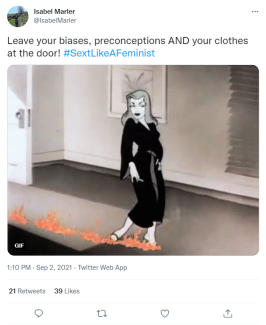
Laisse tes préjugés, tes suppositions ET tes fringues à l’entrée!
