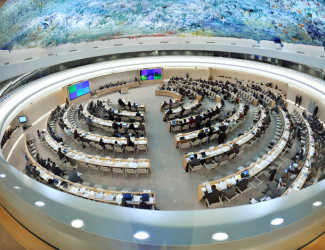
The Human Rights Council (HRC) is the key intergovernmental body within the United Nations system responsible for the promotion and protection of all human rights around the globe. It holds three regular sessions a year: in March, June and September. The Office of the UN High Commissioner for Human Rights (OHCHR) is the secretariat for the HRC.
The HRC works by:
Debating and passing resolutions on global human rights issues and human rights situations in particular countries
Examining complaints from victims of human rights violations or activist organizations on behalf of victims of human rights violations
Appointing independent experts (known as “Special Procedures”) to review human rights violations in specific countries and examine and further global human rights issues
Engaging in discussions with experts and governments on human rights issues
Assessing the human rights records of all UN Member States every four and a half years through the Universal Periodic Review
AWID works with feminist, progressive and human rights partners to share key knowledge, convene civil society dialogues and events, and influence negotiations and outcomes of the session.
With our partners, our work will:
◾️ Monitor, track and analyze anti-rights actors, discourses and strategies and their impact on resolutions
◾️Support the work of feminist UN experts in the face of backlash and pressure
◾️Advocate for state accountability
◾️ Work with feminist movements and civil society organizations to advance rights related to gender and sexuality.
Related Content
كلمة العدد | التجسيدات العابرة للحدود
فقدان الكلام
ترجمة رولا علاء الدين
تشينيلو أونوالو
غوى صايغ
«لمّا نكون مُستَقتِلين للتغيير، لِكوننا في حالة مرضٍ وتمرّدٍ في آنٍ واحد، تخلو لغتنا من التعقيد وتنصقل لتعكس أبسط ركائزها. (...) لكن، ومع استمرار المرض والثورة، تصبح اللغة المُصاغة في هذه الحالة وعنها أكثرَ عمقاً وأكثرَ تعبيراً عن الفوارق الدقيقة، وتكون منغمسة انغماساً شديداً في التجربة الإنسانية التي يواجه فيها المرءُ حدودَه عند نهاية العالم».
بدأنا التخطيط لعدد المجلّة هذا مع نانا داركوا قُبيل مهرجان «ابدعي، قاومي، غيٍّري: مهرجان للحراكات النسوية» لجمعية «حقوق المرأة في التنمية» AWID، وانطلقنا وقتها من سؤالٍ هو بالأحرى ملاحظة حول حالة العالم، ورغبة في تغيير الاعتقادات السائدة: لماذا لا تزال جنسانيّاتنا وملذّاتنا تخضع للترويض والتجريم مع أنّه يتمّ تذكيرنا مراراً وتكراراً بأنّها لا تأتي بأيّ قيمة أو تطوّر؟ واستنتجنا أنّ جنسانيّاتنا، لمّا تتجسّد، فيها ما يتعارض مع النظام العالمي الذي ما زال يتجلّى من خلال ضوابط الحدود، والتمييز العنصري في توزيع اللقاح، والاستعمار الاستيطاني، والتطهير العرقي، والرأسمالية المُستشرية. هل يمكننا إذاً القول إنّ لجنسانيّاتنا قدرةٌ تعطيليّة؟ وهل يصحّ هذا القول عندما ننظر إلى واقع حركاتنا التي يتمّ الاستيلاء عليها ومأسستها في سعيها للتزوّد بالموارد؟
عندما يصبح عملنا المتجسّد مادةً ربحية في أيدي الأنظمة التي نسعى إلى إزالتها فلا عجب أنّ جنسانيّاتنا وملذّاتنا توضَع جانباً من جديد، لا سيّما أنّها ليست مُربِحة بما فيه الكفاية. لقد تساءلنا، في مواقف عدّة خلال إنتاج هذا العدد، ما الذي سيحدث إذا رفضنا مراعاة خدمات الرأسمالية الأساسية؟ لكن هل نجرؤ على هذا التساؤل وقد أنهكنا العالم؟ ربما يتمّ تجاهل جنسانيّاتنا بهذه السهولة لأنها لا تُعتَبَر أشكالاً من أشكال الرعاية. ربما ما نحتاجه هو أن نعيد تصوّر الملذّة كشكلٍ من أشكال الرعاية الجذرية، تكون أيضاً مناهضة للرأسمالية وللمؤسساتية.
بدأنا العام الثاني على التوالي لحالة الجائحة العالمية وكان لا بدّ أن تركّز مقاربتنا للتجسيدات العابرة للحدود القومية على ملاحظة سياسيّة واحدة: أنّ الرعاية هي شكل من أشكال التجسيد. وبما أنّ جزءاً كبيراً من عملنا يتمّ حالياً من دون أيّ اعتبار للحدود بيننا وفينا فنحن جميعاً متجسّدون بشكلٍ عابرٍ للحدود القومية، ونحن جميعاً نفشل. نحن نفشل في رعاية ذاتنا، والأهمّ أننا نفشل في رعاية الآخرين.
هذا الفشل ليس من صنع أيدينا.
إنّ الكثير من أهالينا اعتبروا العملَ مقايضةً، أي أنّه شيءٌ يُعطى مقابل أجرٍ وضمانة بالحصول على الرعاية. صحيحٌ أنّه تمّ الإخلال بهذه المقايضة أحياناً، لكنّ أهالينا ما كانوا يأملون أنّ عملهم سيوفّر لهم الرِضا الذاتي، وكانوا يعتمدون لهذا الغرض على نشاطهم الترفيهي وهواياتهم ومجتمعاتهم. أمّا اليوم، فنحن، أولادهم الذين تمّت تهيأتنا لنعتبر العمل متشابكاً مع الشغف، توقّعاتنا مختلفة تماماً. نحن لا نفرّق بين العمل والترفيه ونعتبرهما عنصراً واحداً، وبالنسبة للكثيرين بيننا، العمل بات يجسّد الذات بكاملها.
إنّ الرأسمالية القائمة على الأبويّة والمغايَرة الجنسية لا ترى لنا أيّ قيمة، ناهيك عن عملنا وجنسانيّاتنا. إنّه نظامٌ سيستمر في طلب المزيد والمزيد منك إلى يوم مماتك، وبعدها سيستبدلك بشخصٍ آخر. يُنتَظَر منّا أن نكون على اتصال بالإنترنت في كلّ الأوقات، ما يعني أنّه لا يمكننا الانصراف عن العمل حتى لو شئنا ذلك. إنّ هذا التَتْجير للعمل وفصله تماماً عن الشخص قد تسلّل إلى كلّ ناحية من نواحي حياتنا، ويتمّ ترسيخ هذا التَتْجير حتى في الأوساط الأكثر نسويّة والأكثر تمرّداً وتشدّداً.
لطالما حمَلَت تطلّعات الرأسمالية ضرراً كبيراً بالأجساد التي لا تتوافق مع النموذج المثالي، وأولئك الذين يسعون إلى ترسيخ سلطتهم استغّلوا الجائحة كفرصة لاستهداف النساء والأقلّيات الجنسية وكلّ مَن يعتبرونه دون المستوى.
تمّ إعداد هذا العدد الخاص بفعل هذا الواقع، وطبعاً، رغماً عن هذا الواقع.
لقد قدّم المساهمون/ المساهمات والعاملون/ العاملات كلّهم تقريباً مجهوداً يفوق طاقاتهم، وكلٌّ من الأعمال الواردة هنا هو نتاجُ سعيٍ شغوف ولكن أيضاً نتاج حالة إنهاكٍ شديد. يشكّل هذا العدد، بطريقة غايةً في الواقعية، تجسيداً للعمل العابر للحدود القومية، علماً أنّ أيّ عمل في عصرنا الرقمي أصبحَ عابراً لتلك الحدود. وفيما فُرِضَ علينا تقبّل حدود جديدة، وهي حدود لا تخالف النظام القائم سابقاً بل تعزّزه، اختبرنا مباشرةً، إلى جانب مساهمينا، كيف تستنزف الرأسمالية طاقاتنا القصوى – كيف يصبح من الصعب بناء الحجج المتماسكة لا سيّما حينما تكون خاضعة لموعد التسليم. إننا نعاني بشكلٍ جَماعي من فقدان الكلام لأننا أساساً نعاني من فقدان العوالم.
الشعور بالضياع والوحدة في عالم الرأسمالية القائمة على الأبوية والمغايَرة الجنسية هو بالتحديد ما يجعل من الضروري أن نعيد تقييم أنظمة الرعاية التي نتّبعها وأن نُعيد النظر فيها. لقد حوّلنا هذا العدد بوسائل عدّة إلى مهمّة لإيجاد الملذّة في الرعاية. فبما أنّه بات من الصعب بناء الحجج المتماسكة، برزت الوسائط البصرية والمبتكرة وقد لجأ كثرٌ ممن اعتادوا الكتابة إلى هذه الوسائط كطرقٍ لإنتاج المعرفة واختراق الضباب الفكريّ الذي أحاط بنا. لقد ضمّينا في هذا العدد أصواتاً أخرى، بالإضافة إلى أصواتٍ عدّة استمعتم إليها في المهرجان، كوسيلة لإطلاق حوارات جديدة وتوسيع آفاقنا.
بما أنّ كلماتنا قد سُرِقَت منّا، يقضي واجبنا السياسي بأن نستمر في إيجاد الوسائل للحفاظ على أنفسنا والآخرين والاهتمام بأنفسنا وبالآخرين. بالتالي، يصبح تجسّدنا نوعاً من المقاومة إذ هو بداية إيجادنا لسبيل الخروج من الذات ودخولها.
"No era una persona. Era una potencia". - Así recuerda unx compañerx activista a Navleen Kumar.
Nacida el 15 de octubre de 1994, Navleen Kumar fue una ferviente activista por el derecho a la tierra y la justicia social de la India.
Con integridad y compromiso, trabajó durante más de una década para proteger y restaurar las tierras de los pueblos indígenas (adivasi) en el distrito de Thane, un área arrebatada por los propietarios y promotores inmobiliarios a través de medios como la coerción y la intimidación. Luchó contra esta injusticia y estos crímenes a través de intervenciones legales en diferentes tribunales, y descubrió que la manipulación de los registros de las tierras era una característica recurrente en la mayoría de los casos de adquisición de terrenos. En uno de los casos, el de los Wartha (una familia tribal), Navleen descubrió que la familia había sido engañada con la complicidad de funcionarixs gubernamentales.
Así, a través de su trabajo, ayudó a restituir la tierra a la familia Wartha, y siguió dedicándose a otros casos de transferencias de tierras adivasi.
"Su artículo sobre el impacto de la alienación de la tierra en las mujeres y las niñas y niños adivasi traza la historia y las complejidades de la alienación tribal desde la década de los 70, cuando las familias de clase media comenzaron a trasladarse a los suburbios de Mumbai, que se extendían mientras el valor de la propiedad en la ciudad aumentaba de forma exponencial.
Los complejos de viviendas proliferaron en estos suburbios, y lxs integrantes de las comunidades tribales, que eran analfabetxs, pagaron el precio por ello. El costo de las tierras de primera, cerca de las líneas de ferrocarril, alcanzó un precio elevado y los constructores se abalanzaron sobre este cinturón como buitres, arrebatando de forma ilegal las tierras a las comunidades tribales y otrxs residentes locales ". - Jaya Menon, Comisión de Justicia y Paz.
Durante el curso de su activismo, Navleen recibió numerosas amenazas y sobrevivió a varios atentados contra su vida. A pesar de ello, siguió trabajando no sólo en lo que era importante para ella, sino que además contribuyó a cambiar la vida y la realidad de las muchas personas a las que apoyó en su lucha por la justicia social.
Navleen murió apuñalada el 19 de junio de 2002 en su edificio de departamentos. Dos gánsteres locales fueron arrestados por su asesinato.
Cuando se hace una búsqueda en Internet sobre «mutilación genital femenina» o «MGF», junto a la entrada de Wikipedia, aparece una imagen de cuatro dibujos lineales de la anatomía femenina, que ilustran cuatro tipos de violencia. (...)
Tshegofatso Senne is a Black, chronically-ill, genderqueer feminist who does the most. Much of their work is rooted in pleasure, community, and dreaming, while being informed by somatic abolitionism and disability, healing, and transformative justices. Writing, researching, and speaking on issues concerning feminism, community, sexual and reproductive justice, consent, rape culture, and justice, Tshegofatso has 8 years of experience theorising on the ways in which these topics intersect with pleasure. They run their own business, Thembekile Stationery, and their community platform Hedone brings people together to explore and understand the power of trauma-awareness and pleasure in their daily lives. Tshegofatso believes deeply in the individual and collective potential of regenerative and sustainable change, pleasure, and care work.
The body. The most permanent home we have.
The body, not the thinking brain, is where we experience most of our pain, pleasure, and joy, and where we process most of what happens to us. It is also where we do most of our healing, including our emotional and psychological healing. And it is where we experience resilience and a sense of flow.
These words, said by Resmaa Menakem in his book My Grandmother’s Hands, have stayed with me.
The body; it holds our experiences. Our memories. Our resilience. And as Menakem has written, the body also holds our traumas. It responds with spontaneous protective mechanisms to stop or prevent more damage. That is the power of the body. Trauma is not the event; it is how our bodies respond to events that feel dangerous to us. It is often left stuck in the body, until we address it. There’s no talking our body out of this response – it just is.
Using Ling Tan’s Digital Superpower app, I tracked how my body felt as I travelled around different parts of my city, Johannesburg, South Africa. The app is a gesture-driven online platform that allows you to trace your perceptions as you move through locations by logging and recording the data. I used it to track my psychosomatic symptoms – physical reactions connected to a mental cause. Whether that be flashbacks. Panic attacks. Tightness in the chest. A fast heartbeat. Tension headaches. Muscle pain. Insomnia. Struggling to breathe. I tracked these symptoms as I walked and travelled to different areas in Johannesburg. And I asked myself.
Where can we be safe? Can we be safe?
Psychosomatic responses can be caused by a number of things, and some are not as severe as others. After experiencing any kind of trauma you may feel intense distress in similar events or situations. I tracked my sensations, ranked on a scale of 1-5, where 1 were the instances I barely felt any of these symptoms – I felt at ease rather than on-guard and jumpy, my breath and heart rate were stable, I was not looking over my shoulder – and number 5 being the opposite – symptoms that had me close to a panic attack.
As a Black person. As a queer person. As a genderqueer person who could be perceived as a woman, depending on what my gender expression is that day.
I asked myself.
Where can we be safe?
Even in neighbourhoods one might consider “safe,” I felt constantly panicked. Looking around me to make sure I wasn’t being followed, adjusting the way my T-shirt sat so my breasts wouldn’t show up as much, looking around to make sure I knew multiple routes to get out of the place I was should I sense danger. An empty road brings anxiety. A packed one does too. Being in an Uber does. Walking on a public road does. Being in my apartment does. So does picking up a delivery from the front of the building.
Can we be safe?
Pumla Dineo Gqola speaks of the Female Fear Factory. It may or may not be familiar, but if you’re someone socialised as a woman, you’ll know this feeling well. The feeling that has you planning every step you take, whether you’re going to work, school, or just running an errand. The feeling that you have to watch how you dress, act, speak in public and private spaces. The feeling in the pit of your stomach if you have to travel at night, get a delivery, or deal with any person who continues to socialise as a cis man. Harassed on the street, always with the threat of violence. Us existing in any space comes with an innate fear.
Fear is both an individual and a socio-political phenomenon. At an individual level, fear can be present as part of a healthy well developing warning system […] When we think about fear, it is important to hold both notions of individual emotional experience and the political ways in which fear has been used in different epochs for control. - Pumla Dineo Gqola, in her book Rape: A South African Nightmare
South African women, femmes, and queers know that every step we take outside – steps to do ordinary things: a walk to the shops, a taxi to work, an Uber from a party – all of these acts are a negotiation with violence. This fear, is part of the trauma. To cope with the trauma we carry in our bodies, we develop responses to detect danger – watching the emotional responses of those around us, reading for “friendliness.” We’re constantly on guard.
Day after day. Year after year. Life after life. Generation after generation.
On the additional challenge of this learned defence system, author of The Body Keeps Score, Bessel Van Der Kolk, has said
It disrupts this ability to accurately read others, rendering the trauma survivor either less able to detect danger or more likely to misperceive danger where there is none. It takes tremendous energy to keep functioning while carrying the memory of terror, and the shame of utter weakness and vulnerability.
As Resmaa Menakem has said, trauma is in everything; it infiltrates the air we breathe, the water we drink, the foods we eat. It is in the systems that govern us, the institutions that teach and also traumatise us, and within the social contracts we enter into with each other. Most importantly, we take it with us everywhere we go, in our bodies, exhausting us and eroding our health and happiness. We carry that truth in our bodies. Generations of us have.
So, as I walk around my city, whether an area is considered “safe” or not, I carry the traumas of generations whose responses are embedded in my body. My heart palpitates, it becomes difficult to breathe, my chest tightens – because my body feels as though the trauma is happening in that very moment. I live hyper vigilant. To the point where one is either too on-guard to mindfully enjoy their life, or too numb to absorb new experiences.
For us to begin to heal, we need to acknowledge these truths.
These truths that live in our bodies.
This trauma is what keeps many of us from living the lives we want. Ask any femme or queer person what safety looks like to them and they’ll mostly share examples that are simple tasks – being able to simply live joyful lives, without the constant threat of violence.
Feelings of safety, of comfort and ease, are spatial. When we embody our trauma, it affects the ways we perceive our own safety, affects the ways we interact with the world, and alters the ways we are able to experience and embody anything pleasurable and joyful.
We have to refuse this burdensome responsibility and fight for a safe world for all of us. Walking wounded as many of us are, we are fighters. Patriarchy may terrorise and brutalise us, but we will not give up the fight. As we repeatedly take to the streets, defying the fear in spectacular and seemingly insignificant ways, we defend ourselves and speak in our own name. - Pumla Dineo Gqola, in her book Rape: A South African Nightmare
Where can we be safe? How do we begin to defend ourselves, not just in the physical sense, but in the emotional, psychological, and spiritual senses?
“Trauma makes weapons out of us all,” adrienne maree brown has said in an interview conducted by Justin Scott Campbell. And her work, Pleasure Activism, offers us multiple methodologies to heal that trauma and ground ourselves in the understanding that healing, justice, and liberation can also be pleasurable experiences. Especially those of us who are the most marginalised, who may have been raised to equate suffering with “The Work.” The Work that so many of us have gone into as activists, community builders and workers, those serving the most marginalised, The Work that we struggle in order to do, burning ourselves out and rarely caring for our minds and bodies. The alternative is becoming more informed about our trauma, able to identify our own needs, and becoming deeply embodied. That embodiment means we are simply more able to experience the world through the senses and sensations in our bodies, acknowledging what they tell us rather than suppressing and ignoring the information it is communicating with us.
Being constantly in conversation with our living body and intentionally practising those conversations connects us to embodiment more deeply; it allows us to make tangible the emotions we feel as we interact with the world, befriend our bodies, and understand all that they try to teach us. When understanding trauma and embodiment paired, we can begin to start the healing and access pleasure more holistically, healthily, and in our daily lives without shame and guilt. We can begin to access pleasure as a tool for individual and social change, tapping into the power of the erotic as Audre Lorde described it. A power that allows us to share the joy we access and experience, expanding our capacity for happiness and understanding that we are deserving of it, even with our trauma.
Tapping into pleasure and embodying the erotic gives us the expansion of being deliberately alive, feeling grounded and stable and understanding our nervous systems. It allows us to understand and shed the generational baggage we’ve been carrying without realising; we can be empowered with the knowledge that even as traumatised as we are, as traumatised as we potentially could be in the future, we are still deserving of pleasurable and joyful lives, that we can share that power with our people. It is the community aspect that is missing from the ways we care for ourselves; self-care cannot exist without community care. We are able to feel a deeper internal trust, safety, and power of ourselves, especially in the face of future traumas that will trigger us, knowing how to soothe and stabilise ourselves. All this understanding leads us to a deep internal power that is resourced to meet any challenges that come your way.
As those living with deep generational traumas, we have come to distrust and perhaps think we are incapable of containing and accessing the power we have. In “Uses of the Erotic: The Erotic as Power,” Lorde teaches us that the erotic offers a source of replenishment, a way to demand better for ourselves and our lives.
For the erotic is not a question only of what we do; it is a question of how acutely and fully we can feel in the doing. Once we know the extent to which we are capable of feeling that sense of satisfaction and completion, we can then observe which of our various life endeavours brings us closest to that fullness.
I don’t say any of this lightly – I know that this is easier said than done. I know that many of us are prevented from understanding these truths, from internalising or even healing them. Resistance comes with acts of feeling unsafe, but is not impossible. Resisting power structures that keep the most powerful safe will always endanger those of us shoved to the margins. Acknowledging the traumas you’ve faced is a reclamation of your lived experiences, those that have passed and those that will follow; it is resistance that embodies that knowledge that we are deserving of more than the breadcrumbs these systems have forced us to lap up. It is a resistance that understands that pleasure is complicated by trauma, but it can be accessed in arbitrary and powerful ways. It is a resistance that acknowledges that our trauma is a resource that connects us to each other, and can allow us to keep each other safe. It is a resistance that understands that even with pleasure and joy, this is not a utopia; we will still harm and be harmed, but we will be better equipped for survival and thrive in a community of diverse care and kindness. A resistance that makes way for healing and connecting to our full human selves.
Healing will never be an easy and rosy journey, but it begins with the acknowledgment of the possibility. When oppression makes us believe that pleasure is not something that we all have equal access to, one of the ways that we start doing the work of reclaiming our full selves — our whole liberated, free selves — is by reclaiming our access to pleasure.
Leah Lakshmi Piepzna-Samarasinha has said in her article in Pleasure Activism (to which she contributed),
I know that for most people, the words “care” and “pleasure” can’t even be in the same sentence. We’re all soaking in ableism’s hatred of bodies that have needs, and we’re given a really shitty choice: either have no needs and get to have autonomy, dignity, and control over your life or admit you need care and lose all of the above.
The power that this has? We understand our traumas, so we understand those of others; we embody the sensations we experience and tend to them rather than distract and avoid. We access pleasure in ways that make us want to share that joy with those in our communities. When we are trauma-informed, we give ourselves more room to experience all this and give ourselves, and others, permission to heal. Imagine, a community in which everyone has access, resources, and time to live pleasurable lives, in whichever way they want and deserve. In which spatial traumas are lessened because the people that occupy them are trauma-aware, are filled with a tender care. Isn’t that healing? Is that not working through generational traumas? Does that not build and sustain healthier futures for us all?
It is time we reconnected with the ancestral knowledge that we deserve to live full lives. We need to get back in touch with our natural right to joy and existing for ourselves. To feel pleasure simply for the sake of it. To not live lives of terror. It sounds radical; it feels radical. In a world where we have been socialised and traumatised to numb, to fear, to feel and remain powerless, to be greedy and live with structural issues that lead to mental illness, what a gift and wonder it is to begin to feel, to be in community with those who feel, to be healthily interdependent in, to love each other boldly. Feeling is radical. Pleasure is radical. Healing is radical.
You have permission to feel pleasure. You have permission to dance, create, make love to yourself and others, celebrate and cultivate joy. You are encouraged to do so. You have permission to heal. Don’t bottle it up inside, don’t try to move through this time alone. You have permission to grieve. And you have permission to live. - adrienne maree brown, “You Have Permission”
Somatic embodiment allows us to explore our trauma, work through it and make meaningful connections to ourselves and the collective. Doing this over time sustains our healing; just like trauma, healing is not a one-time only event. This healing helps move us toward individual and collective liberation.
In “A Queer Politics of Pleasure,” Andy Johnson speaks about the ways in which the queering of pleasure offers us sources of healing, acceptance, release, playfulness, wholeness, defiance, subversion, and freedom. How expansive! When we embody pleasure in ways that are this holistic, this queer, we are able to acknowledge the limitation.
Queering pleasure also asks us the questions that intersect our dreaming with our lived realities.
Who is free or deemed worthy enough to feel pleasure? When is one allowed to feel pleasure or pleased? With whom can one experience pleasure? What kind of pleasure is accessible? What limits one from accessing their full erotic and pleased potential? - Andy Johnson, “A Queer Politics
of Pleasure”
When our trauma-informed pleasure practices are grounded in community care, we begin to answer some of these questions. We begin to understand the liberating potential. As pleasure activists, this is the reality we ground ourselves within. The reality that says, my pleasure may be fractal, but it has the potential to heal not only me and my community, but future bloodlines.
I am a whole system; we are whole systems. We are not just our pains, not just our fears, and not just our thoughts. We are entire systems wired for pleasure, and we can learn how to say yes from the inside out. - Prentis Hemphill, interviewed by Shar Jossell
There’s a world of pleasure that allows us to begin to understand ourselves holistically, in ways that give us room to rebuild the realities that affirm that we are capable and deserving of daily pleasure. BDSM, one of my deepest pleasures, allows me a glimpse into these realities where I can both feel and heal my trauma, as well as feel immeasurable opportunities to say yes from the inside out. While trauma keeps me stuck in a cycle of fight or flight, bondage, kneeling, impact, and breath play encourage me to stay grounded and connected, reconnecting to restoration. Pleasure that is playful allows me to heal, to identify where traumatic energy is stored in my body and focus my energy there. It allows me to express the sensations my body feels through screams of pain and delight, to express my no with no fear and revel in the fuck yes. With a safety plan, aftercare, and a deeper understanding of trauma, kink offers a place of pleasure and healing that is invaluable.
So whether your pleasure looks like cooking a meal at your leisure, engaging in sex, having bed days with your people, participating in disability care collectives, having someone spit in your mouth, going on accessible outings, having cuddle dates, attending an online dance party, spending time in your garden, being choked out in a dungeon,
I hope you take pleasure with you wherever you go. I hope it heals you and your people.
Recognising the power of the erotic within our lives can give us the energy to pursue genuine change within our world. - Audre Lorde, “Uses of the Erotic: The Erotic as Power”
ExploreTransnational Embodiments
This journal edition in partnership with Kohl: a Journal for Body and Gender Research, will explore feminist solutions, proposals and realities for transforming our current world, our bodies and our sexualities.
نصدر النسخة هذه من المجلة بالشراكة مع «كحل: مجلة لأبحاث الجسد والجندر»، وسنستكشف عبرها الحلول والاقتراحات وأنواع الواقع النسوية لتغيير عالمنا الحالي وكذلك أجسادنا وجنسانياتنا.
« Le privé est politique » - tel est le mantra féministe que personnifiait la fougueuse et courageuse Nadyn Jouny. Nadyn avait personnellement vécu la douleur de la violence structurelle des systèmes juridiques qui refusent aux femmes de jouir de leurs droits.
Lorsqu’elle décide de demander le divorce, les tribunaux religieux chiites – conformément aux lois relatives au statut personnel du Liban – lui refusent la garde de son jeune fils Karam. Comme tant d’autres femmes au Liban et d’autres pays, Nadyn s’est retrouvée dans la situation douloureuse et insoutenable de devoir abandonner ses droits sur son enfant pour pouvoir quitter une relation abusive et non voulue. Mais Nadyn s’est battue, jusqu’au dernier jour.
Elle s’est servie de ses compétences médiatiques pour devenir la voix de celles qui n’en ont pas dans leur combat contre un droit de la famille discriminant, tant au Liban qu’à l’étranger. Nadyn a cofondé le groupe autofinancé « Protecting Lebanese Women » (PLW) et s’est alliée à d’autres mères libanaises vivant des situations similaires. Ensemble, elles ont cherché à sensibiliser la société en manifestant pour leurs droits devant les tribunaux religieux et attirant l’attention des médias sur les très grandes injustices qu’elles subissaient.
Nadyn a également collaboré avec ABAAD – Resource Center for Gender Equality, une autre organisation libanaise pour les droits des femmes, à l’occasion de campagnes pour la défense des droits des femmes, l’égalité dans le droit de la famille et la garde des enfants, et contre le mariage forcé et précoce.
Nadyn a tragiquement perdu la vie dans un accident de voiture le 6 octobre 2019, alors qu’elle se rendait à une manifestation contre les augmentations de taxes injustifiées, dans un pays qui connaît déjà une crise financière croissante. Nadyn Jouny n’avait que 29 ans au moment de son décès.
Snippet FEA Intro Acknowledgments (FR)
Nous tenons à remercier le collectif Amar.ela de femmes féministes militantes et créatives qui ont rendu cette série possible, et tout particulièrement Natalia Mallo (le poulpe de l'équipe) pour son soutien et son accompagnement dans ce voyage.
Nous exprimons également notre profonde gratitude et notre admiration à tous les groupes et personnes qui ont participé à ce projet, et nous les remercions d'avoir partagé leur temps, leur sagesse, leurs rêves et leurs illusions avec nous. Nous les remercions de faire de ce monde un monde plus juste, féministe et durable.
Nous espérons que leurs histoires inspireront le reste du monde autant qu’elles nous ont inspirés.
FRMag - Esmeralda takes over the Internet
Esmeralda aux contrôles d’Internet : comment les réseaux sociaux aident les femmes roms à gagner en visibilité
par Émilie Herbert-Pontonnier
Vous vous souvenez d’Esmeralda? Cette héroïne « gitane » et exotique née sous la plume de Victor Hugo, géant de la littérature française, et rendue célèbre par les studios Disney et leur Bossu de Notre-Dame. (...)
📅 Tuesday, March 11, 2025
🕒 2.00-4.00pm EST
🏢 Chef's Kitchen Loft with Terrace, 216 East 45th St 13th Floor New York
Organizer: Observatory on the Universality of Rights (OURs) Consortium
40 Years of AWID: The Scrapbook
Gather, Seed, and Disrupt.
In 2022, AWID celebrates 40 years since our founding. We’re using this moment to reflect on our past and learn from the road traveled as we prepare to look forward, and to forge the journey ahead. As we move through cycles of progress and pushback, we know that struggles for women’s rights and gender justice are iterative and non-linear. In collaboration with artist Naadira Patel, we created a scrapbook that highlights a handful of snapshots from AWID’s last four decades of feminist movement support.
We have not done all this on our own. We share this with deep appreciation for the constellation of feminist activists and groups that have made this work possible. In this context of so many converging crises, we embrace the opportunity to celebrate the power and resilience of feminist movements around the world.
Hevrin Khalaf was a prominent Syrian Kurdish political leader in the autonomous region of Rojava where Kurdish women are risking their lives to resist the Turkish offensive and build a feminist system.
She was Secretary-General of the Future Syria Party (FSP), a group that aimed to build bridges, reconcile different ethnic groups and work towards a “democratic, pluralistic, and decentralized Syria.”
Hevrin was a symbol of this reconciliation effort. She also worked to promote equality between women and men and was a representative for visiting journalists, aid workers, and diplomats.
Hevrin was also a civil engineer from Derik, and was one of the founders of the Foundation for Science and Free Thought in 2012.
On 12 October 2019 she was tortured and murdered by the Turkish-backed militia, Ahrar al-Sharqiya during a military operation against Syrian Democratic Forces in Rojava.
“The killing of Khalaf is a turning point in Syria’s modern history. It once again demonstrated the old Kurdish proverb “no friends but the mountains.” I will always be a friend of Khalaf and her vision of a better world.” - Ahed Al Hendi
El título de la conversación «¿Pansexual, ginosexual o abrosexual? Una exploración de lo queer, el placer y la positividad sexual» da mucho para pensar. Tiffany Kagure Mugo (escritora, educadora y curadora de HOLAAfrica) comienza la sesión con una lectura de Touch [Tocar/Tacto], una compilación recientemente publicada de ensayos de ficción y no ficción sobre sexo, sexualidad y placer. En este fragmento, la autora propone la idea de que el placer es constante y continuo, que está presente en las actividades cotidianas, y que no se circunscribe a las relaciones sexuales.
Esta idea de que el placer es parte de la vida diaria (al igual que tantas otras cosas) atraviesa la conversación, que también abarca temas sobre el deseo, la atracción y la orientación sexual.
Desde el comienzo, existe una sensación de esperanza y posibilidad. Tiffany presenta opciones y explica alternativas, dándonos un nuevo lenguaje para hablar sobre quiénes somos, qué nos gusta, y cómo lo queremos. Esto se refiere al deseo y al sexo, pero se trata primordialmente de autoconocimiento y empoderamiento. Tiffany habla apasionadamente sobre tomar decisiones desde un lugar de poder: aprender sobre la propia identidad para poder elegir lo mejor para unx mismx.
En una conversación abierta y libre, que representa la actitud que Tiffany propone que todxs adoptemos, aprendemos que el conocimiento sobre sexo y sexualidad está en permanente cambio, que los límites se están desplazando. Lo que podemos haber aprendido o, más fundamentalmente, aquello que se nos ocultó durante la infancia o la adultez es exactamente el lugar desde donde deberíamos comenzar a desaprender y reprogramarnos. Tiffany señala que, actualmente, las personas jóvenes necesitan herramientas para comprender las experiencias que ya están teniendo, un recordatorio para no subestimar jamás lo que lxs niñxs y adolescentes saben sobre la clase de placer/es que quieren procurarse en la vida.
La conversación abrió mi mente a esto: conocerme a mí misma me ayudará a desarrollar mi confianza; podré encarar relaciones con cuidado no solo de mí misma sino de otras personas también. Aprender el lenguaje de orientación, atracción, deseo y placer contribuirá a profundizar mis futuras conexiones. Valoré el espacio para pensar sobre este aspecto de mi vida: las partes privadas e íntimas a las que no accedo habitualmente. El entusiasmo de Tiffany sobre el placer y la identidad desplazó mis propias barreras, permitiéndome considerar nuevas posibilidades personales.
La idea de aprender a establecer conexiones holísticas no es algo común todavía. En general, vivimos en una cultura de conexiones instantáneas y pasajeras. Casi no hay tiempo para reflexionar verdaderamente sobre cómo y por qué buscamos relaciones o parejas... al menos, no hasta que llega un momento de crisis.
Por supuesto, existen espacios privilegiados que están abiertos a preguntas y conversaciones, tales como el festival «Crear Résister Transform» de AWID y otras plataformas o publicaciones en línea que promueven la libertad de pensamiento. Pero el acceso a la información de fuentes útiles y sin prejuicios es algo que todavía debe ser descifrado. Esto puede deberse en parte al hecho de que la gente no se siente segura en el lenguaje de la sexualidad y el placer.
La idea del lenguaje y las herramientas se repite durante toda la presentación de Tiffany. Ella y sus colegas están haciendo el trabajo de hablar, enseñar y nutrir, viendo qué es lo que cada persona necesita, dónde están esas personas, qué quieren para sí mismxs, y caminando junto con ellxs mientras construyen sus mundos ideales, brindándoles nuevas palabras y definiciones para ayudarlxs a configurar sus identidades en las diferentes etapas de sus vidas.
Esta es la clase de conversaciones que se necesita, incluso en una sociedad que permanentemente difunde un sinfín de mensajes sobre el cuidado de la salud, con diferentes grados de detalle. A veces la gente debe retrotraerse de las instancias de perspectiva global, y sentirse alentada a aprender sobre sus opiniones y deseos individuales. Esto es lo que hace la ponencia de Tiffany: genera un espacio para cada persona, dentro del rompecabezas general.
Un punto culminante de la ponencia de Tiffany fue la sección sobre los diferentes tipos de atracción:
Sexual: el deseo expreso de tener relaciones sexuales con una o varias personas Sensual: el deseo de tocar a una o varias personas, de estar físicamente cerca, sin necesariamente incluir una relación sexual Romántica: el deseo de salir con una o varias personas, o de estar en una relación con una o varias personas Platónica: el deseo de construir amistades profundas Estética: el deseo de mirar a una o varias personas, sintiendo placer por su apariencia
Estos cinco tipos o niveles de atracción ofrecen una forma abreviada para definir el deseo y el placer, y ayudan a contextualizar las distintas clases de placer que pueden experimentar las personas.
Pensar la atracción más allá de lo físico o sexual ofrece una nueva perspectiva sobre la conexión. Es una oportunidad para restar presión a las relaciones, abriendo oportunidades para asociaciones diferentes, más esclarecidas y satisfactorias.
Esta libertad y este conocimiento que propone Tiffany configuran una hoja de ruta hacia el futuro. La presentación ofreció una nueva perspectiva sobre aquello que es posible.
Tal como lo expresa el fragmento de apertura, el placer es continuo. A la luz de la ponencia de Tiffany, también resulta claro que el placer es dinámico y apasionante. Siempre hay más para aprender.
Esto puede parecer abrumador al comienzo, pero del otro lado del titubeo se encuentran la esperanza, el potencial y la libertad.
Diana Isabel Hernández Juárez fue una maestra guatemalteca, defensora de los derechos humanos y activista comunitaria y del medioambiente. Fue la coordinadora del programa ambiental de la parroquia de Nuestra Señora de Guadalupe, en la costa sur del país.
Diana dedicó su vida a co-crear conciencia ambiental, y trabajó de modo particularmente estrecho con comunidades locales para abordar problemas ambientales y proteger los recursos naturales. Inició proyectos tales como viveros forestales, granjas municipales, huertas familiares y campañas de limpieza. Participó activamente en programas de reforestación, tratando de recuperar especies nativas y paliar la falta de agua, en más de 32 comunidades rurales.
El 7 de septiembre de 2019, Diana recibió disparos y fue asesinada por dos hombres armados desconocidos mientras se encontraba participando de una procesión en su comunidad. Diana tenía solamente 35 años en el momento de su muerte.