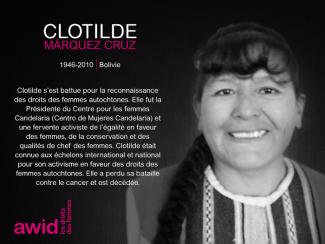
Clotilde Marquez Cruz
Women human rights defenders (WHRDs) worldwide defend their lands, livelihoods and communities from extractive industries and corporate power. They stand against powerful economic and political interests driving land theft, displacement of communities, loss of livelihoods, and environmental degradation.
Extractivism is an economic and political model of development that commodifies nature and prioritizes profit over human rights and the environment. Rooted in colonial history, it reinforces social and economic inequalities locally and globally. Often, Black, rural and Indigenous women are the most affected by extractivism, and are largely excluded from decision-making. Defying these patriarchal and neo-colonial forces, women rise in defense of rights, lands, people and nature.
WHRDs confronting extractive industries experience a range of risks, threats and violations, including criminalization, stigmatization, violence and intimidation. Their stories reveal a strong aspect of gendered and sexualized violence. Perpetrators include state and local authorities, corporations, police, military, paramilitary and private security forces, and at times their own communities.
AWID and the Women Human Rights Defenders International Coalition (WHRD-IC) are pleased to announce “Women Human Rights Defenders Confronting Extractivism and Corporate Power”; a cross-regional research project documenting the lived experiences of WHRDs from Asia, Africa and Latin America.
"Women Human Rights Defenders confronting extractive industries: an overview of critical risks and Human Rights obligations" is a policy report with a gender perspective. It analyses forms of violations and types of perpetrators, quotes relevant human rights obligations and includes policy recommendations to states, corporations, civil society and donors.
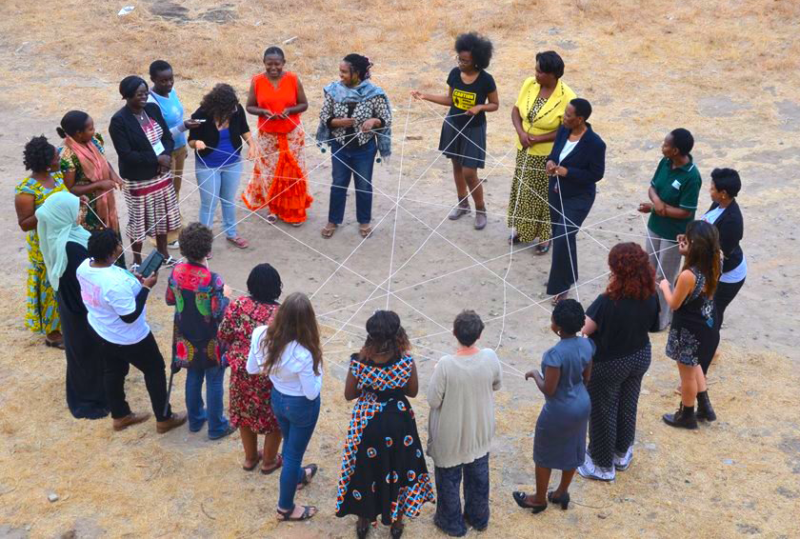
"Weaving resistance through action: Strategies of Women Human Rights Defenders confronting extractive industries" is a practical guide outlining creative and deliberate forms of action, successful tactics and inspiring stories of resistance.
The video “Defending people and planet: Women confronting extractive industries” puts courageous WHRDs from Africa, Asia, and Latin America in the spotlight. They share their struggles for land and life, and speak to the risks and challenges they face in their activism.
Challenging corporate power: Struggles for women’s rights, economic and gender justice is a research paper outlining the impacts of corporate power and offering insights into strategies of resistance.
AWID acknowledges with gratitude the invaluable input of every Woman Human Rights Defender who participated in this project. This project was made possible thanks to your willingness to generously and openly share your experiences and learnings. Your courage, creativity and resilience is an inspiration for us all. Thank you!
La economía solidaria (que incluye la economía cooperativa y la llamada economía del don) es un marco alternativo que adquiere formas diferentes según el contexto y está siempre abierto a los cambios.
Este marco de referencia se asienta sobre los siguientes principios:
En una economía solidaria, quienes producen participan en procesos económicos que guardan íntima relación con sus realidades, con la preservación del medio ambiente y la cooperación mutua.
Según la geógrafa feminista Yvonne Underhill-Sem, la economía del don es un sistema económico en el que los bienes y servicios circulan entre las personas sin que haya acuerdos explícitos acerca de su valor o de una reciprocidad esperada en el futuro.
Lo que hay detrás del otorgamiento de dones es una relación humana, una generación de buena voluntad y el acto de prestar atención a nutrir a toda la sociedad y no solo a lo que concierne a unx mismx y su familia: se trata del colectivo.
En el Pacífico, por ejemplo, esto se manifiesta en la recolección, preparación y procesamiento de recursos terrestres y marinos para tejer alfombras, abanicos, guirnaldas y objetos ceremoniales, así como en la cría de ganado y el almacenamiento de las cosechas estacionales.
Las mujeres tienen diversos incentivos para involucrarse en actividades económicas y que van desde satisfacer sus aspiraciones profesionales y ganar dinero para gozar de una vida confortable en el largo plazo hasta llegar a fin de mes, pagar deudas y huir del desgaste de una vida rutinaria.
Para acomodarse a los diferentes ambientes en los que operan las mujeres, el concepto de economía solidaria está en permanente desarrollo, discusión y debate.
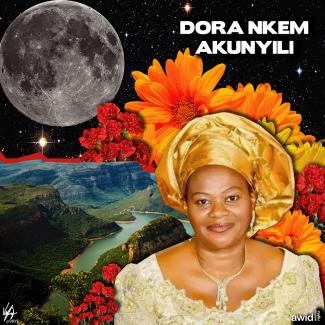
Née dans l'État de Benue, au Nigeria, Dora était une pharmacienne experte et érudite ainsi qu’une dirigeante communautaire de renommée mondiale.
Lorsqu'elle est devenue directrice générale de l'Agence nationale pour la gestion et le contrôle des aliments et drogues (NAFDAC) entre 2001 et 2008, son travail d’envergure révolutionnaire a initié un changement de paradigme au sein de la fonction publique nigériane. Au cours de son mandat, elle a mené des réformes dans l'application des politiques et des réglementations qui ont permis de réduire de manière radicale le nombre de faux médicaments qui ont affecté le secteur pharmaceutique nigérian.
Après avoir incarné la réalité d’une femme courageuse et compétente qui a défié les maux d’une société à dominante patriarcale et qui a conduit au changement, elle est devenue une icône de l’émancipation des femmes. Entre 2008 et 2010 elle a été nommée ministre de l'Information et de la Communication.
Elle est décédée des suites d'un cancer et laisse dans le deuil son mari, ses six enfants et ses trois petits-enfants.

Создать ориентированную на феминистские реалии доказательную базу движения денег их получателей
Solo un año después de su fundación, las integrantes de Nadia Echazú comenzaron a trabajar en la alta costura y organizaron un desfile de moda en el histórico Hotel Bauen.
Mostraron cinco modelos y algunas trabajadoras de la cooperativa textil desfilaron con sus propios diseños.
Esto fue revolucionario no sólo porque estaban diseñando alternativas a la moda convencional, sino también porque estaban creando ropa accesible e inclusiva para cuerpos trans y travesti.
¡No hay economías feministas sin ropa que nos haga sentir increíbles y cómodxs!
La crise économique mondiale actuelle fournit la preuve évidente que les politiques économiques des trois dernières décennies n’ont pas fonctionné.
La dévastation que la crise a opéré sur les ménages les plus vulnérables dans les pays du Nord et du Sud nous rappelle que la formulation de politiques économiques et la réalisation des droits humains (économiques, sociaux, politiques, civils et culturels) ont été trop longtemps séparées l’une de l'autre. La politique économique et les droits humains ne doivent pas être des forces opposées, elles peuvent coexister en symbiose.
Les politiques macroéconomiques influencent le fonctionnement de l'économie dans son ensemble, elles façonnent la disponibilité et la distribution des ressources. Dans ce contexte, les politiques budgétaires et monétaires sont fondamentales.
La politique budgétaire se réfère à la fois aux recettes et aux dépenses publiques, et aux relations entre elles qui sont formulées dans le budget de l’État.
La politique monétaire regroupe les politiques sur les intérêts et les taux de change et la masse monétaire, ainsi que la réglementation du secteur financier.
Les politiques macroéconomiques sont mises en œuvre à l’aide d'instruments tels la fiscalité, les dépenses du gouvernement, et le contrôle entre la masse monétaire et le crédit.
Ces politiques affectent les taux d’intérêt et les taux de change qui ont une influence directe sur, entre autres choses, le niveau de l'emploi, l'accès à un crédit abordable et le marché du logement.
L'application d'un cadre de droits humains aux politiques macroéconomiques permet aux États de mieux se conformer à leur obligation de respecter, de protéger et de réaliser les droits économiques et sociaux. Les droits humains sont inscrits aux conventions internationales selon des normes universelles. Ces normes juridiques sont énoncées dans les traités des Nations Unies tels la Déclaration universelle des droits de l'homme (DUDH), le Pacte international relatif aux droits civils et politiques (PIDCP) et le Pacte international relatif aux droits économiques, sociaux et culturels (PIDESC).
L’Article 1 de la DUDH stipule que « Tous les êtres humains naissent libres et égaux en dignité et en droits ».
Bien que la DUDH ait été rédigée il y a près de six décennies, sa pertinence est toujours de mise. La plupart des principes énoncés répondent aux problèmes auxquels les gens continuent d’être confrontés à l'échelle mondiale. Les questions concernant les châtiments inhumains (art. 5), la discrimination (art. 7), la propriété (art. 17), un salaire égal pour un travail égal (art. 23/2), et l'accès à l'éducation (art. 26/1) sont des questions pertinentes tant pour les pays au Sud et au Nord de l'équateur.
En particulier, les États ont l'obligation, en vertu du droit international, de respecter, de protéger et de réaliser les droits humains, y compris les droits économiques et sociaux des personnes relevant de leur compétence. Cet aspect est particulièrement pertinent aujourd'hui, compte tenu de la crise financière. Aux États-Unis, la réglementation est faussée en faveur de certains intérêts. Dans le contexte du changement social et économique actuel, l'incapacité des gouvernements à étendre leur rôle de surveillance est un échec cuisant face à l’obligation de protéger les droits humains.
Les États devraient respecter les principes clés des droits humains pour réaliser les droits économiques et sociaux. Certains de ces principes ont des implications potentiellement importantes pour la gouvernance des institutions financières et des marchés. Ces possibilités ont été sous explorées jusqu’à présent.
Les droits économiques et sociaux ont un ancrage institutionnel et juridique concret. Les traités internationaux, les déclarations mondiales, les conventions, et, dans un certain nombre de cas, les constitutions nationales ont intégré certains aspects des cadres de droits économiques et sociaux, ce qui a permis l’élaboration d’infrastructures institutionnelles au niveau du droit national et international.
Certaines personnes avancent que l’idée d’une justice mondiale n’est peut-être pas un exercice utile en raison des complexités institutionnelles en jeu. Toutefois, les institutions mondiales ont sans aucun doute des incidences sur la justice sociale, à la fois positives et négatives.
Il est utile de déterminer ce que ces éléments des cadres alternatifs impliquent pour la gouvernance économique, en particulier ceux qui sont soutenus par les institutions existantes. Le cadre des droits économiques et sociaux est un bon exemple concret : ce cadre évolue constamment et les discussions et les délibérations en cours sont nécessaires afin d'aborder les sections sous développées et les lacunes potentielles.

Cette section est fondée sur le blog du CWGL intitulé Applying a Human Rights Framework to Macroeconomic Policies (L'application d'un cadre de droits humains aux politiques macroéconomiques, 2012).
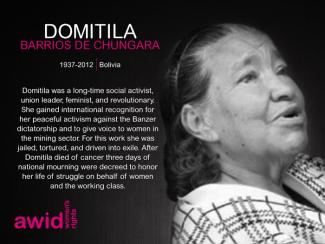
Nadine was a role model to many for her work supporting women and the most vulnerable in her community. She was committed to helping the poor and homeless in particular.
Though her death was reported as an accident, the Ramaroson family, led by her father, André Ramaroson led an investigation that pointed to evidence that she had been murdered. She is reported to have died in a fatal accident occurred between Soanierano - Ivongo and Ste Marie - a story that has been refuted by her family.
She received numerous death threats for her bold political positions. Her case remains in court in Antananarivo (the capital of Madagascar).


Os movimentos feministas, de direitos das mulheres, de justiça de género, de LBTQI+ e de aliados em todo do mundo encontram-se num momento crítico, e enfrentam uma forte retaliação contra direitos e liberdades conquistados anteriormente. Os últimos anos trouxeram o crescimento rápido do autoritarismo, a violenta repressão da sociedade civil e a criminalização dos defensores dos direitos humanos das mulheres e de pessoas de género diverso, o aumento da guerra e do conflito em várias partes do nosso mundo, a perpetuação contínua de injustiças económicas e crises de saúde, da ecologia e do clima interligadas.
La lutte pour un monde rempli de lieux de travail exempts de toute forme de discrimination, de stigmatisation et d'exclusion est une lutte noble. Un monde où le travail sexuel est décriminalisé et reconnu comme travail en fait partie intégrante.
Un monde où tous·tes les travailleur·euses ont des conditions de travail sûres, des salaires décents et peuvent jouir des mêmes droits tels que l'accès à la santé, le droit à la retraite, aux congés maladie, aux vacances, à la sécurité de l'emploi et plus encore, quels que soient leur genre, leur race, leur origine ethnique, leur âge ou leurs capacités. Les droits du travail sont des questions féministes, et les syndicats féministes jouent un rôle clé dans la promotion des droits juridiques, du travail et économiques de tous·tes les travailleur·euses, en particulier les travailleur·euses migrant·e·s, les travailleur·euses domestiques, les travailleur·euses informel·les et les travailleur·euses du sexe. Ce sont ces personnes qui ont récemment été touchées de manière disproportionnée par la pandémie, sa crise des soins, les confinements, les couvre-feux ainsi que la surveillance et la répression policière accrue. Nous vous présentons ici les histoires de militantes féministes et syndicalistes qui se battent pour de meilleures conditions de travail et un monde meilleur pour tous·tes.
Les acteurs anti-droits ont eu un impact substantiel sur le cadre relatif aux droits humains et sur l’interprétation progressiste des normes relatives à ces droits, en particulier dans le champ du genre et de la sexualité.
Pour mesurer l’impact de l’action des conservateurs dans les espaces politiques internationaux, il suffit de constater l’immobilisme et les régressions qui caractérisent la situation actuelle.
Nous sommes témoins de l’affaiblissement des accords et des engagements existants ; de négociations dans l’impasse ; du travail de sape continu mené à l’encontre des agences des Nations Unies, des organes de surveillance des traités et des Procédures spéciales ; et enfin de l’intégration d’un langage rétrograde dans les documents internationaux relatifs aux droits humains.
La CSW, qui se réunit chaque année en mars, est depuis longtemps l’un des espaces les plus contestés du système des Nations Unies. En mars 2015, les conservateurs ont donné le ton avant même que les événements ou les négociations ne commencent. Le document final élaboré par la Commission s’est avéré être une Déclaration très peu ambitieuse qui avait été négociée avant même que les activistes des droits des femmes n’aient pu intervenir.
Pendant la CSW 2016, le nouveau Caucus des jeunes a été infiltré par un grand nombre d’activistes anti-avortement et anti-droits sexuels et reproductifs qui ont réussi à réduire les organisations de jeunes progressistes au silence. Une fois de plus, les intenses négociations ont abouti à un texte terne dans lequel les éléments relatifs à « la famille » sont formulés dans un langage rétrograde.
Alors qu’il est devenu particulièrement important et urgent de faire progresser les droits humains des femmes, la CSW est devenue un espace affaibli et dépolitisé. Il est de plus en plus difficile d’envisager d’y faire progresser ces droits dans la mesure où les activistes progressistes utilisent toute leur énergie pour essayer de faire barrage au recul voulu par les conservateurs.
En tant qu’organe intergouvernemental responsable de la promotion et de la protection des droits humains dans le monde entier, le CDH est une porte d’entrée essentielle pour les conservateurs. Ces dernières années, cette institution a été le théâtre d’un certain nombre de démarches anti-droits.
En concertation avec d’autres acteurs anti-droits, certains États et blocs d’États conservateurs ont adopté une stratégie qui vise à faire retirer tout langage progressiste des résolutions et à introduire des amendements hostiles. Ils s’attaquent le plus souvent aux résolutions qui traitent de droits relatifs au genre et à la sexualité.
Par exemple, lors de la session du CDH qui s’est tenue en juin 2016, les États membres de l’Organisation de coopération islamique (OCI) et leurs alliés se sont opposés à l’adoption d’une résolution sur la discrimination à l’égard des femmes. Au cours de négociations tendues, de multiples dispositions ont été supprimées, y compris celles relative au droit des femmes et des filles de contrôler leur sexualité et leur santé ainsi qu’à leurs droits sexuels et reproductifs. Ont également été supprimées toutes les dispositions portant sur la nécessité d’abroger les lois qui perpétuent l’oppression patriarcale des femmes et des filles dans les familles et celles qui criminalisent l’adultère ou pardonnent le viol conjugal.
Le CDH a également été le théâtre d’initiatives pernicieuses des conservateurs visant à coopter les normes relatives aux droits humains et à introduire un langage conservateur en matière de « droits humains » – comme celui utilisé dans les résolutions en faveur des « valeurs traditionnelles » soutenues par la Russie et ses alliés et, plus récemment, dans le cadre de la campagne pour la « protection de la famille ».
En 2015, un certain nombre d’organisations religieuses conservatrices ont ouvert un nouveau front de lutte en commençant à s’attaquer à la Commission des droits de l’homme, organe de contrôle de l’application du Pacte international relatif aux droits civils et politiques (PIDCP) et instrument essentiel pour les droits humains.
Des groupes anti-droits se sont mobilisés dans l’espoir de faire inclure leur rhétorique anti-avortement dans le traité.
Lorsque la Commission a annoncé qu’elle rédigeait une nouvelle interprétation autorisée du droit à la vie, plus de 30 acteurs non étatiques conservateurs ont envoyé des observations écrites, avançant leurs arguments fallacieux sur le « droit à la vie » – à savoir que la vie commence dès la conception et que l’avortement est une violation de ce droit. Ils ont demandé à ce que ces idées soient incorporées dans l’interprétation de l’article 6 par la Commission.
L’action concertée de ces groupes conservateurs auprès de la Commission des droits de l’homme représente une évolution notable dans la mesure où elle concrétise la volonté des acteurs anti-droits de saper et d’invalider le travail essentiel qu’accomplissent les organes de surveillance de l’application des traités, dont celui de la Commission des droits de l’homme elle-même.

En 2015, les acteurs anti-droits ont mené des actions de plaidoyer dans le cadre de l’élaboration des nouveaux objectifs de développement durable (ODD), insistant une nouvelle fois sur les droits relatifs au genre et à la sexualité. Leurs efforts pour faire adopter un langage rétrograde dans le Programme de développement durable à l’horizon 2030 ont été moins fructueux.
Néanmoins, après avoir réussi à empêcher l’inclusion d’un langage progressiste dans le texte final, les conservateurs ont ensuite adopté une autre stratégie. Pour minimiser la responsabilité des États et saper l’universalité des droits, plusieurs États ont émis de multiples réserves sur les ODD.
Au nom du Groupe des États africains membres de l’ONU, le Sénégal a affirmé que les États africains ne « mettraient en œuvre que les ODD alignés sur les valeurs culturelles et religieuses de ses pays membres ».
Le Saint-Siège a également émis un certain nombre de réserves, affirmant qu’il était « certain que l’engagement selon lequel ‘personne ne serait laissé de côté’ serait compris comme une reconnaissance du droit à la vie de la personne, de la conception jusqu’à la mort naturelle ».
L’Arabie saoudite est allée plus loin encore, déclarant que le pays ne suivrait pas les règles internationales relatives aux ODD qui feraient référence à l’orientation sexuelle ou à l’identité de genre, les qualifiant de « contraires à la loi islamique ».
Les acteurs anti-droits ont un pouvoir d’influence de plus en plus marqué au sein de l’Assemblée générale des Nations Unies. En 2016, lors de la 71e session, l’AG a été le théâtre de la féroce opposition des acteurs anti-droits à un nouveau mandat créé en juin 2016 en vertu de la Résolution du Conseil des droits de l’homme sur l’orientation sexuelle et l’identité de genre : le mandat d’Expert indépendant pour la protection contre la violence et la discrimination basées sur l’orientation sexuelle et l’identité de genre[Béné1] (OSIG). Quatre actions ont été mises en œuvre dans les espaces de l’AG pour tenter de réduire la portée de ce mandat.
Le Groupe des États africains a notamment coordonné la présentation d’une résolution hostile auprès de la Troisième Commission[Béné2] , visant essentiellement à faire indéfiniment ajourner ce nouveau mandat. Bien que cette tentative n’ait pas abouti, il s’agit d’une tactique nouvelle et préoccupante visant à bloquer rétroactivement la création d’un mandat présenté par le Conseil des droits de l’homme.
Les acteurs anti-droits œuvrent maintenant à porter directement atteinte à l’autorité du CDH auprès de l’Assemblée générale. Les acteurs anti-droits ont également tenté de nuire à ce mandat en menant une actions auprès de la Cinquième Commission (chargée des questions administratives et budgétaires). Cette initiative inédite a conduit un certain nombre d’États à tenter (encore une fois sans succès) de bloquer le financement des experts des droits humains de l’ONU, dont celui de l’Expert indépendant pour la protection contre la violence et la discrimination basées sur l’orientation sexuelle et l’identité de genre.
Bien que ces multiples tentatives n’aient pas réussi à empêcher la création et le maintien de ce nouveau mandat, le soutien important que ces acteurs ont reçu, les stratégies innovantes qui ont été mise en œuvre et les puissantes alliances régionales qui se sont forgées tout au long des négociations nous donnent une idée des difficultés auxquelles nous allons devoir faire face.
Télécharger le chapitre complet (en anglais)
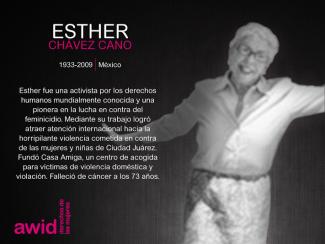
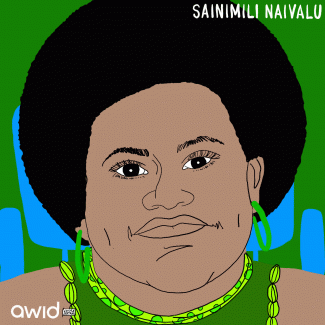
“I’ve witnessed discrimination on the streets, being teased on the streets and verbally abused on the streets. I have also made numerous friends and have met a lot of people. There may be dangers out there but I am a survivor and this is where I will be for now.”
- Sainimili Naivalu
She demanded policy makers and stakeholders provide disability friendly policies and services such as the construction of ramps in towns and cities to increase accessibility. Physical barriers were not the only ones she strived to change. From her own experience, she knew that more difficult changes need to take place in social and economic spheres. Many of the challenges disabled people face are rooted in attitudes that carry discrimination and stigma.
A survivor and a fighter, Sainimili contributed to co-creating feminist realities that foster inclusion and shift attitudes towards disabled people. As a member of the Spinal Injury Association of Fiji (SIA) and through Pacific Disability Forum’s Pacific Enable project she attended the International Labour Organisation “Start Your Business” training in Suva, enabling her to transform her ideas into her own business. She was an entrepreneur at the Suva Market Stall 7, offering manicure services, as well as running SIA’s women’s market stall selling handicrafts, sulus and artifacts. Sainimili’s plan was to expand her business and become a major employer of disabled people.
In addition to her activism, she was also a table tennis medalist and youth champion.
A vivacious personality, Sainimili was one of a kind. You would always know that Sainimili is in a room because her laughter and her stories would be the first thing that you would notice.
- Michelle Reddy
Sainmili passed away in 2019.
(Доступно на английском языке)

This economical model exploits nature and as it intensifies, so does the inequality between global North with their large corporations, and the global South, where resources are extracted.
Find more on our report on EXTRACTIVE INDUSTRIES
There are sustainable alternatives for the environment and women's rights.

Conocida como la Drag Queen de color de Nueva York, Sylvia fue feroz e incansable en su voluntad por cambiar las cosas, y en su defensa de quienes quedaron marginadxs y excluidxs cuando el movimiento por los "derechos de la comunidad gay" se volvió predominante en los Estados Unidos, a principios de los 70.
En 1973, durante un conocido discurso por el día de Christopher Street, Sylvia gritó en medio de la multitud de integrantes de la comunidad LGBT:
"Todos ustedes me dicen, anda y esconde la cola entre las patas.
No voy a seguir aguantando esta mierda.
Me han golpeado.
Me han roto la nariz.
Me han metido en la cárcel.
He perdido mi trabajo.
He perdido mi departamento
por la liberación gay, ¿y todos ustedes me tratan así?
¿Qué carajo les pasa a todos ustedes?
¡Piensen en eso!"
En 1969, a la edad de 17 años, Sylvia participó en los emblemáticos disturbios de Stonewall, al lanzar, presuntamente, el segundo cóctel molotov para protestar por la redada policial en este bar gay de Manhattan. Siguió siendo una figura central en los levantamientos posteriores, organizando mítines y luchando contra la brutalidad policial.
En 1970, Sylvia trabajó junto con Marsha P. Johnson para establecer Street Transvestite Action Revolutionaries [Acción Travesti Callejera Revolucionaria] (S.T.A.R., por sus siglas en inglés), un colectivo político y una organización que establecería proyectos de apoyo mutuo para las personas trans que vivían en la calle, aquellxs que luchaban contra la drogadicción, las que estaban encarceladas y, en particular, para las personas trans de color que vivían en la pobreza.
Desafiante de las etiquetas, Silvia vivió la vida de una manera que retaba a las personas del movimiento de liberación gay a pensar de manera diferente. Ella dijo:
"Me fui de casa a los 10 años, en 1961. Hice la calle en la 42. El inicio de los años 60 no era un buen momento para lxs drag queens, los chicos afeminados o los chicos que usaban maquillaje como nosotrxs. En ese entonces nos golpeaba la policía, y todo el mundo. Yo no salí realmente como drag queen hasta finales de los 60, cuando se arrestaba a lxs drag queens, qué degradación había. Recuerdo que la primera vez que me arrestaron, ni siquiera estaba vestida totalmente en drag. Estaba caminando y los policías me arrebataron de la calle. La gente ahora quiere llamarme lesbiana porque estoy con Julia, y yo digo: "No. Soy sólo yo. No soy lesbiana". Estoy cansada de que me etiqueten. Ni siquiera me gusta la etiqueta transgénero. Estoy cansada de vivir con etiquetas. Sólo quiero ser quien soy. Soy Sylvia Rivera.
A través de su activismo y su coraje, Sylvia ofreció un espejo que reflejaba todo lo que estaba mal en la sociedad, pero también la posibilidad de transformación. Sylvia nació en 1951 y falleció en 2002.
Grupos, organizações e movimentos cujo foco específico ou principal seja os direitos das mulheres, de jovens, a justiça de género, os direitos das pessoas LBTQI+ e de aliados em todas as regiões e em todos os níveis, quer sejam novos ou já estabelecidos.