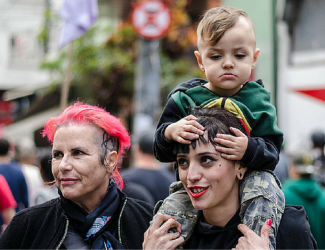
Flickr/Leonardo Veras (CC BY 2.0)

Protection of the Family

The Issue

Over the past few years, a troubling new trend at the international human rights level is being observed, where discourses on ‘protecting the family’ are being employed to defend violations committed against family members, to bolster and justify impunity, and to restrict equal rights within and to family life.

The campaign to "Protect the Family" is driven by ultra-conservative efforts to impose "traditional" and patriarchal interpretations of the family, and to move rights out of the hands of family members and into the institution of ‘the family’.

“Protection of the Family” efforts stem from:

  • rising traditionalism,
  • rising cultural, social and religious conservatism and
  • sentiment hostile to women’s human rights, sexual rights, child rights and the rights of persons with non-normative gender identities and sexual orientations.

Since 2014, a group of states have been operating as a bloc in human rights spaces under the name “Group of Friends of the Family”, and resolutions on “Protection of the Family” have been successfully passed every year since 2014.

This agenda has spread beyond the Human Rights Council. We have seen regressive language on “the family” being introduced at the Commission on the Status of Women, and attempts made to introduce it in negotiations on the Sustainable Development Goals.


Our Approach

AWID works with partners and allies to jointly resist “Protection of the Family” and other regressive agendas, and to uphold the universality of human rights.

In response to the increased influence of regressive actors in human rights spaces, AWID joined allies to form the Observatory on the Universality of Rights (OURs).  OURs is a collaborative project that monitors, analyzes, and shares information on anti-rights initiatives like  “Protection of the Family”.

Rights at Risk, the first OURs report, charts a map of the actors making up the global anti-rights lobby, identifies their key discourses and strategies, and the effect they are having on our human rights.   

The report outlines “Protection of the Family” as an agenda that has fostered collaboration across a broad range of regressive actors at the UN.  It describes it as: “a strategic framework that houses “multiple patriarchal and anti-rights positions, where the framework, in turn, aims to justify and institutionalize these positions.”
 

Related Content

‘Our desire is our revolution!’: The politics of love and queer sexualities

‘Our desire is our revolution!’: The politics of love and queer sexualities

Gabby De Cicco

Mujeres Al Borde (MaB, ‘Women on the Edge’) is an explosive feminist cocktail of different identities and artistic disciplines created in 2001 in Colombia. A six-member team coordinates its programs Al Borde Productions, Al Borde Theatre, and Multitudes Al Borde. Over the course of 15 years of artivism more than 5,000 people have participated in their community programming in Colombia, Chile, and other countries in South and Central America. Pansexual artivist, transfeminist, and MaB co-founder Ana Lucia Ramirez shares her reflections on the group’s work.

A revolutionary desire

“Our desire is our revolution!” This has been our slogan since we created Mujeres al Borde. We are convinced that desire (exclusively in the sexual sense) is political.

When we embody a desire that is not heteronormative we begin to live differently in the world and can become more conscious of the oppressions we need to change and the injustices which have been normalized,” explains Ana.

“With this slogan we give a revolutionary and transformative place to our desire, our desire for other possible bodies, other ways to love, to experience pleasure, to have relationships with people, with other beings, with the earth. It is a desire that also goes beyond the sexual, that refers to the desire for another world and the commitment to making way for more just, free, and happy worlds,” she adds.

There are many ways to transform the world. One of Mujeres al borde’s ways has been to ensure that all voices are heard, especially the voices which have been marginalized or, out of concerns for their own personal security, have remained behind a wall of silence.

“The tagline of our community film project AL BORDE Productions is ‘We tell stories to change the world’. ” While we were making autobiographical documentaries with LGBT activists, we learned that one of the first fears that people who are sexual or gender dissidents need to confront is breaking the silence about who we are,” she says. For Ana and her fellow activists, for people to tell their stories in their own voice, and to recognize that their stories are worth telling and being heard “is a huge act of courage; it means confronting a society that threatens to symbolically and materially exclude us if we decide to be visible.”

Finding pleasure in the margins

Ana remembers that in their beginning the idea was to create a space to come together and “create other ways of being ‘the women’ who are living sexual and gender dissidences.” They identify as women who are ‘on the edge’ for not conforming to expectations about “gender, beauty, decency, or ‘political correctness,’ and who are not interested in giving up who we are to enter a place of privilege. On the edge, on the borders and margins, we find pleasure, fluidity, creativity, we find a place to create together with others who no longer fear being the weird ones, and on the contrary, enjoy it.”

The group has had bisexual women participants, 70-year-old lesbian women, trans women who find themselves and begin their transition in their 40s, 12-year-old trans children, women with intersex experiences, lesbian and bisexual women, pansexual women, girls with lesbian/bisexual moms, non-binary people, men who reject and question their gender identity and privilege, people with different abilities, transvestites of different ages, transformists, cross dressers, queer people, marimacha butch women, and heterosexual cisgender women who are critical of sexual norms and advocate for their rights.

“We have been a very happy group with so much beauty and difference that has come together around transfeminism, art, and activism.”

And if we are talking about artivism…

We understand art as an experience that changes us and through which we can also change the world. The activism that moves us recognizes that the power to create the world we dream of is in our own hands, in the strength of our own community doing activism through art.

In a film we are creating images
of what will be our collective memory.
In the creation of a character
people are valiantly discovering themselves.
When we create other narratives through storytelling,
documentaries, femzines or performances, we produce
references that will help others to know they are not alone,
they are not the only ones. Artivism gives our voice back,
heals us, emphasizes community and the collective,
brings us together to dream as a group
and to create new potential dreams.

Our artivism is contrasexual and transfeminist. It is that way because from here on the edge, we have understood that there are certain truths that need to be challenged so that our lives are possible, truths that sustain oppressions that are ending the lives of women, girls, children, gender and sexual dissident people all over the world. We challenge the patriarchy, cissexism, gender binaries, norms on corporality, desire, love, pleasure, the obligation to be heterosexual, to be mothers, to be women and to be men.

No more masks

The theatre troupe of Mujeres al Borde, “Las Aficionadas” (The Fans), debuted in June 2001 with its first play, “Olga sin pelos en la lengua” (Straight-talking Olga; or literally, “Olga with no hair on her tongue”). Ana recalls that it was harder to come out of the closet in Colombia in those years. More than half of the lesbian and bisexual women participating in the group hid their sexual orientation and would often march in the Pride parade wearing masks or eye masks.

Clau Corredor, a co founder of the group, imagined a scene in which several of them would take centre stage and say over and over, “I am bisexual. I am a lesbian.” They would say it for three months of rehearsals, “even though they hadn’t found the strength to say it in their own lives,” Ana explains. On opening night there was a full house, with more than 200 people in the audience and “our compañeras were really nervous. The play was a hit, and they said their lines with such strength and determination. ‘I am bisexual. I am a lesbian.’ The audience gave them a standing ovation.”

The “LGBT Pride” parade in Bogota was two days after the show opening, and the protagonist and other compañeras from the show went to the place where they were handing out masks to wear for the march. “We saw them just then and went up to say hello,” Ana recalls, “but before they could put them on, some people on the street started yelling, ‘Olga! Olga! Olga sin pelos en la lengua!’ They came up and excitedly asked whether we were the ones from the play. We were all surprised and happy about being recognized, especially the lead actress.

Just then the person handing out the masks asked them how many they would need. They looked at one another and said, ‘No, this time we are not going to wear a mask.’ That was one of the most meaningful moments for us when we were starting out—one we still remember today with tears and laughter.”

Region
Latin America
Source
AWID

¡Nuestro deseo es nuestra revolución!: Políticas del amor y las sexualidades queer

¡Nuestro deseo es nuestra revolución!: Políticas del amor y las sexualidades queer

Mujeres Al Borde (MaB) es un cocktail explosivo feminista de diferentes identidades y disciplinas artísticas que nació en el 2001 en Colombia. El equipo está conformado actualmente por seis personas que llevan adelante sus programas Al Borde Producciones, Teatro Al Borde, Multitudes Al Borde. Durante 17 años de artivismo más de 5000 personas han participado de sus procesos comunitarios tanto en Colombia, Chile como en otros países de Sudamérica y Centroamérica. Compartió y reflexionó sobre lo hecho por el grupo la artivista pansexual y transfeminista Ana Lucia Ramirez, co-fundadora de MaB.

Un deseo revolucionario

«¡Nuestro deseo es nuestra revolución! Este ha sido el lema que nos ha identificado y acompañado desde el inicio de Mujeres al Borde.

Estamos convencidxs de que el deseo (entendido solo como algo sexual) es algo plenamente político, que cuando encarnamos un deseo no heteronormado comenzamos a habitar el mundo de otra forma y podemos ser más conscientes de las opresiones que necesitamos cambiar, de las injusticias que están naturalizadas» explica Ana.

Y luego agrega: «Con esta frase le otorgamos un lugar revolucionario y transformador a nuestro deseo, nuestro deseo de otros cuerpos posibles, otras formas de amar, de sentir placer, de relacionarnos con las personas, con otros seres, con la tierra. Es un deseo que también desborda lo sexual, y que se refiere al deseo de otro mundo y al compromiso de abrir posibilidades para mundos más justos, libres y felices».

Existen diversas formas de transformar el mundo. Una que Mujeres al borde ha desarrollado es lograr que todas las voces se escuchen, especialmente las voces que se han mantenido marginadas o que por cuestiones de falta de seguridad personal se han recluido detrás de una pared de silencio.

«La consigna de nuestro proyecto de cine comunitario AL BORDE Producciones es ‘Contamos historias para cambiar el mundo’. Durante el proceso de realizar documentales autobiográficos con activistas LGBT, entendimos que uno de las primeros miedos que las personas disidentes de la sexualidad y el género necesitamos enfrentar, es el de romper el silencio sobre quienes somos» dice Ana.

Para ella como para sus compañerxs, el que las personas puedan contar sus historias con voz propia, y que se reconozca que sus historias merecen ser contadas y escuchadas, «es un gran acto de valor, es enfrentar una sociedad que nos amenaza simbólica y materialmente con la exclusión si decidimos ser visibles».

Encontrando el placer en el borde

Ana recuerda que cuando comenzaron la idea era crear un espacio para encontrarse y poder «crear otros sentidos de lo que podíamos ser ‘las mujeres’ que habitamos las disidencias sexuales y de género». Es por esto que se reconocen como mujeres que están al borde, que no cumplen con las expectativas «del género, de la belleza, de la decencia, de lo ‘políticamente correcto’, y a las que además, no nos interesa renunciar a ser quienes somos por entrar en un lugar de privilegio. En el borde, en las fronteras, márgenes, encontramos placer, fluidez, creatividad, donde hallamos un lugar para crear junto con otr*s que también han perdido el miedo a ser las raras, l*s rar*s, y por el contrario, lo disfrutan».

En el grupo han participado mujeres bisexuales, señoras lesbianas de 70 años, mujeres trans que se descubren y empiezan su tránsito a los 40, niños trans de 12, mujeres con experiencias intersex, madres lesbianas y bisexuales, personas pansexuales, niñas hijas de mamás lesbianas/bisexuales de nuestra comunidad, personas de género no binario, hombres que rechazan y cuestionan su identidad de género y privilegios, personas con capacidades diferentes, travestis de diversas edades, transformistas, cross dressing, personas queer, marimachas, también mujeres cis heterosexuales críticas a la norma sexual y que también son activistas por sus derechos derechos. «Hemos sido un grupo muy felíz con tanta belleza y diferencia que hemos reunido en torno al transfeminismo, el arte y el activismo».

Y si de artivismo se trata…

Entendemos el arte como una experiencia
que nos cambia y desde la que podemos
también cambiar el mundo.
El activismo que nos hace vibrar es
aquel que reconoce que el poder
de hacer el mundo que soñamos
está en nuestras propias manos, en la fuerza
de nuestra propia comunidad
haciendo activismo desde el arte.

En una película estamos creando
las imágenes de lo que será nuestra memoria colectiva.
En la creación de un personaje teatral las personas
van descubriéndose valientemente a sí mismas.
Cuando creamos otras narraciones a través de cuentos,
documentales, femzines o performances, producimos
referentes que van a hacerle saber a otrxs que no están solxs,
que no son lxs únicxs. Este artivismo nos devuelve la voz,
nos sana, pone el acento en lo comunitario, lo colectivo,
nos reúne a soñar en grupo y a hacer posibles esos sueños.

Nuestro artivismo es contrasexual y transfeminista.
Es así porque en este lugar desde el borde, hemos entendido
que hay ciertas verdades que necesitan ser desafiadas
para que nuestras vidas sean posibles, verdades que sostienen
opresiones que están acabando con la vida de mujeres, niñas,
niños, personas de las disidencias sexuales y del género
en todo el mundo. Desafiamos el patriarcado, el cisexismo,
el binario de género, las normas de la corporalidad, del deseo,
del amor, del placer, la obligación de ser heterosexuales,
ser mamás, ser mujeres y ser hombres.

No más máscaras

El grupo teatral de Mujeres al Borde, «Las Aficionadas», estrenó en junio de 2001, su primera obra, titulada «Olga sin pelos en la lengua». Ana recuerda que en aquellos años era más complicado salir del closet en Colombia, y que más de la mitad de las mujeres lesbianas y bisexuales que participaban del grupo vivían su orientación sexual de manera oculta, y era frecuente que participaran de la marcha del Orgullo con máscaras y antifaces.

A Clau [Corredor, otrx de lxs fundadorxs del grupo] se le ocurrió una escena donde varias de ellas pasaban al frente y decían una y otra vez: «Soy bisexual. Soy lesbiana». Lo dijeron durante tres meses en cada ensayo, «aunque en su vida no habían encontrado la fuerza de decirlo» explica Ana.

El día del estreno el lugar estaba llenísimo, con más de 200 personas en el público y «las compañeras estaban muy nerviosas. La obra fue un éxito, y ellas dijeron con mucha fuerza y determinación su texto de ‘Soy bisexual. Soy lesbiana’. El público se levantó para aplaudirlas».

Dos días después del estreno fue la marcha del «Orgullo LGBT» en Bogotá, y la actriz protagonista y otras de las compañeras de la obra fueron hasta donde repartían máscaras para ponérselas durante la marcha. «Justo las vemos y nos acercamos a saludarlas» recuerda Ana, «y antes de ponerse las máscaras, unas personas que estaban ahí en la calle, comenzaron a gritarles: ‘¡Olga, Olga! ¡Olga sin pelos en la lengua!’. Se acercaron y nos preguntaron emocionad*s si éramos l*s de la obra de teatro. Todas estábamos sorprendidas y felices con el reconocimiento, sobre todo la protagonista.

En ese momento la persona que daba las máscaras les preguntó: ¿Cuántas necesitan? Ellas se miraron y dijeron: ‘NO, esta vez no vamos a usar máscara’. Ha sido uno de los momentos que más nos marcó cuando comenzamos, todavía hoy lo recordamos con lágrimas y risa».

Source
AWID