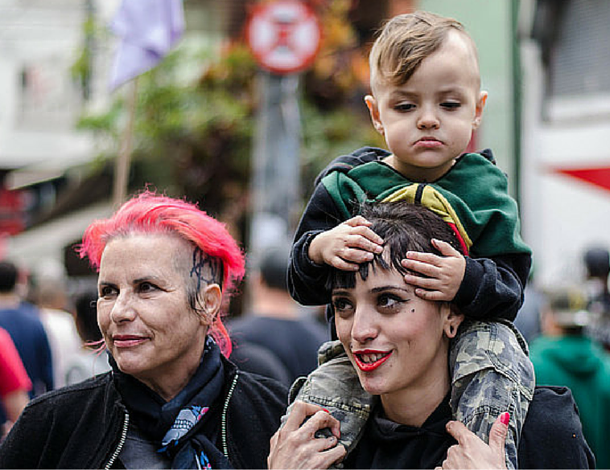
Over the past few years, a troubling new trend at the international human rights level is being observed, where discourses on ‘protecting the family’ are being employed to defend violations committed against family members, to bolster and justify impunity, and to restrict equal rights within and to family life.
The campaign to "Protect the Family" is driven by ultra-conservative efforts to impose "traditional" and patriarchal interpretations of the family, and to move rights out of the hands of family members and into the institution of ‘the family’.
“Protection of the Family” efforts stem from:
rising traditionalism,
rising cultural, social and religious conservatism and
sentiment hostile to women’s human rights, sexual rights, child rights and the rights of persons with non-normative gender identities and sexual orientations.
Since 2014, a group of states have been operating as a bloc in human rights spaces under the name “Group of Friends of the Family”, and resolutions on “Protection of the Family” have been successfully passed every year since 2014.
This agenda has spread beyond the Human Rights Council. We have seen regressive language on “the family” being introduced at the Commission on the Status of Women, and attempts made to introduce it in negotiations on the Sustainable Development Goals.
Our Approach
AWID works with partners and allies to jointly resist “Protection of the Family” and other regressive agendas, and to uphold the universality of human rights.
In response to the increased influence of regressive actors in human rights spaces, AWID joined allies to form the Observatory on the Universality of Rights (OURs). OURs is a collaborative project that monitors, analyzes, and shares information on anti-rights initiatives like “Protection of the Family”.
Rights at Risk, the first OURs report, charts a map of the actors making up the global anti-rights lobby, identifies their key discourses and strategies, and the effect they are having on our human rights.
The report outlines “Protection of the Family” as an agenda that has fostered collaboration across a broad range of regressive actors at the UN. It describes it as: “a strategic framework that houses “multiple patriarchal and anti-rights positions, where the framework, in turn, aims to justify and institutionalize these positions.”
Related Content
Forum Theme (Forum page)
El tema del 14° Foro Internacional de AWID es Realidades feministas: nuestro poder en acción.
En este Foro, vamos a celebrar y multiplicar las propuestas poderosas que nos rodean, en sus distintos estadios de evolución.
Fornecer a membres da AWID, parceires do movimento e financiadores uma análise atualizada, robusta, baseada em fatos e orientada para a ação das realidades do financiamento de movimentos feministas e do estado atual do ecossistema do financiamento feminista.
2
Identificar e demonstrar oportunidades para transferir mais recursos de maior qualidade para a organização feminista, expor soluções falsas e interromper tendências que fazem com que o financiamento não seja bem-sucedido e/ou se mova contra a justiça de género e objetivos feministas interseccionais.
3
Articular visões, propostas e objetivos feministas para a justiça no financiamento.
Son soutien aux femmes et aux personnes les plus vulnérables de sa communauté a fait que Nadine était un modèle pour beaucoup. Elle était déterminée à aider les pauvres et les sans-abri en particulier.
Bien que sa mort ait été déclarée comme étant accidentelle, la famille Ramaroson, sur l’initiative de son père André Ramaroson, a mené une enquête qui a mis en évidence des preuves de son assassinat. Elle serait décédée dans un accident mortel survenu entre Soanierano - Ivongo et Ste Marie - une histoire qui a été réfutée par sa famille. Elle avait reçu de nombreuses menaces de mort pour ses positions politiques résolues. L’affaire est toujours en cours auprès des tribunaux à Antananarivo (la capitale de Madagascar).
Illumination by the Light of the Full Moon: An African BDSM experience
Akosua Hanson is an artistic activist, based in Accra, Ghana. Her work spans radio, television, print media, theatre, film, comic art exhibitions, art installations, and graphic novels. Akosua’s activism has been centred around pan-Africanism and feminism, with an interest in the intersection of art, pop culture, and activism. She has a Masters in Philosophy in African Studies with a focus on Gender and African Philosophical Thought. Akosua Hanson is the creator of Moongirls, a graphic novel series that follows the adventures of four superheroes fighting for an Africa free from corruption, neocolonialism, religious fundamentalism, rape culture, homophobia and more. She works as a radio host at Y 107.9 FM, Ghana.
Ever experienced moments of deep clarity during or after sex?
In these panels, the Moongirl Wadjet is engaged in BDSM lovemaking with a two-gender daemon. Of the four Moongirls, Wadjet is the healer and philosopher, the conduit of the Oracle. She does this to launch a scientific and spiritual process – an experiment she calls “Illumination by the Light of the Full Moon” – through which she traces a vibrational time arc between her memories, sensations, emotions, visions, and imagination. It is a form of vibrational time travel in order to discover what she terms as “truth-revelations.”
During the experience, some of Wadjet’s hazy visions include: an approaching apocalypse brought about by humans’ environmental destruction in service to a voracious capitalism; a childhood memory of being hospitalized after a mental health diagnosis; and a vision of a Moongirls’ origin story of the Biblical figure of Noah as an ancient black Moongirl warning of the dangers of environmental pollution.
More than a fun kink to explore for the sensations, BDSM can be a way of addressing emotional pain and trauma. It has been a medium of sexual healing for me, providing a radical form of liberation. There is a purge that happens when physical pain is inflicted on the body. Inflicted with consent, it draws out emotional pain – almost like a “calling forth.” The whip on my body allows me to release suppressed emotions: anxiety, depression, my sense of defenselessness to the stresses that overwhelm me sometimes.
When engaging in BDSM as an avenue for healing, lovers must learn to be very aware of and responsible for each other. Because even though consent may have been initially given, we must be attentive to any changes that might occur in the process, especially as feelings intensify. I approach BDSM with the understanding that in order to surrender pain, love and empathy have to be the basis of the process and by that, I create space or open up for love.
The engagement with aftercare after the infliction of pain is a completion of the process. This can be done in very simple ways such as cuddling, checking if they need water, watching a movie together, sharing a hug or just sharing a joint. It can be whatever your chosen love language is. This holding space, with the understanding that wounds have been opened, is necessary to complete the process of healing. It is the biggest lesson in practising empathy and learning to really hold your partner, due to the delicacy in blurring the lines between pain and pleasure. In this way, BDSM is a form of care work for me.
After BDSM sex, I feel a clarity and calm that puts me in a great creative space and spiritually empowers me. It is an almost magical experience watching the pain transform into something else in real time. Similarly, this personally liberating experience of BDSM allows Wadjet to access the foreknowledge, wisdom, and clarity to aid in her moongirl duties in fighting African patriarchy.
Moongirls was birthed during my tenure as the director for Drama Queens, a young artistic activist organization based in Ghana. Since our inception in 2016, we’ve employed different artistic media as part of their feminist, pan-Africanist, and environmentalist activism. We used poetry, short stories, theatre, film, and music to address issues such as corruption, patriarchy, environmental degradation, and homophobia.
Our inaugural theatre production, “The Seamstress of St. Francis Street” and “Until Someone Wakes Up” addressed the problem of rape culture in our communities. Another one, “Just Like Us,” was arguably one of the first Ghanaian theatre productions to directly address the country’s deep-seated issue of homophobia. Queer Universities Ghana, our queer film workshop for African filmmakers, has trained filmmakers from Ghana, Nigeria, South Africa, and Uganda. Films birthed during the workshop, like “Baby Girl: An Intersex Story” by Selassie Djamey, have gone on to be screened at film festivals. Therefore, moving to the medium of graphic novels was a natural progression.
About seven years ago, I’d started a novel that I never completed about the lives of four women. In 2018, the Open Society Initiative for West Africa (OSIWA) opened up a grant opportunity that launched the production of the project and my uncompleted novel was turned into Moongirls.
There have been two seasons of Moongirls made up of six chapters each. Contributing writers and editors for the first season were Suhaida Dramani, Tsiddi Can-Tamakloe, George Hanson, and Wanlov the Kubolor. Writers for the second season were Yaba Armah, Nadia Ahidjo, and myself. Character illustrations and conceptualizations were by Ghanaian artist Kissiwa. And AnimaxFYB Studio, a premium animation, design, and visual effects studio, does the illustrations.
During the experience, some of Wadjet’s hazy visions include: an approaching apocalypse brought about by humans’ environmental destruction in service to a voracious capitalism; a childhood memory of being hospitalized after a mental health diagnosis; and a vision of a Moongirls’ origin story of the Biblical figure of Noah as an ancient black Moongirl warning of the dangers of environmental pollution.
Writing Moongirls between 2018 and 2022 has been a labour of love for me, even, a labour for liberation. I aim to be very explorative in form and style: I’ve dabbled in converting other forms of writing, such as short stories and poetry, to graphic novel format. By merging illustration and text, as graphic novels do, Moongirls aims to tackle the big issues and to honor real life activists. My decision to centre queer women superheroes – which is rare to see in this canon – came to mean so much more when a dangerous backdrop started developing in Ghana in 2021.
Last year saw a marked hike in violence for the Ghanaian LGBT+ community that was sparked by the shutdown of an LGBT+ community centre. This was followed by arbitrary arrests and imprisonment of people suspected to be on the queer spectrum, as well as of those accused of pushing an “LGBT agenda.” Crowning this was the introduction in Ghanaian Parliament of an anti-LGBT bill named “Proper Human Sexual Rights and Ghanaian Family Values.” This bill is arguably the most draconian anti-LGBT bill ever drafted in the region, following previous attempts in countries like Nigeria, Uganda and Kenya.
I remember quite vividly the first time I read the draft of this bill.
It was a Friday night, typically a night I take off to rest or party after a long work week. By sheer luck, the draft was leaked and shared with me on a WhatsApp group. As I read it, a deep sense of fear and alarm made burnt toast of my Friday night chill. This bill proposed to slap any LGBT+ advocacy with five to ten years of imprisonment, and to fine and imprison people who identify as LGBT+ unless they “recanted” and accepted conversion therapy. In the draft bill, even asexual people were criminalized. The bill went for all fundamental freedoms: freedoms of thought, of being, and the freedom to hold one’s personal truth and choose to live your life by that truth. The bill even went for social media and art. If it passed, Moongirls would be banned literature. What the bill proposed to do was so evil and far-reaching, I was stunned into a depression at the depth of hate from which it had been crafted.
Scrolling through my Twitter timeline that night, the terror I felt inside me was mirrored. The timeline was a livestream of emotions as people reacted in real time to what they were reading: disbelief to terror to a deep disappointment and sorrow when we realized how far the bill wanted to go. Some tweeted their readiness to fold up and leave the country. Then, in the way Ghanaians do, sorrow and fear is alchemized to humour. From humour came the zest to upscale the fight.
So, the work still continues. I created Moongirls to provide an alternative form of education, to provide knowledge where it has been suppressed by violent patriarchy, and to create visibility where the LGBT+ community has been erased. It is also important that African BDSM is given this platform of representation when so much of BDSM representation is white. Sexual pleasure, through BDSM or otherwise, as well as non-heterosexual love, transcend race and continent because sexual pleasure and its diversity of experience are as old as time.
Lisez nos recherches sur le financement, sur les défenseuses des droits humains, sur la création de mouvements, sur les fondamentalismes, la justice économique et beaucoup plus
Êtes-vous à la recherche d'un emploi? L'un des avantages de rejoindre la Communauté de l'AWID est d'avoir accès à notre tableau d'offres d'emploi organisé par la communauté. Vous aurez l'occasion d'explorer de nouvelles opportunités et vous aurez également la possibilité de partager des postes vacants et des appels à propositions avec tous les membres.
« J’ai constaté la discrimination dans la rue, que ce soit par des taquineries ou des agressions verbales qui y ont lieu. Je me suis aussi faite plein d’ami·e·s et j’y ai rencontré plusieurs personnes. Il se peut que ce soit dangereux là-bas, mais je suis une survivante, et pour le moment, c’est là où je suis. » - Sainimili Naival
Sainimili Naivalu était une activiste féministe des droits des personnes handicapées issue du village de Dakuibeqa, sur l’île de Beqa aux Fidji.
Elle a demandé aux responsables et acteurs politiques de fournir des politiques et des services adaptés au handicap, comme la construction de rampes dans les villes et les villages afin d'accroître leur accessibilité. Les barrières physiques n’étaient pas les seules qu’elle aspirait à modifier. Sur la base de sa propre expérience, elle savait que des changements plus difficiles devaient être menés dans les sphères économiques et sociales. Bon nombre des défis avec lesquels sont aux prises les personnes handicapées trouvent leurs racines dans les attitudes discriminantes et stigmatisantes.
Survivante et combattante, Sainimili a contribué à co-créer des réalités féministes qui renforcent l’inclusion et font évoluer les attitudes par rapport à l’égalité des personnes handicapées. Elle a été membre de la Spinal Injury Association of Fiji (SIA) ainsi que participé à la formation « Démarrez votre entreprise » de l’Organisation internationale du Travail à Suva via le projet « Pacific Enable » (le Pacifique rend possible) du Forum Asie-Pacifique sur le handicap. Elle a ainsi pu transformer ses idées en une entreprise qui lui était propre. Elle était commerçante sur l’étal de marché 7 de Suva, offrant des services de manucure, tout en gérant un stand au marché des femmes SIA pour y vendre de l’artisanat, des suls et des objets historiques. Sainimili planifiait d’élargir son commerce et de devenir une employeuse majeure de personnes handicapées.
Outre son activisme, elle était également médaillée de tennis de table et une récente championne.
Avec sa personnalité vive, Sainimili était unique. On savait toujours lorsqu’elle était dans la pièce car ses rires et ses histoires étaient la première chose qu’on pouvait remarquer. - Michelle Reddy
Sainmili est décédée en 2019.
Moving Conversation
Thank you, Ángela and Pilar.
Yannia Sofía Garzón Valencia I am a Black woman and a community weaver. I live in Santander de Quilichao in Cauca, Colombia. I am interested in the creative processes that organize sustainable collective life. I like exchanging thoughts and cooking, investigating and analyzing, planting seeds and learning from plants, reading and playing. I am currently coordinating the observatory of gender-based violence against afro-descendant communities in Colombia (@VigiaAfro).
The three of us were “sharing” the afternoon in a neighborhood south of Bogota.
There was an unusually large green playing area and we sat on little wooden stools under an elderberry tree. We were finally experiencing that other form of love – that pleasure of being together and listening to each other. For me, these kinds of chats are among the expressions of love that life had only recently allowed me to enjoy. I had not known this other form of love – the kinds found outside workshops, activist spaces, classrooms, or workplaces – to be possible. Yet we three friends spent the afternoon amongst ourselves and we did not pretend to be blind to the color of our respective skins. Rather, it was a lived factor that allowed us to intimately discuss the similarities and differences in our childhood and youthful experiences.
Those chats were unrelated to any upcoming activities of the Black movement in Colombia, but they still nourish me and acquire new meanings. Our closeness was woven through coming together, recognizing each other, and identifying the uniqueness of our liberations. And by realizing there is not just one but many paths to liberation – those paths we inhabited every time we said “no” and rebelled. Far from feeling discomfort, we met in an authenticity made of weakness and strength, one which brought us closer instead of separating us.
Our purpose on that beautiful afternoon was to just be – to have an awareness of simply being amongst ourselves. We walked through our pasts so that the memories that stayed with us were those we decided to keep as ours, and not those that fear let through and found a place for. We remembered exact fragments of TV shows, and sang songs written by artists who had taught us about loving well, hating well, cursing like the worst villain, and suffering like the best leading lady.
We told each other about our school pranks, and what remained in our subconscious after being exposed to the many ways the media repeats the same thing – after the teachers and nuns at school overexposed us to stories so that we would identify with and appropriate Cinderella’s aspirations for our own lives. This would set the tone for the rest of our story: the drama of the impoverished and diminished girl who is yet to achieve her full value through an act that redeems her condition. And that act can only be brought about by the gaze of a male who, at the very least, is white, hence deserving of what is between our thighs – his “main aspiration” – and the “perfect realization of our dreams,” which we are told should then be our main aspiration.
There were three of us there that afternoon. Each had been brought up in a different part of the country, but it was fascinating that we could all still quote fragments and situations from songs and soap operas that often – as we realized by getting to know each other – shared codes or symbols that were replicated, with a few variations, in our homes, in our first relationships, and in our neighborhoods and schools. Brought up by “dramas” (is that what that very successful genre is called?) where the more you suffer, the more you deserve, the issue of “how and in which situations it is acceptable and legitimate to suffer” becomes an important mandate on how the person who suffers should be seen, what they should do, and whom they should be. Some of us managed to liberate ourselves and “learn” a definition of love that could only be learnt in adulthood, shattering illusions, and accepting natural sin. And becoming aware of the industrial production of a virgin, which we may refuse to look like as she has no place in our understanding, and the disappointment this alienation brings.
After singing, we reviewed our early sexual explorations. I never thought that most people experienced them before the age of nine and that even in adulthood, those experiences, those memories, remain a heavy burden. Even today, in thousands of places, millions of girls and boys see their innocence curtailed by lack of trust and the ignorance we present them with when they try to explore their bodies. Blaming curiosity is a most efficient control mechanism. We went back to the brief conversations we had when we changed the history of our lives from cursed Black beings to a perspective that rebirthed us. We remembered how many of our aunts and female cousins left their homes, their core, their roots, to seek a future outside, elsewhere.
The future comes with a price: it demands that those relationships that marked our childhood are reshaped and confined to oblivion. They are our foundations, but they are not relevant if we want to move ahead. For us, advancing was to learn by heart what we do to ourselves with the opportunities we find elsewhere. That it is elsewhere, and not within us, that opportunities lie, that we are available, that we need to be outside. However, for many of our aunts and female cousins, the few opportunities to enroll and stay in an evening class or take a sabbatical from domestic work were paid for by becoming the first sexual experience of relatives living in the future. A future for which others before them had also paid for, and whose price they had already forgotten. The demand for this payment arrived with the same inevitability as a public utility service bill. We will not take up that legacy.
In Colombia and Latin America, there was an etiquette manual called La urbanidad de Carreño (Carreño’s Etiquette Manual). It was mandatory reading until the 90s in both public and private schools. The manual conditioned how bodies were perceived and my mother, taken in and brought up by Carmelite nuns, knew it by heart. The first time I read it I had to stop more than once to rub my stomach, which hurt from laughing so much. It has ridiculous instructions such as: take a shower with your eyes closed and turn off the lights to wear your nightclothes. Different chapters address how one is to behave at home, in the street, and during a dinner or lunch party – in short, the norms of good taste and etiquette. The ethical core of good citizens was the urbanity that allowed one to distance oneself from rural life. The same manual indicated that shouting a greeting to an acquaintance on the other side of the street was indecorous; good manners dictate that you must cross the street. By the same token, men must remove their coats and place them over puddles of water if accompanying a woman whose shoes should not get wet. I thought about greeting someone across a river, and how it is so hot where we live that we don’t require coats.
"She learned that to care for her belly, she needed to keep her tissues warm, to avoid the cold that comes through the soft spot on the top of the head, through the feet, the ears, so it would not hurt particularly at moontime. For that, you need to be careful about what you eat and what you don’t eat, how you dress and how you walk, as all that has to do with girls’ health. The woman elder says that, from her devoted grandfather, she learnt that cramps became more common when houses no longer had floors made of mud and/or wood. When concrete and tiles came, when the material making up the house allowed the cold to come in through the feet, tension also grew in the belly tissue."
The manual’s author, Mr. Carreño is the opposite of the grandfather of a woman elder born in Turbo. She told me once that her grandfather was a wise man, that he told her about birthing and how to take care of her body. She learned that to care for her belly, she needed to keep her tissues warm, to avoid the cold that comes through the soft spot on the top of the head, through the feet, the ears, so it would not hurt, particularly at moontime. For that, you need to be careful about what you eat, how you dress, and how you walk, as all that has to do with a girl’s health. The woman elder said that, from her devoted grandfather, she learnt that cramps became more common when houses no longer had floors made of mud and/or wood. When concrete and tiles came, when the material making up the house allowed the cold to come in through the feet, tensions in the belly tissue also grew.
Surprised again. Such a distance between Don Carreño and the wise grandfather in terms of being aware of life – as distant as the mandates of proper behavior that stifle your impulses and senses, even the most common sense that values health. At that moment, I was able to understand one of the many ways that concrete obstructs the earth’s breathing, and our own as part of her. I had not realized there was, and still is, the architecture and materials for taking care of our bodies. In Colombia, as well as in other countries, the materials used to make houses are taken as indicators of multidimensional poverty. A house built with concrete moves the home away from being considered poor. This is just one disappointing example of how progress pushes us to abandon the relationship between our environment and our body. Good taste and urbanity pushes us outside: to move forward, they lie, you have to go out there.
It bothered us to realize that neither our mothers nor fathers had spoken to us about menstruation, except when the brown stain had already smeared our knickers. They failed to preserve us from the shame that was supposed to be a natural feeling once menstruation had come. Along with menstruation came the belly cramps often endured in silence, because there was work to be done; some cramps were due to cysts, hematomas, or fibroids that killed the grandmothers who had discovered and forgotten the healing treatments, and then were forgotten themselves. That our mothers and fathers’ breaths turned colder and colder, but the Outside froze familiarity and, instead of warming our bellies, passed judgment with advice similar to warnings of the only thing men care about. This was applied to all men – legitimizing the plundering role of the phallus, as if its only option was to take what we have between our legs. The multiple versions of that truth were replaced by an unmovable and deeply-set naturalization: telling all women that we must preserve ourselves for one of them, for the one that will first introduce his penis inside us, for the one that will give us something in exchange, and that we are women only because we aspire to and let him put it inside us. As a girl I explored little penises and clitorises and, in between games among girls, the question was whispered: whose turn is it to play man and whose turn is it to play woman? And the answer: the beginnings of little orgasms, regardless of with whom. I guess the same must happen among male bodies.
The experiences and explorations of our aunts, female cousins, and acquaintances focused on the body and its nudity as taboo. They avoided expressing and naming it, to the point of covering it up, assigning new names to its excreting, expelling, procreating, and, just for us women, its receiving functions. Once I heard a woman elder in a workshop say that when she was living with her grandmother, her memory was of this old woman sleeping with one eye open, the other closed, and a rifle by the mattress. The softest night sound was enough for her to grab the rifle and aim. This is a common situation in the Colombian Pacific, where some harmful behaviors are normalized. Married and single men who like a young woman would enter her room at night – we call it gateada. It was a risk: if those with authority in the home realized what was happening, abuse or not, the man could be hurt or even killed.
This practice of taking the law into one’s own hands has failed to put an end to gateadas, even today. In that same workshop – as I kept telling my sisters – other participants said that neither they nor their mothers would leave their daughters alone with their fathers at bath time, unless the girls were wearing underwear. I remembered then my father’s voice saying, when I was seven, your mother never let me bathe you. After sharing this, another woman responded that, in contrast, her father would give her a bath naked in the courtyard of her childhood home until she turned seven, and then her eldest brother did it until she turned nine. She never felt anything strange in the way they looked at her; for them, it was just another task in caring for the most spoiled child in the home. She remembered being seen for what she was: a daughter child, a sister child, who did not like the water.
Once again childhoods, yesterday and today. We were surprised by that story, and it comforted us. Even I had seen things being different elsewhere; my daughter’s father bathed her in the tub until she was almost two. Even before turning two, he would give her a few soft slaps upwards on her bum, to make it bigger, as he said. Here, we could also speak of other dimensions of how we construct our bodies, but that is a different story. For me, it was one care task, among many, that we agreed to divide between ourselves before the baby was born. And the decision to not see every man as a lurking rapist does not mean they are not rapists, but instead that they can stop being so. There are also men and male bodies that have been brought up to never be rapists.
This is still happening. It happened to a friend of ours and to my own daughter. I thought: how can it be that some women are coupled with men they cannot trust to care for their daughters? I am sure that my mum loved my dad. And even though we seldom speak about the woman she was before becoming my mum, I know her experiences of abuse cannot be compared to the brutality and over-tolerance of those of today. But that is still a decision many women in many places make, and that leads to other questions. How often, how repeated were cases of abuse in our extended families to make women openly, or in indiscernible ways, forbid their partners from bathing their daughters? Is it related to the media overexposure we are subject to almost from birth? What makes family ties blur and turn into just bodily-satisfaction exchanges? Is it the proximity to urban values that cares so much about the right shapes of female bodies as objects of desire, and pushes male bodies to behave like owners and conquerors, fulfilling the mandate to mimic media representations so they feel safe in their identity? Is it concrete and other codes, like the Carreño etiquette, that sustain it? Is it encouraged by the need to forget certain relationships as the price of progress, that insistence on “doing for the outside?” What happens to what we learned in our times, those of us who, in secret or not, undertook sexual explorations as children? Were they erased by guilt? Were they the seeds of mistrust and shame in nudity? Were they the seeds of mistrust and shame of being inside oneself? Indeed, aren’t these learnings possibilities to trust in, understand the nudity of bodies as part of respecting oneself and others? These questions emerge in trusted spaces, where the fear to say what one thinks and feels is driven away by the intention of accompaniment. I imagine how many of us there are in all corners of this planet and I am certain these are not new questions, that messages in them are repeated, and that we find ourselves living the answers.
ExploreTransnational Embodiments
This journal edition in partnership with Kohl: a Journal for Body and Gender Research, will explore feminist solutions, proposals and realities for transforming our current world, our bodies and our sexualities.
نصدر النسخة هذه من المجلة بالشراكة مع «كحل: مجلة لأبحاث الجسد والجندر»، وسنستكشف عبرها الحلول والاقتراحات وأنواع الواقع النسوية لتغيير عالمنا الحالي وكذلك أجسادنا وجنسانياتنا.
“But when was the master
ever seduced from power?
When was a system ever broken
by acceptance?
when will the BOSS hand you power with love?
At Jo’Burg, at Cancun or the U.N? – Molara Ogundipe
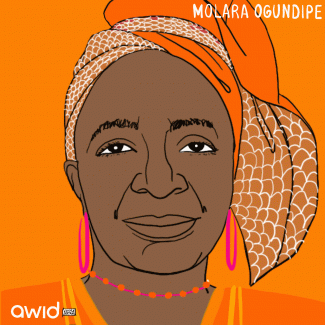
In an interview at the 2010 Ghana International Book Fair, Molara Ogundipe introduced herself with the words: “...I’m a Nigerian. I’ve lived possibly all over the world except for the Soviet Union and China.”
Across the different continents and countries, Professor Ogundipe taught comparative literature, writing, gender, and English studies using literature as a vehicle for social transformation and re-thinking gender relations.
A feminist thinker, writer, editor, social critic, poet, and activist Molara Ogundipe succeeded in combining theoretical work with creativity and practical action. She is considered to be one of the leading critical voices on African feminism(s), gender studies and literary theory.
Molara famously coined the concept of “stiwanism’ from the acronym STIWA – Social Transformations in Africa Including Women recognizing the need to move “away from defining feminism and feminisms in relation to Euro-America or elsewhere, and from declaiming loyalties or disloyalties.”
In her seminal work ‘Re-creating Ourselves’ in 1994, Molara Ogundipe (published under Molara Ogundipe-Leslie) left behind an immense body of knowledge that decolonized feminist discourse and “re-centered African women in their full, complex narratives...guided by an exploration of economic, political and social liberation of African women and restoration of female agency across different cultures in Africa.”
In speaking about the challenges she faced as a young academic she said:
”When I began talking and writing feminism in the late sixties and seventies, I was seen as a good and admirable girl who had gone astray, a woman whose head has been spoilt by too much learning".
Molara Ogundipe stood out for her leadership in combining activism and academia; in 1977 she was among the founding members of AAWORD, the Association of Women in Research and Development. In 1982 she founded WIN (Women In Nigeria) to advocate for full “economic, social and political rights” for Nigerian women. She then went on to establish and direct the Foundation for International Education and Monitoring and spent many years on the editorial board of The Guardian.
Growing up with the Yoruba people, their traditions, culture, and language she once said :
“I think the celebration of life, of people who pass away after an achieved life is one of the beautiful aspects of Yoruba culture.”
Molara’s Yoruba ‘Oiki’ praise name was Ayike. She was born on 27 December 1940 and at the age of 78, Molara passed away on 18 June 2019 in Ijebu-Igbo, Ogun State, Nigeria.
Carta de amor a los movimientos feministas: el adiós de Hakima y Cindy
Queridos movimientos feministas:
Ustedes nos recibieron con los brazos abiertos cuando en el Foro de AWID 2016 en Bahía se anunció que íbamos a ser las nuevas codirectoras ejecutivas de AWID. Fue un momento que sentimos lleno de posibilidades: estábamos construyendo un oasis feminista que ayudaría a sostener las luchas colectivas que teníamos por delante. Salimos de Bahía con una sensación muy clara de la responsabilidad que nos cabía: hacer lo mejor que pudiéramos al servicio de ustedes, liderando a AWID de tal manera que les sirviera de apoyo y tuviera impacto para ustedes.
Ahora es el momento de abrir el camino a nuevos liderazgos
Tras cinco años de recorrido, dejamos nuestro rol como codirectoras ejecutivas de AWID. Esta decisión coincide con la finalización de nuestro ciclo estratégico actual. Pensamos que es el momento ideal para hacernos a un costado y apoyar una renovación en el liderazgo. Creemos que los liderazgos feministas transformadores son cíclicos.
Valoramos mucho la oportunidad que tuvimos de desempeñar un rol dentro de los 40 años que abarca la historia de AWID, sosteniendo y guiando a la organización en el contexto difícil de una pandemia global y la agudización de muchas crisis.
Sabemos que ustedes, movimientos feministas, nos van a acompañar en nuestros próximos recorridos, donde sea que transcurran. Una y otra vez nos han enseñado a ser fuertes y resilientes. Tal vez cumplamos roles diferentes, pero en forma colectiva seguiremos avanzando juntxs.
Nuestro recorrido
Tenemos recuerdos vívidos de aquellxs con quienes nos reunimos en Indonesia, Malasia, Nepal, Tailandia, Taiwán y otros lugares para crear juntxs el Foro AWID, de su generosidad y su entusiasmo. Sin duda alguna lo que más lamentamos de estos cinco años pasados es no haber podido ofrecerles un Foro presencial.
Una vez que tomamos la decisión difícil (aunque necesaria) de cancelar el Foro AWID nos concentramos en responder a las preguntas existenciales que tantas organizaciones también estaban enfrentando: ¿cómo podemos cambiar la forma en que trabajamos para seguir siendo relevantes teniendo en cuenta que todxs nosotrxs, cada quien a su manera, estamos afectadxs por el agotamiento, la enfermedad y la pena? ¿Cómo podemos construir relaciones significativas cuando nos vemos limitadxs a encontrarnos solo en forma virtual? Todavía no existen respuestas claras para estas preguntas pero ustedes, movimientos feministas, nos han mostrado el camino.
Con mucho orgullo vimos a feministas liderando las respuestas para mitigar los impactos de COVID-19 en nuestras comunidades. Lxs feministas somos quienes respondemos directamente a las crisis y vamos a continuar exigiendo que se reconozca nuestra labor y se le asignen los recursos que corresponde. Ustedes muchas veces respondieron con entusiasmo a nuestras convocatorias, haciéndose presentes de maneras increíbles en nuestra campaña por un Rescate Feminista y más tarde en el festival Crear Resister Transform. Siempre nos acompañaron en la incidencia colectiva, ya fuera en espacios de derechos humanos, con quienes diseñan políticas o con donantes.
El trabajo que hicimos con ustedes nos inspiró para introducir un cambio importante y ampliar las oportunidades de participación entre nuestrxs afiliadxs sin que todo esté centralizado en AWID. A esto le llamamos «enfoque de membresía basado en la solidaridad» y nos entusiasma anunciar que este año presentaremos la plataforma de la Comunidad de AWID.
Ustedes nos enseñaron que, como no podemos contar con el sistema, lo que más importa es que nos apoyemos unxs a otrxs. Si hay algo que esperamos haber hecho bien en estos años, es crear espacios para desarrollar vínculos nuevos y más profundos así como posibilidades de apoyo y colaboración mutua.
Queremos destacar especialmente con amor y respeto a quienes forman y formaron el equipo de AWID (tanto el personal como lxs integrantes del Consejo Directivo) con quienes tuvimos el honor de trabajar durante estos años. Aprendimos algo de cada unx de ustedes y sentimos una profunda gratitud por todo lo que le han dado a AWID a lo largo de los años.
Entramos a este rol siendo la primera pareja de codirectoras ejecutivas de AWID. Aprendimos de las muchas tradiciones activistas y comunitarias de liderazgo colectivo y de las organizaciones feministas que ya habían implementado esta modalidad antes que nosotras. Sabemos que ninguna de nosotras dos podría haberlo hecho sin la otra. Pudimos aprovechar los puntos fuertes de cada una y apoyarnos mutuamente para cumplir con nuestra tarea lo mejor posible.
Lo que viene
Llegamos juntas a este rol y nos vamos juntas, aun cuando nuestras fechas de partida sean diferentes. Estamos comprometidas a colaborar para que la transición sea fluida y para que durante este año los nuevos liderazgos puedan contar con un proceso deliberado de incorporación a sus roles.
Movimientos feministas: están en muy buenas manos con el equipo de AWID. Ellxs saben lo que tienen que hacer. Y a nosotras nos enorgullece dejar a la organización en una posición de fortaleza y resiliencia. Esperamos ver a muchxs de ustedes en el Foro AWID de 2024. Nos van a reconocer fácilmente: vamos a ser esas que están entre el público relajadas y pasándolo bien.
Vaya nuestro amor y nuestra valoración por todo lo que han hecho con y por nosotras. El impacto que ustedes han tenido en nuestras vidas va mucho más allá de los últimos cinco años y sin duda alguna continuará durante mucho tiempo en el futuro.
Estamos encantadxs de anunciar el lanzamiento del nuevo podcast de AWID: ESE FUEGO FEMINISTA. Esta serie narrativa revela más de 40 años de movimientos feministas e imagina nuevos caminos a seguir.
En nuestra temporada piloto, escucharán cinco historias cautivadoras que forman parte de la actual constelación de activismo feminista. Presentado por nuestra Gopika Bashi, subdirectora de programas de AWID, cada episodio explora realidades feministas únicas pero interconectadas que están logrando una mayor justicia de género y asegurando derechos humanos.
ESE FUEGO FEMINISTA es producido en asociación con lxs ganadorxs de Webby, Hueman Group Media. Puedes suscribirte al podcast y escuchar nuestro primer episodio aquí.
Encuéntranos en Apple Podcasts, Spotify o donde sea que obtengas tus podcasts. ¡Comparte con tu red! Ayúdanos a difundir historias que enciendan nuestro fuego feminista y nos muevan a la acción.