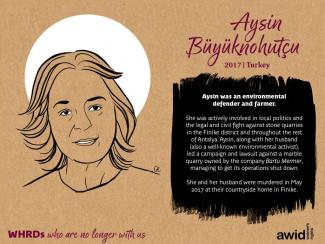
Aysin Büyüknohutçu
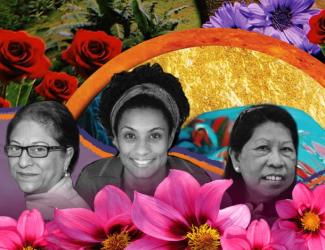
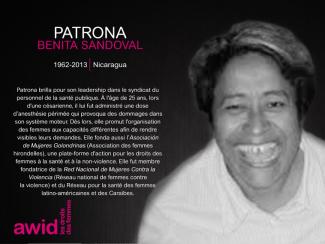
L’hommage se présente sous forme d’une exposition de portraits d’activistes du monde entier qui ne sont plus parmi nous qui ont lutté pour les droits des femmes et la justice sociale.
Cette année, tout en continuant à convoquer la mémoire de celleux qui ne sont plus parmi nous, nous souhaitons célébrer leur héritage et souligner les manières par lesquelles leur travail continue à avoir un impact sur nos réalités vécues aujourd’hui.
49 nouveaux portraits de féministes et de défenseur·e·s viennent compléter la gallerie. Bien que de nombreuses des personnes que nous honorons dans cet hommage sont décédé·e·s du fait de leur âge ou de la maladie, beaucoup trop d’entre iels ont été tué·e·s à cause de leur travail et de qui iels étaient.
Visiter notre exposition virtuelle
Les portraits de l'édition 2020 ont été illustrés par Louisa Bertman, artiste et animatrice qui a reçu plusieurs prix.
L’AWID tient à remercier nos membres, les familles, les organisations et les partenaires qui ont contribué à cette commémoration. Nous nous engageons auprès d’elleux à poursuivre le travail remarquable de ces féministes et défenseur·e·s et nous ne ménagerons aucun effort pour que justice soit faite dans les cas qui demeurent impunis.
« Ils ont essayé de nous enterrer. Ils ne savaient pas que nous étions des graines » - Proverbe mexicain
Le premier hommage aux défenseur-e-s des droits humains a pris la forme d’une exposition de portraits et de biographies de féministes et d’activistes disparu·e·s lors du 12e Forum international de l’AWID en Turquie. Il se présente maintenant comme une gallerie en ligne, mise à jour chaque année.
Depuis, 467 féministes et défenseur-e-s des droits humains ont été mis·es à l'honneur.
Originaire des Fidji, Veena Singh est féministe et femme de couleur. Élevée dans une petite commune rurale de ces îles, elle tire sa force de la richesse de son héritage mixte (sa mère est une femme autochtone fidjienne et son père est de descendance indo-fidjienne). L’identité et le vécu de Veena ont largement façonné son engagement envers la justice, l’équité et l’inclusion. Avec plus d’une vingtaine d’années d’expérience dans les droits humains, l’égalité des genres, l’épanouissement de la communauté et l’inclusion sociale, Veena croit passionnément qu’il faut faire bouger les lignes du pouvoir pour provoquer le changement transformateur qui permettra de construire l’économie de la bienveillance. Elle travaille dans des domaines très divers, notamment l’épanouissement de la communauté ; les femmes, la paix et la sécurité ; les politiques sociales ; les droits humains ; et le plaidoyer politique.
Elle est profondément engagée à faire avancer l’inclusion, la paix et la justice, la santé et les droits sexuels et reproductifs, la justice climatique, la justice transitionnelle et les droits humains. Elle possède une vaste expérience des réseaux de terrain, des organisations internationales et des institutions gouvernementales, et elle place toujours au centre les approches pilotées à l’échelle locale et par les communautés ainsi que les principes féministes.
En dehors de sa « vie de bureau », Veena est une défenseuse de l’environnement, de la santé mentale et c’est aussi une écrivaine. Mère de 11 chats, elle ne jure que par les saris et a un gros faible pour le courrier traditionnel et les cartes postales. Observatrice attentive des mouvements féministes aux Fidji et dans le Pacifique, Veena est en plein parcours personnel pour « décoloniser sa pensée et soi-même, en entreprenant une introspection radicale ». Par-dessus tout, elle est animée par le désir et le rêve de livrer des écrits auxquels pouvoir s’identifier, qui résonnent auprès des autres, en connectant avec la diaspora du Pacifique et en amplifiant les voix marginalisées.
Nous vivons dans un monde où la destruction de la Nature alimente notre économie mondiale actuelle. |
Même en période de crise climatique, les gouvernements continuent d'encourager les industries agricoles à grande échelle à se développer. Ces activités empoisonnent la terre, menacent la biodiversité et détruisent la production alimentaire et les moyens de subsistance locaux. Pendant ce temps, alors que les femmes produisent la majorité de la nourriture dans le monde, elles ne possèdent presque aucune terre. |
|
Et si nous percevions la terre et la Nature non pas comme une propriété privée à exploiter, mais comme une totalité avec laquelle vivre, apprendre et coexister harmonieusement ? Et si nous réparions nos relations avec la terre et adoptions des alternatives plus durables qui nourrissent à la fois la planète et ses communautés? Nous Sommes la Solution (NSS) est l'un des nombreux mouvements dirigés par des femmes qui s'efforcent d'atteindre cet objectif. Voici leur histoire. |
|

This is a French article
- created from the French site
No, we appreciate your work but are not asking for responses from individuals at this time.
Caroline ha estado de forma periódica en AWID; en fechas anteriores, organizó los foros de 2005 y 2008 en Bangkok y Ciudad del Cabo, y cumplió otras funciones institucionales. Antes de incorporarse a AWID, impartió clases de inglés de pregrado, luego abandonó el ámbito académico para dirigir el Festival Internacional de Cine Asiático de Toronto y trabajar en otros proyectos. En fechas más recientes, se ha desempeñado como Responsable de Operaciones en Spring Strategies. Fuera del plano laboral, Caroline generalmente puede ser hallada a su jardín, en comunión con sus queridas plantas e intentando hacer las paces con los insectos y los roedores que suelen aparecer.
AGROÉCOLOGIE ET SOUVERAINETÉ ALIMENTAIRE EN TANT QUE RÉSISTANCE |
Aujourd'hui, la production alimentaire industrielle à grande échelle utilise des plantations à culture unique, des organismes génétiquement modifiés et d'autres pesticides qui détruisent la terre et les connaissances des communautés locales. |
L'agroécologie est une résistance à l'agriculture hyper-industrialisée qu’utilisent les multinationales. L'agroécologie donne la priorité à l'agriculture à plus petite échelle, aux cultures multiples et à la production alimentaire diversifiée, tout en centrant les connaissances et pratiques traditionnelles locales. L'agroécologie va de pair avec les revendications de souveraineté alimentaire, ou le "droit des peuples à une alimentation saine et culturellement appropriée produite par des méthodes écologiquement rationnelles et durables, et leur droit de définir leurs propres systèmes alimentaires et agricoles" (Via Campesina, Déclaration de Nyéléni).
Le rôle des femmes, des communautés indigènes et rurales et des personnes racialisées des pays du Sud Global est essentiel dans la préservation des systèmes alimentaires.
Les agroécologistes féministes s'efforcent aussi de démanteler les rôles de genre oppressifs et les systèmes patriarcaux intégrés à la production alimentaire. Comme le montrent les héroïnes de Nous Sommes la Solution, elles génèrent une agroécologie libératrice en renforçant la résilience des communautés, en autonomisant les femmes paysannes et agricultrices tout en en préservant les traditions locales, les territoires et les connaissances des communautés productrices de nourriture.
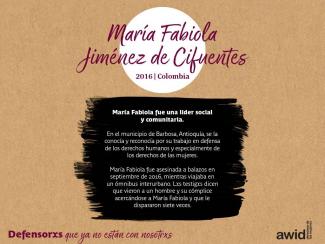

Notre hommage en ligne met à l’honneur cinq défenseuses des droits humains assassinées au Moyen-Orient ou en Afrique du Nord. Ces défenseuses étaient avocates ou militantes et ont œuvré pour les droits des femmes ou pour les droits civils. Leur mort met en évidence les conditions de travail souvent difficiles et dangereuses dans leurs pays respectifs. Nous vous invitons à vous joindre à nous pour commémorer la vie, le travail et l’activisme de ces femmes. Faites circuler ces mèmes auprès de vos collègues et amis ainsi que dans vos réseaux et twittez en utilisant les hashtags #WHRDTribute et #16Jours.
S'il vous plaît cliquez sur chaque image ci-dessous pour voir une version plus grande et pour télécharger comme un fichier


La encuesta está disponible en KOBO, una plataforma de fuente abierta para recopilar, gestionar y visualizar datos. Para participar, simplemente haz clic en el enlace a la encuesta aquí. Sigue las instrucciones para responder la encuesta.
Ekaete Judith Umoh est une défenseure internationale des droits des personnes en situation de handicap et experte en développement inclusif. Elle analyse avec finesse les questions relatives au genre, au handicap et au développement inclusif. Son rêve est d’accroître la visibilité des femmes et des filles en situation de handicap au sein du mouvement féministe international et dans tous les efforts de développement à travers le monde.
Passionnée d’activisme et de politique, Ekaete devient la première femme élue présidente de l’Association nationale des personnes en situation de handicap (Joint National Association of Persons with Disabilities, JONAPWD), au Nigéria. À ce titre, elle dirige les organisations de personnes en situation de handicap dans la lutte pour la signature de la loi nigériane sur le handicap de 2019, qu’elle défendait sans relâche depuis plus de 17 ans. Par la suite, elle rejoint CBM Global en tant que directrice nationale et joue un rôle pionnier à la tête de son équipe pendant trois ans, pour briser le cercle de la pauvreté et du handicap au Nigéria. Outre son activisme dans le domaine du handicap, Ekaete a été consultante auprès de plusieurs agences de développement, proposant son expertise technique de l’inclusion des personnes en situation de handicap dans la conception de programmes et projets.
Nous Sommes la Solution uplifts and grows the leadership of rural women working towards African solutions for food sovereignty.
.
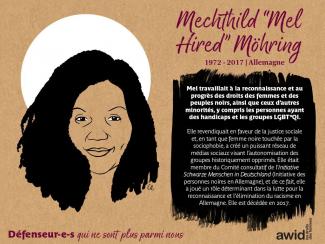
In our 2015 Online Tribute to Women Human Rights Defenders No Longer With Us we are commemorating four women from Sub-Saharan Africa, three of whom were murdered due to their work and/or who they were in their gender identity and sexual orientation. Their deaths highlight the violence LGBT persons often face in the region and across the globe. Please join AWID in honoring these women, their activism and legacy by sharing the memes below with your colleagues, networks and friends and by using the hashtags #WHRDTribute and #16Days.
Please click on each image below to see a larger version and download as a file


Oui, elle est accessible aux personnes ayant une diversité de capacités d’audition, de mouvement, de vision et cognitives.
Alejandra se passionne pour les droits des femmes et la justice de genre. Elle rêve de créer un monde qui place le soin en son cœur, celui des personnes comme celui de la nature. Experte féministe en droits humains, elle a travaillé dans des domaines en lien avec le genre, le climat, la justice sociale et économique au sein de diverses organisations internationales. Ses domaines d’expertise comprennent le développement des connaissances et la co-création, la recherche, la facilitation et le plaidoyer. Elle est titulaire d’un master en droits humains de l’université d’Essex et a rédigé et co-élaboré de nombreuses publications, dont l’article «Enragée: Femmes et Nature». La campagne Activisme Féministe Sans Peur s’appuie sur des entretiens et des recherches menés par Alejandra.
Originaire d’Argentine, elle a vécu et travaillé dans plusieurs pays d’Europe et d’Amérique latine au cours des vingt dernières années. Alejandra aime la photographie, la mer, préparer des gâteaux avec sa fille et déguster des plats du monde entier. En tant que mère, elle met un point d’honneur à briser le cycle des schémas répétitifs transgénérationnels. Alejandra puise son énergie et son inspiration auprès des femmes extraordinaires qui font partie de sa vie, et qui vivent aux quatre coins du monde.
Cooperativa Textil Nadia Echazú