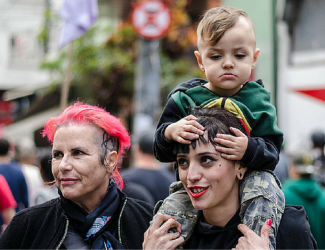
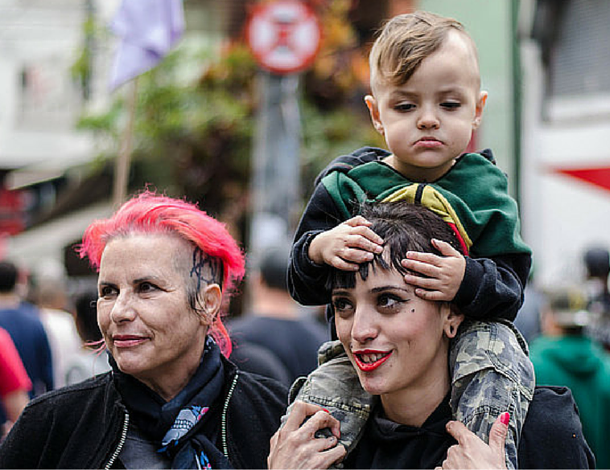
Flickr/Leonardo Veras (CC BY 2.0)

Análisis Especiales

AWID es un organización feminista internacional de membresía, que brinda apoyo a los movimientos que trabajan para lograr la justicia de género y los derechos de las mujeres en todo el mundo.

Protección de la familia

El contexto

Esta sección de análisis especial ofrece un análisis feminista crítico y acceso a los recursos clave relacionados con la «protección de la familia» en los espacios internacionales de derechos humanos.

Durante los últimos años, venimos observando una nueva y preocupante tendencia en el ámbito internacional de derechos humanos, donde se están empleando discursos sobre la «protección de la familia» para defender violaciones cometidas contra miembros de la familia, de modo de reforzar y justificar la impunidad y para coartar la igualdad de derechos en el seno de la familia y la vida familiar. 

La campaña para «proteger a la familia» es impulsada por proyectos conservadores que tienen como fin imponer interpretaciones «tradicionales» y patriarcales de familia; quitando los derechos de las manos de sus miembros para ponerlos en las de la institución «familia».

Los proyectos de «protección de la familia» tienen su origen en los siguientes fenómenos:

  • el auge del tradicionalismo,
  • el auge del conservadurismo cultural, social y religioso, y
  • posturas hostiles a los derechos humanos de las mujeres, los derechos sexuales, los derechos de las niñas y los niños y los derechos de las personas con identidades de género y orientaciones sexuales no normativas.  

Desde 2014 un grupo de estados opera como bloque en espacios de derechos humanos, bajo el nombre «Group of Friends of the Family» [Grupo de amigos de la familia], y a partir de entonces se han aprobado resoluciones sobre la «Protección de la familia» todos los años.

Esta agenda se ha extendido más allá del Consejo de Derechos Humanos (HRC, por sus siglas en inglés).  Hemos visto cómo el lenguaje regresivo sobre «la familia» se ha introducido en la Comisión de la Condición Jurídica y Social de las Mujeres (CSW, por sus siglas en inglés), y hemos asistido a intentos por incluir este lenguaje en las negociaciones sobre los Objetivos de Desarrollo Sostenible.


Nuestro enfoque

AWID trabaja con asociadxs y aliadxs para resistir conjuntamente las agendas regresivas de «Protección de la familia» y otras, y para defender la universalidad de los derechos humanos.

En respuesta a la creciente influencia de actores regresivos en los espacios de derechos humanos, AWID se ha unido con aliadxs para formar el Observatorio de la Universalidad de los Derechos (OURs, por sus siglas en inglés).  OURs es un proyecto colaborativo que monitorea, analiza y comparte información sobre iniciativas anti-derechos tales como la «Protección de la familia».

Derechos en Riesgo, el primer informe de OURs, traza un mapa de los actores que conforman el cabildeo global anti-derechos e identifica sus discursos y estrategias principales, señalando los efectos que estos discursos y estrategias están teniendo sobre nuestros derechos humanos.

El informe expone a la «Protección de la familia» como una agenda que ha promovido la colaboración entre una amplia gama de actores regresivos en las Naciones Unidas. La describe como un marco estratégico que aloja «múltiples posiciones patriarcales y anti-derechos, cuyo marco, a su vez, apunta a justificar e institucionalizar estas posiciones».
Contenido relacionado

Our values - bodily autonomy

Autonomie, intégrité et libertés corporelles

Nous célébrons le droit de chacun·e à choisir son identité, ses relations, ses objectifs, son travail, ses rêves et ses plaisirs, et ce qu'iel fait de son esprit, de son corps et de son âme. Nous croyons qu'il est nécessaire de travailler à l'accès aux ressources, aux informations et à des environnements sûrs et favorables qui permettent d'atteindre cet objectif.

Наша группа не имела ежегодного финансирования в период с 2021 по 2023 год. Можем ли мы пройти опрос?

Да, мы хотим получить ваш ответ, независимо от того, сколько раз (один, два или три) вы получали финансирование в период между 2021 и 2023 годами.

Merci d'avoir participé à la création de nos Horizons féministes

Un grand MERCI d'avoir pris part au 13ème Forum international de l'AWID !

Toute l'équipe de l'AWID vous remercie de nous avoir rejoint pour ces quatre jours d'apprentissage et de célébrations, pour envisager, rêver et co-créer nos Horizons féministes.

Nous avons été incroyablement inspiré-e-s et enthousiasmé-e-s par tout ce travail collectif que nous avons accompli ensemble !

Pour plus d'images, d'inspiration et de ressources :

Visitez le site du Forum

Bonne lecture !


Connectez-vous au #AWIDForum

Nadine Ramaroson

Nadine was a role model to many for her work supporting women and the most vulnerable in her community. She was committed to helping the poor and homeless in particular.

Though her death was reported as an accident, the Ramaroson family, led by her father, André Ramaroson led an investigation that pointed to evidence that she had been murdered. She is reported to have died in a fatal accident occurred between Soanierano - Ivongo and Ste Marie - a story that has been refuted by her family.

She received numerous death threats for her bold political positions. Her case remains in court in Antananarivo (the capital of Madagascar). 


Nadine Ramaroson, Madagascar

Snippet FEA Union Otras Photo 5 (EN)

Photo of people sitting on red chairs in a hall

Combien coûte l’inscription au Forum ?

Cette information ne sera disponible qu’à l’ouverture de l’inscription. 


14th AWID international Forum is cancelled (forum page)

The 14th AWID International Forum is cancelled

Given the current world situation, our Board of Directors has taken the difficult decision to cancel Forum scheduled in 2021 in Taipei. 

Read the full announcement

Porque é que são necessários o nome e as informações de contacto do grupo/organização e/ou movimento que preencher o inquérito?

Pedimos estes dados para facilitar a revisão das respostas, para evitar respostas duplicadas e para poder entrar em contacto com o seu grupo caso não tenha conseguido completar o inquérito e/ou tenha dúvidas ou perguntas adicionais. Para mais informações sobre como utilizamos as informações pessoais que recolhemos através do nosso trabalho, clique aqui.

Agroecology and Food Sovereignty

Context

The search for alternative means of food production based on environmental sustainability is gaining ground across regions. This worldwide search comes with a common characteristic: the need to involve rural people and particularly women, building on their local priorities and knowledge by employing the principle of agroecology.

Definition

Agroecology is a way of practicing agriculture or using technologies that do not harm the environment. It proposes breaking with the hegemonic rural development model based on large landed estates and single-crop plantations that benefit mostly agricultural businesses and entrenches social exclusion.   

In family farming, agroecology manifests as a resistance to the current development model and its social, cultural, environmental, and economic problems. It opposes the lack of the farmer’s financial capital autonomy; and it symbolizes a resistance to the current agribusiness model.

Feminist perspective

Efforts based solely on agroecology may not be sufficient to solve all problems of women’s marginalization and invisibility. A feminist perspective is then crucial to analyze the norms associated with the idea of family as currently constituted as the perfect institution, as well as with the condition of women’s subordination.

In simpler terms, it is important to include in this debate a reflection on socially constructed gender roles to advance the emancipatory potential of agroecology.


Learn more about this proposition

Part of our series of


  Feminist Propositions for a Just Economy

Sainimili Naivalu

“I’ve witnessed discrimination on the streets, being teased on the streets and verbally abused on the streets. I have also made numerous friends and have met a lot of people. There may be dangers out there but I am a survivor and this is where I will be for now.”
- Sainimili Naivalu

Sainimili Naivalu was a feminist and disability rights activist from the village of Dakuibeqa on Beqa Island, Fiji.

She demanded policy makers and stakeholders provide disability friendly policies and services such as the construction of ramps in towns and cities to increase accessibility. Physical barriers were not the only ones she strived to change. From her own experience, she knew that more difficult changes need to take place in social and economic spheres. Many of the challenges disabled people face are rooted in attitudes that carry discrimination and stigma. 

A survivor and a fighter, Sainimili contributed to co-creating feminist realities that foster inclusion and shift attitudes towards disabled people. As a member of the Spinal Injury Association of Fiji (SIA) and through Pacific Disability Forum’s Pacific Enable project she attended the International Labour Organisation “Start Your Business” training in Suva, enabling her to transform her ideas into her own business. She was an entrepreneur at the Suva Market Stall 7, offering manicure services, as well as running SIA’s women’s market stall selling handicrafts, sulus and artifacts. Sainimili’s plan was to expand her business and become a major employer of disabled people.

In addition to her activism, she was also a table tennis medalist and youth champion. 

A vivacious personality, Sainimili was one of a kind. You would always know that Sainimili is in a room because her laughter and her stories would be the first thing that you would notice.
- Michelle Reddy

Sainmili passed away in 2019. 

Snippet FEA Principles of Work S4 (ES)

Cuatro manos sosteniéndose por las muñecas, formando un cuadrado.

HORIZONTALIDAD

En quelles langues les informations seront-elles disponibles sur le Forum ?

Anglais, français, espagnol et chinois mandarin.

“Where is the Money for Women’s Rights?" AWID’s WITM Toolkit (landing page intro) ES

Una nueva edición de la investigación "¿Dónde está el dinero?" está actualmente en marcha.

Obtén más información

Manual «¿Dónde está el dinero?» (WITM)

Una metodología de investigación que puedes aplicar tú mismx

Women leaders
© UN Women/Ashutosh Negi (CC BY-NC-ND 2.0) [https://creativecommons.org/licenses/by-nc-nd/2.0/]

AWID presenta este Manual WITM para apoyar a personas y organizaciones que quieran investigar por su cuenta las tendencias en el financiamiento para una región, temática o población en particular, adaptando las metodologías de investigación de AWID.


El Manual WITM de AWID es producto de diez años de experiencia. Las investigaciones de WITM y este Manual son una demostración política y práctica de los recursos y pasos necesarios para realizar investigaciones en acción de buena calidad.

Más información sobre el contexto de la metodología de la investigación WITM

El equipo WITM también ofrece apoyo técnico y político antes y durante el proceso de investigación. Te invitamos a leer el Manual y a ponerte en contacto con nosotras en fundher@awid.org si necesitas más información.

إلى متى يمكن الإجابة على الاستطلاع؟

وسيكون التحقيق مفتوحًا حتى 31 أغسطس 2024. الرجاء تكملته خلال هذا الوقت للتأكد بأن تشمل ردودكم/ن في التحليل.

AWID Members Engaging at CSW61

Member states and women's rights advocates and organisations are gathering at the United Nations Headquarters in New York from 13 - 24 March for the 61st Commission on the Status of Women to address ‘women’s economic empowerment’ in the context of Sustainable Development Goal 5.

Whilst AWID is looking forward to physically meeting those of you who will be in New York, we want to engage with all those who cannot attend CSW, and as much as possible, amplify your voices in relevant spaces.

Continue reading to find out how to engage with AWID around CSW, whether you are attending physically or not.


Participate in an artistic takeover!

We are thrilled that AWID member Nayani Thiyagarajah is attending CSW this year and will take over the AWID Instagram. She will be available onsite to connect with other members for a possible feature on our Instagram. She will also explore possibilities of including some AWID members in a short film on the theme, ‘The personal is political’, a story of Nayani’s participation in this year’s CSW.

Nayani Thiyagarajah

Who is Nayani?

Nayani Thiyagarajah is a director, producer, and writer, dedicated to stories for the screen. A daughter of the Tamil diaspora, she calls Toronto home. For over 10 years, Nayani has worked in the arts and cultural industries. Her first independent feature documentary Shadeism: Digging Deeper (2015) had its World Premiere at the 2015 Zanzibar International Film Festival, where it won a Special Jury Prize. Nayani recently launched [RE]FRAME, with her producing partner Camaro West, a production company based out of Atlanta and Toronto, focused on re-framing the narratives around Black, Indigenous, and other people of colour through storytelling on screen.

On a more serious note, it should be noted that Nayani has a strange laugh, she's quite awkward, and her head is always in the clouds. She feels blessed beyond belief to create stories for the screen and play make believe for a living. Above all else, she believes in love.

(Biography submitted by Nayani)

Interested in meeting Nayani and being considered for inclusion in the film?

  • Send an email to membership@awid.org with the subject line “CSW Artistic Takeover”

  • By 13 March 2017

  • Please include your full name and country information.


Can't attend? Voice it!

If you are not able to attend CSW61 because of a travel ban, either due to the one imposed by the Trump administration or one you are facing from your own government, please share your story with us.

Send us messages you want heard in the United Nations spaces concerning funding, the impact of the reinstatement of the Global Gag Rule, and the need to push back against all types of religious fundamentalisms. You can send these in the following formats:

  • Video: no longer than two minutes and sent through a file sharing folder (for example dropbox, google drive) 

  • Audio: no longer than two minutes and sent through a file sharing folder (for example dropbox, google drive)

  • Image: you can share a photo or a poster of your message 

  • Text: no longer than 200 words and sent in the body of an email or in a word document

Share your message with us


Meet other members @CSW61

AWID members tell us that connecting with other members at CSW is valuable. In such a huge advocacy space, it is useful to connect with others including activists working on similar issues, or originating from the same country or region. Recognising the importance of connecting for movement building, we invite you to:

Interested in connecting with other members @CSW61?

  • Email membership@awid.org with the subject line “CSW AWID Members

  • NOTE: Please let us know your full name and country, and if we can share your email address with other members interested in meeting at CSW. 

Meet current AWID members


Take a picture!

If you are attending the CSW, we’d love to see what’s going on through your eyes!

Show us by capturing a moment you find speaks to the energy in the CSW space, be it on or off site. We hope to publish some of your ‘images’ on our social media channels and share on awid.org

You can send us: 

  • colour and/ or black and white photographs with a title (if you wish) and 

  • a caption (no longer than 100 words) about the story your image tells.

​Please also include:

  • your full name and country of origin and

  • let us know if we can publish the information you shared (in part or in full).

Send your images:

  • Email membership@awid.org with the subject line “CSW: Take a Picture!

  • During the whole CSW or shortly after until Tuesday 28 March 2017. 

Sylvia Rivera

Sylvia Rivera fue activista por los derechos civiles, travesti y trabajadora sexual.

Conocida como la Drag Queen de color de Nueva York, Sylvia fue feroz e incansable en su voluntad por cambiar las cosas, y en su defensa de  quienes quedaron marginadxs y excluidxs cuando el movimiento por los "derechos de la comunidad gay"  se volvió predominante en los Estados Unidos, a principios de los 70.

En 1973, durante un conocido discurso por el día de Christopher Street, Sylvia gritó en medio de la multitud de integrantes de la comunidad LGBT:

"Todos ustedes me dicen, anda y esconde la cola entre las patas.
No voy a seguir aguantando esta mierda.
Me han golpeado.
Me han roto la nariz.
Me han metido en la cárcel.
He perdido mi trabajo.
He perdido mi departamento
por la liberación gay, ¿y todos ustedes me tratan así?
¿Qué carajo les pasa a todos ustedes?
¡Piensen en eso!"

En 1969, a la edad de 17 años, Sylvia participó en los emblemáticos disturbios de Stonewall, al lanzar, presuntamente, el segundo cóctel molotov para protestar por la redada policial en este bar gay de Manhattan. Siguió siendo una figura central en los levantamientos posteriores, organizando mítines y luchando contra la brutalidad policial.

En 1970, Sylvia trabajó junto con Marsha P. Johnson para establecer Street Transvestite Action Revolutionaries [Acción Travesti Callejera Revolucionaria] (S.T.A.R., por sus siglas en inglés), un colectivo político y una organización que establecería proyectos de apoyo mutuo para las personas trans que vivían en la calle, aquellxs que luchaban contra la drogadicción, las que estaban encarceladas y, en particular, para las personas trans de color  que vivían en la pobreza.

Desafiante de las etiquetas, Silvia vivió la vida de una manera que retaba a las personas del movimiento de liberación gay a pensar de manera diferente. Ella dijo:

"Me fui de casa a los 10 años, en 1961.  Hice la calle en la 42. El inicio de los años 60 no era un buen momento para lxs drag queens, los chicos afeminados o los chicos que usaban maquillaje como nosotrxs. En ese entonces nos golpeaba la policía, y todo el mundo. Yo no salí realmente como drag queen hasta finales de los 60, cuando se arrestaba a lxs drag queens, qué degradación había. Recuerdo que la primera vez que me arrestaron, ni siquiera estaba vestida totalmente en drag. Estaba caminando y los policías me arrebataron de la calle. La gente ahora quiere llamarme lesbiana porque estoy con Julia, y yo digo: "No. Soy sólo yo. No soy lesbiana". Estoy cansada de que me etiqueten. Ni siquiera me gusta la etiqueta transgénero. Estoy cansada de vivir con etiquetas. Sólo quiero ser quien soy. Soy Sylvia Rivera. 

A través de su activismo y su coraje, Sylvia ofreció un espejo que reflejaba todo lo que estaba mal en la sociedad, pero también la posibilidad de transformación. Sylvia nació en 1951 y falleció en 2002.

Snippet FEA No feminist economies without feminist unions (FR)

Pas d’économies féministes sans syndicats féministes!

Par le biais de l'organisation syndicale, Sopo, Sabrina et Linda se battent non seulement pour les droits des femmes, des travailleur·euses essentiel·les, des travailleur·euses migrant·e·s et des travailleur·euses du sexe, mais pour les droits de tous·tes les travailleur·euses .

La lutte pour mettre fin à l'exploitation des travailleur·euses est une lutte féministe. C’est pourquoi il n’y a pas d’économies féministes sans syndicats féministes.