
Ray Alexander Simons
Esta sección de análisis especial ofrece un análisis feminista crítico y acceso a los recursos clave relacionados con la «protección de la familia» en los espacios internacionales de derechos humanos.
Durante los últimos años, venimos observando una nueva y preocupante tendencia en el ámbito internacional de derechos humanos, donde se están empleando discursos sobre la «protección de la familia» para defender violaciones cometidas contra miembros de la familia, de modo de reforzar y justificar la impunidad y para coartar la igualdad de derechos en el seno de la familia y la vida familiar.
La campaña para «proteger a la familia» es impulsada por proyectos conservadores que tienen como fin imponer interpretaciones «tradicionales» y patriarcales de familia; quitando los derechos de las manos de sus miembros para ponerlos en las de la institución «familia».
Desde 2014 un grupo de estados opera como bloque en espacios de derechos humanos, bajo el nombre «Group of Friends of the Family» [Grupo de amigos de la familia], y a partir de entonces se han aprobado resoluciones sobre la «Protección de la familia» todos los años.
Esta agenda se ha extendido más allá del Consejo de Derechos Humanos (HRC, por sus siglas en inglés). Hemos visto cómo el lenguaje regresivo sobre «la familia» se ha introducido en la Comisión de la Condición Jurídica y Social de las Mujeres (CSW, por sus siglas en inglés), y hemos asistido a intentos por incluir este lenguaje en las negociaciones sobre los Objetivos de Desarrollo Sostenible.
AWID trabaja con asociadxs y aliadxs para resistir conjuntamente las agendas regresivas de «Protección de la familia» y otras, y para defender la universalidad de los derechos humanos.
En respuesta a la creciente influencia de actores regresivos en los espacios de derechos humanos, AWID se ha unido con aliadxs para formar el Observatorio de la Universalidad de los Derechos (OURs, por sus siglas en inglés). OURs es un proyecto colaborativo que monitorea, analiza y comparte información sobre iniciativas anti-derechos tales como la «Protección de la familia».
Derechos en Riesgo, el primer informe de OURs, traza un mapa de los actores que conforman el cabildeo global anti-derechos e identifica sus discursos y estrategias principales, señalando los efectos que estos discursos y estrategias están teniendo sobre nuestros derechos humanos.
El informe expone a la «Protección de la familia» como una agenda que ha promovido la colaboración entre una amplia gama de actores regresivos en las Naciones Unidas. La describe como un marco estratégico que aloja «múltiples posiciones patriarcales y anti-derechos, cuyo marco, a su vez, apunta a justificar e institucionalizar estas posiciones».
Most Member States of the European Union have laws and practices that either criminalize or control sex workers in ways unacceptable to them. Criminalization of sex workers and/or their clients only contributes to increase the vulnerability of sex workers, who are already facing stigma, discrimination and exclusion from society on a daily basis. In Spain for example, the government is currently trying to pass an Organic Law for the Abolition of Prostitution, which will result in more clandestiny and violence. Let’s dive into the stories of sex workers and union organizers fighting to decriminilaze sex work and advance their labor rights.
Amal fue una destacada política y parlamentaria de Libia.
Fue docente de la Universidad de Benghazi desde 1995 hasta su muerte, en 2017. Amal fue activista de la sociedad civil e integrante de varias iniciativas sociales y políticas. Asistió a las familias de lxs mártires y de lxs desaparecidxs y fue una de lxs fundadorxs de una iniciativa juvenil llamada «Juventud de Benghazi Libia».
En las elecciones parlamentarias de 2014, Amal fue elegida para la Cámara de Representantes con más de 14.000 votos (el mayor número de votos recibido por unx candidatx en las elecciones de 2014). Permanecerá en la memoria de muchxs como una mujer que actuó en política para garantizar un futuro mejor en uno de los contextos de la región más difíciles y afectados por los conflictos.

par Gabrielle Tesfaye
Quand j’ai créé mon court-métrage d’animation The Water Will Carry Us Home, mon esprit était branché sur un monde magique de résilience téméraire et de sirènes ancestrales transformant leurs cicatrices/plaies les plus profondes en une nouvelle vie. Le film se déroulant à l’époque du commerce transatlantique de l’esclavage, j’ai eu envie de montrer l’histoire de l’esclavage américain, telle qu’elle n’a jamais été racontée précédemment. Je voulais offrir à mes ancêtres la commémoration qu’iels n’ont jamais reçue, et j’avais comme motivation de m’approprier l’histoire qui continue à nous dépeindre comme des victimes désemparées. Je voulais simplement raconter la vérité. En me réappropriant et en réimaginant notre histoire et notre point de vue, je guérissais en même temps les traumatismes générationnels dont nous souffrons aujourd’hui. C’est cet important travail que font de très nombreuses femmes du continent africain et de la diaspora africaine, donnant vie à nos Réalités féministes collectives.
J’ai mené des recherches très systématiques pour la réalisation de ce film, et en consultant ce qui avait été écrit, j’ai vu ce qui ne l’avait pas été. À plusieurs reprises, j’ai eu l’impression d’être confrontée à un mur en essayant de trouver quelque chose qui n’y était pas, et c’est dans ces lacunes que j’ai pris conscience que les conteuses d’aujourd’hui comblent les vides. Les histoires les plus utiles se cachent dans l’art contemporain, dans les films et dans le folklore de la diaspora africaine.
The Water Will Carry Us Home s’est ainsi déplacé dans le monde entier, dans les cœurs de la diaspora. Le film m’a également menée ici, en tant que commissaire des projections de films africains et de la diaspora pour l’initiative de cocréation de Réalités féministes de l’AWID. En sélectionnant ces films, j’étais à la recherche d’histoires totalement uniques, crues et représentatives du pouvoir féministe en action. Avec les trois courts-métrages et le long, ces films révèlent des histoires parmi des communautés d’Afrique et de la diaspora, notamment en Éthiopie, en Ouganda, en République démocratique du Congo, en Afrique du Sud et au Kenya. Ces films présentent les femmes africaines comme elles sont réellement : autogouvernées et autonomisées par l’objectif sans filtre de leur travail.
The Water Will Carry Us Home carried itself around the world into the hearts of the Diaspora. It also led me here, as the curator of the African and Diaspora film screenings of AWID’s Co-Creating Feminist Realities initiative. Whilst curating this collection of films, I looked for stories that were completely unique, raw and representational of feminist power in action. Consisting of three shorts and one feature, they reveal stories through many communities in Africa and the diaspora, including Ethiopia, Uganda, The Democratic Republic of Congo, South Africa and Kenya. These films reposition African women as what they truly are- self governing and empowered through the unfiltered lens of their work.
« Un récit incroyablement beau, attentif et finement observateur de la connexion entre l'Afrique et sa diaspora formée par la traite transatlantique d’esclaves. L'univers visuel qu'il crée est tout simplement magnifique... un écho de la fusion des traditions spirituelles et du temps non linéaire qui montre comment nous vivons encore les moments du passé qui ont formé de « nouveaux » mondes de négritudes pour la diaspora. »
- Jessica Horn, stratège féministe panafricain·e, écrivain·e et cocréateur·rice de The temple of her skin (Le temple de sa peau)
«...vraiment unique, brut et représentatif du pouvoir féministe en action. »
- Collectif Hers is Ours (La sienne est nôtre), organisateur du Festival Outsider Moving Art & Film
Notre documentaire Women Hold Up the Sky, créé par la WoMin African Alliance, raconte l’histoire de femmes activistes en Ouganda et en République démocratique du Congo qui réclament activement leurs droits fonciers menacés localement par les mines et autres activités d’extraction. Le film expose certes la corruption liée à l’extractivisme, mais partage enfin ce qui fait tant défaut sur les écrans : la manière dont les femmes africaines de la base s’organisent activement, créent des stratégies et mènent des analyses au sein de leur communauté, pour créer des alternatives axées sur les femmes et menées par la communauté. Margaret Mapondera, de WoMin, l’explique de manière très poétique : ce sont les « gardiennes des terres, des forêts, des eaux, des rivières et des territoires; les façons selon lesquelles les femmes détiennent et transmettent leurs histoires/les histoires des femmes de notre passé et de nos avenirs; les manières à la fois puissantes et transformatrices d’être femme s’incarnent dans leurs relations entre elles, avec l’environnement et avec elles-mêmes ».
« Une œuvre cinématographique rafraîchissante et indispensable qui met en évidence les nombreuses façons dont les femmes africaines se rassemblent pour créer des alternatives dirigées par les femmes et axées sur la communauté… Le combat est engagé et les femmes en détiennent la clé. »
- Collectif Hers is Ours (La sienne est nôtre), organisateur du Festival Outsider Moving Art & Film
Pumzi, de la réalisatrice Wanuri Kahiu acclamée par la critique, établit un pont entre l’Afrique et la science-fiction en se centrant sur le climat et l’environnementalisme. Pumzi imagine un monde futuriste où l’humanité aura été contrainte de s’installer sur une autre planète. Si Pumzi semble afro-futuriste et nouveau pour l’Afrique en surface, Kahiu révèle que la science-fiction et le fantastique ont toujours existé dans les récits africains, mais qu’ils n’ont simplement jamais été reconnus. Kahiu crée un monde où les femmes cherchent les vérités et sont les héroïnes qui nous guident dans un monde nouveau, soit à l’opposé des images qui placent les femmes en tant que victimes de la guerre et de la destruction. À l’inverse, Pumzi rédige le récit de femmes africaines qui se sauvent elles-mêmes et résolvent leurs propres problèmes, qui ne s’arrêtent à aucun prix dans la poursuite des visions énigmatiques qu’elles insufflent dans leurs rêves.
« Un film de science-fiction africain pionnier, situant les femmes comme scribes du futur et ouvrant nos visions vers d'autres mondes, d'autres univers que nous pourrions occuper en tant qu'Africain·e·s - un exercice toujours important à réaliser lorsqu’on envisage les modes de sortie de crises actuelles. »
- Jessica Horn, stratège féministe panafricain·e, écrivain·e et cocréateur·rice de The temple of her skin (Le temple de sa peau)
Le seul long métrage du programme, Finding Sally, se déroule dans l’Éthiopie des années 1970, à l’époque de la Terreur rouge. Il documente l’étonnante histoire de la tante de la réalisatrice Tamara Mariam Dawit, l’activiste Sally Dawit. Le film nous raconte l’incroyable aventure de Sally, jeune et courageuse activiste qui évolue dans les années les plus violentes de l’histoire de l’Éthiopie. L’histoire de Sally révèle non seulement la gravité de l’époque, mais ses réflexions sur sa propre évolution en tant que jeune femme. Dawit a intentionnellement fait abstraction des voix d’hommes dans son film, pour se centrer sur le point de vue et le regard des femmes. L’histoire de l’Éthiopie a si souvent, et si longtemps, été racontée par des hommes que la réalisation de cette puissante histoire protège la réalité en rendant honneur au point de vue féministe. Dawit explique que « [l]es femmes pendant la révolution et la guerre ne sont souvent mentionnées qu’en tant qu’épouse de quelqu’un, ou que cuisinière ou secrétaire. Je voulais observer et montrer l’activisme autour de la révolution, uniquement à travers les mémoires et les voix des femmes ». Finding Sally démontre la réappropriation de l’histoire que réclament les cinéastes actuelles. C’est un embrasement de pouvoir féministe et de nos réalités connectées, à travers l’histoire.
« La responsabilité nous incombe, de nous souvenir de ces femmes qui nous ont précédé·e·s et de leur brillant travail, pour ne pas être oubliées comme les milliers de femmes qui l’ont déjà été en menant le bon combat. Sally est une sacrée femme, pourvu qu’elle ne soit jamais oubliée. »
- Collectif Hers is Ours (La sienne est nôtre), organisateur du Festival Outsider Moving Art & Film
Inscrivez-vous ici pour regarder ce film du 18 au 22 juin
Ces films constituent maintenant une partie importante de ma psyché. Ils me poussent à continuer à créer des alternatives puissantes vers la justice depuis l’intérieur. Ils affirment que je suis une femme dans un monde de femmes, tenant les cieux à bout de bras et construisant activement des Réalités féministes indestructibles. Ces films sont davantage que des histoires d’Africaines. Tout le monde peut s’y référer, ils sont source d’inspiration et donnent l’exemple de Réalités féministes pour nous toustes dans le monde entier.
Facebook: @AWIDWomensRights
Instagram: @awidwomensrights
Twitter ENG: @awid
Twitter ES: @awid_es
Twitter FR: @awid_fr
LinkedIn: Association for Women's Rights in Development (AWID)
We believe in a full application of the principle of rights including those enshrined in international laws and affirm the belief that all human rights are interrelated, interdependent and indivisible. We are committed to working towards the eradication of all discriminations based on gender, sexuality, religion, age, ability, ethnicity, race, nationality, class or other factors.
Sim, encorajamo-lo a partilhar mais sobre questões importantes para si ao responder à(s) pergunta(s) aberta(s) no final do inquérito.
The main focus of our work is global. We also work closely with members and other women’s rights organizations and allies at the local, national and regional levels so that their realities inform our work.
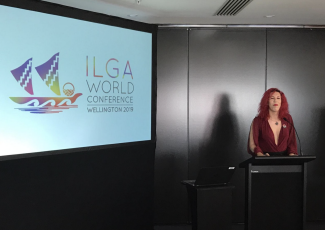
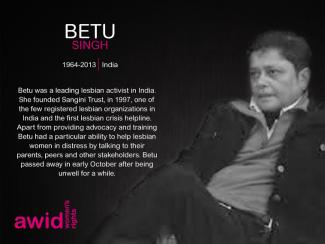
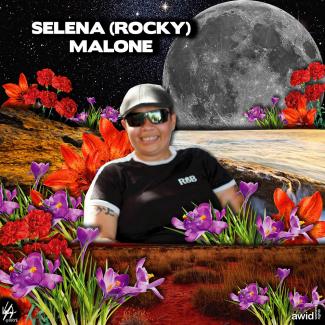
Engagée auprès de jeunes lesbiennes, gays, bisexuels, transgenres, intersexuels, queers, et transgenres (appelés Brotherboys-BB et Sistergirls-SS dans la communauté aborigène en Australie), Rocky faisait preuve de vision et d'un leadership inspirants.
Rocky avait commencé sa carrière auprès de la police du Queensland en tant qu'agent de liaison. Faire une différence était très important pour elle. Elle a mené un travail de soutien impressionnant auprès de jeunes de cette communauté en tant que responsable du service jeunesse « Open Doors » (portes ouvertes). Rocky a œuvré dans des situations complexes liées spécifiquement aux questions de genre et d'identité sexuelle.Elle avait un don naturel dans ce domaine: c’était une leader communautaire solide, une femme sereine, une amie fidèle, une personne aimante et attentionnée ainsi qu’une actrice du changement. Rocky était membre fondatrice d’IndigiLez Leadership and Support Group.
En 2016, à la Cour suprême de Brisbane, l'ancien juge de la Haute Cour, Michael Kirby, a cité le nom de Rocky lorsqu'il a loué le travail du service juridique de la communauté LGBTI au fil des années. Rocky s'est engagée très fermement en faveur des droits humains de la communauté « LGBTIQBBSG », elle a repoussé les limites et induits des changements de manière respectueuse et aimante.
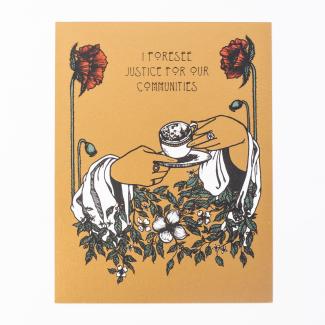
Tasseography is the study of coffee grounds and/or tea leaves for the act of divination. It is a practice that has been passed down through the women on my Armenian side of the family and was taught to me by my mother, she from her mother, and so on. As I would watch my Nana read the coffee grounds from the Armenian coffee prepared for family and friends, I would notice how often times she would see what she would want to say. These prints say some of the things I want to see in the world; I hope you do too.
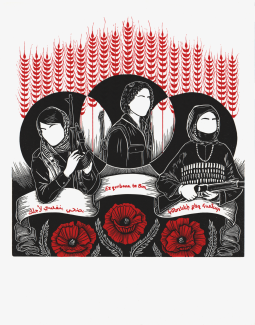
This print celebrates the resilience, sacrifice and strength of SWANA freedom fighters throughout history and the solidarity that exists. It was originally inspired by an article I read about an exhibition held in Tatvan, a district of Bitlis that was highlighting the Armenian presence in the region. My ancestors are from Bitlis, now within the borders of modern day Turkey.
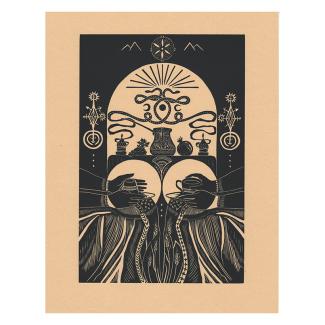
Tasseography (the study of reading coffee grounds) is a cultural practice that Armenian women have used for hundreds of years to speak among and to each other, a coded language to open up conversations, to build inter-relatedness and weave connections.
![]Ali Chavez Leeds portrait](/sites/default/files/styles/max_325x325/public/2021-10/portrait.jpeg?itok=0yU3PqLe)
Participé en una actividad solo para afiliadxs, y lo que me conmovió en particular fue ver cómo había espacio para que todas compartieran, y que no había ningún juicio al respecto. Toda la sesión fue enérgica y vibrante.- Kirthi Jayakumar, fundadora de The Gender Security Project, India
سيتم جمع المعطيات لأهداف إحصائية لتسليط الضوء على وضع التمويل للحركات النسوية العالمية وسيتم عرضها فقط بشكل إجمالي. لن تنشر AWID المعلومات عن اي منظمة محددة ولن تعرض أي من المعلومات التي ستمكّن من التعرّف على منظمة عن طريق موقعها أو صفاتها دون موافقة المنظمة.
El Foro Internacional de AWID es una reunión de 2.000 líderes de derechos de las mujeres y activistas de todo el mundo. El Foro AWID es el evento recurrente más grande de su tipo, y cada Foro tiene lugar en un país diferente en el Sur global.
El Foro Internacional de AWID es un evento de la comunidad global y, al mismo tiempo, un espacio para una transformación personal radical. Es un encuentro único: el Foro reúne a los movimientos feministas, por los derechos de las mujeres, por la justicia de género, LBTQI+ y aliados, en toda nuestra diversidad y humanidad, para conectarnos, sanar y florecer.
Únete a nosotrxs en Bangkok, Tailandia, y de manera virtual, en diciembre de 2024.
Linda Porn est une autre héroïne de l'organisation syndicale féministe et de l'activisme des travailleur·euses du sexe au niveau national (en Espagne) et transnational.
Originaire du Mexique, elle vit en Espagne depuis les années 2000. Elle est travailleuse du sexe, militante, mère célibataire et artiste multidisciplinaire.
Puisant dans ces différentes identités, elle utilise la performance, l'art vidéo et le théâtre pour rendre visibles les luttes aux intersections du transféminisme, du travail du sexe, de la migration, du colonialisme et de la maternité. Elle combine l'art et le travail du sexe tout en prenant soin de sa fille en tant que mère célibataire.
Linda appartient également à des groupes de travailleur·euses du sexe qui luttent pour leurs droits, comme le syndicat OTRAS et CATS Murcia. Elle a également cofondé le groupe 'Madrecitas' - qui rend visible et dénonce la violence institutionnelle raciste contre les familles migrantes. Violence à laquelle elle et sa fille ont été soumises en tant que travailleuse du sexe et mère célibataire migrante.
Ne ratez pas son travail artistique ici!

Zita was a women’s rights activist who defended the rights of rural women in Greater Kivu.
She was the first Executive Director of UWAKI - a well known women’s organisation. Through her work with Women's Network for Rights and Peace (RFDP), and the Women's Caucus of South Kivu for Peace, she committed her life to helping to restore peace in the Eastern DRC. She spoke out strongly against the use of sexual violence as a weapon of war.
In 2006, she put herself forward as a candidate in the first democratic elections in the DRC. Although she did not win, she continued to advocate for women’s rights and the South Kivu community remembers her fondly.

Curado por Jess X. Snow
Con asistencia de Kamee Abrahamian y Zoraida Inglés
Editado por Kamee Abrahamian
A través de Asia y el Pacífico, y de toda su vasta diáspora, mujeres feroces y personas trans han estado luchando por un futuro en el que todxs puedan ser libres. A medida que la subida de los niveles del mar amenaza a las islas del Pacífico y las costas de Asia continental, la batalla por proteger la Tierra y los océanos se intensifica en todo el mundo. Nuestro planeta guarda una memoria geológica de todo lo que ha experimentado. El auge de la colonización, la industrialización y la destrucción ambiental está conectado con el crecimiento del Estado-Nación patriarcal binario. El poder que reside en la Tierra para reencarnar, sanar y florecer a pesar de la violencia debe, por lo tanto, conectarse con las mujeres, con la maternidad, con la indigeneidad, y con todas las fuerzas expansivas, sagradas y queer. No es una coincidencia que las realidades feministas unan la lucha por la protección de los derechos de las mujeres y de las personas trans y LGBTQ+ con la lucha por la protección de la Tierra. Desde las madres-hijas protectoras de Mauna Kea en el Reino de Hawái hasta las complejas relaciones madre-hijx de lxs refugiadxs vietnamitas, los despertares sexuales queer en la conservadora India, la recuperación del hogar en Mongolia Interior y la lucha por la liberación LGBTQ en Filipinas: esta colección de películas es una cosmología de las formas en las que las mujeres y las personas queer y trans contemporáneas de Asia-Pacífico defienden el camino hacia nuestra liberación colectiva, a través de océanos y fronteras.
Todas estas películas tienen un fuerte sentido de lugar: activistas indígenas protegen sus territorios sagrados, lxs jóvenes despejan las narrativas coloniales de su tierra natal para descubrir verdades ocultas, se exploran complejas relaciones de maternidad y cuidados, y lxs personajes recurren a sus propios cuerpos y a su sexualidad como santuario, cuando la familia y la ciudad que lxs rodea amenazan su seguridad.
por Jess X. Snow
«Una película inolvidable, con asombrosas tomas que invocan la resistencia ambiental feminista, y cuán profundamente arraigada está esa resistencia en la historia cultural y en la tierra...»
- Jessica Horn, activista feminista panafricana, escritora y co-creadora del sitio web the temple of her skin
En el documental experimental Afterearth, cuatro mujeres luchan por preservar el volcán, el océano, la tierra y el aire para las generaciones futuras. A través de música, poesía y sentidos testimonios que honran zonas próximas al Océano Pacífico: Hawái, Filipinas, China y América del Norte, Afterearth es una meditación poética sobre la relación intergeneracional y feminista de cuatro mujeres con las tierras y las plantas de las cuales provienen.
por Jalena Keane Lee
En Standing Above the Clouds, dos activistas nativas hawaianas (madre e hija) luchan juntas para proteger su montaña sagrada, Mauna Kea, y evitar que sea utilizada como sitio de la construcción de uno de los telescopios más grandes del mundo. Como protectoras de Mauna Kea, esta película muestra la relación interconectada entre Aloha ʻĀina (amor a la tierra) y el amor a lxs ancianxs y a las generaciones venideras.
por Quyên Nguyen-Le
En el cortometraje narrativo experimental Nước (agua/tierra natal) unx adolescente vietnamita-estadounidense genderqueer desafía las narrativas dominantes sobre la Guerra de Vietnam en Los Ángeles, California. A través de potentes secuencias oníricas y quiebres de la realidad, esta película sigue el camino de lx joven que intenta reconstruir y entender la experiencia de su madre como refugiada de la Guerra de Vietnam.
por Kimi Lee
En Kama’āina, una joven queer de dieciséis años debe pilotear su vida en las calles de Oahu hasta que, finalmente, guiada por una tía, encuentra refugio en el Pu’uhonua o Wai’anae, el campamento organizado de personas sin techo más grande de Hawái.
por Karishma Dev Dube
En Devi (diosa, en hindi) Tara, una joven lesbiana no declarada, arriesga tanto su familia como su tradición al aceptar su atracción por la criada de su infancia. Ambientada en Nueva Delhi, Devi es una historia de transición a la adultez, así como un comentario sobre las distinciones sociales y de clase que actualmente dividen a las mujeres en la India contemporánea.
por Yuan Yuan
En Heading South, Chasuna, una niña de 8 años criada por su madre en la meseta de Mongolia Interior, visita a su padre violento en la gran ciudad. En casa de su padre se encuentra con una nueva incorporación a la familia, y debe aceptar el hecho de que su verdadero hogar es inseparable de su madre y de su tierra.
por Johnny Symons & S. Leo Chiang
El largometraje Outrun sigue la trayectoria de la primera mujer transgénero del Congreso de Filipinas. Confrontando la opresión de una nación predominantemente católica, su viaje triunfal se convierte en un clamor por los derechos de las personas LGBTQ+ de todo el mundo.
Abarcando formas documentales, narrativas y experimentales, estas películas muestran que los cuidados comunitarios, el amor por unx mismx y la escucha transformadora profunda entre nuestros seres amados son un portal a las realidades feministas a las que hoy estamos dando existencia. Desde toda la zona de Asia-Pacífico y su diáspora, estas historias nos enseñan que, frente a la violencia, la ternura es la fuerza de resistencia más intensa.
Mira nuestra conversación con lxs cineastxs
Facebook: @AWIDWomensRights
Instagram: @awidwomensrights
Twitter ENG: @awid
Twitter ES: @awid_es
Twitter FR: @awid_fr
LinkedIn: Association for Women's Rights in Development (AWID)
Le Forum de l’AWID s’articulera autour de 6 sujets interconnectés. Ces ‘points d’ancrage’ sont centrés sur les réalités féministes.