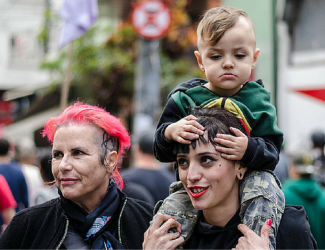
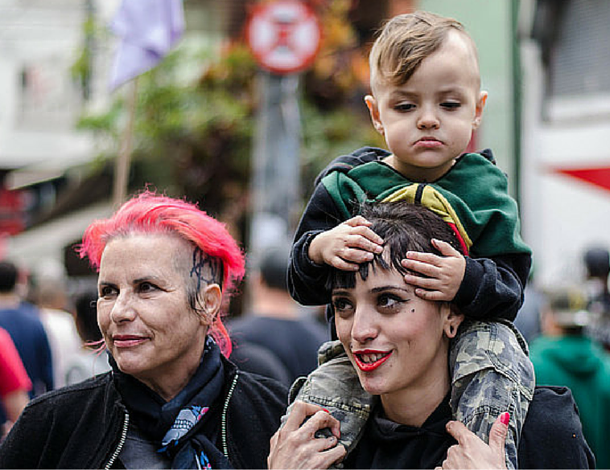
Flickr/Leonardo Veras (CC BY 2.0)

Análisis Especiales

AWID es un organización feminista internacional de membresía, que brinda apoyo a los movimientos que trabajan para lograr la justicia de género y los derechos de las mujeres en todo el mundo.

Protección de la familia

El contexto

Esta sección de análisis especial ofrece un análisis feminista crítico y acceso a los recursos clave relacionados con la «protección de la familia» en los espacios internacionales de derechos humanos.

Durante los últimos años, venimos observando una nueva y preocupante tendencia en el ámbito internacional de derechos humanos, donde se están empleando discursos sobre la «protección de la familia» para defender violaciones cometidas contra miembros de la familia, de modo de reforzar y justificar la impunidad y para coartar la igualdad de derechos en el seno de la familia y la vida familiar. 

La campaña para «proteger a la familia» es impulsada por proyectos conservadores que tienen como fin imponer interpretaciones «tradicionales» y patriarcales de familia; quitando los derechos de las manos de sus miembros para ponerlos en las de la institución «familia».

Los proyectos de «protección de la familia» tienen su origen en los siguientes fenómenos:

  • el auge del tradicionalismo,
  • el auge del conservadurismo cultural, social y religioso, y
  • posturas hostiles a los derechos humanos de las mujeres, los derechos sexuales, los derechos de las niñas y los niños y los derechos de las personas con identidades de género y orientaciones sexuales no normativas.  

Desde 2014 un grupo de estados opera como bloque en espacios de derechos humanos, bajo el nombre «Group of Friends of the Family» [Grupo de amigos de la familia], y a partir de entonces se han aprobado resoluciones sobre la «Protección de la familia» todos los años.

Esta agenda se ha extendido más allá del Consejo de Derechos Humanos (HRC, por sus siglas en inglés).  Hemos visto cómo el lenguaje regresivo sobre «la familia» se ha introducido en la Comisión de la Condición Jurídica y Social de las Mujeres (CSW, por sus siglas en inglés), y hemos asistido a intentos por incluir este lenguaje en las negociaciones sobre los Objetivos de Desarrollo Sostenible.


Nuestro enfoque

AWID trabaja con asociadxs y aliadxs para resistir conjuntamente las agendas regresivas de «Protección de la familia» y otras, y para defender la universalidad de los derechos humanos.

En respuesta a la creciente influencia de actores regresivos en los espacios de derechos humanos, AWID se ha unido con aliadxs para formar el Observatorio de la Universalidad de los Derechos (OURs, por sus siglas en inglés).  OURs es un proyecto colaborativo que monitorea, analiza y comparte información sobre iniciativas anti-derechos tales como la «Protección de la familia».

Derechos en Riesgo, el primer informe de OURs, traza un mapa de los actores que conforman el cabildeo global anti-derechos e identifica sus discursos y estrategias principales, señalando los efectos que estos discursos y estrategias están teniendo sobre nuestros derechos humanos.

El informe expone a la «Protección de la familia» como una agenda que ha promovido la colaboración entre una amplia gama de actores regresivos en las Naciones Unidas. La describe como un marco estratégico que aloja «múltiples posiciones patriarcales y anti-derechos, cuyo marco, a su vez, apunta a justificar e institucionalizar estas posiciones».
Contenido relacionado

Body

Do I have to be an AWID member to participate in the Forum?

No, you don't have to be an AWID member to participate but AWID members receive a discounted registration fee as well as a number of other benefits. Learn more on how to become an AWID member.

ours chapter 6

Chapitre 6

Les tendances antidroits au sein des systèmes régionaux des droits humains

À la Commission africaine et au Système interaméricain, les antidroits promeuvent les notions essentialistes de culture et de genre pour miner les avancées en matière de droits et décrédibiliser la redevabilité. Les antidroits gagnent en influence dans les systèmes de protection des droits humains régionaux et internationaux.

En lire plus

Snippet2 - WCFM type of funding- EN

Court icon

Type of funding:

Be it core funding, programmes & projects or rapid response/ emergency grants.

Voici votre guide pratique et les infographies «Vers un écosystème de financement féministe»

Mariam Uy Acob

Mariam était assistante juridique à l'Alliance des droits humains Kawagib Moro.

Mariam était une fervente critique de la militarisation imposée aux communautés moro et a constamment dénoncé les bombardements aériens et les cantonnements de troupes. Elle a dû fuir et chercher refuge après avoir révélé et dénoncé des injustices commises à l'encontre des communautés musulmanes aux Philippines.

Il semble que Mariam ait été assassinée par de présumés agents de l'armée à cause de son action en tant que défenseure. Les assaillants qui l‘ont tuée l’ont épiée, ont rattrapé le véhicule dans lequel elle se trouvait et ont fait feu sur elle à sept reprises.


Mariam Uy Acob, Philippines

¿Y si no puedo asistir en persona? ¿El Foro tendrá formato híbrido?

¡Sí! Actualmente estamos explorando tecnologías innovadoras que permitan una conexión y participación significativas.

Workshop Methodology

Coming soon:

Workshop Methodology

Want to bring people together to strengthen resistance? This methodology for workshops offers group exercises to increase collective knowledge and power, with options to adapt to your needs.

Coming soon!

Clone of Snippet - Intro WITM - ES

«¿Dónde está el dinero para las organizaciones feministas?»

¿Cuánto sabes sobre financiamiento feminista? 📊 Pon a prueba tu conocimiento sobre la movilización de recursos para el financiamiento de la organización feminista, respondiendo al cuestionario "¿Dónde está el dinero?":

Completa el quiz en línea Descarga la versión para imprimir


La encuesta ha cerrado. ¡Muchas gracias!

Queremos expresar nuestro más sincero agradecimiento a todos los diversos grupos, colectivos y organizaciones feministas de todo el mundo que respondieron a la encuesta WITM. Su participación y sus puntos de vista han sido inestimables y enriquecerán enormemente nuestra comprensión colectiva de los recursos feministas a nivel mundial.

The AWID Forum Access Fund

We strive to make the AWID Forum a truly global gathering with participation from a diverse array of movements, regions and generations. To this end, AWID mobilizes resources for a limited Access Fund (AF) to assist some participants with the costs of attending the Forum. 

The 14th AWID International Forum will take place 11-14 January 2021, in Taipei, Taiwan. 


How will  the Access Fund be allocated?

For this AWID Forum, there will be no application process. 

Access Fund grants will be allocated by invitation only to:

  • Two  persons per activity selected for the Forum program (decided by those organizations, groups or individuals organizing the activity) 
  • Participants who identify as part of Priority Forum  Constituencies (PFCs) recommended by the organizations, networks and groups who are co-creating the Forum with AWID. 
  • PFCs are those which we consider would strengthen our collective power as movements, are not centered in mainstream feminist movements, and whose Feminist Realities we would like to honor, celebrate and visibilize: 
    - Black feminists 
    - Indigenous feminists
    - Trans, gender non-conforming and intersex feminists
    - Feminists with disabilities 
    - Feminist sex workers and informal workers, including migrant workers
    - Feminists affected by migration 
    - Women affected by drug policy
    - Feminists from the Forum regions (with a focus on the Pacific and mainland China) 

In addition, AWID will fund approximately 100 participants from the Forum’s location. Forum Committee Members (Content and Methodology, Access and Host) as well as those in the Artists Working Group [link] are also granted Access Fund support.

What does the Access Fund cover?

For selected participants, the Access Fund will cover the cost of their:

  • Flight
  • Accommodation
  • Visa
  • Local transportation in Taipei
  • Travel medical insurance

The Access Fund will NOT cover their: 

  • Forum registration fee
  • Transportation to and from the airport in their city of departure
  • Other incidental costs

Apart from the Access Fund, how can I fund my participation at the Forum?

We have listed other ideas on how to fund your participation at the AWID Forum on the Funding Ideas page. 

More Funding Ideas

Ana M. Tallada Iglesia

Ana was a strong advocate of women’s rights and worked with a broad cross-section of women, from those in grassroots networks to those in the private sector.

She believed in building bridges across sectors. Ana was a member of the National Network for the Promotion of Women (RNPM), and was active in developing many social programs that address issues such as sexual and reproductive health and rights. 


Ana M. Tallada Iglesia, Peru
Body

Qu'en est-il de la justice climatique? Est-ce vraiment le moment d'effectuer autant de vols internationaux ?

Nous nous posons la même question et nous pensons qu'elle n’admet pas de réponse simple. Le Forum de l’AWID pourrait être, pour de nombreux participant·e·s, l'un des rares voyages internationaux qu'ils·elles effectueront au cours de leur vie. La pandémie nous a révélé les possibilités mais aussi les limites des espaces virtuels pour la construction de mouvements : rien ne vaut une rencontre en personne. Les mouvements ont besoin de connexions transfrontalières pour renforcer leur pouvoir collectif face aux menaces qui pèsent sur eux, notamment la crise climatique. Nous sommes d'avis que le prochain Forum de l'AWID pourrait ouvrir un espace stratégique afin d'organiser ces conversations et explorer les alternatives qui se posent aux voyages internationaux. L'élément hybride du Forum est une composante importante de cette exploration.

Crear | Résister | Transform: A Walkthrough of the Festival! | Content Snippet EN

As heteropatriarchal capitalism continues to force us into consumerism and compliance, we are finding that our struggles are being siloed and separated by physical as well as virtual borders.

And with the additional challenges of a global pandemic to overcome, this divide-and-conquer strategy has been favorable for the proliferation of exploitation across many areas.

Yet, From September 1 to September 30, 2021, Crear | Résister | Transform: a festival for feminist movements! took us on a journey of what it means to embody our realities in virtual spaces. At the festival, feminist activists from across the world came together, not only to share experiences of hard-won freedoms, resistances, and cross-borders solidarities, but to articulate what a transnational form of togetherness could look like. 

It is this togetherness that has the potential to defy borders, weaving a vision for a future that is transformative because it is abolitionist and anti-capitalist. Spread out over a month, across digital infrastructures that we occupied with our queerness, our resistance, and our imaginaires, the festival showed a way to deviate from the systems that make us complicit in the oppression of others and ourselves. 

Though Audre Lorde taught us that the master’s tools will never dismantle the master’s house, Sara Ahmed showed us that we can misuse them. Because we had to make space for assembly, in spite of all the other demands on our time, it became possible to imagine a disruption to the reality of heteropatriarchal capitalism.

Now, if we understand assembly as a form of pleasure, then it becomes possible to make the link between transgressive pleasure and transnational/transdigital resistance. Between the kinds of pleasure that challenges borders on the one hand, and queerness, campiness, land and indigenous struggle, anti-capitalism, and anti-colonial organizing on the other. 

This issue attempted to capture a sense of how the festival’s exercise in assembly took on multiple shapes and imaginations. Beyond direct collaborations with some of its speakers and dreamers, we brought on a plethora of other voices from the Global South to be in conversation with many of its themes and subjects. Below is a map of some of the festival’s panels that most inspired us.

WITM - Refreshed DATA SNAPSHOTS - FR

Présentation des donnée

Notre force collective, notre sagesse et notre engagement sont illimités... mais pas nos comptes en banque.

Cette synthèse s’appuie sur les réponses de 1 174 organisations féministes, de défense des droits des femmes, LBTQI+ et alliées (désignées ci-après comme « organisations féministes et de défense des droits des femmes ») issues de 128 pays, ayant participé à l’enquête Où est l’argent pour l’organisation des mouvements féministes ?. Les données reflètent les expériences vécues entre 2021 et 2023, et sont examinées au regard des tendances de restrictions budgétaires qui se profilent pour 2024–2025.

Découvrez l’état des lieux du financement des organisations féministes aujourd’hui.

Instantanés de données à venir

AWID Member Community Guidelines

Co-creating welcoming and safe spaces

The co-creation of our feminist realities starts with ourselves and how we treat each other. We are dedicated to creating and protecting safe and supportive spaces for our communities both online and in person. We also consider that safe and welcoming spaces are co-owned and co-created.

We  expect our members to act in a manner that is ethical, responsible and consistent with the values of AWID and assume collective responsibility to ensure an atmosphere of mutual respect and solidarity. 


All AWID members are encouraged to: 

  • Connect with others, help break isolation and further solidarity.  It’s easy to feel lost and alone, and a little friendliness and responsiveness goes a long way.

  • Interact and engage peacefully. Differences in opinion will naturally arise, so please think of these differences as useful for expanding your thinking and ways of seeing the world.

  • Help build a space that recognizes and validates multiple lived experiences and diversities of bodies and gender expressions. Recognize that we all carry intersectional identities.

  • Use inclusive language. Be respectful of how people want to be referred to in terms of gender identity or expression (like pronouns), and practice inclusive language. 

  • Listen and make adjustments in your behavior and ways of engaging if someone says they feel uncomfortable. Don’t ask others questions that you wouldn't want to be asked yourself.

  • Help challenge oppressive behavior, which includes harassment, verbal or physical violence, violation of consent, and any action that perpetuates classism, ageism, ableism, racism, misogyny, heterosexism, transphobia and other oppressions.  If needed, please reach out to AWID staff. 

  • Practice speaking and listening with an open mind and heart and without judgement.

  • Be honest, open and heartfelt. Speak and share authentically about your experiences, your challenges, your hopes and dreams, and your vision for your own life and your community.

  • Practice active listening and self-awareness. Be aware of how much time and space you are taking up- leave room for others, practice active listening and learning.

  • Be mindful and credit others for their work and activism. Remember that we are all working collectively to contribute to change-- Ensure that you recognize the contribution of others and credit them when appropriate e.g. in discussions, or in articles, pictures etc.

  • Stay safe! We encourage you to take measures to protect yourself online and in person, especially if you have reason to believe that speaking out will put you in danger. Members may use aliases or profile images that conceal their identity. For more information please refer to the Digital Security First Aid Kit for Human Rights Defenders produced by APC - Association for Progressive Communications. 

  •  Respect the privacy needs of others! Do not share or forward any information without explicit permission.


Our Values

Solidarity 

We take a position in solidarity with each other and diverse struggles for justice and freedoms. We strive to mobilize and strengthen collective action and practice meaningful ways of working with each other.

Human rights

We believe in a full application of the principle of rights including those enshrined in international laws and affirm the belief that all human rights are interrelated, interdependent and indivisible. We are committed to working towards the eradication of all discriminations based on gender, sexuality, religion, age, ability, ethnicity, race, nationality, class or other factors.

Responsibility, Accountability, and Integrity

We strive for transparency, responsible use of our resources, fairness in our collaborations and accountability and integrity with our members, partners, funders and the movements with(in) which we work. We are committed to reflecting on our experiences, sharing our learnings openly, and striving to change our practices accordingly.

Intersectionality

We believe that for feminist movements to be transformative and strong we must continue to work across our similarities and differences. We also must interrogate power and privilege both within and outside our movements.

Bodily autonomy, integrity and freedoms

We celebrate everyone's right to choose their identities, relationships, goals, work, dreams and pleasures, and what they do with their mind, body and spirit. We believe in working towards access to resources, information and safe and enabling environments that allow this to happen.

Justice and systemic change

We work towards a world based on social, environmental, and economic justice; and interdependence, solidarity, and respect. We work towards dismantling systems of oppressive power and against all its manifestations, including patriarchy, fundamentalisms, militarisms, fascisms and corporate power that threaten our lives and our world. We want a just world where resources and power are shared in ways that enable everyone to thrive.


Please note:  

AWID reserves the right to delete comments, suspend or revoke membership when our community guidelines have been violated. AWID members are not authorised to represent AWID in any official capacity unless stipulated in writing. Members cannot use AWID spaces to proselytize or recruit members to join a religious faith or organisation. Members cannot use AWID spaces to request funds for personal use although links to external fundraising efforts or activism campaigns are permissible.