AWID es un organización feminista internacional de membresía, que brinda apoyo a los movimientos que trabajan para lograr la justicia de género y los derechos de las mujeres en todo el mundo.
En septiembre de 2016, 1800 feministas y activistas por los derechos de las mujeres de todos los rincones de nuestros movimientos se congregaron en las costas de Bahia, en el 13º Foro Internacional de AWID.
En esta sección se destacan los logros, los aprendizajes y los recursos que surgieron de las ricas conversaciones mantenidas. Te invitamos a analizar, compartir y comentar.
¿Qué ha pasado desde 2016?
Uno de los aportes más importantes del Foro fue la necesidad de ampliar y profundizar nuestro trabajo entre movimientos, frente a la confluencia de los fascismos en auge, fundamentalismos, codicia corporativa y cambio climático.
Con esto en mente, AWID, en asociación con múltiples aliadxs, ha estado trabajando para que estas semillas de resistencia:
AWID se ha comprometido, mediante su próximo plan estratégico y su proceso del Foro, a continuar y profundizar las relaciones, las lecciones y los procesos iniciados en el Foro 2016 y basándonos en el momento actual.
¿Que pasa ahora?
El mundo es un lugar muy diferente de lo que era un año atrás, y seguirá cambiando en los próximos años.
El próximo Foro de AWID se realizará en la región del Pacífico Asiático (el lugar y la fecha exactos serán anunciados en 2018). Esperamos que te unas a nosotrxs.
Sobre el Foro de AWID
Los Foros de AWID comenzaron en 1983 en Washington DC. Desde entonces, el evento ha crecido hasta convertirse en muchas cosas para muchas personas: un proceso iterativo para darle forma a nuestros análisis, objetivos y acciones; un hito crucial que fortalece los feminismos de lxs participantes e infunde energías a sus procesos de organización; un hogar político donde lxs defensoras de derechos humanos encuentran un santuario y solidaridad.
Lorsqu’on effectue une recherche en ligne sur les « Mutilations génitales féminines » ou « MGF », un schéma en quatre parties sur l’anatomie des femmes apparaît à côté d’une page Wikipédia dédiée. (...)
Un gozo para el mundo: Seis preguntas a Naïké Ledan
Entrevista realizada por Chinelo Onwualu
Naike Ledan es una defensora de la justicia social, una feminista comprometida y con 20 años de experiencia en la defensa de los derechos humanos y la justicia social, el empoderamiento de las mujeres, la lucha por el acceso universal a los servicios básicos y la inclusión social, así como por el desarrollo de las capacidades de la sociedad civil. Tiene una vasta trayectoria de trabajo en Canadá, en África occidental y meridional, y en Haití, en la promoción de los derechos civiles, el desarrollo de las capacidades de las organizaciones de la sociedad civil, enfocada sobre todo en los determinantes sociales de la exclusión estructural. Valora los principios de un liderazgo compartido, anticolonial, contra la opresión y los espacios antipatriarcales.
Chinelo Se te conoce como activista por los derechos trans; me intriga cómo fue tu recorrido hasta allí.
Naike Crecí en Haití donde viví hasta los 18 años y luego me fui a vivir a Montreal donde pasé 19 años. Cuando volví a Haití, en 2016, pensaba que estaba regresando a casa pero el lugar había cambiado y tuve que readaptarme. No volví a conectarme como había esperado hacerlo con la familia y las amistades de mi infancia. Volví habiendo vivido en el exterior, con una situación laboral cómoda y durante mucho tiempo me sentí bastante extranjera. Y a la vez me sentía muy en casa por el idioma, los silencios entendidos, no tener que explicar nada cuando empezamos a cantar un anuncio publicitario. Ya sabes: esas cosas que compartimos, esa energía, ese espacio, ese espíritu.
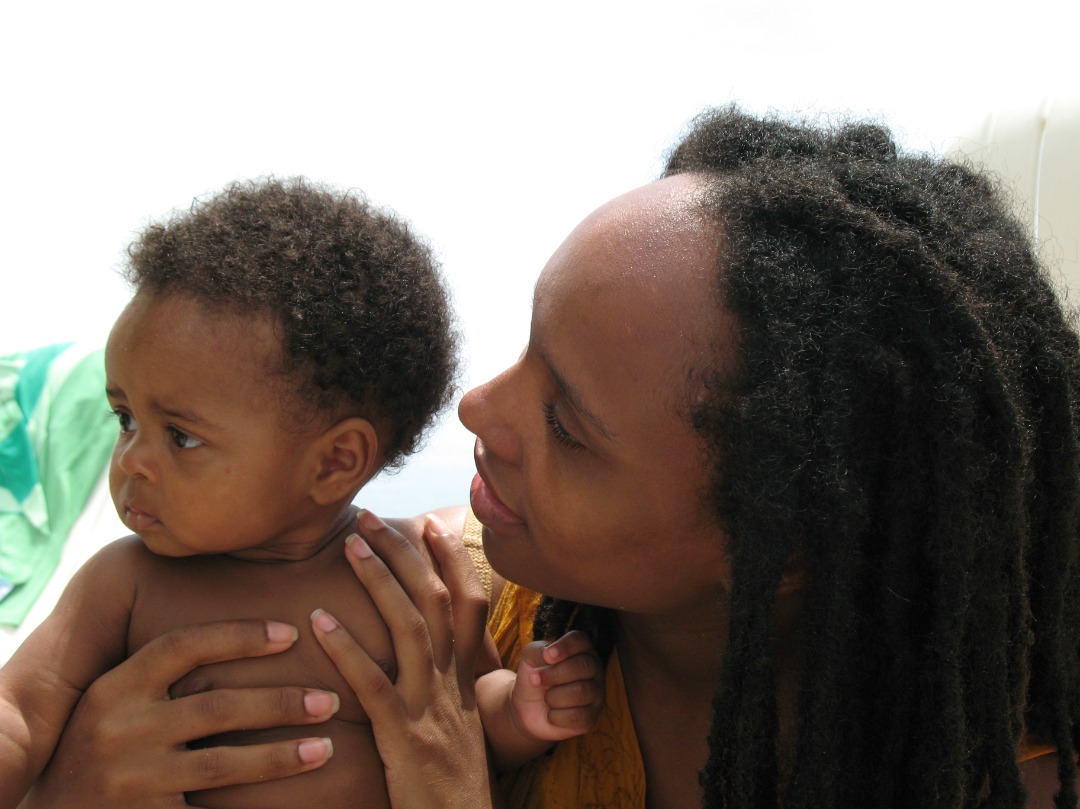
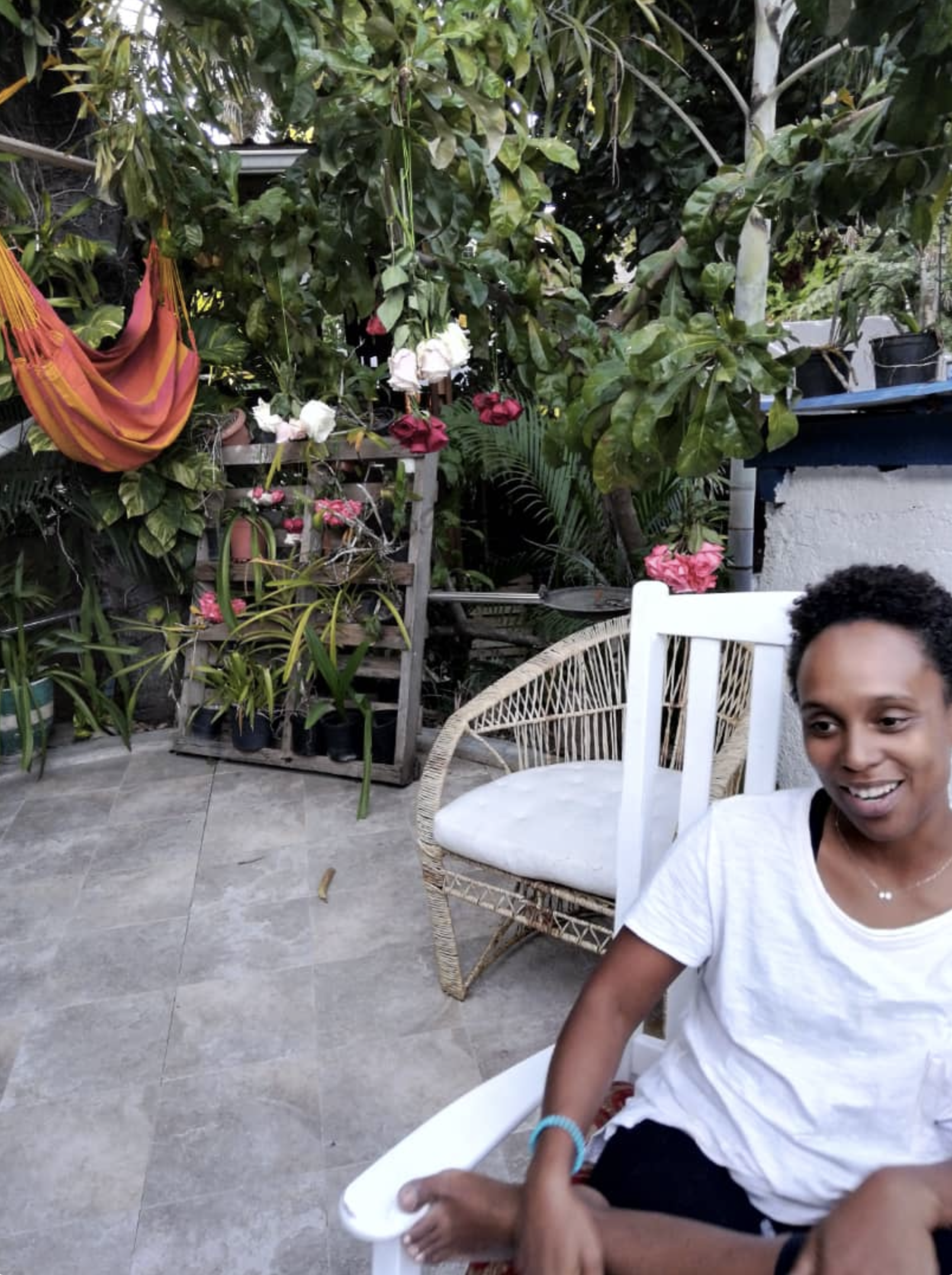
Cuando volví a amarme a mí mismx – yo lo llamaría «renacimiento» – que coincidió con parir a mi primerx hije, parirme a mí mismx y enamorarme de mi ser queer o alguien que ama a personas de su mismo género. (Créditos: Naïké Ledan)
Lo que me ayudó fue que me gustó mucho la tarea de andar por el país y documentar lo que la gente sabía. Entonces, dejé la comodidad de lado. Me convertí en directora nacional de una organización regional que era completamente queer. Mi trabajo consistía sobre todo en conseguir recursos y desarrollar capacidades en la sociedad civil. Mi estrategia era salir a las zonas rurales, buscar a todas las organizaciones pequeñas que había ahí, ayudarlas a desarrollar su capacidad y financiarlas. No me interesaban lxs polítiquxs, ni andar a los apretones de manos o sacarme fotos (risas). Tuve un muy buen aliado: Charlot Jeudy, el activista (queer) que fue asesinado hace tres años en su casa. Nos acercamos mucho después de que se prohibió en Haití un festival de cine afro-queer que habíamos planeado juntxs. La prohibición hizo mucho ruido y logró que se hablara de ser queer en todas partes, entonces Charlot me presentó a todas las OSC pequeñitas que había en cada rincón del país. Y ahí estaba yo para ayudarlas a registrarse o a elaborar sus planes estratégicos. Fue esa clase de trabajo la que me convirtió en activista queer y, por extensión, en activista trans. Aunque yo no me defino como activista. Es una palabra con mucho peso, ¿no crees? Es algo que otrxs dicen de ti. Yo creo que solo soy amante y luchadorx (risas).
Chinelo Cuéntame sobre el taller que facilitaste durante el Festival de AWID. ¿De qué se trataba y en qué contexto surgió?
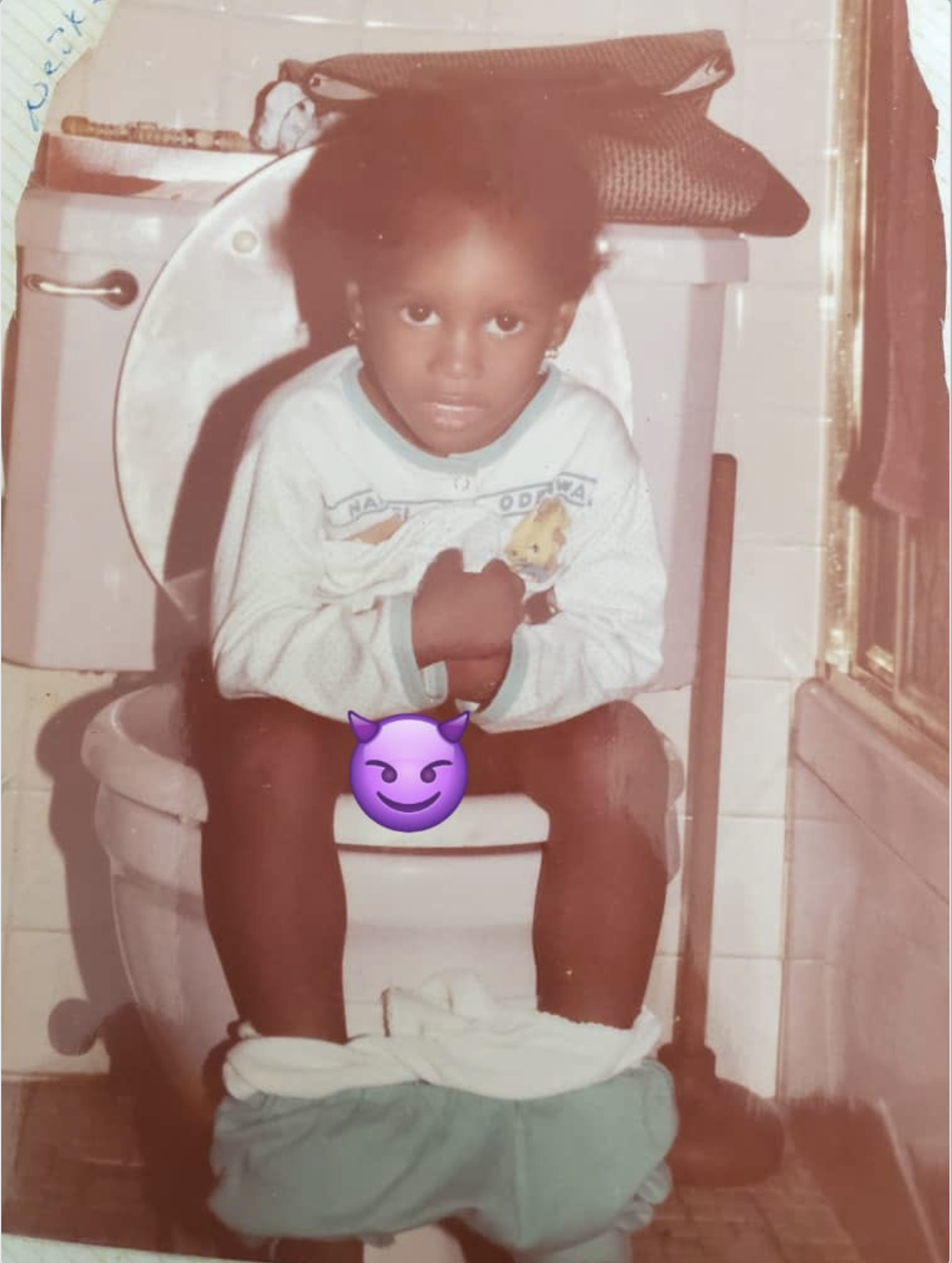
Mi profunda conciencia de mí mismx en la infancia y cómo ya cuestionaba las desigualdades e injusticias a muy temprana edad (+/- 4 años de edad). (Créditos: Naïké Ledan)
Naike Los medios internacionales no hablan en serio sobre Haití, pero en un ambiente político tan malo como el que estamos viviendo, el ambiente económico se torna aún más catastrófico. Como haitianx más bien de clase media, que habla otros idiomas, que tiene otros pasaportes, al principio dudé de si yo debía ocupar ese espacio o no. Pero muchas veces me veo como un puente más que como alguien que va a hablar de sí mismx. Entonces decidí invitar a Semi, una joven mujer trans brillante que vive fuera de Puerto Príncipe, para que tomara el espacio y la palabra, y nos trazara un recorrido sobre el ecosistema de las realidades que viven las mujeres trans en Haití. Terminamos creando una sesión sobre el feminismo que no incluye — o, diría yo, los espacios feministas formales (que no lo hacen) — y cómo en Haití las chicas trans no cuentan con espacios donde puedan contribuir al conocimiento de las mujeres y compartir sus realidades. Por eso el Festival de AWID me dio la oportunidad de ceder el espacio a las mujeres que deben ocuparlo. Lo pasamos muy bien, tomamos vino en línea mientras charlábamos. Mi cofacilitadora, Semi, contó cómo fue haber sido unx niñx/niña/mujer trans en distintas etapas de su vida. También habló de los peligros de la calle, de la pobreza, la exclusión, lo que ocurre cuando «se te nota», así como de sus victorias.
Chinelo ¿Qué relación existe en Haití entre las mujeres trans y las organizaciones feministas? ¿Cómo ha sido tu experiencia en este sentido?
Naike La experiencia de las mujeres trans en Haití ha sido realmente difícil; devastadora en realidad. Pasaron de la invisibilidad absoluta a estar extremadamente sexualizadas. Otra cosa que sucede es que las están matando y los medios no informan acerca de esos asesinatos. Así de inexistentes, de borradas son y están las mujeres trans. Están en todas partes pero no en los espacios laborales, ni en los espacios feministas ni en las organizaciones. Ni siquiera en las organizaciones LGBT. Solo muy recientemente, y gracias a mucha presión del activismo, algunas de estas organizaciones de alguna manera se están readaptando, pero en los espacios feministas esto sigue estando fuera de toda consideración. Todavía tenemos que escuchar el viejo discurso excluyente que dice «No son mujeres. Por supuesto, si no se les nota … » La cultura de que no se note es una conversación sobre gestión de riesgos: cuánto se te nota y cuánto no se te nota, y lo que eso implica para tu cuerpo y en términos de la violencia que causa. En las realidades trans-excluyentes que vivimos, que se reproducen en muchos espacios feministas, a las que no «se les nota» en absoluto tal vez se las considere chicas, pero solo hasta cierto punto. Pero, ¿qué pasa cuando se enamoran, cuando quieren conversar, cuando están en el armario, cuando quieren adoptar una determinada estética o seguir una carrera? La conversación sobre la terapia hormonal termina centrándose en la reducción de riesgos, como lo dijo la propia Semi en el taller. Pero no tenemos la opción de las terapias hormonales, no tenemos ni el marco médico ni un sistema que apoye a las que quieran tomar por ese camino.
Chinelo Cuando hablas de lo que piensa la sociedad acerca de las personas trans y las personas queer, suena bastante similar a lo que ocurre en Nigeria que puede ser un ambiente profundamente homofóbico.
Naike Haití es un país muy complejo de maneras muy hermosas. Aquí nada es simple, ¿sabes?, las cosas nunca son de una sola forma. La gente es muy tolerante, y también muy homofóbica. Hay zonas rurales en las que la gente no es para nada homofóbica porque allí hay muchos templos vudús y esa es una religión que respeta la vida. Un principio básico de la religión vudú es que todxs lxs niñxs son niñxs. Por eso es una religión que no define lo que está bien ni lo que está mal. Durante muchísimo tiempo la gente pensó en Haití como un refugio, un lugar donde había tolerancia — estamos hablando de los setenta, ochenta, antes del VIH, inclusive los noventa. Luego vino el terremoto (en 2010) donde murieron casi 300 000 personas. Y entonces llegó todo ese dinero de las iglesias evangélicas del sur de Estados Unidos para reconstruir el país y encontrar a Jesús. Por eso la homofobia en Haití es algo muy reciente. En lo profundo, en el corazón del alma de su cultura, no puedo realmente decir que sea un país homofóbico. Pero en la vida cotidiana no hay duda de que esa violencia lastima la piel de las personas queer. Y de las mujeres, de las mujeres empobrecidas, las mujeres de piel oscura, porque el colorismo está muy arraigado en el Caribe.
Chinelo ¿Cómo te has enfrentado a esto? ¿Cuál ha sido tu estrategia para sobrevivir?
Mi regreso a Haití como parte de mi proceso de descolonización y la elección de posicionar físicamente mis sentidos y los de mi familia de manera inflexible del lado de la magia y la negritud. (Créditos: Naïké Ledan)
NaikeEstoy enamoradx de mi trabajo. Me encanta trabajar. Cuando recién llegué trabajaba en una ONG horrible pero el trabajo que hacía era maravilloso. Estaba siempre en zonas rurales, conversando y aprendiendo de la gente, de las mujeres. Y eso me colmó el corazón durante mucho tiempo porque adoro mi cultura, a la gente negra, a las mujeres negras, a las ancianas negras, lxs bebés negrxs. Es algo que me colma espiritualmente. Cuando vivíamos en Canadá, mis hijxs iban a esas escuelas sólo de blanquxs donde lxs trataban como mascotas. No hablaban creole ni francés. Y ahora corren libres por el jardín y ya están empezando a pelearse en creole. También encontré espacios de supervivencia en la gente a la que conocí. Forjé lazos con gente queer y con otra gente rara como yo, y eso ha sido realmente maravilloso. Pero ahora todo se ha vuelto más difícil porque ya no me siento segurx en Haití. En Puerto Príncipe ocurren casi 40 secuestros por semana, y esto es así desde 2018. Ahora tengo ataques de ansiedad y de pánico. Entonces, es hora de irme y he comenzado a preguntarme dónde está mi hogar. Pasé 19 años en Montreal pero allí nunca sentí que estuviera en mi casa. Desde que me fui, nunca lo extrañé y por eso no quiero volver. Últimamente estoy llorando mucho porque siento como que está comenzando mi segundo exilio.
Chinelo ¿Cómo es tu relación con el placer, el tiempo libre y el descanso?
Naike Mi relación con el placer, el tiempo libre y el descanso es la misma, porque para mí son una sola cosa. Son esos momentos vividos en los que disfruto del sol sobre mi rostro, por ejemplo. Es placer, tiempo libre y descanso a la vez.
Placer: Es el espacio al que siempre voy, casi siempre como refugio donde puedo celebrarme a mí mismx. Me reservo el poder y el derecho de hacer mucho ruido o nada de ruido cuando disfruto del placer que siento — de todo el placer en el que me deleito en abundancia, viciosamente, que incluye el placer de la soledad y el silencio pero no se limita a eso.
Tiempo libre: andar en bicicleta, ir a festivales de música, comer, descubrir vinos, bailar las danzas vudús tradicionales de Haití son algunas de las muchas opciones que se me ocurren en este momento.
Descanso: Para eso vivo. Como persona que sobresale en su trabajo y que está literalmente enamorada de él, es una paradoja lo haraganx que soy. Nadie lo sabe porque lo que todo el mundo ve es una persona que trabaja muchísimo y es muy exitosa. No saben que puedo ser inflexible en cuanto a disfrutar profundamente de no hacer nada.
ExplorarCorporalidades Transnacionales
Esta edición en alianza con Kohl: una publicación para Body and Gender Research analizará soluciones, propuestas y realidades feministas para transformar nuestro mundo actual, nuestros cuerpos y nuestras sexualidades.
نصدر النسخة هذه من المجلة بالشراكة مع «كحل: مجلة لأبحاث الجسد والجندر»، وسنستكشف عبرها الحلول والاقتراحات وأنواع الواقع النسوية لتغيير عالمنا الحالي وكذلك أجسادنا وجنسانياتنا.
“But when was the master
ever seduced from power?
When was a system ever broken
by acceptance?
when will the BOSS hand you power with love?
At Jo’Burg, at Cancun or the U.N? – Molara Ogundipe
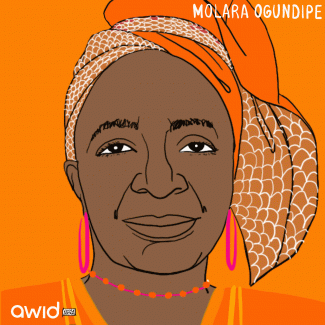
In an interview at the 2010 Ghana International Book Fair, Molara Ogundipe introduced herself with the words: “...I’m a Nigerian. I’ve lived possibly all over the world except for the Soviet Union and China.”
Across the different continents and countries, Professor Ogundipe taught comparative literature, writing, gender, and English studies using literature as a vehicle for social transformation and re-thinking gender relations.
A feminist thinker, writer, editor, social critic, poet, and activist Molara Ogundipe succeeded in combining theoretical work with creativity and practical action. She is considered to be one of the leading critical voices on African feminism(s), gender studies and literary theory.
Molara famously coined the concept of “stiwanism’ from the acronym STIWA – Social Transformations in Africa Including Women recognizing the need to move “away from defining feminism and feminisms in relation to Euro-America or elsewhere, and from declaiming loyalties or disloyalties.”
In her seminal work ‘Re-creating Ourselves’ in 1994, Molara Ogundipe (published under Molara Ogundipe-Leslie) left behind an immense body of knowledge that decolonized feminist discourse and “re-centered African women in their full, complex narratives...guided by an exploration of economic, political and social liberation of African women and restoration of female agency across different cultures in Africa.”
In speaking about the challenges she faced as a young academic she said:
”When I began talking and writing feminism in the late sixties and seventies, I was seen as a good and admirable girl who had gone astray, a woman whose head has been spoilt by too much learning".
Molara Ogundipe stood out for her leadership in combining activism and academia; in 1977 she was among the founding members of AAWORD, the Association of Women in Research and Development. In 1982 she founded WIN (Women In Nigeria) to advocate for full “economic, social and political rights” for Nigerian women. She then went on to establish and direct the Foundation for International Education and Monitoring and spent many years on the editorial board of The Guardian.
Growing up with the Yoruba people, their traditions, culture, and language she once said :
“I think the celebration of life, of people who pass away after an achieved life is one of the beautiful aspects of Yoruba culture.”
Molara’s Yoruba ‘Oiki’ praise name was Ayike. She was born on 27 December 1940 and at the age of 78, Molara passed away on 18 June 2019 in Ijebu-Igbo, Ogun State, Nigeria.
OURs y amistades en el Espacio de Solidaridad Feminista
✉️ Solo con invitación
📅 Martes 11 de marzo de 2025
🕒 De 02:00 a 04:00 p.m., EST
🏢 Chef's Kitchen Loft with Terrace, 216 East 45th St 13th Floor New York
Organiza: Consorcio Observatorio sobre la Universalidad de los Derechos (OURS)
Snippet - Podcast Intro (EN)
We are thrilled to announce the launch of AWID’s new podcast THAT FEMINIST FIRE. Our narrative series unravels over 40 years of feminist movements—and reimagines a way forward.
In our pilot season, you’ll hear five compelling stories that are part of a constellation of feminist activism today. Hosted by our very own Gopika Bashi, Deputy Director of Programmes at AWID, each episode explores unique but interconnected feminist realities that are achieving greater gender justice and human rights.
Produced by our Webby-winning podcast partner Hueman Group Media, you can subscribe toTHAT FEMINIST FIREand listen to our first episode here.
Find us on Apple Podcasts, Spotify, or wherever you get your podcasts. Share with your network! Help us spread stories that ignite our feminist fire and move us to action.
artwork: “Entretejidas” [Interwoven women] by Surmercé >
Clone of Corporalidades Transnacionales | Nota de lxs editorxs
Sin palabras
Chinelo Onwualu
Ghiwa Sayegh
«Cuando estamos desesperadxs por el cambio, como sucede tanto en la enfermedad como en la insurrección, nuestro lenguaje se vacía de complejidad, se queda con sus componentes más esenciales… Sin embargo, a medida que la enfermedad y la revolución persisten, el lenguaje que se hizo en ellas y sobre ellas se profundiza, admite más matices, inmerso en la aguda experiencia humana de encontrar los propios límites en el lugar del fin del mundo».
Cuando comenzamos a delinear este número con Nana Darkoa, antes de Crear | Résister | Transform: un festival para movimientos feministas! de AWID, partimos de una pregunta que es más bien una observación sobre el estado del mundo, un deseo de cambiar el terreno: ¿por qué nuestras sexualidades y placeres siguen siendo domesticados y criminalizados incluso cuando nos dicen, una y otra vez, que no tienen valor ni contribuyen al progreso? Llegamos a la conclusión de que cuando se corporizan, hay algo en nuestras sexualidades que opera contra un orden del mundo que sigue manifestándose en los controles fronterizos, los apartheids en relación a las vacunas, el colonialismo de asentamiento, la limpieza étnica, y el capitalismo descontrolado. ¿Podemos hablar, entonces, del potencial disruptivo de nuestras sexualidades? ¿Podemos seguir haciendo eso cuando, para poder obtener recursos, nuestros movimientos deben ser cooptados e institucionalizados?
Cuando el trabajo de nuestros cuerpos se convierte en ganancias en las manos de los sistemas que buscamos desmantelar, no sorprende que nuestras sexualidades y placeres queden relegados una vez más a las márgenes, especialmente cuando no son lo suficientemente rentables. En muchos momentos durante la producción de este número, nos preguntamos qué sucedería si nos negáramos a dar cabida a los servicios esenciales del capitalismo. Pero ¿podemos atrevernos a hacer esa pregunta cuando estamos agotadxs por el mundo? Quizás nuestras sexualidades son desestimadas con tanta facilidad porque no son vistas como formas de cuidado. Quizás lo que necesitemos sea reimaginar el placer como una forma radical de cuidado, una que también es anticapitalista y anti-institucional.
Estamos entrando en nuestro segundo año completo de pandemia global y nuestro abordaje de la corporalidad transnacional ha tenido que concentrarse en un único descubrimiento político: que cuidar es una forma de habitar la corporalidad. Y como ahora tanto de nuestro trabajo se hace sin tomar en cuenta los límites entre y dentro de nosotrxs, todxs somos Corporalidades Transnacionales, y eso a todxs nos sale mal. Estamos fallando en cuanto a cuidarnos y, lo que es más grave, en cuidar a lxs otrxs.
Ese fracaso no es producto de nuestras acciones.
Muchxs de nuestras madres y padres pensaban que el trabajo era transaccional, algo que debía darse a cambio de una compensación y una garantía de cuidado. Y si bien ese intercambio no siempre se cumplió, nuestrxs madres y padres no esperaban que su trabajo les diera satisfacción. Para eso tenían su ocio, sus pasatiempos, y sus comunidades. Hoy, nosotrxs, sus hijxs, que hemos sido condicionadxs para pensar en nuestro trabajo como entrelazado con nuestra pasión, no tenemos esas expectativas. Pensamos el trabajo y el ocio como una sola y misma cosa. Para demasiadas personas, el trabajo ha llegado a encarnar todo lo que somos.
Sin embargo, el capitalismo heteropatriarcal no nos valora, ni hablar de que valore nuestro trabajo o nuestras sexualidades. Este es un sistema que solo te exigirá más y más hasta que mueras. Y cuando mueras, te reemplazará por otra persona. Que se espere que estemos en línea todo el día significa que simplemente no podemos tomar distancia del trabajo, ni siquiera cuando queremos hacerlo. Esta comercialización del trabajo, divorciándolo de la persona, ha permeado cada aspecto de nuestras vidas y está siendo perpetuado incluso en los círculos más feministas, más radicales y más revolucionarios.
Las expectativas capitalistas siempre han sido particularmente dañinas para los cuerpos que no se ajustan a su ideal. Y quienes buscan consolidar sus poderes han utilizado la pandemia como una oportunidad para concentrar sus ataques en las mujeres, las minorías sexuales y cualquier otrx a quien subestimen.
Este número especial existe debido a eso y ciertamente a pesar de eso.
Casi todxs lxs colaboradorxs e integrantes del equipo se estaban presionando para ir más allá de su capacidad. Cada una de las colaboraciones fue producida desde un lugar de pasión, pero también de un increíble agotamiento. De una forma muy real, este número encarna el trabajo transnacional y, en el mundo digital en el cual vivimos, todo trabajo se ha convertido en trabajo transnacional. A medida que nos enfrentamos a nuevas fronteras que no han roto un viejo orden sino que lo reifican, experimentamos de primera mano, junto a nuestrxs colaboradorxs, cómo el capitalismo vacía nuestros límites, cómo se hace difícil construir argumentos coherentes, especialmente cuando tenemos una fecha límite para hacerlo. Nos quedamos colectivamente sin palabras, porque nos quedamos sin mundos.
Es precisamente porque nos sentimos perdidxs y solxs en el mundo del capitalismo heteropatriarcal que tenemos que reevaluar y repensar nuestros sistemas de cuidado. En muchos sentidos, hicimos de este número una misión de encontrar placer en el cuidado. Porque se ha vuelto más difícil construir argumentos coherentes, los medios visuales y creativos han pasado al primer plano. Muchas personas que solían escribir se han volcado a estos medios como una vía para producir conocimiento y atravesar la niebla mental que nos ha envuelto a todxs. Trajimos otras voces a este número, además de muchxs a quienes ya escucharon en el Festival, como una manera de abrir nuevas conversaciones y ampliar nuestros horizontes.
Dado que nos roban nuestras palabras, es nuestro deber político seguir encontrando maneras de mantenernos y cuidarnos a nosotrxs mismxs y a lxs otrxs. Muchas de nuestras realidades actuales están tratando de borrarnos y desplazarnos, mientras que siguen explotando nuestro trabajo. Nuestra corporización, por lo tanto, se convierte en una forma de resistencia; es el comienzo de que encontremos nuestro camino hacia afuera y hacia nosotrxs mismxs.
Yamile Guerra fue una conocida abogada, líder comunitaria y activista política de la región colombiana de Santander.
Trabajó activamente para resolver las disputas entre comunidades locales y empresas promotoras, y abogó contra la apropiación ilegal de las tierras. Yamile ocupó varios cargos políticos, entre ellos la Secretaría General del Gobierno de Santander en Bogotá, y se presentó también a la Alcaldía de Bucaramanga. En los últimos años de su vida, Yamile se volvió cada vez más activa en las causas medioambientales contra los desarrollos urbanos, particularmente, en la defensa de los humedales biodiversos de Santurbán contra los desarrollos urbanos, una región que abastece de agua dulce a casi 2 millones de personas .
Según su familia y amigxs, Yamile recibía amenazas de muerte a diario y había pedido protección a las autoridades.
"Ella era muy consciente de este problema [litigio de tierras] y manifestó repetidamente que se sentía insegura". - Alixon Navarro Muñoz, periodista y amigo de la familia Guerra.
El 20 de julio de 2019, Yamile fue asesinada a tiros por dos hombres en Floridablanca, Santander. Acababa de terminar de discutir con ellos por una disputa de tierras. Un sospechoso fue arrestado más tarde por su asesinato y admitió haber recibido un pago por llevar a cabo su asesinato. Según varios informes, o Yamile fue la tercera integrante de su familia en ser asesinada a causa de las disputas por tierras. El padre de Yamile, Hernando Guerra, había sido asesinado también varios años antes.
El asesinato de Yamile forma parte de una ola de violencia y asesinatos sistemáticos contra cientos de activistas sociales y defensorxs de los derechos humanos en Colombia. Según el Instituto de Estudios para el Desarrollo y la Paz (INDEPAZ), en el momento de la muerte de Yamile, más de 700 líderes comunitarios y activistas de derechos humanos habían sido asesinadxs desde que el país firmó un acuerdo de paz en agosto de 2016. La mayoría de ellxs fueron asesinadxs por enfrentar el tráfico ilegal de drogas y las operaciones mineras. Las personas indígenas, afrocolombianas y las mujeres defensoras de derechos humanos son lxs activistas que corren mayor riesgo.
Menos de una semana después de la muerte de Yamile, miles de colombianxs marcharon por pueblos y ciudades sosteniendo fotos en blanco y negro de activistas que habían sido asesinadxs, en las pancartas se podía leer: "Sin líderes no puede haber paz" y "No más derramamientos de sangre".
Yamile Guerra tenía solo 42 años en el momento de su asesinato.
El espacio que creó este festival era muy necesario. Necesario para el alma de quienes buscamos consuelo en estas horas sombrías. Necesario para esas ansias de comunidad en un mundo que se siente cada vez más aislado y, sobre todo, necesario para quienes luchamos contra los mismos sistemas que nos han puesto a muchxs de nosotrxs de rodillas, en especial durante los últimos dos años.
«Las crisis no son un fenómeno nuevo para los movimientos feministas y sociales; tenemos una dilatada historia de supervivencia ante la opresión y de construcción de nuestras comunidades y de nuestras propias realidades».
Defender visiones alternativas y realidades alternativas a la que estamos viviendo ahora es la piedra basal de la agenda feminista. Hay muchísimas personas maravillosas que están abocadas a explorar distintas formas de existencia para nosotrxs en el mundo. Son alternativas centradas en las personas. Son equitativas y justas. Son mundos colmados de amor, ternura y cuidados. Las visiones descritas son prácticamente demasiado bellas para imaginar, pero debemos forzarnos a imaginar porque es la única forma de seguir.
Durante los últimos 10 años, he tenido la increíble fortuna de trabajar con un colectivo feminista que no solo está imaginando una realidad alternativa, sino que está viviendo en ella activamente. Nos inspira la labor de tantos otros movimientos feministas de todo el globo que no han permitido que el patriarcado blanco supremacista y capitalista los disuadan de su visión. Este colectivo me mantuvo en pie cuando todo lo que deseaba era desmoronarme. Muy similar a la historia que relató María Bonita el cuarto día del festival; la liberación que he encontrado en los movimientos feministas es demasiado potente como para que solo yo la experimente. Es algo para compartir, algo que tenemos que gritarlo a los cuatro vientos para invitar a otras personas a sumarse.
El cuarto día del festival nos trajo una conversación cautivante entre Felogene Anumo, la Dra. Dilar Dirik, Nana Akosua Hanson y Vandana Shiva, quienes alentaron a quienes asistimos al festival a creer no solo que un futuro alternativo es posible, sino que se hace imperiosamente necesario. Los feminismos venimos hablando de mundos alternativos desde hace muchos años, y escuchar hablar sobre ellos en el panel no solo nos abrió los ojos, sino que además nos reconfortó. Cuando digo que nos reconfortó quiero decir que me hizo sentir seguridad al saber que ciertamente existen sólidas redes feministas globales que trabajan en las fronteras nacionales e internacionales para descolonizar los marcos establecidos de nuestras realidades actuales.
¿En qué consiste una realidad alternativa?
Durante la sesión, la Dra. Dirik destacó el hecho de que la convicción, el sacrificio y la paciencia son lo más necesario para abolir los sistemas opresivos en los que vivimos hoy. La colaboración, el compañerismo, la creatividad, la solidaridad y la autonomía. Estos son los pilares fundamentales para erigir una sociedad global feminista a los que todos los movimientos feministas del mundo deberíamos aferrarnos.
En todo el globo se pueden encontrar varios ejemplos prácticos de estas realidades, incluido el Movimiento Soulaliyate para los Derechos de las Mujeres al Uso de la Tierra. En referencia a las mujeres tribales de Marruecos que viven en tierras colectivas, el Movimiento de Mujeres Soulalyate es la primera movilización nacional de base por los derechos a la tierra de ese país. Si bien, en un principio, el movimiento era bastante pequeño, este creció hasta convertirse en una agenda de orden nacional que desafió la naturaleza de género de las leyes que rigen el uso de la tierra en Marruecos. En 2019, el grupo contribuyó a modificar el marco legislativo nacional sobre la gestión de los bienes comunitarios a través de la adopción de tres conjuntos de leyes que garantizan la igualdad entre mujeres y hombres.
Saber de estos movimientos feministas que están haciendo su parte para convertir en realidad los futuros alternativos es sumamente inspirador y necesario, en especial cuando me cuesta tanto lidiar con la sucesión interminable de malas noticias que parecen fluir sin interrupción.
«El patriarcado capitalista es como un cáncer. No se sabe cuándo para de crecer». Dra. Vandana Shiva
Desde siempre, AWID ha sido un movimiento inspirado en las realidades feministas que podemos vivir. Con sus festivales, así como con la revista y la caja de herramientas sobre las realidades feministas, nos ha mostrado otro modo de hacer las cosas. Podemos imaginar un mundo donde el cuidado sea prioridad, donde las economías feministas y la justicia de género sean la norma. La creación de futuros alternativos es nuestra forma de devolver el golpe, es nuestra forma de resistir a la violencia que se perpetra contra nuestros cuerpos todos los días.
El Festival Crear | Resister | Transform me permitió sentirme muy conectada con una comunidad global, a muchxs de lxs cuales nunca voy a conocer. Saber que todxs estamos reclamando y trabajando en pos de otro mundo encendió una llama en mi alma y no veo la hora de conocer qué nos traerá el próximo festival.
Si te lo perdiste, cerciórate de ver la sesión «Otro mundo está en camino: alternativas, feminismos y otro mundo» celebrada el cuarto día del festival. Y recuerda, como expresó la Dra. Shiva de modo tan elocuente: «La energía de las mujeres mantendrá la vida en la tierra. No nos vencerán».
Binta Sarr était une activiste pour la justice sociale, économique, culturelle et politique, en plus d’avoir occupé le poste d’ingénieure hydraulique au Sénégal. Après 13 années de service, celle-ci a choisi de quitter le fonctionnariat pour travailler auprès de femmes rurales et marginalisées.
Cet engagement a donné lieu à la création de l’Association pour la promotion des femmes sénégalaises (APROFES), un mouvement de base auquel est venu se greffer une organisation fondée par Binta en 1987. L’une de ses approches était la formation au leadership, non seulement dans le cadre d’activités économiques mais également en lien avec les droits des femmes et leur accès à des fonctions décisionnelles.
“« Les populations à la base doivent s’organiser, se mobiliser, assumer le contrôle citoyen et exiger une gouvernance démocratique dans tous les secteurs de l’espace public. La priorité des mouvements sociaux doit aller au-delà de la lutte contre la pauvreté et être axée sur des programmes de développement articulés et cohérents en adéquation avec les principes des droits humains, tout en prenant en compte leurs besoins et leurs préoccupations tant au niveau national, sous régional que dans une perspective d’intégration africaine et mondiale. » – Binta Sarr
Ancrée dans la conviction de Binta, à savoir que les changements essentiels dans le statut des femmes nécessitent la transformation des attitudes masculines, APROFES a adopté une approche interdisciplinaire et s’est appuyée sur la radio, les séminaires et le théâtre populaire, offert une éducation publique innovante et apporté un soutien culturel aux actions de sensibilisation. Sa troupe de théâtre populaire a créé des pièces sur le thème des castes dans la société sénégalaise, de l’alcoolisme et de la violence conjugale. Binta et son équipe ont également pris en compte l’interconnexion essentielle entre la communauté et le monde élargi.
« Pour APROFES, il s’agit d’étudier et de prendre en compte les interactions entre le micro et le macro, le local et le mondial, ainsi que les différentes facettes du développement. De l’esclavage à la colonisation, le néo-colonialisme et la marchandisation du développement humain, qui représentent la majeure partie des ressources d’Afrique et du Tiers-Monde (pétrole, or, minéraux et autres ressources naturelles), demeurent sous le contrôle des cartels financiers et autres multinationales qui dominent ce monde mondialisé. » – Binta Sarr
Binta était également l’une des membres fondatrices de la section féminine de l’Association culturelle et sportive Magg Daan, et a reçu des mentions élogieuses de la part du gouverneur régional et du ministre de l’Hydrologie pour sa « dévotion aux populations rurales ».
Née en 1954 dans la petite ville de Guiguineo, Binta est décédée en septembre 2019.
Hommages:
« La perte est incommensurable, la douleur est lourde et profonde mais nous allons résister pour ne pas pleurer Binta; nous allons garder l’image de son large sourire en toutes circonstances, pour résister et nous inspirer d’elle, maintenir, consolider et développer son œuvre... » – Page Facebook de l’APROFES, 24 septembre 2019
« Adieu, Binta! Nul doute que ton immense héritage sera préservé. » – Elimane FALL, président de l’ACS Magg-Daan