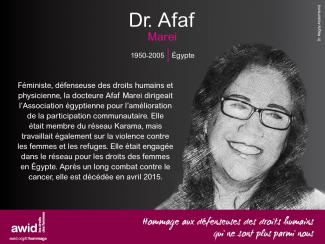
Dr. Afaf Marei

Lxs defensorxs se identifican a sí mismas como mujeres y personas lesbianas, bisexuales, transgénero, queer e intersex (LBTQI) y otrxs que defienden derechos y que debido a su trabajo en derechos humanos están bajo riesgos y amenazas específicos por su género y/o como consecuencia directa de su identidad de género u orientación sexual.
Lxs defensorxs son objeto de violencia y discriminación sistemáticas debido a sus identidades y su inclaudicable lucha por derechos, igualdad y justicia.
El Programa Defensorxs colabora con contrapartes internacionales y regionales así como con lxs afiliadxs de AWID para crear conciencia acerca de estos riesgos y amenazas, abogar por medidas de protección y de seguridad que sean feministas e integrales, y promover activamente una cultura del autocuidado y el bienestar colectivo en nuestros movimientos.
lxs defensorxs enfrentan los mismos tipos de riesgos que todxs lxs demás defensorxs de derechos humanos, de comunidades y del medio ambiente. Sin embargo, también están expuestas a violencia y a riesgos específicos por su género porque desafían las normas de género de sus comunidades y sociedades.
Nos proponemos contribuir a un mundo más seguro para lxs defensorxs, sus familias y comunidades. Creemos que actuar por los derechos y la justicia no debe poner en riesgo a lxs defensorxs, sino que debe ser valorado y celebrado.
Promoviendo la colaboración y coordinación entre organizaciones de derechos humanos y organizaciones de derechos de las mujeres en el plano internacional para fortalecer la capacidad de respuesta en relación a la seguridad y el bienestar de lxs defensorxs.
Apoyando a las redes regionales de defensorxs y de sus organizaciones, tales como la Iniciativa Mesoamericana de Mujeres Defensorxs de Derechos Humanos y la WHRD Middle East and North Africa Coalition [Coalición de Defensorxs de Derechos Humanos de Medio Oriente y África del Norte], promoviendo y fortaleciendo la acción colectiva para la protección, poniendo el énfasis en establecer redes de solidaridad y protección, promover el autocuidado y la incidencia y movilización por la seguridad de lxs defensorxs.
Aumentando la visibilidad y el reconocimiento de lxs defensorxs y sus luchas, así como de los riesgos que enfrentan, a través de la documentación de los ataques que sufren, e investigando, produciendo y difundiendo información sobre sus luchas, estrategias y desafíos.
Movilizando respuestas urgentes de solidaridad internacional para lxs defensorxs que están en riesgo a través de nuestras redes internacionales y regionales y de nuestrxs afiliadxs activxs.
Nous aspirons à faire du Forum de l’AWID un réel rassemblement mondial, où participeront une gamme diverse de mouvements, de régions et de générations. Dans ce but, l’AWID mobilise des ressources pour un Fonds d’accès limité, qui soutiendra les coûts liés à la participation de certaines personnes au Forum.
Le 14ème Forum international de l’AWID se tiendra du 11 au 14 janvier 2020 à Taipei, à Taïwan.
Pour ce Forum de l’AWID, il n’y aura pas de processus de candidature.
En supplément, l’AWID financera la participation d’environ 100 personnes de la région d’accueil du Forum. Les membres des comités du Forum (Contenu et méthodologie, Accès et Accueil) ainsi que les membres du Groupe de travail des artistes recevront aussi un soutien du Fonds d'accès.
Nous avons listé d’autres options pour financer votre participation au Forum de l’AWID sur cette page qui contient des idées de financement.


AWID began preparing this annual report just as the global pandemic began to unravel how we gather, organize and live our lives. It is impossible to review what we have done without COVID-19 tinting our assessment.
Download the full 2019 Annual review
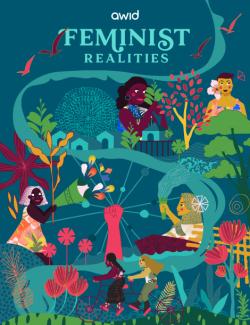
It is an urgently needed affirmation that there are other, more just ways of organizing our lives. During 2019 hundreds of groups shared their experiences and proposals for feminist realities with us, ranging from radical networks of community support in Latin America facilitating self-managed abortion, to practices of community-centered economies in Indonesia and community-centered food systems in India and the US, to a re-imagination and new practice of harm-free rites of passage in Sierra Leone. These are the experiences that will chart a path forward for a “new normal”.
Yet long histories of oppression and violence can make it difficult to imagine the possible. A key part of our work in 2019 was to spark these explorations through a toolkit AWID launched to support groups interested in unearthing the stories and aspirations that are the building blocks of feminist propositions.
Through the Observatory on the Universality of Rights, Feminists for a Binding Treaty, Count Me In! and other alliances, AWID has continued to push back against unfettered corporate power and fascist and fundamentalist agendas that undermine women’s rights and gender justice. With dim prospects for transformative change through multilateral processes and limited responsiveness from most states, we are redoubling our efforts to ensure that feminist movements, in all their diversity, are resourced in ways that match the critical roles they play - supporting their communities, demanding rights and responding to crises. In 2019 we introduced feminist principles and approaches to ground-breaking funds like the Spotlight Initiative and the Equality Fund, and succeeded in leveraging resources through feminist reality seed grant funding from feminist funders.
As we look ahead, it is clear that the context is calling for a transformation of our organizing strategies:
AWID is embarking on a new membership model that lowers barriers to access and emphasizes opportunities for engagement and cross-member connection. We will continue to experiment with different online tools and processes for building community. Cross-movement engagement will stay at the center of our work. AWID’s actions in solidarity with oppressed movements and identities, even and especially where these are marginalized in feminist movements, are important to drive change and support broad and inclusive movements for all.
We are resilient, we adapt, and we show up for each other. And we have to keep doing better. Thank you to all who are part of the journey with us.
Download the full 2019 Annual review
جديد
كمشارك/ة عبر الإنترنت، يمكنك توجيه النشاطات والتواصل والتحدث مع الآخرين/ الأخريات وتجربة الإبداع والفن والاحتفال بمنتدى جمعية حقوق المرأة في التنمية بشكل مباشر. سيستمتع المشاركون/ات المتصلون/ات عبر الإنترنت ببرنامج غني ومتنوع، بدءًا من ورشات العمل والنقاشات وحتى نشاطات الاستشفاء والعروض الموسيقية. ستركز بعض الأنشطة على التواصل بين المشاركين/ات عبر الإنترنت، وسيكون البعض الآخر هجينًا بالفعل، يركز على الاتصال والتفاعل بين المشاركين/ات عبر الإنترنت وأولئك الموجودين/ات في بانكوك.
La cocréation de nos réalités féministes commence par nous-mêmes, et nos façons de nous traiter les un·e·s les autres. Nous nous efforçons de créer et de protéger des espaces qui sécurisent et soutiennent nos communautés, à la fois en ligne et en personne.
Nous envisageons aussi les espaces sécurisés et accueillants, tout comme cocréés, et dont la possession est partagée. Nous attendons de nos membres qu'iels agissent de façon éthique, responsable et cohérente vis-à-vis des valeurs de l’AWID, et qu'iels assument une responsabilité collective pour garantir un environnement de respect mutuel et de solidarité.
Remarque :
L’AWID se réserve le droit de supprimer des commentaires, suspendre ou révoquer l’adhésion de membres en cas de violation des règles de la communauté. Les membres de l’AWID ne sont pas autorisés à représenter l’AWID à titre officiel, sauf mention écrite contraire. Les membres ne peuvent pas utiliser les espaces de l’AWID à des fins de prosélytisme ou de recrutement de membres pour rejoindre une organisation ou une croyance religieuse. Les membres ne peuvent pas utiliser les espaces de l’AWID pour demander des fonds à des fins personnelles, bien que les liens vers des actions de levée de fonds ou des campagnes de mobilisation soit autorisés.
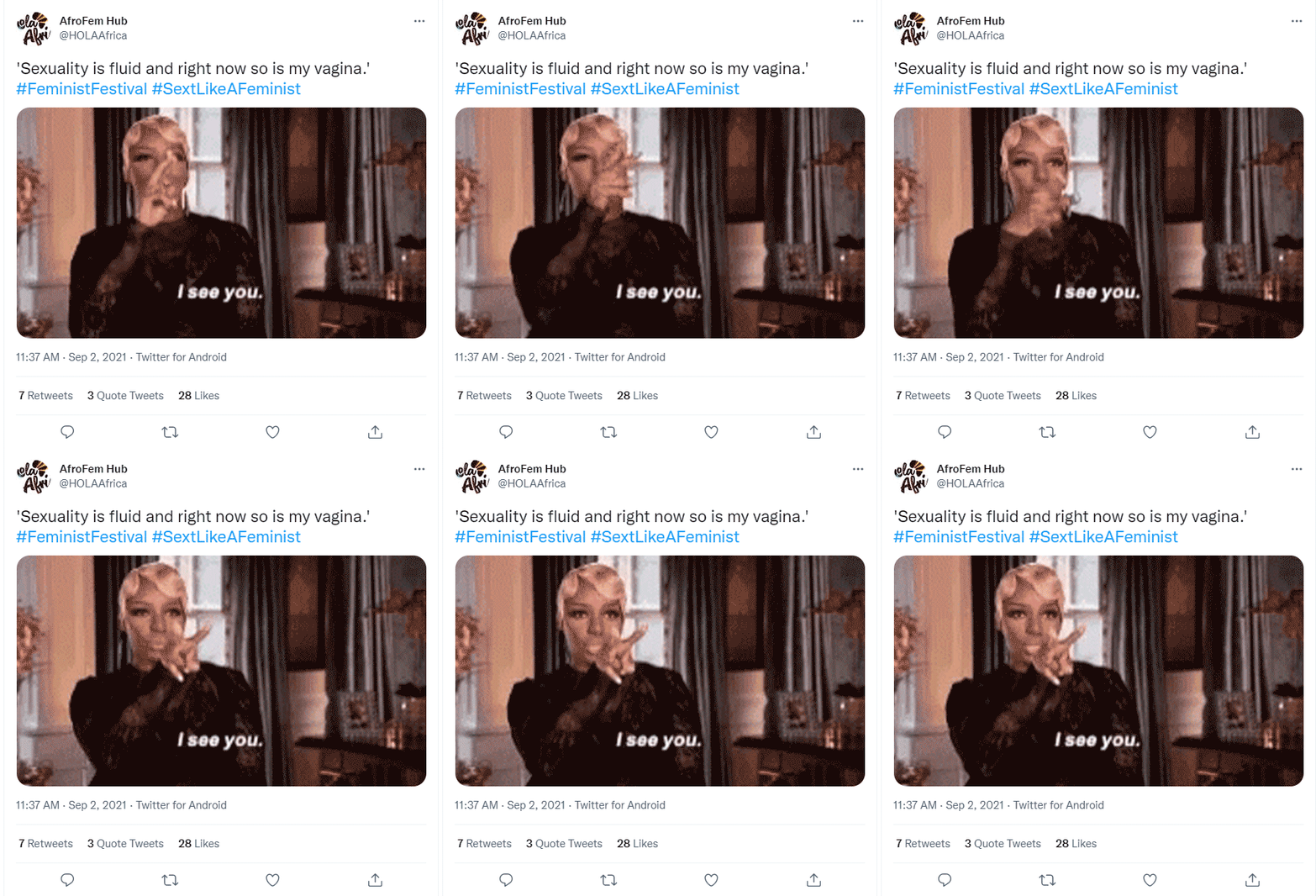
‘La sexualidad es fluida y en este momento mi vagina también’
#FeministFestival #SextLikeAFeminist
Del 27 - 30 April, 2026, AWID estará en la Conferencia Women Deliver 2026, co-creando un hogar político con movimientos feministas y de justicia de género basado en el cuidado y la solidaridad transnacional.
En un momento en que el fascismo y la militarización continúan en aumento a nivel global, la conexión feminista y la solidaridad a través de las fronteras es lo que realmente necesitamos. Estamos organizando múltiples espacios en Women Deliver y en línea para conectar movimientos entre sí en conversaciones para construir agendas feministas de solidaridad y acción.
From the rising right in many countries and the flurry of funding cuts hitting hard civil society of the Global Majority, to the ongoing genocide in Gaza, the intensification of violent conflicts in Sudan, and climate crisis in many parts of our planet, we are facing real forces of fascism and a world order of impunity. This makes our opportunities to come together and build solidarity particularly valuable and imperative for our survival as a global feminist community. Of course, in 2024, the 15th AWID International Forum finally happened, and what a powerful space it was.
Download the full 2024 Annual Report
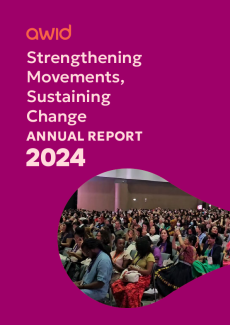
As we look ahead, we build on the powerful calls to action made by feminists at the AWID Forum; Together we can build a world where justice, liberation and care are not aspirations but realities.
By Alejandra Laprea
What a difficult task, that of condensing all the power and diversity of voices being raised in Latin America to tell the other stories emerging in this vast territory, to speak of the feminist realities we are building in our movement and other community-based organizations.
I spent a long time trying to establish parameters for the search and selection of these films, with the idea that they would enable you to get a little closer to so many dreams and projects that are slowly coming into being in the territories Nuestroamericanos, of our Americas, as we like to call them ourselves. It was a tough job trying to establish parameters, such as geographic location, linguistic justice, and representation of diverse communities — Indigenous, Afro-descendants, migrants — and the many causes and claims for which they raise their voices. I arrived at the conclusion that making such a compilation would be the work of years, one of those projects always under construction.
And so I decided to search for works that have emerged out of organizing and activism, as well as films that will perhaps spark major debates that we are yet to have.
In this selection of films you will find the voices of filmmakers who are not content with simply recording the feminist realities that palpitate in every corner of this vast and diverse territory. These are works that from their very conceptualization are questioning for what, by whom, and how films and videos are made. They understand film to be an instrument of struggle, something more than images to be enjoyed on a screen. These are individual or collective filmmakers who see film and video making as an instrument to promote discussion, open a debate, and thus serve as a resource for popular and feminist pedagogies.
Seen in this light, this small film selection is a journeythrough feminist realities on two levels; on one level are the stories you will see, and on another level, there is the experimentation of filmmakers who are seeking and creating other feminist realities through the ways in which they are making films and telling stories.
Enjoy this journey through films that Resist, Create, and Transform.
Direction: Giovana García Soto
Docu-fiction
Spanish with English subtitles
In Lima is Burning our work plays with documentary and fiction to take us into the life of Gía, a non-binary person, who uses performance art as a tool to denounce and transgress, as a vital manifesto against transfobia in every space, including gays spaces. With Gía we also take a look at transfeminism as a safe community in which Gía feels embraced, where she shares feelings and affections.
Giovana Garcia Sojo is a young peruvian audiovisual producer, specialized in low-budget production, creation for children and adolescents in cinema and cinematographic script by the International School of Cinema and Television - EICTV in San Antonio de Baños - Cuba. Giovana has developed her path as a director towards women and feminized identities, Lima is Burning is one of her first works.
Director: Patricia Ortega
Fiction
Spanish with English subtitles
Patricia Ortega, director of «Yo, Imposible» [“Being Impossible”] explores through the character of Ariel, a young girl whose intersex body was surgically violated as a child, the many ways that society attempts to normalize sexual and gender diversity.
The film tells the story of how Ariel discovers she was born intersex and subjected to several surgeries to normalize her genitals. This discovery leads the character to rediscover her body and reconstruct her identity. The audience is led to question a society dominated by heteronormativity which renders others invisible and condemns them to a life of unhappiness.
Patricia Ortega is a Venezuelan filmmaker living in Argentina who studied at the International School of Film and Television in Cuba, where she specialized in film directing. Patricia uses fiction to address extreme situations that women or feminized bodies go through, and how they overcome them.
«Yo, Imposible»' takes a position vis-à-vis the dominant conception of a world in which only the masculine and feminine exist, which makes others invisible. “They are not sick. They are just genetically different. Interventions are done on their genitals and bodies through hormones without their consent, which is a violation of their human rights and identity, forcing them to fit into established categories'' - Patricia Ortega
Director: Maria Torrellas Liebana
Documentary
Spanish with English subtitles
María Torrellas narrates the story of the Cuban Revolution through the women who brought it to life, Vilma Espín, Celia Sánchez, and Haydee Santamaría, among others.
For women, telling the story of the Cuban Revolution is not something of the past, but a daily struggle that Torrellas shows through the voices of Cuban rural women, professionals, students, and workers in the present. In “Cuban Women in Revolution” we encounter the current challenges facing Cuban women such as the persistence of old prejudices, new forms of violence, and the constant challenge of creating new feminist realities for themselves and the next generations in a territory besieged by USA imperialism for more than 70 years.
María Torrellas is a journalist and documentary filmmaker. She has a long trajectory of filmmaking and has won, among others, the Santiago Alvarez in Memoriam award for her documentary “Memoria de una hija de Oshun” [Memory of a Daughter of Oshun].
“In the documentary I have woven together the struggles of yesterday’s heroines with those of today’s women. The women tell their own stories and also describe those whose struggles they most admire. It made an impression on me to hear the words ‘The Revolution gave us everything’ or ‘What would have become of my family without the Revolution?’ from voices of compañeras who are poor, rural, or Black.” - María Torrellas
Directors: Gabriela Arnal and Marzel Ávila for Fondo de Acción Urgente - LAC
Ecuador 2019
Spanish with English subtitles
CUIDANDERAS joins the words cuidar (to care for) and curanderas (women healers) synthesizing the identities of a series of women in Latin American territories, women who put their bodies and all their energy into protecting the Commons, what Pachamama gives us, with the commitment that we use it as wisely as the rest of living beings doThis mini series of documentary films presents the stories of three collectives of Latin American women who are committed to caring for their territories, healing their bodies, and confronting extractivist and racist projects in Ecuador, Colombia, and Bolivia.
Province of Orellana, Ecuador. For centuries the Waorani women have been engaged in a struggle for their territory in the Amazon and the preservation of their Indigenous culture. Today they confront threats by the oil industry and their death-production model. From the jungle, leaders from the Waorani Women’s Association of the Ecuadoran Amazon (AMWAE, in Spanish) share the motivation behind their resistance and show their greatest power: their inexhaustible joy.
Buenaventura, Colombia. In the largest and most violent port city in Colombia, plagued by decades of armed conflict, racism, and machismo, a group of women refuse to give in to fear and continue to resist in the face of adversity. The Butterflies with New Wings network is made up of Black women from the Pacific coast of Colombia who work together to protect their territory, recuperate their ancestral traditions, and heal the wounds of systematic and structural violence.
Indigenous, rural, and regantes (women in charge of irrigation) in Bolivia are calling for the care and protection of bodies-earth-territories, as they are faced with an extractive production model which threatens their lives, health, physical and sexual integrity, and the survival of their communities and territories. The Network of Defenders of Mother Earth is made up of women from 12 Indigenous communities who are defending the right to water and denouncing mining companies’ violations of human rights and the rights of Nature while working to recuperate their ancestral ways of knowledge and practices of collective care.
“CUIDANDERAS, a combination of the words cuidar (to care for) and curanderas (women healers), presents the stories of Latin American women defenders who are caring for their territories and healing their bodies. The collective power of these women has changed the history of their communities in Ecuador, Colombia, and Bolivia as they confront extractivist and racist production models.”
Director: Carolina Reynoso
Argentina 2013
Spanish
If there is one thing that has marked feminist movements across the continent of Latin America that is the call for abortion to be made available, safe, and free. From North to South feminist movements are rising up and taking to the streets fighting for the liberation of our first territory, our bodies, which is why this selection must include a documentary on abortion to fully understand the power of the women of Nuestramérica.
Yo aborto, Tu Abortas, Todxs Callamos [I abort, you abort, we all keep silent] presents the stories of seven women from different social classes, including the director of the documentary herself, who reflect on something they have all experienced in their own bodies: clandestine abortion.
Through their stories, the film aims to bust myths regarding the voluntary interruption of pregnancy, de-stigmatize the topic, and show one of the most common forms of violence in the Americas in a new light.
Director, researcher, and producer of feminist films. She is also a feminist activist who organizes workshops on screenwriting from a gender perspective so that more films are made showing other counterhegemonic realities and stories. Carolina Reynoso strikes a balance between activism and creation in each one of her works.
“We are a group of filmmakers who make documentaries in order to continue fighting to make abortion available, safe, and free in Argentina. The film presents the testimonies of seven women from different social classes, including the director of the documentary herself, who reflect on something they have all experienced in their own bodies: clandestine abortion.” -The filmmaking team
Nosotras Audiovisuales, collective of Chilean women filmmakers
Chile 2020
Spanish
“Urgent Stories” is a series created by women to make their needs and important experiences visible to the people living in the territories that today comprise Chile. This film series aims to keep alive the flame ignited by the social uprising of October 2019, the flame ofChile in all its diversity that woke up and said, ‘Enough!’
«Resistencia en ollas comunes» [Resistance in the Soup Kitchens] is the first of these “Urgent Stories.” Through the voices of four women from Iquique, Valparaiso, Chillan and Santiago, it shows how by collectively assuming care work they are on the front lines of resistance, creating other feminist realities for themselves and the communities where Latin American women live.
Nosotras audiovisuales
This organization was formed in 2017 to link together women involved in the Chilean filmmaking scene. It helps women filmmakers to network, collaborate, and share information along with their works and perspectives on the field.
Nosotras Audiovisuales contributes to the Chilean uprising by documenting it and collectively generating new material.
Micol Metzner
Argentina 2019
Spanish
Based on her personal experience, director Micol Metzner presents a film mixing documentary with fiction, aligning her filmmaker’s voice with that of thousands of women who have been victims of trafficking across the continent and showing how solidarity among women is the best form of protection.
Filmmaker trained at the Instituto de Arte Cinematográfico de Avellaneda [Avellaneda Institute of Film Arts]. Art director and editor. Metzner belongs to the Video Cluster of the City of Buenos Aires, a community space and multisectorial cooperative for independent projects.
She facilitates filmmaking workshops in working class neighbourhoods and spaces of enclosure (youth group homes and women’s prisons). She is a member of the film production house MVM.
“The production house MVM was born out of the necessity to express a lot of things that we regularly protest on the streets about while also doing it in a creative way through drawing, film, and photography.The production house MVM is a place that interrogates language, image, film from a feminist perspective. It is also a place for processing everything we have gone through and using art to make things sometimes to heal, sometimes to generate public debate as happened with this short film…I didn’t imagine that was going to happen, but when we showed it, a lot of things were set in motion. Discussions happen that are even more enriching than the short film itself. That this can happen based on something we made is so good…” - Micol Metzner
Facebook: @AWIDWomensRights
Instagram: @awidwomensrights
Twitter ENG: @awid
Twitter ES: @awid_es
Twitter FR: @awid_fr
LinkedIn: Association for Women's Rights in Development (AWID)
Manal Tamimi est une activiste palestinienne et une défenseuse des droits humains. Mère de quatre enfants, elle est titulaire d’une maîtrise en droit international humanitaire. Son activisme lui a valu d’être arrêtée trois fois et d’être blessée à plusieurs reprises, notamment avec des balles explosives réelles qui sont interdites sur le plan international. Sa famille est elle aussi prise pour cible : ses enfants ont été arrêtés et blessés à balles réelles plus d’une fois. Le dernier incident dont elle a été victime était une tentative d’assassinat contre son fils Muhammad, qui a reçu une balle dans la poitrine, près du cœur, quelques semaines après sa libération des prisons d’occupation où il avait passé deux ans. Sa philosophie de vie : « si on va me faire payer parce que je suis palestinienne et non parce que j’ai commis un crime, je refuse de mourir en silence ».