Consejo de Derechos Humanos (CDH)
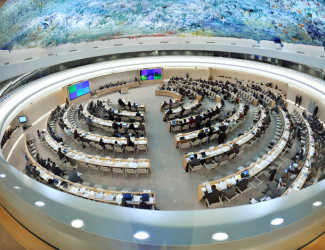
El Consejo de Derechos Humanos (CDH) es el cuerpo intergubernamental del sistema de las Naciones Unidas responsable de la promoción y protección de todos los derechos humanos en todo el mundo. El HRC se reúne en sesión ordinaria tres veces al año, en marzo, junio y septiembre. La La Oficina del Alto Comisionado para los Derechos Humanos (ACNUDH) es la secretaría del Consejo de Derechos Humanos.
El CDH trabaja de la siguiente forma:
-
Debate y aprueba resoluciones sobre cuestiones mundiales de derechos humanos y el estado de los derechos humanos en determinados países
-
Examina las denuncias de víctimas de violaciones a los derechos humanos o las de organizaciones activistas, quienes interponen estas denuncias representando a lxs víctimas.
-
Nombra a expertos independientes que ejecutarán los «Procedimientos Especiales» revisando y presentado informes sobre las violaciones a los derechos humanos desde una perspectiva temática o en relación a un país específico
-
Participa en discusiones con expertos y gobiernos respecto a cuestiones de derechos humanos.
-
A través del Examen Periódico Universal, cada cuatro años y medio, se evalúan los expedientes de derechos humanos de todos los Estados Miembro de las Naciones Unidas
La Sesión actual - CDH44
Se está llevarando a cabo en Ginebra, Suiza del 30 de junio al 17 de julio de 2020.
AWID trabaja con socios feministas, progresistas y de derechos humanos para compartir conocimientos clave, convocar diálogos y eventos de la sociedad civil, e influir en las negociaciones y los resultados de la sesión.
Con nuestrxs socixs, nuestro trabajo será:
◾️ Monitorear, rastrear y analizar actores, discursos y estrategias anti-derechos y su impacto en las resoluciones
◾️ Desarrollar conjuntamente una labor de promoción conjunta para contrarrestar a los actores anti-derechos y debatir más a fondo las conclusiones del Informe de Tendencias de OUR de 2017
◾️ Apoyar, coordinar y desarrollar de manera colaborativa el Caucus feminista emergente en el CDH
Contenido relacionado
Key opposition discourses
Ultra conservative actors have developed a number of discourses at the international human rights level that call on arguments manipulating religion, culture, tradition, and national sovereignty in order to undermine rights related to gender and sexuality.
Anti-rights actors have increasingly moved away from explicitly religious language. Increasingly, we see regressive actors - who may previously have derided human rights concepts - instead manipulating and co-opting these very concepts to further their objectives.
Protection of the family
This emerging and successful discourse appears innocuous, but it functions as a useful umbrella theme to house multiple patriarchal and anti-rights positions. The ‘protection of the family’ theme is thus a key example of regressive actors’ move towards holistic and integrated advocacy.
The language of ‘protection of the family’ works to shift the subject of human rights from the individual and onto already powerful institutions.
It also affirms a unitary, hierarchical, and patriarchal conception of the family that discriminates against family forms outside of these rigid boundaries. It also attempts to change the focus from recognition and protection of the rights of vulnerable family members to non-discrimination, autonomy, and freedom from violence in the context of family relations.
The Right to Life
The Holy See and a number of Christian Right groups seek to appropriate the right to life in service of an anti-abortion mission. Infusing human rights language with conservative religious doctrine, they argue that the right to life, as set out in the Universal Declaration of Human Rights and the International Covenant on Civil and Political Rights, applies at the moment of conception.
The discourse has no support in any universal human rights instrument. Yet this is an appealing tactic for anti-rights actors, because the right to life cannot be violated under any circumstances and is a binding legal standard.
Sexual rights
Anti-rights actors use a number of rhetorical devices in their campaign to undermine sexual rights: they argue that sexual rights do not exist or are ‘new rights,’ that they cause harm to children and society, and/or that these rights stand in opposition to culture, tradition or national laws.
Conservative actors engaged in advocacy at the UN attack the right to comprehensive sexuality education from several directions. They claim that CSE violates ‘parental rights’, harms children, and that it is not education but ideological indoctrination. They also claim that comprehensive sexuality education is pushed on children, parents, and the United Nations by powerful lobbyists seeking to profit from services they provide to children and youth.
Attempts to invalidate rights related to sexual orientation and gender identity have proliferated. Ultra conservative actors argue that application of long-standing human rights principles and law on this issue constitutes the creation of ‘new rights’; and that the meaning of rights should vary radically because they should be interpreted through the lens of ‘culture’ or ‘national particularities.’
Reproductive Rights
Christian Right organizations have been mobilizing against reproductive rights alongside the Holy See and other anti-rights allies for several years. They often argue that reproductive rights are at heart a form of Western-imposed population control over countries in the global South. Ironically, this claim often originates from U.S. and Western Europe-affiliated actors, many of whom actively work to export their fundamentalist discourses and policies.
Regressive actors also cite to ‘scientific’ arguments from ultra-conservative think tanks, and from sources that rely on unsound research methodologies, to suggest that abortion causes an array of psychological, sexual, physical, and relational side effects.
Protection of children and parental rights
Just as anti-rights actors aim to construct a new category of ‘protection of the family,’ they are attempting to construct a new category of ‘parental rights,’ which has no support in existing human rights standards.
This discourse paradoxically endeavours to use the rights protections with which children are endowed, as articulated in the Convention on the Rights of the Child, to support the rights of parents to control their children and limit their rights.
Violence against women
Increasingly, anti-rights actors are attempting to infiltrate and subvert standards and discourses developed by women human rights defenders, such as violence against women (VAW).
At the Commission on the Status of Women and other spaces, one rhetorical move is to treat VAW as a concept in which to embed anti-reproductive rights and patriarchal arguments. Ultra conservative actors, for example, have argued that non-heteronormative or traditional intimate partner relationships are a risk factor for violence, and emphasize that fathers are necessary to protect families from violence.
Gender and ‘gender ideology’
The Holy See has set off a sustained critique of gender, ‘gender ideology’, ‘gender radicals,’ and gender theory, and anti-rights actors often read the term as code for LGBTQ rights. Gender is used by the religious right as a cross-cutting concept that links together many of their discourses. Increasingly, the hysteria on this subject fixates on gender identity and trans rights.
Complementarity and human dignity
Complementarity of the sexes is a discourse employed by a number of ultra-conservative actors today. Its rhetoric is structured around an assumption of difference: men and women are meant to have differing but complementary roles in marriage and family life, and with respect to their engagement in the community and political and economic life.
Reference to ‘natural’ roles is meant to fundamentally reject universal human rights to equality and non-discrimination.

It is also used to justify State and non-State violations of these rights, and non-compliance with respect to State obligations to eliminate prejudices and practices based on stereotyped roles for men or women.
National sovereignty and anti-imperialism
This discourse suggests that national governments are being unjustly targeted by UN bodies, or by other States acting through the UN. This is an attempt to shift the subject of human rights from the individual or marginalized community suffering a rights violation to a powerful and/or regressive institution - i.e. the state, in order to justify national exceptions from universal rights or to support state impunity.
Religious freedom
Anti-rights actors have taken up the discourse of freedom of religion in order to justify violations of human rights. Yet, ultra-conservative actors refer to religious freedom in a way that directly contradicts the purpose of this human right and fundamentally conflicts with the principle of the universality of rights. The inference is that religious liberty is threatened and undermined by the protection of human rights, particularly those related to gender and sexuality.
The central move is to suggest that the right to freedom of religion is intended to protect a religion rather than those who are free to hold or not hold different religious beliefs.
Yet under international human rights law, the right protects believers rather than beliefs, and the right to freedom of religion, thought and conscience includes the right not to profess any religion or belief or to change one’s religion or belief.
Cultural rights and traditional values
The deployment of references to culture and tradition to undermine human rights, including the right to equality, is a common tactic amongst anti-rights actors. Culture is presented as monolithic, static, and immutable, and it is is often presented in opposition to ‘Western norms.’
Allusions to culture by anti-rights actors in international policy debates aim to undermine the universality of rights, arguing for cultural relativism that trumps or limits rights claims. Regressive actors’ use of cultural rights is founded on a purposeful misrepresentation of the human right. States must ensure that traditional or cultural attitudes are not used to justify violations of equality, and human rights law calls for equal access, participation and contribution in all aspects of cultural life for all, including women, religious, and racial minorities, and those with non-conforming genders and sexualities.
Subverting ‘universal’
Anti-rights actors in international policy spaces increasingly manipulate references to universal or fundamental human rights to reverse the meaning of the universality of rights.
Rather than using the term universal to describe the full set of indivisible and interrelated human rights, ultra conservative actors employ this term to instead delineate and describe a subset of human rights as ‘truly fundamental.’ Other rights would thus be subject to State discretion, ‘new’ rights or optional. This discourse is especially powerful as their category of the truly universal remains unarticulated and hence open to shifting interpretation.
Other Chapters
Snippet FEA The fight for a world full of workplaces (ES)
La lucha por un mundo lleno de lugares de trabajo libres de todas formas de discriminación, estigma y exclusión es digna. Un mundo en el que el trabajo sexual sea descriminalizado y reconocido como trabajo es parte integrante de esto.
Un mundo donde todxs lxs trabajadorxs tengan condiciones de trabajo seguras, salarios dignos y puedan disfrutar de los mismos derechos como el acceso a la salud, pensiones, permisos por enfermedad, vacaciones, seguridad laboral y más, sin importar su género, raza, etnia, edad o capacidad.
Los derechos laborales son cuestiones feministas, y los sindicatos feministas desempeñan un papel clave en la promoción de los derechos legales, laborales y económicos de todxs lxs trabajadorxs, especialmente lxs trabajadorxs migrantes, lxs trabajadorxs domésticxs, lxs trabajadorxs informales y lxs trabajadorxs sexuales. Estas son personas que recientemente se han visto afectadas de manera desproporcionada por la pandemia, su crisis de cuidados, los confinamientos, toques de queda y el aumento de la vigilancia y represión policial.
Aquí les presentamos las historias de activistas feministas y sindicalistas que luchan por mejores condiciones de trabajo y mejores mundos para todxs.
Fariha Al Berkawi
When development initiatives, religious fundamentalisms and the state of women’s rights collide
Nuestro nuevo documento de investigación El diablo se esconde en los detalles aborda la falta de conocimientos sobre los fundamentalismos religiosos en el sector del desarrollo, y se propone comprender mejor de qué manera estos fundamentalismos inhiben el desarrollo y, en particular, los derechos de las mujeres. Propone recomendaciones para que quienes trabajan en temas de desarrollo desafíen la labor de los fundamentalismos y eviten fortalecerlos inadvertidamente. [CTA download link: Leer el documento completo]
Seven pointers to consider
| Graphic1 | 1. Control of women’s bodies, sexuality, and choice are “warning signs” of rising fundamentalisms. |
| 2. Neoliberal economic policies have a particularly negative impact on women, and fuel the growth of religious fundamentalisms. | Graphic2 |
| Graphic3 | 3. Choosing religious organizations as default for partnerships builds their legitimacy and access to resources, and supports their ideology, including gender ideology. |
| 4.Everyone has multiple identities and should be defined by more than just their religion. Foregrounding religious identities tends to reinforce the power of religious fundamentalists. | Graphic4 |
| Graphic5 | 5. Religion, culture, and tradition are constantly changing, being reinterpreted and challenged. What is dominant is always a question of power. |
| 6. Racism, exclusion, and marginalization all add to the appeal of fundamentalists’ offer of a sense of belonging and a “cause”. | Graphic6 |
| Graphic7 | 7. There is strong evidence that the single most important factor in promoting women’s rights and gender equality is an autonomous women’s movement. |
Auge global de los fundamentalismos religiosos.
El Diablo se esconde en los detalles proporciona detalles de las graves violaciones a los derechos humanos y, en particular, de las violaciones a los derechos de las mujeres, causados por los fundamentalismos auspiciados por los Estados, así como por actores fundamentalistas no estatales como milicias, organizaciones comunitarias confesionales e individuos. La profundización fundamentalista de normas sociales atávicas y patriarcales está provocando el aumento de la violencia contra las mujeres, las niñas y las defensoras de derechos humanos (WHRDs). El informe propuesta estas ideas clave para abordar el problema:
- [icon] Fundamentalismos religiosos están ganando terreno en el seno de las comunidades
- [icon] Sistemas políticos
- [icon] Escenarios internacionales, con efectos devastadores para la gente común y para las mujeres en particular.
Los agentes de desarrollo deben actuar urgentemente.
Quienes trabajan en el desarrollo están de capacidad de asumir una posición más firme. Su capacidad colectiva para reconocer y enfrentar conjuntamente a los fundamentalismos religiosos resulta crucial para promover la justicia social, económica y de género y los derechos humanos de todas las personas en el marco del desarrollo sostenible. Resulta fundamental promover que el poder y los privilegios se entiendan desde la óptica del feminismo interseccional y aplicar esta comprensión a los interrogantes sobre religión y cultura. Las organizaciones de mujeres ya poseen conocimientos y estrategias para oponerse a los fundamentalismos. Quienes trabajan en el desarrollo deberían apoyarse en estos e invertir en coaliciones enfocadas en múltiples temáticas. Lo anterior, les ayudará a alcanzar nuevos horizontes.
Snippet FEA Georgia's minimum wage (FR)
Le salaire minimum en Géorgie est l’un des plus bas dans le monde. Cette réalité touche surtout les femmes.
Non seulement le pays a un écart de rémunération important entre les genres, mais les femmes travaillent également des heures plus longues et moins réglementées avant de rentrer chez elles pour s'occuper des tâches ménagères et de leur famille. Il n'y a pas de congé de maternité, pas d'augmentation de salaire pour les heures supplémentaires, pas d'assurance-chômage, et pas de congé de maladie ou d'autre protection sociale. Sous la pression d’organisations occidentales, les partis politiques oligarchiques géorgiens ont mis en œuvre des réformes qui détruisent l'État-providence, augmentent les mesures d'austérité et aggravent l'exploitation des travailleur·euses, le tout au profit des grandes entreprises qui applaudissent le pays pour sa «facilité à faire des affaires». Les médias, cooptés par des intérêts privés et corporatifs, sont partiaux sur ces questions ou les réduisent au silence. L'organisation syndicale reste l'une des rares options pour lutter pour les droits humains fondamentaux et pour tenir l'État et les entreprises responsables des violations et persécutions quotidiennes et généralisées contre les travailleur·euses, et en particulier les femmes.
Source: Minimum-Wage et entretien avec Sopo Japaridze dans Open Democracy
Rahma Abdulkadir
Here is your Feminist Realities Toolkit
Thank you for taking the first steps to Co-create Feminist Realities!
Learn more about Feminist Realities
Any questions? Please do not hesitate to contact us
Snippet FEA collaborator and allies Photo 4 (EN)

Isabel Martinez Martinez
資助建議
本頁面為如何資助您參與第14屆AWID論壇提供一些想法和靈感。
在您計劃將要在論壇上開展的活動時,請同時考慮如何為參加論壇提供資金支持。典型的費用支出包括:住宿、旅行、簽證、論壇註冊費等。
重要的是請注意,該論壇將有很多“開放空間”和學習、交流運動的機會,而正式會議的數量則少很多。(請參閱下面的“在籌款中如何描述我們的論壇”,以瞭解在您的宣傳中可使用的語言。)
與您目前的資助者合作:
首先聯繫您當前的資助者:最好的選擇始終是求助於當前的捐助者。
請確保提前準備:我們建議最晚在2020年初與這些資助方聯繫。許多支持女權組織的資助者為論壇旅行分配了一些預算。其他的資助方也可能將其囊括在續訂補助金中或包含在其他旅行基金裡。
如果貴組織有資助者,請告訴他們您想參加AWID論壇並學習、體驗、交流和建立網絡,即使您的活動還未被選中。為了能夠支持您的參與,您的捐助者需要提前了解此事,因此請立即告訴她們吧!(她們已經在決定將在2020年分配哪些資金)。
尋求新的資助者:
如果您目前沒有捐助者的支持或無法獲得論壇旅行的贈款,請考慮與新的捐助者聯繫。
- 您可以在AWID的門戶網站“誰能資助我組織女性的維權?” (In English) 中看到特定資助者的介紹。
- 考慮去接觸國家、區域或全球等層面的女權主義與女性基金會。(In English)
- 探索資助者網絡,例如Candid和歐洲基金會中心 (In English),以獲取您所在地區的資助者列表和機會。
各個資助方的申請截止日期和要求不盡相同,並且撥款審查過程可能需要數月的時間。如果您正在考慮申請新的資金,請盡快開始申請。
有創意的靈感:
女權主義運動長期以來在資助我們自己的行動方面保持著創造力。以下是我們收集的一些想法,用於啟發不同的籌款方式:
- 動員您的社區來支持參與:通過社區晚宴、舞蹈晚會以及本地的表演、活動和遊覽等方式從會員中籌集少量資金。
- 通過使用 gofundme, indiegogo, plumfund, or kickstarter 等各種在線工具組織捐贈圈和眾包來動員網絡。
- 獲得本地的收入來源,包括來自個人捐助者和會費的收入。
- 考慮通過與其他社區和社會正義團體的戰略夥伴關係共同集資。
想瞭解更多靈感,請參閱AWID正在進行的關於自主資源的系列文章,其中包括有關籌集參會資金的具體想法。(in English)
機會補助金:
AWID正在努力使論壇成為一個真正的全球性聚會,保障來自不同運動、地區和年齡層的參會者都可以參與。鑑於此,AWID為參與者調集資源並提供有限數量的機會補助金,以幫助她們支付參加論壇的費用。
AWID的機會補助金將為部分論壇參與者和會議/活動的主持人提供支持。您可以在申請過程中指出是否要申請AWID機會補助金。我們無法保證您能否申請到,所以我們強烈建議您為自己參加會議和論壇尋求其他資助。
即使您已申請了AWID的機會補助金,我們仍鼓勵您繼續探索其他的選擇來資助您參加論壇。機會補助金的申請結果將在2020年6月結束之前得到確認。請記住,這些資源非常有限,我們無法為所有申請人提供支持。
在籌款中如何描述我們的論壇:
當您與資助方或您自己的網絡聯繫時,這裡的一些示例信息可能會有所幫助。您可以隨時以對您有用的任何方式進行調整!
AWID論壇是一個聯合創建的女權運動空間,可激發參與者自身的行動積極性,並在多種權利和正義運動中加強與他人的聯繫。參與者可以從希望、能量和激進的想像力中汲取靈感,加深共享的分析和學習,建立跨領域的運動團結,以製定更加綜合的議程並推進聯合戰略。
我們的組織正在尋求資金參加論壇,以便與來自世界各地的其他活動家和運動聯繫在一起,加強我們的戰略並分享工作成果。我們受到過往參與者的啟發,她們描述了這場全球女權主義聚會的力量:
“在四天的時間裡……各種聲音交織在一起,形成了關於性別平等狀況的全球視角。當我說“全球”一詞時,我是指同時翻譯成七種不同的語言……”
“它提醒著我們,我們並不孤單。論壇提供了必要的途徑幫助我們將集體力量轉化為運動。無論是何種意識形態、身份或邊界,我們的力量都體現在我們的願景和對彼此的支持中。”
重要的是請注意,該論壇將有很多“開放空間”和學習、交流運動的機會,而正式會議的數量則少很多。儘管很多與會者不會參加正式的會議,但仍有寶貴的空間來學習、制定戰略和體驗女權運動在行動中的集體力量。
預算的考慮:
在計算花費以及思考需要募集多少款項時,最重要的是要考慮可能出現的成本。以下是要考慮的關鍵項目支出的示例:
- 機票
- 論壇註冊費(請注意,即便AWID授予您機會補助金,您也要自己支付註冊費)
- 簽證費用
- 旅遊健康保險
- 往返機場的本地旅行(出租車或其他交通工具)
- 中途停留的費用,例如飛機需要長時間中途停留時的住宿費和伙食費
- 住宿(如果您旅行很遠,可以給自己一天的恢復時間,無論是在之前或之後)
- 設備(旅行期間需要的WiFi或國際通訊費用,AWID將在論壇期間提供WiFi)
- 論壇上分享或交換的任何材料(可視教具,報告,藝術品!)的材料費
- 雜費和/或包括食物與其他花銷的每日津貼(論壇期間,AWID將提供所有午餐和咖啡/茶歇,外加一頓晚餐)
- 附件,例如可能使您的旅行更加舒適、安全和有重要意義的任何其他支持
我們期待與您在論壇上見面!
論壇是一個協作過程
該論壇不僅僅是一個四天的會議。它更為女權主義現實實踐的運動增強之旅提供了另一個驛站,該旅程早已開始也將在論壇結束後繼續。
Snippet FEA different lines of work S4 (ES)
Líneas de trabajo:
EN CONTRA DE
Luz Yohana Lopez Vidal
Can speakers or other activity details be changed during 2024?
As we are submitting the application almost one year before the actual event.
Yes! Currently the form requests to list presenters even if they are not confirmed yet. We understand that changes are likely to occur within a year.