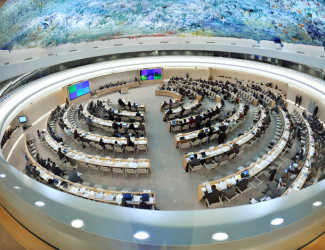
A general view of participants at the 16th session of the Human Rights Council in Geneva, Switzerland.
Análisis Especiales
AWID es un organización feminista internacional de membresía, que brinda apoyo a los movimientos que trabajan para lograr la justicia de género y los derechos de las mujeres en todo el mundo.
El Consejo de Derechos Humanos (CDH) es el cuerpo intergubernamental del sistema de las Naciones Unidas responsable de la promoción y protección de todos los derechos humanos en todo el mundo. El HRC se reúne en sesión ordinaria tres veces al año, en marzo, junio y septiembre. La La Oficina del Alto Comisionado para los Derechos Humanos (ACNUDH) es la secretaría del Consejo de Derechos Humanos.
El CDH trabaja de la siguiente forma:
Debate y aprueba resoluciones sobre cuestiones mundiales de derechos humanos y el estado de los derechos humanos en determinados países
Examina las denuncias de víctimas de violaciones a los derechos humanos o las de organizaciones activistas, quienes interponen estas denuncias representando a lxs víctimas.
Nombra a expertos independientes que ejecutarán los «Procedimientos Especiales» revisando y presentado informes sobre las violaciones a los derechos humanos desde una perspectiva temática o en relación a un país específico
Participa en discusiones con expertos y gobiernos respecto a cuestiones de derechos humanos.
A través del Examen Periódico Universal, cada cuatro años y medio, se evalúan los expedientes de derechos humanos de todos los Estados Miembro de las Naciones Unidas
Se está llevarando a cabo en Ginebra, Suiza del 30 de junio al 17 de julio de 2020.
AWID trabaja con socios feministas, progresistas y de derechos humanos para compartir conocimientos clave, convocar diálogos y eventos de la sociedad civil, e influir en las negociaciones y los resultados de la sesión.
Con nuestrxs socixs, nuestro trabajo será:
◾️ Monitorear, rastrear y analizar actores, discursos y estrategias anti-derechos y su impacto en las resoluciones
◾️ Desarrollar conjuntamente una labor de promoción conjunta para contrarrestar a los actores anti-derechos y debatir más a fondo las conclusiones del Informe de Tendencias de OUR de 2017
◾️ Apoyar, coordinar y desarrollar de manera colaborativa el Caucus feminista emergente en el CDH
Ardente défenseure des droits des femmes et des enfants, Su’ad dirigeait Al-Weed Al-Alaiami, une organisation irakienne de défense des droits humains.
Elle a participé aux manifestations de juillet 2018 qui ont eu lieu à Bassorah et dans plusieurs autres villes irakiennes pour protester contre le chômage, réclamer des emplois et des services publics appropriés pour les citoyen-ne-s, ainsi que pour exiger l'élimination de la corruption endémique. Le 25 septembre 2018, Su’ad a été assassinée dans le quartier d’Al-Abbasiyah, dans le centre-ville de Bassorah.
Une vidéo de l’incident a montré une personne qui s'est approchée d'elle alors qu'elle montait dans sa voiture, et lui a tiré une balle dans la tête avant de pointer son arme sur son chauffeur, Hussain Hassan, qui a été blessé à l'épaule. Su’ad Al-Ali avait 46 ans et était mère de quatre enfants.
Snippet FEA Meet the Solidarity Network (FR)
SYNDICAT RÉSEAU SOLIDARITÉ
Nous vous présentons le syndicat Réseau Solidarité, un syndicat de la santé et des services dirigé majoritairement par des femmes. Émergeant en réponse à la précarité croissante, aux salaires insuffisants et aux environnements de travail hostiles auxquels les travailleur·euses géorgien·es sont confrontés quotidiennement, le Syndicat Réseau Solidarité se bat pour des lieux et des conditions de travail décents.
Son objectif? Créer un mouvement syndical national démocratique. Pour ce faire, il s'est associé à d'autres syndicats locaux et régionaux et a lentement constitué un réseau de syndicats, permettant à de plus en plus de travailleuses de devenir dirigeantes syndicales en cours de route.
Son approche politique est holistique. Pour le syndicat Réseau Solidarité, les questions relatives aux droits du travail sont directement liées aux programmes et réformes politiques et économiques nationaux plus larges. C'est pourquoi iels font pression pour la justice fiscale, les droits des femmes et des personnes LGBTQIA+, et luttent contre le démantèlement de l'État-providence géorgien.
Le syndicat Réseau Solidarité fait également partie de Grève Sociale Transnationale (Transnational Social Strike, TSS), une plate-forme et infrastructure politique inspirée par l'organisation des migrant·e·s, des femmes et des travailleur·euses essentiel·les qui s'efforcent de créer des liens entre les mouvements ouvriers à travers le monde et de fomenter la solidarité globale.
Fornecer a membres da AWID, parceires do movimento e financiadores uma análise atualizada, robusta, baseada em fatos e orientada para a ação das realidades do financiamento de movimentos feministas e do estado atual do ecossistema do financiamento feminista.
2
Identificar e demonstrar oportunidades para transferir mais recursos de maior qualidade para a organização feminista, expor soluções falsas e interromper tendências que fazem com que o financiamento não seja bem-sucedido e/ou se mova contra a justiça de género e objetivos feministas interseccionais.
3
Articular visões, propostas e objetivos feministas para a justiça no financiamento.
El Foro Internacional de AWID es una reunión de 2.000 líderes de derechos de las mujeres y activistas de todo el mundo. El Foro AWID es el evento recurrente más grande de su tipo, y cada Foro tiene lugar en un país diferente en el Sur global.
El Foro Internacional de AWID es un evento de la comunidad global y, al mismo tiempo, un espacio para una transformación personal radical. Es un encuentro único: el Foro reúne a los movimientos feministas, por los derechos de las mujeres, por la justicia de género, LBTQI+ y aliados, en toda nuestra diversidad y humanidad, para conectarnos, sanar y florecer.
Únete a nosotrxs en Bangkok, Tailandia, y de manera virtual, en diciembre de 2024.
by Marta Plaza Fernández, Madrid, Spain (@gacela1980)
The feminist reality that I want to share is about weaving networks in which we uphold one another. Networks which come together in different ways, which emerge from our shared vulnerability, and which make all of us stronger.
The streets of Chamberí, my neighbourhood in Madrid, became much more of a home following the gatherings in the plazas organized by the citizens movement that originated in a rally on May 15, 2011. I think about how, during those years, we met each other and were able to associate faces, voices, smiles with so many neighbours who previously were only silhouettes without names or pasts, and who we passed by without seeing or hearing each other. I think about how we’ve become involved and dedicated; how we’ve woven a palpable, tangible community; how we’ve been advancing hand in hand towards building a new more inhabitable world, which we want and that we urgently need to create.
A group of activists and utopian neighbours, (in the best sense of the word utopian) – that moves us to action to do something real – that group for me was practically the first that reacted differently when I shared a part of my history and identity with them. With these women I shared my psychiatric diagnosis, my multiple hospital stays, the number of daily pills that accompanied me, my disability certificate, my difficulty in preserving that vital link that periodically disintegrates in my hands.
These neighbours, friends, comrades, links, loves –did not only not distance themselves from me once they got to know someone who many others had labelled as problematic, manipulator, egotistical – but became my principal network of affection and mutual support. They decided to navigate with me when the sea became agitated with storms. These people have given a different meaning to my days.
Building our feminist reality also encompasses carrying the “I believe you, sister” that we use when a friend has suffered a macho attack to the violence experienced by psychiatrized women at the hands of the very psychiatric system and institutions that are supposed to help us (and instead are often the new abuser who traumatizes and hurts us all over again). And this reality must include respect for our decisions, without taking away our agency and capacity to direct our own steps to one space or another; to listen to our narratives, desires, needs…without trying to impose others that are alien to us. It means not delegitimizing our discourse, not alluding to the label of our diagnosis, nor our madness.
With these transformation, each stay in the psychiatric institute did erase the ties that we had been able to build, but instead this network stayed by my side, its members took turns so that each day there would be no lull in calls, in visits, so that I could feel them as close as one can feel another person separated by locked doors (but unfortunately open for abuse) within the confines of the psychiatric ward. Through the warmth and kindness from my people I could rebuild that vital link that had once again been broken.
The even bigger leap happened when I was already aware of the numerous violent acts and abuse (where among other assaults, I spent days strapped to a bed, relieving myself where I lay), I decided that I would not go back to being interned.
This network of care, these women neighbours-friends-loves-comrades, they respected my refusal to return to the hospital and supported me through each crisis I’ve been through since then. Without being interned, without violence.
They took turns accompanying me when my link to life was so broken that I felt such a huge risk which I couldn’t handle on my own. They organized WhatsApp group check-ins. They coordinated care and responsibilities so that no one would feel overwhelmed - because when an individual feels overloaded, they make decisions based on fear and the need for control instead of prioritizing accompaniment and care.
That first crisis that we were able to surmount together in this way – without being admitted to the psychiatric institute, represented a dramatic change in my life. There were months when my life was at risk, of intense suffering and of so much fear for my people and for me. But we overcame it together, and all that I thought was that if we could get over that crisis, then we could also find ways to face all the difficulties and crises that may come.
These feminist realities that we’re building day by day keep expanding, growing and taking different forms. We’re learning together, we’re growing together. Distancing ourselves from a welfare mentality, one of the first lessons was that, in reality, there wouldn’t be anyone receiving care (because of a psychiatric label) or anyone helping, from the other side of the sanity/insanity line. We learnt – we’re learning – to move to a different key – that of mutual support, of providing care and being cared for, of caring for each other.
We’ve also explored the limits of self care and the strength of collectivizing care and redistributing it so it’s not a burden that paralyzes us; we learnt – and we keep learning today – about joy and enjoying care that is chosen.
Another recent learning is about how difficult it was to start integrating money as another component of mutual support that we all give and receive. It was hard for us to realize how internalized capitalism kept on reverberating in our relationship with money, and that even though no one expected any payment for the containers of lentils we cooked amongst us when eating and cooking were difficult tasks, our expectation regarding money was different. Phrases like “how much you have is how much you’re worth” become stuck inside of us without critically analyzing them. It’s easy to keep thinking that the money each one has is related to the effort made to earn it, and not due to other social conditioning distant from personal merit. In fact, within this well-established mutual support network – redistributing money based on needs without questioning – was still a remote reality for our day to day. That’s why this is something that we’ve recently started to work on and think through as a group.
We want to get closer to that anti-capitalist world where mutual support is the way that we have chosen to be in the world; and that entails deconstructing our personal and collective relationship with money and internalized capitalism.
In these feminist realities we also know that learning never stops, and that the road continues to be shaped as we travel upon it. There is still much to do to keep caring for ourselves, to keep expanding perspectives and to make ourselves more aware of the persistent power imbalances, of privileges that we hold and continue to exercise, without realizing the violence that they reproduce.
Though we’ve already travelled so far, we still have a long way to go to get closer to that new world that we hold in our hearts (and for some within our crazy little heads too). Racism, classism, adult-centrism, fat-phobia, and machismo that persists among our partners.
Among the pending lessons, we’ve needed for a long time already to build a liveable future in which feminism is really intersectional and in which we all have space, in which the realities and oppressions of other sisters are just as important as our own. We also need to move forward horizontally when we build collectively – getting rid of egos, of protagonisms, to live together and deal with the need for recognition in a different way. And to also keep making strides grounded in the awareness that the personal is always, always political.
How we relate to and link with each other cannot be relegated to the private domain, nor kept silent: other loves are possible, other connections and other families are necessary, and we are also inventing them as we go.
This new world which we want to create, and that we need to believe in – is this kind world – in which we can love, and feel pride in ourselves – and in which all worlds will fit. We’ll keep at it.
Looking at activists and feminists as healers and nourishers of the world, in the midst of battling growing right wing presence, white supremacy and climate change. This piece highlights how our feminist reality puts kindness, solidarity, and empathy into action by showing up and challenging the status quo to liberate us all.
« Après
Après l’amour la première fois,
Nos corps et nos esprits nus
Une galerie des glaces,
Complètement désarmés, absolument fragiles,
Nous nous couchons dans les bras de l’autre
Respirant attentivement,
Avec la crainte de briser
Ces figurines en cristal. » - Fahmida Riaz
Fahmida Riaz a brisé les tabous sociaux en écrivant sur le désir des femmes dans ses poèmes, créant des récits alternatifs à propos du corps des femmes et de leur sexualité, et établissant de nouveaux standards dans la littérature urdu.
Son travail s’est confronté à de sévères critiques de la part des conservateurs, qui l’ont accusée d’utiliser des expressions érotiques et « pornographiques » dans son langage poétique.
Fahmida a finalement été mise sur liste noire et accusée de sédition en vertu de l’article 124A du Code pénal pakistanais sous la dictature de Zia-ul-Haq. Forcée à l’exil en 1981, elle a passé presque sept ans en Inde avant de retourner au Pakistan.
Dans la préface de « Badan Dareeda » (Un corps ravagé), un recueil de poèmes publié en 1974, elle écrit :
Si, en effet, je suis forcée à me tenir aujourd’hui devant ce maqtal et me confronte à la potence, je dois y faire face, la tête haute. Mes poèmes sont la trace d’une tête mutilée : des sons émanant même lorsque suspendue par des cordes… Un corps ravagé a pris la forme de razmia, ou d’un son de rupture. Et si cette rupture est effectivement choquante pour les gens, c’est que la poète a atteint son intention : elle a réussi à la perturber. (traduction de l’urdu vers l’anglais par Asad Alvi)
La splendeur de Fahmida résidait dans sa défiance de toute logique ou toute catégorie particulière de genre, nation, religion ou culture. Elle refusait d’être mise dans le rôle d’une « femme poète », brisant les définitions traditionnelles de la poésie féminine, des concepts et des thématiques (variant entre conscience politique, corps, culture, désir, religion, foyer), et renversant les inhibitions assignées à son genre.
« Il faut que vous compreniez que la culture ne peut avoir d’essence. Les cultures changent, circulent entre elles, formant de nouvelles cultures. La culture est née de cette façon. Il n’y a pas de conflits de cultures. »
Fahmida a écrit plus de 15 livres de poésie et de fiction, dont son poème ‘Taaziyati Qaraardaaden’ («Résolutions de condoléances» en anglais) qui pourrait servir d'hommage approprié à sa vie et à son héritage et de collection de poèmes (Apna Jurm To Saabit He «Mon crime est prouvé») publié en 1988 durant son exil.
Fahmida Riaz est née à Meerut, en Inde, le 28 juillet 1946 et est décédée le 21 novembre 2018 à Lahore, au Pakistan.
Be part of an international feminist membership organization and community. Our members are based in all regions of the world, learning and supporting each other in a global network based on solidarity.
AWID Community Jobs board - FR
Bourse d'emploi communautaire
Êtes-vous à la recherche d'un emploi? L'un des avantages de rejoindre la Communauté de l'AWID est d'avoir accès à notre tableau d'offres d'emploi organisé par la communauté. Vous aurez l'occasion d'explorer de nouvelles opportunités et vous aurez également la possibilité de partager des postes vacants et des appels à propositions avec tous les membres.
2002: les discussions sur les questions relatives au financement du développement commencent
La Conférence de Monterrey sur le financement du développement a marqué le début des discussions sur les questions relatives au financement du développement.
Le Consensus de Monterrey a été adopté lors de cette première conférence internationale sur le financement du développement. Il s’agissait de la première réunion au sommet organisée sous l’égide des Nations Unies à traiter des questions financières fondamentales et des problématiques connexes relatives au développement mondial.
La conférence et ses phases préparatoires furent le théâtre d’une coopération sans précédent entre les Nations Unies, la Banque mondiale (BM), le Fonds monétaire international (FMI) et l'Organisation mondiale du commerce (OMC), montrant une partie des efforts entrepris pour promouvoir une cohérence et une homogénéité plus importantes au sein des systèmes et institutions monétaires, commerciaux et financiers internationaux.
Lors de cette conférence, les débats sur le financement du développement ont, pour la première fois, impliqué les gouvernements, des représentant-e-s de la société civile et le secteur privé. Ces acteurs ont porté les discussions au-delà des aspects « techniques » pour traiter des modalités de mobilisation et de canalisation des ressources financières nécessaires à la mise en œuvre des objectifs de développement internationalement convenus auparavant lors des sommets et conférences des Nations Unies des années 1990. Parmi ces objectifs figurent notamment les objectifs du Millénaire pour le développement (OMD).
Le Caucus des femmes a non seulement noté le caractère historique de cette conférence et déclaré que celle-ci pouvait permettre de relever les défis structurels qui continuaient à ralentir le développement, mais il a aussi souligné les inquiétudes engendrées par les conséquences de la militarisation croissante et de la montée des fondamentalismes à l’encontre des femmes, et ceci malgré le fait que le Consensus de Monterrey considérait que le système économique et financier mondial fonctionnait au profit de toutes et tous.
Pour en savoir plus sur les six axes de Monterrey et sur les mécanismes de suivi de la conférence : Gender Issues and Concerns in Financing for Development (en anglais), par Maria Floro, Nilufer Çagatay, John Willoughby et Korkut Ertürk (INSTRAW, 2004).
Exposition Pleasure Garden
Cette œuvre est la collaboration photographique et illustrative réalisée par Siphumeze et Katia pendant le confinement. Elle se penche sur les récits de sexe et de plaisir des queers noirs, le bondage, le sexe protégé, les jouets, la santé mentale et le sexe et bien d'autres choses encore. Elle a été créée pour accompagner l'anthologie Touch.
Mental Health (Santé mentale)Sex and Spirtuality (Sexe et spiritualité)Orgasm (Orgasme)
À propos des artistes
Siphumeze Khundayi est une créatrice d'art, photographe et animatrice qui s'intéresse aux moyens créatifs de réunir le dialogue et la pratique artistique en relation avec l'identité queer africaine.
Elle est directrice créative de HOLAAfrica!, un collectif panafricaniste féministe en ligne.
Ses travaux de performance en solo et collaboratifs ont été présentés dans un certain nombre de festivals et d'espaces théâtraux tels que le festival Ricca Ricca au Japon.
Elle a mis en scène deux productions nominées aux Naledi Awards en 2017 et 2018. Elle a aussi mis en scène un spectacle qui a remporté un prix Standard Bank Ovation en 2020.
En tant que photographe, elle a participé à une exposition de groupe intitulée Flowers of my Soul (Fleurs de mon âme) en Italie, organisée par le Misfit Project. Elle a produit trois publications pour HOLAAfrica et a été publiée dans le deuxième volume, pour lequel elle a fourni la couverture: As You Like des Gerald Kraak Anthologies.
Katia Herrera est une artiste visuelle numérique de 21 ans originaire de la ville bruyante de Saint-Domingue, en République dominicaine. Bien que Herrera soit une introvertie autoproclamée, ses œuvres d'art sont remarquablement fortes dans un monde qui tente de faire taire les voix des personnes noires. Avec des titres comme Black Woman (Femme Noire), You Own the Moon (La Lune t’Appartient), Earth Goddess (Déesse de la Terre), Forever (Pour Toujours) et Universe Protector (Protecteur.rice de l’Univers), l'héritage de Herrera sera marqué par sa volonté passionnée de mettre en lumière l'endurance et la persévérance des Noir·e·s d'hier et d'aujourd'hui, afin de contrer le discours selon lequel la peau noire ne devrait être associée qu'à l'esclavage.
L'une de ses œuvres la plus belle et la plus vivante, Universe Protector, dépeint l'âme noire comme une entité divine pleine de force, de puissance et de grandeur. C’est dans sa jeunesse que son amour du graphisme a été stimulé grâce à l'art de ses parents et le Photoshop qu'ils avaient téléchargé sur leur ordinateur pour leur photographie professionnelle.
Sylvia Rivera was a civil rights activist, a transvestite and sex worker.
Known as the New York Drag queen of color, Silvia was fierce and tireless in her advocacy, in defense of those who were marginalized and excluded as the “gay rights” movement mainstreamed in the United States in the early 1970’s.
In a well-known speech on Christopher Street Day in 1973, Sylvia, shouted through a crowd of LGBT community members:
“You all tell me, go and hide my tail between my legs.
I will no longer put up with this shit.
I have been beaten.
I have had my nose broken.
I have been thrown in jail.
I have lost my job.
I have lost my apartment.
For gay liberation, and you all treat me this way?
What the fuck’s wrong with you all?
Think about that!”
In 1969, at age 17, Silvia took part in the iconic Stonewall Riots by allegedly throwing the second Molotov cocktail to protest the police raid of the gay bar in Manhattan. She continued to be a central figure in the uprisings that followed, organizing rallies and fighting back police brutality.
In 1970, Sylvia worked together with Marsha P. Johnson to establish Street Transvestite Action Revolutionaries (S.T.A.R.), a political collective and organisation that would set up projects of mutual support for trans people living on the streets, those struggling with drug addiction and in prisons and in particular for trans people of color and those living in poverty.
Defiant of labels, Silvia lived life in a way that challenged people in the gay liberation movement to think differently. She said:
“I left home at age 10 in 1961. I hustled on 42nd Street. The early 60s was not a good time for drag queens, effeminate boys or boys that wore makeup like we did. Back then we were beat up by the police, by everybody. I didn't really come out as a drag queen until the late 60s. when drag queens were arrested, what degradation there was. I remember the first time I got arrested, I wasn't even in full drag. I was walking down the street and the cops just snatched me. People now want to call me a lesbian because I'm with Julia, and I say, "No. I'm just me. I'm not a lesbian." I'm tired of being labeled. I don't even like the label transgender. I'm tired of living with labels. I just want to be who I am. I am Sylvia Rivera.
Through her activism and courage, Sylvia offered a mirror that reflected all that was wrong within society, but also the possibility of transformation. Sylvia was born in 1951 and passed away in 2002.
Snippet FEA Sopo Japaridze Quote (ES)
"Sabemos que todo está en nuestra contra y hay muy pocas posibilidades de cambiar eso. Pero creemos en la intervención y creo que tenemos una oportunidad y deberíamos usarla. Es por eso que estamos haciendo todo lo que estamos haciendo. Estamos dispuestos a presionar por cosas inauditas".
Participa en el Foro Internacional de AWID - un importante encuentro feminista global—, y accede a descuentos especiales para afiliadxs de AWID y puntos de entrada para el diálogo virtual. Creado en conjunto por los movimientos feministas, el Foro es un espacio único para una discusión profunda y para dejar correr la imaginación, donde desafiamos y fortalecemos nuestros procesos organizativos, donde conectamos nuestras luchas y las realidades feministas.
The theme of the Fourth High-level Dialogue on Financing for Development, 23-24 March 2010: The Monterrey Consensus and Doha Declaration on Financing for Development: status of implementation and tasks ahead. It had four round tables on: the reform of the international monetary and financial systems; impact of the financial crisis on foreign direct investments; international trade and private flows; and the role of financial and technical development cooperation, including innovative sources of development finance, in leveraging the mobilization of domestic and international financial resources for development.
There was also the informal interactive dialogue involving various stakeholders that focused on the link between financing for development and achieving the Millennium Development Goals.
Nicole Barakat
We transcend time and place, Hand cut found paper (2017)We will remember who we are and We will persist Cotton embroidered hand cut lamé on wool silk cloth (2018)We will return home, Silk embroidered hand cut lamé on cotton velveteen (2018)We will heal in the now, Hand cut silk, wool, lamé, cotton, direct digital print silk satin on linen (2018)
we are infinite
An exhibition by Nicole Barakat, embodying her reconnection with the diaspora of objects from her ancestral homelands in the South West Asia and North Africa (SWANA) region.
Barakat presents a collection of textile works as manifestations of her practice of engaging with displaced, and often stolen objects held within Western museum collections including the Louvre, British Museum and Nicholson Museum.
To by-pass the gatekeepers and breach the vitrines holding these ancestral objects, Barakat reclaims pre-colonial, non-linear, receptive forms of knowing that are often devalued and dismissed by colonial and patriarchal institutions - engaging with coffee cup divination, dream-work, intuitive listening and conversations with the objects themselves (source).
About Nicole Barakat
Nicole Barakat is a queer femme, SWANA artist born and living on Gadigal Country (so-called Sydney, Australia). She works with deep listening and intuitive processes with intentions to transform the conditions of everyday life. Her work engages unconventional approaches to art-making, creating intricate works that embody the love and patience that characterises traditional textile practices.
Her works include hand-stitched and hand-cut cloth and paper drawings, sculptural forms made with her own hair, cloth and plant materials as well as live work where she uses her voice as a material.
Nicole’s creative practice is rooted in re-membering and re-gathering her ancestral knowing, including coffee divination and more recently working with plants and flower essences for community care and healing.