Consejo de Derechos Humanos (CDH)
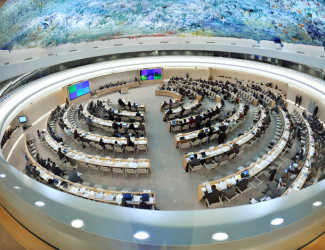
El Consejo de Derechos Humanos (CDH) es el cuerpo intergubernamental del sistema de las Naciones Unidas responsable de la promoción y protección de todos los derechos humanos en todo el mundo. El HRC se reúne en sesión ordinaria tres veces al año, en marzo, junio y septiembre. La La Oficina del Alto Comisionado para los Derechos Humanos (ACNUDH) es la secretaría del Consejo de Derechos Humanos.
El CDH trabaja de la siguiente forma:
-
Debate y aprueba resoluciones sobre cuestiones mundiales de derechos humanos y el estado de los derechos humanos en determinados países
-
Examina las denuncias de víctimas de violaciones a los derechos humanos o las de organizaciones activistas, quienes interponen estas denuncias representando a lxs víctimas.
-
Nombra a expertos independientes que ejecutarán los «Procedimientos Especiales» revisando y presentado informes sobre las violaciones a los derechos humanos desde una perspectiva temática o en relación a un país específico
-
Participa en discusiones con expertos y gobiernos respecto a cuestiones de derechos humanos.
-
A través del Examen Periódico Universal, cada cuatro años y medio, se evalúan los expedientes de derechos humanos de todos los Estados Miembro de las Naciones Unidas
La Sesión actual - CDH44
Se está llevarando a cabo en Ginebra, Suiza del 30 de junio al 17 de julio de 2020.
AWID trabaja con socios feministas, progresistas y de derechos humanos para compartir conocimientos clave, convocar diálogos y eventos de la sociedad civil, e influir en las negociaciones y los resultados de la sesión.
Con nuestrxs socixs, nuestro trabajo será:
◾️ Monitorear, rastrear y analizar actores, discursos y estrategias anti-derechos y su impacto en las resoluciones
◾️ Desarrollar conjuntamente una labor de promoción conjunta para contrarrestar a los actores anti-derechos y debatir más a fondo las conclusiones del Informe de Tendencias de OUR de 2017
◾️ Apoyar, coordinar y desarrollar de manera colaborativa el Caucus feminista emergente en el CDH
Contenido relacionado
¿Por qué AWID eligió Taipéi como sede del Foro?
AWID dedicó casi dos años al trabajo de identificar una sede para el Foro en la región Asia-Pacífico (la ubicación del Foro rota entre las distintas regiones).
Sobre la base de una investigación documental inicial y de consultas con aliadxs (que nos llevaron a eliminar muchas otras opciones de la región), organizamos una serie de visitas exhaustivas a Nepal, Malasia, Sri Lanka, Tailandia, Indonesia y, más tarde, Taiwán.
Cada visita incluyó, no solo la evaluación de la infraestructura logística, sino también encuentros con grupos y activistas feministas locales para entender mejor el contexto y conocer su percepción de las oportunidades y los riesgos potenciales de organizar un Foro de AWID en sus contextos.
En nuestras visitas encontramos movimientos feministas locales impresionantemente vibrantes y diversos.
Estos movimientos expresaron, en varias ocasiones, sentimientos encontrados respecto de las oportunidades y los riesgos que podría acarrearles la visibilidad de un evento como el Foro. En una de las visitas, durante los primeros treinta minutos de la reunión, escuchamos a lxs activistas presentes decir, en forma unánime, que un Foro de AWID sufriría una enorme reacción, que los derechos LGBTQ son un asunto particularmente candente, y que los grupos fundamentalistas aparecerían con toda su fuerza a interrumpir el evento.
Cuando respondimos, «De acuerdo, entonces ustedes no creen que sea una buena idea», nuevamente la respuesta unánime fue «Por supuesto que es una buena idea, ¡queremos cambiar la narrativa!». En algunos de estos lugares nos resultó difícil oír y ver que muchxs activistas feministas querían aprovechar la oportunidad de un evento grande y visible, y que estaban preparadxs a enfrentar los riesgos locales; pero nuestras consideraciones, como anfitrionxs de casi dos mil personas de todo el mundo, nos imponen un cálculo distinto del riesgo y la factibilidad.
También tuvimos que analizar qué significa organizar un foro feminista que a sea coherente con los principios de inclusión, reciprocidad y autodeterminación, en aquellos casos en que la política y la práctica de Estado son, en general, contrarias a estos principios (aunque lxs funcionarixs de los ministerios de turismo hayan trabajado arduamente para atenuar estas características).
Sopesamos las consideraciones de infraestructura con la oportunidad potencial de impulsar algunas agendas feministas a nivel nacional, y el contexto político nacional.
En muchos de estos lugares, monitorear el contexto nos resultó un ejercicio pendular: de un momento abierto y seguro para los debates feministas podíamos pasar a otro de brutal represión y xenofobia, capaz de sacrificar las prioridades feministas como piezas de negociación política para tranquilizar a las fuerzas antiderechos del ala derechista.
El proceso ha sido una reflexión aleccionadora sobre el contexto increíblemente complicado para el activismo por los derechos de las mujeres y la justicia de género en todo el mundo.
Nuestras dificultades en la región Asia-Pacífico nos llevaron a preguntarnos si no sería más fácil mover el Foro a una región distinta. Sin embargo, hoy en día no podríamos organizar un Foro de AWID en Estambul como lo hicimos en 2012, ni podríamos hacerlo en Brasil como lo hicimos en 2016.
Teniendo en cuenta toda esta complejidad, AWID seleccionó Taipéi como ubicación para el Foro porque:
- ofrece un cierto grado de estabilidad y seguridad para la diversidad de participantes que convocamos al Foro;
- tiene también un alto nivel de capacidad logística, y resulta accesible para muchxs viajerxs (con la facilitación de un trámite de visa electrónico para conferencias internacionales); y
- el Foro es bien recibido por el movimiento feminista local, que está muy interesado en interactuar con feministas de todo el mundo.
Al organizar el Foro de AWID, estamos tratando de construir y sostener, de la mejor manera posible, un espacio para las diversas expresiones de solidaridad, indignación, esperanza e inspiración que son el núcleo de los movimientos feministas.
En este momento, creemos que Taipéi es la sede, dentro de la región Asia-Pacífico, que mejor nos permitirá construir ese espacio seguro y rebelde para nuestra comunidad feminista global.
De hecho, en el mundo contemporáneo no existe una ubicación ideal para un Foro centrado en las Realidades Feministas. Donde sea que vayamos, ¡debemos construir ese espacio juntxs!
Snippet - Feminist Mixer - EN
Feminist Mixer: Speed Dating for Feminists!
✉️ By registration only. Register here
📅 Tuesday, March 11, 2025
🕒 6.00-8.00pm EST
🏢 Chef's Kitchen Loft with Terrace, 216 East 45th St 13th Floor New York
Organizer: AWID
Snippet AWID Forum Location Announcement Title (EN)
Announcing the AWID Forum Date & Location
Club de Cine Feminista - Club de Cine Feminista
Ya está disponible nuestro primer programa del Club de Cine Feminista: «Tenderness is the Sharpest Resistance» [«La ternura es la resistencia más intensa»], que es una serie de películas sobre realidades feministas de Asia-Pacífico curada por Jess X. Snow.
Binta Sarr
Binta Sarr fue una activista por la justicia social, económica, cultural y política, y una ingeniera hidráulica en Senegal. Después de 13 años en la administración pública, Binta dejó ese camino para trabajar con mujeres rurales y marginadas.
Fue de este compromiso que surgió la Association for the Advancement of Senegalese Women [Asociación para el Avance de las Mujeres Senegalesas] (APROFES, por sus siglas en inglés), un movimiento y organización de base que Binta fundó en 1987. Uno de sus principales enfoques fue la formación de dirigentes, en relación no solo con las actividades económicas, sino también con los derechos de las mujeres y el acceso a los puestos de toma de decisiones.
"Las poblaciones de base deben organizarse, movilizarse, asumir el control ciudadano y exigir la gobernabilidad democrática en todos los sectores del espacio público. La prioridad de los movimientos sociales debe ir más allá de la lucha contra la pobreza y debe centrarse en programas de desarrollo articulados y coherentes en consonancia con los principios de los derechos humanos, teniendo en cuenta al mismo tiempo sus necesidades y preocupaciones tanto a nivel nacional como subregional y desde una perspectiva de integración africana y mundial". - Binta Sarr
Partiendo de la convicción de Binta de que el cambio fundamental de la condición de la mujer requiere una transformación de las actitudes masculinas, APROFES adoptó un enfoque interdisciplinario, al utilizar la radio, los seminarios y el teatro popular, además de proporcionar una educación pública innovadora y brindar apoyo cultural a las acciones de sensibilización. Su compañía de teatro popular representó piezas originales sobre el sistema de castas en el Senegal, el alcoholismo y la violencia conyugal. Binta y su equipo también analizaron la conexión crucial entre la comunidad y el mundo en general.
"Para APROFES, se trata de estudiar y tener en cuenta las interacciones entre lo micro y lo macro, lo local y lo global y también, las diferentes facetas del desarrollo. Desde la esclavitud hasta la colonización, el neocolonialismo y la mercantilización del desarrollo humano, la mayor parte de los recursos de África y del Tercer Mundo (petróleo, oro, minerales y otros recursos naturales) están todavía bajo el control de carteles financieros y las otras multinacionales que dominan este mundo globalizado". - Binta Sarr
Binta fue una de las integrantes fundadoras de la sección femenina de la Asociación Cultural y Deportiva Magg Daan. Recibió distinciones del Gobernador Regional y del Ministro de Hidrología por su "devoción por la población rural".
Nacida en 1954 en Guiguineo, un pequeño pueblo rural, Binta falleció en septiembre de 2019.
Tributos:
"La pérdida es inconmensurable, el dolor es pesado y profundo, pero resistiremos para no llorar a Binta; no lloraremos a Binta, mantendremos la imagen de su amplia sonrisa en todas las circunstancias, para resistir e inspirarnos en ella, para mantener, consolidar y desarrollar su obra..." - Página de Facebook de Aprofes, 24 de septiembre de 2019.
"¡Adiós Binta! Creemos que tu inmenso legado será preservado." - Elimane FALL , presidente de ACS Magg-Daan
Debbie Stothard
Durante sus 38 años de carrera, Debbie Stothard ha trabajado con diferentes comunidades y activistas para involucrar en los derechos humanos y la justicia a los Estados, organizaciones intergubernamentales y otras partes interesadas a lo largo de Asia, África, Europa y las Américas. Su trabajo está enfocado en las prioridades temáticas de las empresas y en los derechos humanos, en la prevención de las atrocidades y en el liderazgo de las mujeres. Por ello, ha sido facilitadora o persona de referencia en casi 300 eventos de capacitación durante los últimos 15 años. La mayoría fueron talleres orientados a las bases, desarrollados en el terreno, centrados en la incidencia en derechos humanos, alfabetización económica, en empresas y derechos humanos, y en justicia transicional y prevención de las atrocidades. Su trabajo en justicia transicional y prevención de las atrocidades ha estado enfocado principalmente en Burma/Myanmar, aunque también ha proveído asesoramiento para responder a situaciones de otros países alrededor del mundo.
Entre 1981 y 1996, Debbie trabajó como periodista especializada en crímenes, activista estudiantil, analista política, académica, consejera de gobierno y proveedora de comida en Malasia y Australia, mientras era voluntaria en causas de derechos humanos. En 1996, fundó ALTSEAN-Burma, que encabezó una variedad de programas de innovación y empoderamiento en derechos humanos. Entre ellos, el programa intensivo permanente de liderazgo de ALTSEAN para diferentes mujeres jóvenes de Burma, que, durante los últimos 22 años, ha ayudado a fortalecer y ampliar el liderazgo de las mujeres en las zonas afectadas por el conflicto. Se desempeñó como integrante de la Junta de la Federación Internacional de Derechos Humanos (FIDH) durante 9 años como secretaria general adjunta (2010-2013) y secretaria general (2013-2019), durante los cuales promovió la misión y el perfil de la FIDH en, aproximadamente, 100 reuniones y conferencias por año.
Suzette Jordan
Anatomy of a Survivor's Story
Maryum Saifee (@msaifee), New York, USA
When you do a search for “Female Genital Mutilation” or “FGM” online, an image of four line-drawings of the female anatomy pop up next to its Wikipedia entry. It illustrates four types of violence. The first being a partial cut to the clitoris. The second, a more invasive cut with the entire clitoris removed. The third is progressively worse with the removal of the clitoris, labia majora and minora. And the fourth box illustrates a series of hash marks to symbolize stitches over the vaginal opening to allow only for urination and menstruation.
As a survivor of FGM, most questions about my story fixate on the physical. The first question I usually get asked is what type of FGM I underwent. When I told a journalist once that I went through Type 1, she said “oh, that’s not so bad. It’s not like type three which is far worse.” She was technically right. I had the least invasive form. And for many years, I gaslighted myself into feeling a sense of relief that I was one of the lucky ones. I comforted myself noting that I could have been less fortunate with all of my genitalia gouged out, not just the clitoral tip. Or worse I could have been one of the ones who didn’t survive at all. Like Nada Hassan Abdel-Maqsoud, a twelve year old, who bled to death on a doctor’s operating table earlier this year in Upper Egypt. Nada is a reminder to me that for every data point -- 200 million women and girls who live with the consequences of FGM globally -- there is a story. Nada will never be able to tell hers.
As much as I find the label “survivor” suffocating at times -- I also realize there is privilege embedded in the word. By surviving, you are alive. You have the ability to tell your story, process the trauma, activate others in your community and gain insights and a new language and lens to see yourself through.
The act of storytelling can be cathartic and liberating, but it can also shatter the storyteller in the process.
Without integrating the psychosocial support of trained clinicians into storytelling and healing retreats, well-intentioned interventions can result in more trauma. This is all the more important as FGM survivors navigate the double pandemic of their own PTSD from childhood trauma, and the indefinite COVID-19 global shutdown.
In many anti-FGM advocacy spaces, I have seen this insatiable hunger to unearth stories -- whatever the cost to the storyteller. The stories help activate funding and serve as a data point
for measuring impact.
Survivor stories then become commodities fueling a storytelling industrial complex. Storytellers, if not provided proper mental health support in the process, can become collateral damage.
My motivation in writing this piece is to flip the script on how we view FGM survivors, prioritizing the storyteller over the story itself.
FGM survivors are more than the four boxes describing how the pieces of our anatomy were cut, pricked, carved, or gouged out. In this essay, I’ll break down the anatomy of an FGM survivor’s story into four parts: stories that break, stories that remake, stories that heal, and stories that reveal.
Type 1: Stories that break
I was sitting in the heart of Appalachia with a group of FGM survivors, meeting many for the first time. As they shared their traumas, I realized we all belonged in some way or another to the same unenviable club. A white Christian survivor from Kentucky - who I don’t think I would have ever met if we didn’t have FGM survivorship connecting us - told the contours of her story.
There were so many parallels. We were both cut at seven. She was bribed with cake after her cut. I was bribed with a jumbo-sized Toblerone chocolate bar when mine was over. Absorbing her trauma overwhelmed me. And I imagine when I shared my story, others in the circle may also have been silently unraveling. We didn’t have a clinician or mental health professional in a facilitation role and that absence was felt. The first night, I was sharing a room with six other survivors and tried hard to keep the sounds of my own tears muffled. By the last day, I reached breaking point. Before leaving for the airport, my stomach contracted and I convulsively vomited. I felt like I was purging not only my pain, but the pain of the others I’d absorbed that week. We all dutifully produced our stories into 90 second social media friendly soundbites with narration and photos. But at what cost?
Type 2: Stories that remake
On February 6, 2016, the Guardian published my story as a survivor. The second it was released, I was remade. My identity transformed from nondescript, relatively invisible mid-level Foreign Service Officer to FGM survivor under a public microscope. That same day, then-U.S. Ambassador to the United Nations Samantha Power tweeted my story with the introduction: “I was seven years old” before linking to the article. The tweet symbolized a moment for me where my personal and professional worlds collided. Since then, they have been forever intertwined.
Even though I spent ten years of my career as a diplomat focused on other issues -- I lived in Cairo during the early days of the Arab Spring in 2011 and served in Baghdad and Erbil when the Syrian revolution turned from an uprising to civil war -- all of those past experiences that began to make mefeel erased. When I spoke on panels, my identity would be reduced to “survivor.” Like other survivors, I have worked hard to rewrite the script on how others see me.
I reinsert pieces of my other identities when speaking to underscore to the broader public that while yes, I am a survivor of childhood trauma and while my FGM story may have remade a part of my identity, it doesn’t define me.
Type 3: Stories that heal
With the guidance of a mental health expert, I have spent the last few months doing a deep dive into my FGM survivor story. I have told and retold my story over dozens of times in public venues. My goal is to break the culture of silence and inspire action. At this point, the telling of my story has almost become mechanized, as though I am reciting a verse from the Quran I memorized as a kid. I would always start with: “I was sitting an anthropology class when a fellow student described her research project on Female Genital Mutilation. And that’s when I had the memory jolt. A memory I had suppressed since childhood came flooding to the foreground.” I go into the details of what happened in granular detail -- the color of the floor, the feelings of confusion and betrayal in the hazy aftermath. And then I go on to talk about the afternoon I confronted my mother about the summer she and my father shipped my brother and off to India to stay with my aunt. The summer it happened. I later found out my aunt cut me without my parents’ consent. In my years of telling and retelling this story, I would have moments I felt nothing, moments I would break down, and moments of relief. It was a mixed bag, often contradictory emotions happening all at once.
When I began to take apart the story, I discovered the core moment where I felt most gutted. It wasn’t the cut itself. It was the aftermath. I remember sitting in a corner alone, feeling confused and ashamed. When I looked at my aunt on the other side of the room, she was whispering to my cousin and they both pointed and laughed at me. Unearthing the moment of shame - the laughter - has haunted me since childhood. The piece that was carved out of me is called “haram ki boti” which translates into sinful flesh. Over time, the physical scar healed. But for many FGM survivors, the psychological wounds remain
Type 4: Stories that reveal
Last year, I decided to take a sabbatical from the Foreign Service. I was burning out on both ends -- I had just completed a really tough assignment in Pakistan and was also doing anti-FGM
advocacy in my personal capacity. When I came home, an acquaintance from graduate school approached me to capture my story on film. As part of the process, she would send a camera
crew to shadow me. Sometimes while giving speeches, other times filming mundane interactions with friends and family. On a visit to my home in Texas, I’ll never forget the moment where my mom told me her story of survival. As part of the film, we went on a roadtrip to Austin to visit the university where I first had the memory jolt. My mom is patiently waiting for the cameraman to set up his tripod. My father is standing next to her.
In the end, we eventually had the conversation I never had the courage to have with either of my parents face to face. Looking them both in the eye, retelling my story with a camera as witness, we discussed how FGM ripped our family apart (specifically my dad’s relationship with his sister). For the first time, I heard my mom talking about her own experience and the feeling of betrayal when she discovered my aunt cut me without her consent. When I later told her that FGM was actually indigenous to the U.S. and Europe and that it was a cure for hysteria (prescribed by doctors) up until the 19th century, my mother exclaimed “that’s crazy to me, this was a cure for hysteria. I’m going to educate other doctors to speak out.” And in that moment, my mother, a survivor who had never shared her story before, became an activist.
My story, intertwined with her story, revealed a tightly woven fabric of resistance. With our voices, we were able to break the cycle of intergenerational structural violence. We were able to rewrite the stories of future generations of girls in our own family and hopefully one day, the world.
“Dreams”
by Neesa Sunar (@neesasunar), Queens, USA
This is a woman breaking free from her mundane reality, devoid of color. She dreams in a colorful, "nonsensical" way that people in her life would not understand. She could be considered insane, yet her dreams are more vivid and imaginative than actual life. This is frequently how schizophrenia occurs to me, more engaging and exciting than real life.

< United against the violence, by Karina Ocampo
Freeing the Church, Decolonizing the Bible for West Papuan Women, by Rode Wanimbo >
Snippet - CSW69 On feminist resourcing today - ES
Sobre la dotación de recursos feministas de hoy
- Responde el quiz "¿Dónde está el dinero?" aquí
- Our Resource (en inglés)
- Recursos autónomos: ¿Cómo lxs activistas podemos dotar de recursos a nuestro activismo?
- Qué podemos aprender de lxs feministas que se autofinancian
Snippet Discover Forum Stories (ES)

Los movimientos feministas han cambiado y se han adaptado enormemente desde la última vez que nos reunimos de esta manera - así que para recordar por qué son importantes los Foros de AWID, pedimos a activistas de todo el mundo que reflexionaran y compartieran sus historias, impresiones y recuerdos. Esto es lo que aprendimos.
Film club - The Turtle's rage
La carapace de mon père (2012) Allemand | Arabe avec sous-titres anglais
LA CARAPACE DE MON PÈRE raconte l'histoire d'un homme mystérieux dont la vie a été modelée par la fuite, l’expulsion, la vie en exil et un retour raté en Palestine. Le film comporte la quête d’une fille cherchant à obtenir des réponses de la part de son père.
Discussion en direct avec Pary El-Qalqili, réalisatrice de « La carapace de mon père »
Laurie Carlos
Laurie Carlos était une comédienne, réalisatrice, danseuse, dramaturge et poétesse aux États-Unis. Artiste hors pair et visionnaire, c’est avec de puissants modes de communication qu’elle a su transmettre son art.
« Laurie entrait dans la pièce (n’importe quelle pièce/toutes les pièces) avec une perspicacité déroutante, un génie artistique, une rigueur incarnée, une féroce réalité – et une détermination à être libre... et à libérer les autres. Une faiseuse de magie. Une devineresse. Une métamorphe. Laurie m’a dit un jour qu’elle entrait dans le corps des gens pour trouver ce dont ils et elles avaient besoin. » - Sharon Bridgforth
Elle a employé plusieurs styles de performance alliant les gestes rythmiques au texte. Laurie encadrait les nouveaux·elles comédien·ne·s, performeur·euse·s et dramaturges, et a contribué à développer leur travail dans le cadre de la bourse Naked Stages pour les artistes émergent·e·s. Associée artistique au Penumbra Theatre, elle a participé à la sélection de scripts à produire, dans l’objectif « d’intégrer des voix plus féminines dans le théâtre ». Laurie faisait également partie des Urban Bush Women, une compagnie de danse contemporaine reconnue qui contait les histoires de femmes de la diaspora africaine.
Elle fit ses débuts à Broadway dans le rôle de Lady in Blue, en 1976, dans la production originale et primée du drame poétique For colored girls who have considered suicide / when the rainbow is enuf de Ntozake Shange. L’oeuvre de Laurie inclut White Chocolate, The Cooking Show et Organdy Falsetto.
« Je raconte les histoires à travers le mouvement – les danses intérieures qui se produisent spontanément, comme dans la vie – la musique et le texte. Si j’écris une ligne, ce n’est pas forcément une ligne qui sera dite ; ce peut être une ligne qui sera bougée. Une ligne à partir de laquelle de la musique est créée. Le geste devient phrase. Tant de ce que nous sommes en tant que femmes, en tant qu’êtres, tient aux gestes que nous exprimons les un·e·s par rapport aux autres, tout le temps, et particulièrement dans les moments d’émotion. Le geste devient une phrase, ou un état de fait. Si j’écris “quatre gestes” dans un script, cela ne signifie pas que je ne dis rien;cela veut dire que j’ai ouvert la voie à ce que quelque chose soit dit physiquement. » Laurie Carlos
Laurie est née et a grandi à New York, a travaillé et vécu à Minneapolis-Saint-Paul. Elle est décédée le 29 décembre 2016, à l’âge de 67 ans, après un combat contre le cancer du côlon.
Hommages :
« Je pense que c’était exactement l’intention de Laurie. De nous sauver. De la médiocrité. De l’ego. De la paresse. De la création artistique inaboutie. De la paralysie par la peur.
Laurie voulait nous aider à briller pleinement.
Dans notre expression artistique.
Dans nos vies. » - Sharon Bridgforth pour le Pillsbury House Theatre
« Quiconque connaissait Laurie aurait dit que c’était une personne singulière. Elle était sa propre personne. Elle était sa propre personne, sa propre artiste ; elle mettait en scène le monde tel qu’elle le connaissait avec un vrai style et une compréhension fine, et elle habitait son art. » – Lou Bellamy, Fondatrice de la Penumbra Theatre Company, pour le Star Tribune
Lire un hommage complet par Sharon Bridgforth (seulement en anglais)
Simone Jagger
Simone has 20 years’ experience working in management support and administration in non-profit organizations, in particular post-graduate medical education and ICT training. She has qualifications in Management Support and Paralegal studies. She is based in South Africa, enjoys traveling and is an amateur Genealogist.
Francela Mendez
Principles of Engagement
Welcome to Crear | Résister | Transform: a festival for feminist movements!
Principles of Engagement
AWID is committed to creating an online space that invites and challenges us all to operate from a place of courage, curiosity, generosity and shared responsibility.
We invite you to co-create spaces with us that are free of harassment and violence, where everyone is respected in their gender identity and expression, race, ability, class, religion, language, ethnicity, age, occupation, type of education, sexuality, body size, and physical appearance. Spaces where we recognize inequalities in our world and strive to transform them in our own interactions with each other.
We want to create a space where ...
- we can all be present
This means that we are able to listen, understand and relate to each other. To feel close, in spite of it all being virtual. For this, we will make interpretation available and open channels (like chat and other tools) for you to react and share. To hear each other better, we invite you to wear headphones during the conversation. If it is possible for you , we suggest that you close your email and any other likely source of distraction while you are in the conversation.
- all forms of knowledge are valued
Let us celebrate the multiple ways in which knowledge shows up in our lives. We invite you to approach the conversation with curiosity and openness to learn from others, allowing ourselves to unlearn and relearn through the exchange, as a way to start collectively building knowledge.
- all of us feel welcome
We are committed to holistically approaching accessibility by being mindful of different physical, language, mental and safety needs. We want a space that is welcoming of folks from various backgrounds, beliefs, abilities and experiences. We will be proactive but we also ask that you communicate your needs with us, and we will do our best within our capacity to address these needs.
- all of us feel safe and respected:
We all commit individually and collectively to respect each other’s privacy and to seek people’s consent before sharing any images or content generated during the conversation that involves them.
Creating a safer, respectful and enjoyable environment for the conversations, is everybody's responsibility.
Reporting
If you notice that someone is behaving in a discriminatory or offensive manner, please contact the reference person who will be indicated at the beginning of the session.
Any participants that express oppressive language or images, will be removed from the call and will not be readmitted. We will not engage with them in any way.
Snippet - CSW69 - What Can Feminist Movements Learn - EN
What Can Feminist Movements Today Learn from Beijing 1995?
✉️ By registration only. Register here
📅 Wednesday, March 12, 2025
🕒 6.30–8:00pm EST
🏢 Church Center of the United Nations, 777 United Nations Plaza, New York, NY 10017
🎙️Co-facilitated by: Inna Michaeli, Co-Executive Director
Organizer: Jass, Gender at Work, and Count Me In! Consortium
Quelles mesures seront mises en place pour protéger la santé publique et contenir les risques d'épidémie de la Covid19 ?
Nous surveillons attentivement ce risque parmi d'autres, et nous publierons des informations détaillées concernant la santé et la sécurité dès l'ouverture des inscriptions afin que vous puissiez prendre une décision en toute connaissance de cause. En outre, le format hybride est conçu de façon à offrir une expérience de participation significative aux personnes qui préféreront ne pas voyager ou qui ne sont pas en mesure de le faire.
OURS 2021 - Explorar los capítulos
Explorar los capítulos
Roxana Reyes Rivas
Roxana Reyes Rivas, philosopher, feminist, lesbian, poet, politician and LGBT and women’s rights activist from Costa Rica. Owner of a sharp pen and incisive humour, a laugh a minute. She was born in 1960 and raised in San Ramón of Alajuela, when it was a rural town, and her whole life she would break away from the mandates of what it meant to be a woman.
With El Reguero (Costa Rican lesbian group) she organized lesbian festivals for over a decade, fun-filled formative spaces to come together at a time when the Costa Rican government and society persecuted and criminalized the lesbian existence. For hundreds of women the lesbian festivals where the only place they could be themselves and come together with others like them.
Roxana would often say founding political parties was one of her hobbies. “It’s important for people to understand there are other ways to do politics, that many issues need to be solved collectively”. She was one of the founders of the New Feminist League and VAMOS, a human rights focused political party.
“The philosophical trade is meant to jab, to help people ask themselves questions. A philosopher who doesn’t irritate anyone is not doing her job”. For 30 years Roxana taught philosophy at several Costa Rican public universities. Through her guidance, generations of students reflected about the ethical dilemmas in science and technology.
Roxana’s favourite tool was humour, she created the Glowing Pumpkin award, an acknowledgement to ignorance that she would bestow upon public figures, through her social media channels, mocking their anti-rights expressions and statements.
An aggressive cancer took Roxana at the end of 2019, before she could publish a compilation of her poems, a departing gift from the creative mind of a feminist who always raised her voice against injustice.