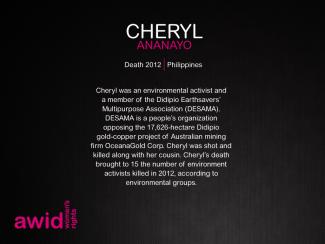
Cheryl Ananayo
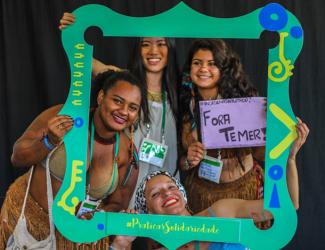
Young feminist activists play a critical role in women’s rights organizations and movements worldwide by bringing up new issues that feminists face today. Their strength, creativity and adaptability are vital to the sustainability of feminist organizing.
At the same time, they face specific impediments to their activism such as limited access to funding and support, lack of capacity-building opportunities, and a significant increase of attacks on young women human rights defenders. This creates a lack of visibility that makes more difficult their inclusion and effective participation within women’s rights movements.
AWID’s young feminist activism program was created to make sure the voices of young women are heard and reflected in feminist discourse. We want to ensure that young feminists have better access to funding, capacity-building opportunities and international processes. In addition to supporting young feminists directly, we are also working with women’s rights activists of all ages on practical models and strategies for effective multigenerational organizing.
We want young feminist activists to play a role in decision-making affecting their rights by:
Fostering community and sharing information through the Young Feminist Wire. Recognizing the importance of online media for the work of young feminists, our team launched the Young Feminist Wire in May 2010 to share information, build capacity through online webinars and e-discussions, and encourage community building.
Researching and building knowledge on young feminist activism, to increase the visibility and impact of young feminist activism within and across women’s rights movements and other key actors such as donors.
Promoting more effective multigenerational organizing, exploring better ways to work together.
Supporting young feminists to engage in global development processes such as those within the United Nations
Collaboration across all of AWID’s priority areas, including the Forum, to ensure young feminists’ key contributions, perspectives, needs and activism are reflected in debates, policies and programs affecting them.
por Judyannet Muchiri
En octubre del año pasado, me fui a Kenia para empezar lo que he llegado a considerar el trabajo más importante que he hecho hasta ahora. (...)
arte: «Healing Together» [Sanar juntxs], Upasana Agarwal >
"نعم! يرجى قراءة الدعوة للمشاركة والتقدم هنا . الموعد النهائي هو 15 يناير 2024" .
Par Nkhensani Manabe
Le titre de la conversation « Pansexuel, Gynasexuel ou Abrosexuel ? Une plongée dans la queerness, le plaisir et la positivité sexuelle » donne matière à réflexion. Tiffany Kagure Mugo, auteure, éducatrice et programmatrice de HOLAAfrica, commence la discussion par une lecture de Touch, une collection récemment publiée d'essais de fiction et de non-fiction sur le sexe, la sexualité et le plaisir. Dans cet extrait, l'auteure avance l'idée que le plaisir est constant et continu, qu'il se retrouve dans les activités quotidiennes et ne se limite pas aux relations sexuelles.
Cette idée, du plaisir faisant autant partie de la vie quotidienne qu'autre chose, guide la discussion, couvrant également les thèmes du désir, de l'attirance et de l'orientation sexuelle.
Dès le départ , il y a ce sentiment d'espoir et de possibilité. Tiffany présente des options et explique les alternatives, nous donnant un nouveau langage pour parler de qui nous sommes, de ce que nous aimons et de comment nous le voulons. Il est question de désir et de sexe, mais surtout de connaissance de soi et d'autonomisation. Tiffany parle avec passion du fait de prendre des décisions à partir d'un lieu de pouvoir : apprendre de sa propre identité afin de pouvoir faire les meilleurs choix pour soi-même.
Dans une discussion ouverte et libre, représentant l'attitude que Tiffany voudrait que nous adoptions tou·te·s, nous apprenons que les savoirs sur le sexe et la sexualité sont en constante évolution, et que leurs limites se déplacent. Ce qu’on a peut-être appris ou, plus important encore, ce dont nous avons été tenus à l'écart en tant qu'enfants ou adultes, est précisément le point de départ pour désapprendre et se déprogrammer. Tiffany souligne que les jeunes de nos jours ont besoin d'outils pour comprendre les expériences qu'iels vivent déjà, un rappel sur le fait de ne jamais sous-estimer ce que les enfants et les adolescent·e·s savent sur le type de plaisir(s) qu’iels poursuivent dans la vie.
La conversation m’a ouvert l’esprit sur un point : me connaître m'aidera à prendre confiance en moi ; je pourrai aborder les relations en prenant soin non seulement de moi-même mais des autres. Apprendre le langage de l'orientation, de l'attirance, du désir et du plaisir contribuera à approfondir mes relations futures. J'ai apprécié le fait d'avoir un espace pour réfléchir à cet aspect de ma vie - ces parties privées et intimes auxquelles je n'accède pas souvent. L'enthousiasme de Tiffany pour le plaisir et l'identité a repoussé mes propres limites et m’a permis d'ouvrir de nouvelles possibilités personnelles.
L'idée d'apprendre à établir des liens holistiques n'est pas encore courante. Globalement, nous vivons dans une culture de connexions instantanées et éphémères. Il n'y a pratiquement jamais de temps pour réfléchir réellement à la raison et au type de relation ou de partenariat que nous recherchons - du moins, pas avant une période de crise.
Bien sûr, il existe des espaces dédiés à accueillir les questions et les discussions, tels que le festival AWID Crear Résister Transform et d'autres plateformes ou publications en ligne de pensée libre - mais l'accès à l'information à partir d'une source utile et sans jugement est toujours laborieux . Cela peut être dû en partie au fait que les gens ne font pas confiance au langage de la sexualité et du plaisir.
La notion de langage et d'outils se répète tout au long de la présentation. Tiffany et ses collègues assurent la fonction de parler, d'enseigner et d’alimenter. Voir ce dont les personnes ont besoin, où elles se trouvent, ce qu'elles veulent pour elles-mêmes et marcher à leurs côtés pendant qu'elles construisent leurs mondes idéaux. Leur donner de nouveaux mots et définitions pour les aider à façonner leurs identités à différentes étapes de leur vie.
Les conversations de ce type sont nécessaires, même dans une société qui diffuse à tout moment une myriade de messages sur la santé, plus ou moins détaillés. Les gens ont parfois besoin d’être tirés à l'écart pendant les grands moments collectifs et encouragés à connaître leurs opinions et leurs désirs individuels. C'est ce que fait le discours de Tiffany : il donne aux gens un espace au sein du plus grand puzzle.
Sexuel - signifie le désir exprimé d'avoir des relations avec une ou plusieurs personnes
Sensuel - le désir de toucher une ou plusieurs personnes, d'être physiquement proche sans nécessairement avoir des rapports sexuels
Romantique - le désir de sortir ou d'être en relation avec une ou plusieurs personnes
Platonique - le désir de nouer des amitiés étroites
Esthétique - le désir de regarder et d'apprécier l'apparence d'une ou de plusieurs personnes
Ces cinq types ou niveaux d'attraction offrent un raccourci du désir et du plaisir, et aident à contextualiser les différents types de plaisir que les gens peuvent éprouver.
Penser l'attirance au-delà du physique ou du sexuel offre une nouvelle perspective sur les liens. C'est une chance de relâcher la pression sur les relations, ouvrant des opportunités pour des partenariats différents, plus éclairés et épanouissants.
Cette liberté et ces connaissances soulignées par Tiffany constituent une feuille de route pour l'avenir. La présentation a ainsi offert une perspective nouvelle sur ce qui est possible.
Comme le soulignait l'extrait d'ouverture, le plaisir est continu. À la lumière de la discussion de Tiffany, il devient clair que le plaisir est également dynamique et excitant. Il y a toujours plus à apprendre.
Cela peut être intimidant au début, mais de l'autre côté de l'hésitation, il y a de l'espoir, du potentiel et de la liberté.
إذا تم قبول مقترحك فسيتم الاتصال بك من قبل فريق جمعية حقوق المرأة في التنمية لتقييم احتياجات الترجمة الفورية وإمكانية الوصول والاستجابة لها.
Related content
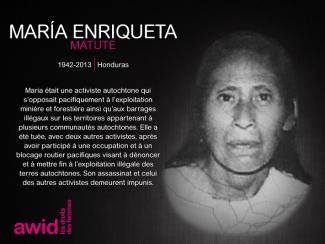
The Guardian: Mexican woman who uncovered cartel murder of daughter shot dead
The Economist: Obituary: Miriam Rodríguez Martínez died on May 10th
New York Times: Gunmen Kill Mexican Activist for Parents of Missing Children
United Nations Human Rights Office of the High Commissioner: Mexico: UN rights experts strongly condemn killing of human rights defender and call for effective measures to tackle impunity

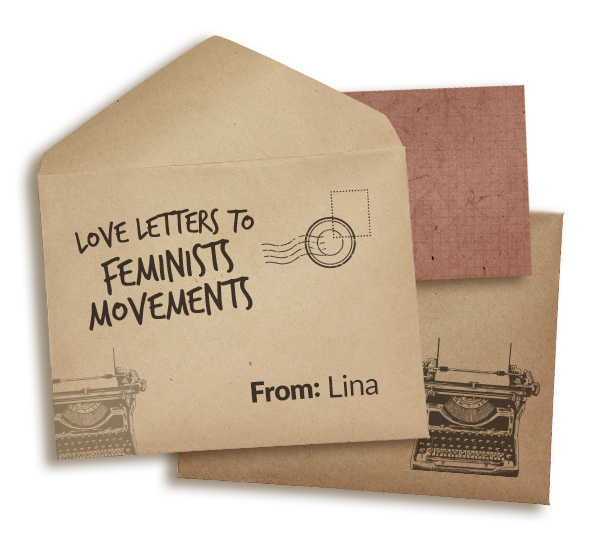
I have belonged to you for as long as I can remember. As a young girl, I did not know there was a word -feminist- for us people, who aspire to overcome and dismantle the patriarchy, who seek refuge in the arms of inclusion and intersectionality, who treat people as equals regardless of their gender, race, sexuality, religion, and ethnicity, who are constantly learning to do better, to be better and to use their privilege to uplift others.
When I was 14, my middle school French teacher, a 6ft tall thirty-year-old man, assaulted a female student in my class in front of all of us. The student, who was a childhood friend of mine, and several girls in my class went to the headmaster to report him, parents got involved, and the entire class of 30 students vouched for the girl. But all our attempts to hold him accountable failed and the administration covered up the girl’s story and he never got fired or persecuted. The girls in my class and I were outraged so we did what every young raging feminist would do. WE EGGED HIS CAR! and though the eggs get washed off easier and the paint we used to write “Pig” and “Khamaj '' -scumbag- needed to get scrubbed off. I will never forget how that made us girls feel. Liberated, enraged, happy, close-knit, and in power. The same feeling replicates in every feminist setting I have been in ever since. The teen feminist in me grew up to join Women Deliver, AWID, Unootha, facilitate feminist workshops at university, and even get persecuted for my feminist affiliation at 19, but that’s another story for another letter.
Feminist movements and spaces offer me safety and empowerment. They are the mothers we wished we had and the link we needed to connect and organize ourselves despite our differences against a common enemy that has been undermining everyone, patriarchy. It is through you that I learned to be resilient and to gather my strengths and skills and direct them towards uplifting others and bringing to light the marginalized and giving a voice to the voiceless.
What I love most about you, feminist movements is that you mess up sometimes, you disregard and marginalize as well, you have bias as does every other movement but what makes you different is that you always strive to be better. Accountability is not something you’re afraid of and you are an ever-changing collective that reflects how altruism and philanthropy in the effort of gender equity change as time passes.
May you always grow, may you do better, may you always rage, may you always roar, may you always love, may you always speak different tongues, and may you always be in power.
Love, light, and rage,
Lina
Tous nos processus de changement reposent sur les relations que nous établissons dans des espaces comme les forums de l'AWID, où l'on danse ensemble, où l'on fait ressortir son humour, sa vraie personnalité, où l'on raconte des histoires. C'est ce qui fait la différence.
- Nicky Mcintyre, États-Unis
THE TURTLE'S RAGE tells the story of a mysterious man, whose life has been molded by flight, expulsion, life in exile and the failed return to Palestine. The film is composed of a daughter's search for answers from her father.
باختصار، نعم! تعمل جمعية حقوق المرأة في التنمية حاليًا مع لجنة إمكانية الوصول لضمان إمكانية الوصول إلى المنتدى قدر الإمكان. نحن نجري أيضًا تدقيقًا لإمكانية الوصول إلى مكان انعقاد المنتدى والفنادق المحيطة ووسائل النقل. ستكون المعلومات التفصيلية حول إمكانية الوصول في منتدى جمعية حقوق المرأة في التنمية متاحة في هذا القسم قبل فتح التسجيل. وفي الوقت نفسه، لأية أسئلة يرجى الاتصال بنا.
Je suis ravie de te faire part d’un de mes rendez-vous les plus remarquables en tant que féministe en situation de handicap. C’était le 30 mai 2014. L’Organisation nationale des puissantes dames porteuses d’un handicap visuel (NOVEL) participait aux festivités de la Fashion Week 2014 des Philippines, au profit de notre campagne de plaidoyer pour les cannes blanches. Deux dames aveugles défilaient sur le podium pour promouvoir la canne blanche comme symbole de l’égalité des genres, de l’autonomisation, de l’inclusion totale et de la participation égale des femmes et des filles porteuses de handicap visuel au sein de la société.
J’étais extrêmement nerveuse au moment de leur passage devant la foule, en tant que porte-parole de notre projet auprès des productions Runway (j’avais douloureusement attendu cette approbation pendant une année entière), sachant qu’elles n’étaient pas des mannequins, elles avaient été nommées Madame Philippines Vision et la première dauphine 2013 de Madame Philippines sur Roues, Signe et Vision par Tahanang Walang Hagdanan, Inc. (« Maison sans marches »). Elles n’avaient pas pu participer à leur séance d’orientation et s’étaient entraînées la veille au soir sans pouvoir le faire avec des mannequins professionnelles. Avant que ne commence le spectacle, je les avais appelées pour booster leur confiance et prier ensemble que Dieu les guide. Lorsqu’elles ont quitté le podium, j’ai pris une grande respiration alors que les larmes coulaient sur mes joues. Je me sentais euphorique parce que nous y étions parvenues malgré toutes les difficultés! Notre message au monde disant que les femmes et les filles en situation de handicap visuel pouvaient marcher en toute dignité, liberté et indépendance sur la même base d’égalité que les autres, grâce à notre appareil d’aide – les cannes blanches – qui était passé! On a parlé de nous sur les réseaux sociaux ainsi que sur les chaînes de télévision.
Ma vie de féministe en situation de handicap a débutcé comme un moyen de réparer mon manque de confiance et de trouver une autre trajectoire de réussite pour ma vie après avoir survécu à une vicieuse attaque à l’acide en 2007, alors que j’attendais le véhicule qui devait me ramener chez moi depuis le bureau. Mes yeux ont été fortement touchés, au point où je suis devenue une femme malvoyante.
Ce progrès n’est pas sans coût, tout comme il n’est pas parfait. Les activistes féministes, les groupes et les activistes se retrouvent face aux difficultés typiques rencontrées dans les contextes conservateurs et affectés par des conflits. Mais l’impact du mouvement des jeunes féministes au Soudan mérite d’être encensé. Dépasser les obstacles internes des différences de culture, de religion et des conflits historiques est un défi en soi, que les jeunes féministes au Soudan semblent relever activement. La création d’écoles féministes au Darfour et dans le Kordofan révèle la trajectoire unique du travail des jeunes féministes au Soudan, dont nous pouvons tirer des enseignements.
Je n’avais jamais pensé que ma vie pourrait être aussi joyeuse et pleine de sens avant de rencontrer les femmes leaders du mouvement pour le genre et le handicap, qui n’ont cessé depuis d’exercer une influence positive sur moi. Leurs mots d’encouragement m’ont plu et sont devenus la musique la plus douce à mes oreilles. Mon cœur brisé bondit comme un oiseau qui prend son envol à chaque fois que je pense à elles et au féminisme qui m’a encouragée à contribuer pour que les choses changent pour nos sœurs en situation de handicap qui sont invisibles et pour celles qui continuent à être discriminées. Jusqu’à ce jour, je suis consumée par le désir d’être avec le mouvement. Je ne peux cacher mon excitation chaque fois que je soumets des propositions de projets à différentes parties prenantes pour l’autonomisation, le développement et la promotion de nos sœurs en situation de handicap. Ou à chaque fois que j’interviens dans des conversations locales, nationales et internationales pour faire entendre nos voix, même lorsque cela est à mes dépens.
De manière inattendue, j’ai été choisie pour représenter notre pays à l’assemblée générale de l’Union mondiale des aveugles (UMA) en 2012 en Thaïlande, bien que je venais d’arriver dans le mouvement en faveur du handicap. Cette même année, j’ai été la seule femme élue au comité de l’Union philippine des aveugles (UPA). J’ai eu envie de me rapprocher de nos sœurs ayant un handicap visuel et de les informer sur leurs droits et afin qu’elles connaissent les questions transversales. En 2013, nous avons officiellement lancé NOVEL pour soutenir l’autonomisation de nos sœurs en situation de handicap, constituer des coalitions de mouvements de plurihandicap et de mouvements de femmes et promouvoir le développement inclusif du genre du handicap.
Ma participation en tant que copersonne pour les ressources des femmes en situation de handicap dans notre soumission au rapport alternatif à la CEDAW en 2016 avec les groupes de femmes marginalisées, coordonné par Women’s Legal and Human Rights Bureau (WLB), m’a ouvert de nombreuses portes et également permis de travailler avec différentes organisations de femmes et de participer aux Journées internationales de l’inclusion de Berlin en 2017, aux côtés de trois leaders philippines en situation de handicap; journées au cours desquelles nous avons fait part de nos bonnes pratiques, et principalement de notre engagement auprès de mouvements des femmes d’autres pays.
Ma trajectoire en tant que féministe en situation de handicap a été une véritable montagne russe émotionnelle pour moi. J’en ai retiré beaucoup de joie et un sentiment de valeur lors du travail pour la promotion de nos sœurs en situation de handicap pour une participation totalement inclusive, égale et efficace dans la société, mais je me suis également sentie frustrée et en colère lorsque j’ai tout donné et que j’ai essuyé des remarques négatives. Malgré tout, c’est ce que je ressens parce que je suis amoureuse du mouvement.
Je vois mon avenir dans le travail en solidarité avec le mouvement afin de veiller à ce que nos sœurs, en situation de handicap ou non, puissent profiter de, et participer également et entièrement dans la société.
Plein d’amour,
Gina Rose P. Balanlay
Féministe en situation de handicap
Philippines
We are monitoring this and other risks carefully, and will publish comprehensive health and safety information when the registration opens, so you could make an informed decision. In addition, the hybrid format is designed to provide a meaningful engagement experience to the participants who will prefer not to travel or are not able to travel.