Young Feminist Activism
Organizing creatively, facing an increasing threat
Young feminist activists play a critical role in women’s rights organizations and movements worldwide by bringing up new issues that feminists face today. Their strength, creativity and adaptability are vital to the sustainability of feminist organizing.
At the same time, they face specific impediments to their activism such as limited access to funding and support, lack of capacity-building opportunities, and a significant increase of attacks on young women human rights defenders. This creates a lack of visibility that makes more difficult their inclusion and effective participation within women’s rights movements.
A multigenerational approach
AWID’s young feminist activism program was created to make sure the voices of young women are heard and reflected in feminist discourse. We want to ensure that young feminists have better access to funding, capacity-building opportunities and international processes. In addition to supporting young feminists directly, we are also working with women’s rights activists of all ages on practical models and strategies for effective multigenerational organizing.
Our Actions
We want young feminist activists to play a role in decision-making affecting their rights by:
-
Fostering community and sharing information through the Young Feminist Wire. Recognizing the importance of online media for the work of young feminists, our team launched the Young Feminist Wire in May 2010 to share information, build capacity through online webinars and e-discussions, and encourage community building.
-
Researching and building knowledge on young feminist activism, to increase the visibility and impact of young feminist activism within and across women’s rights movements and other key actors such as donors.
-
Promoting more effective multigenerational organizing, exploring better ways to work together.
-
Supporting young feminists to engage in global development processes such as those within the United Nations
-
Collaboration across all of AWID’s priority areas, including the Forum, to ensure young feminists’ key contributions, perspectives, needs and activism are reflected in debates, policies and programs affecting them.
Related Content
Lucy O.
Con más de 10 años de experiencia en finanzas, Lucy ha dedicado su carrera a misiones con y sin fines de lucro. También ha prestado trabajo voluntario para organizaciones sin fines de lucro. Desde el acelerado mundo de las finanzas, Lucy siente pasión por estar al día con las competencias tecnológicas asociadas con este ámbito. Lucy se incorporó a AWID en 2014. En su tiempo libre disfruta de la música, de viajar y de practicar una variedad de deportes.
L’activisme au Moyen-Orient et en Afrique du Nord
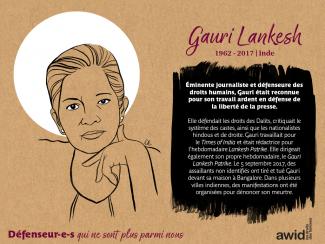
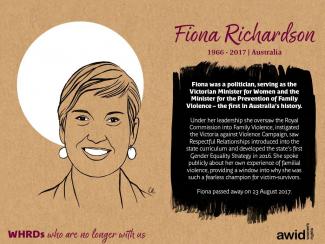
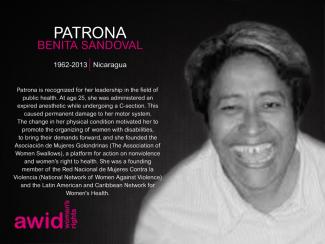
Notre hommage en ligne met à l’honneur cinq défenseuses des droits humains assassinées au Moyen-Orient ou en Afrique du Nord. Ces défenseuses étaient avocates ou militantes et ont œuvré pour les droits des femmes ou pour les droits civils. Leur mort met en évidence les conditions de travail souvent difficiles et dangereuses dans leurs pays respectifs. Nous vous invitons à vous joindre à nous pour commémorer la vie, le travail et l’activisme de ces femmes. Faites circuler ces mèmes auprès de vos collègues et amis ainsi que dans vos réseaux et twittez en utilisant les hashtags #WHRDTribute et #16Jours.
S'il vous plaît cliquez sur chaque image ci-dessous pour voir une version plus grande et pour télécharger comme un fichier


Snippet FEA Land and Agroecology
LAND AND
AGROECOLOGY
Rural Women Caring for Nature and Communities
Snippet - WITM Articulate - EN
Articulate feminist visions, proposals and agendas for resourcing justice.
Doris Viloria Palomares
Kasia Staszewska
Kasia soutient le travail des mouvements féministes et de justice sociale depuis 15 ans. Avant de rejoindre l'AWID, Kasia dirigeait les politiques et le plaidoyer d’ActionAid et d’Amnesty International, tout en se mobilisant avec des féministes et des groupes de justice sociale en Pologne pour l'accès à l'avortement et la lutte contre les violences aux frontières européennes. Kasia est passionnée par le ressourcement des organisations féministes dans tout leur courage, leur richesse et leur diversité. Elle partage son temps entre Varsovie et son village communautaire de bricolage dans la forêt. Elle adore les saunas et aime follement son chien Wooly.
WHRDs from Sub-Saharan Africa
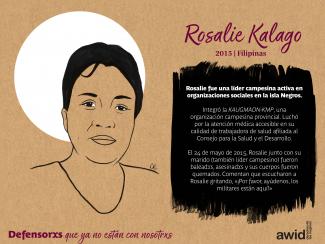
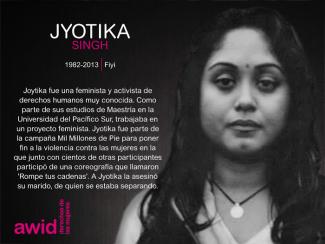
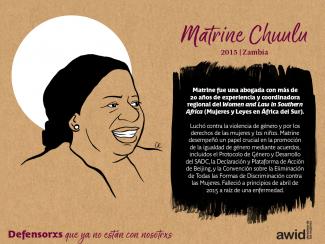
In our 2015 Online Tribute to Women Human Rights Defenders No Longer With Us we are commemorating four women from Sub-Saharan Africa, three of whom were murdered due to their work and/or who they were in their gender identity and sexual orientation. Their deaths highlight the violence LGBT persons often face in the region and across the globe. Please join AWID in honoring these women, their activism and legacy by sharing the memes below with your colleagues, networks and friends and by using the hashtags #WHRDTribute and #16Days.
Please click on each image below to see a larger version and download as a file


Maria do Espírito Santo da Silva
Snippet FEA Audio Land and Agroecology (EN)
Listen to the story here:
Qui devrait participer à cette enquête?
Les groupes, organisations et mouvements qui travaillent spécifiquement, ou principalement, à la défense des droits des femmes et des filles, pour la justice de genre, pour la défense des droits des personnes LBTQI+ et des allié·es dans toutes les régions et à tous les niveaux, que ces structures soient récentes ou non.
Estela Ambrosio Luna
Marta Musić
Marta is a queer, transfeminist non-binary activist-researcher from ex-Yugoslavia, currently based in Barcelona. They work as a transnational movement organizer, a feminist economist and a weaver of systemic alternatives. They are the co-founder and one of the coordinators of the Global Tapestry of Alternatives, a global process that seeks to identify, document and connect alternatives on local, regional and global levels. Locally, they are engaged in anti-racist, transfeminist, queer, migrant organizing. They also hold a doctoral degree in Environmental Science and Technology from the Autonomous University of Barcelona, dedicated to decolonial feminist perspectives of a pluriverse of systemic alternatives and the creation of feminist alternative systems based on care and the sustainability of life. During their free time, they enjoy boxing, playing the guitar and the drums as part of a samba band, photography, hiking, cooking for loved ones and spoiling their two cats.
Research methology
Over eight years, we did four global surveys and built a research methodology.
In 2013, we published three global reports. These reports confirm that women’s rights organizations are doing the heavy lifting to advance women’s rights and gender equality by using diverse, creative and long-term strategies, all while being underfunded.
Our 2010 global survey showed that the collective income of 740 women’s organizations around the world totaled only USD 104 million. Compare this with Greenpeace International, one organization with a 2010 budget of USD 310 million1. Imagine the impact these groups could have if they were able to access all the financial resources they need and more?
AWID’s WITM research has catalyzed increased funding for women’s rights organizing. WITM research was a driving force behind the Catapult crowdfunding platform, which has raised USD 6.5 million for women’s rights. The Dutch Government cited WITM research as a reason for its unprecedented MDG 3 Fund of EU 82 million. WITM research has also led to the creation of several new funds: FRIDA – The Young Feminist Fund, the Indigenous Women’s Fund, Fundo Elas, the Mediterranean Women’s Fund and the Rita Fund.
Funding trends analyses
While the WITM research has shed important light on the global funding landscape, AWID and partners have identified the need to dig deeper, to analyze funding trends by region, population and issue. In response, organizations are now using AWID’s WITM research methodology to do their own funding trends analyses. For example, in November 2013, Kosova Women’s Network and Alter Habitus – Institute for Studies in Society and Culture published Where is the Money for Women’s Rights? A Kosovo Case Study.
At the same time, AWID continues to collaborate with partners in Where is the Money for Indigenous Women’s Rights (with International Indigenous Women’s Forum and International Funders for Indigenous Peoples) and our upcoming Where is the Money for Women’s Rights in Brazil? (with Fundo Elas).
Several organizations have also conducted their own independent funding trends research, deepening their understanding of the funding landscape and politics behind it. For example, the South Asian Women’s Fund was inspired by AWID’s WITM research to conduct funding trends reports for each country in South Asia, as well as a regional overview. Other examples of research outside of AWID include the collaboration between Open Society Foundations, Mama Cash, and the Red Umbrella Fund to produce the report Funding for Sex Workers Rights, and the first-ever survey on trans* and intersex funding by Global Action for Trans* Equality and American Jewish World Service.
Vicky HernaÌndez Amador
Snippet FEA Objectives NSS Family Farming (ES)
AGRICULTURA FAMILIAR, AGROECOLOGÍA Y SOBERANÍA ALIMENTARIA

How do you define external funding?
External funding includes grants and other forms of funding from philanthropic foundations, governments, bilateral, multilateral or corporate funders and individual donors – from both within your country or abroad. It excludes resources that groups, organizations and/or movements generate autonomously such as, for example, membership fees, the voluntary contributions of staff, members and/or supporters, community fundraisers, venue hires or sale of services. For ease and clarity, definitions of the different types of funding as well as short descriptions of different donors are included in the survey.
Mechthild "Mel Hired" Möhring
Read also:
We all can dance
by Mechthild Möhring (aka serialmel)
How I punt myself at the narrow hard knitting I once retrieved. I'm dancing in the kitchen when I'm alone. Gracile and powerful. When I'm in company I'm clumsy. My body scandalizes, scandalizes the laws of look I feel, scandalizes the words which banished me. "Of course she can dance, it's in her blood as a Black person." "If she is able to dance nicely she is good in bed" they whisper, they murmur, no - they say it openly into my face. They smirk and rub themselves against me and let me move back. I stumble and fall. My feet reject their duty. Bearish I get out of breath. Smiling I place myself out of events and notice how my face freezes into a mask.
Translated into English by Tsepo Bollwinkel
Original in German
Tanzen können wir alle
Von Mechthild Möhring (aka serialmel)
Wie ich mich stosse an den engen, harten Maschen, in die ich mich einst zurückgezogen habe. Ich tanze in der Küche, wenn ich allein bin. Grazil und kraftvoll. Wenn ich in Gesellschaft bin, bin ich unbeholfen. Mein Körper eckt an, an die Gesetze des Blicks, den ich spüre, an die Worte, die mich bannten. „Natürlich kann sie tanzen, als Schwarze hat sie das im Blut.“ „Wenn sie gut tanzen kann, dann ist sie auch gut im Bett“ flüstern sie, raunen sie, nein, sie sagen es mir laut ins Gesicht. Sie grinsen und reiben sich an mir und lassen mich zurückweichen. Ich stolpere und falle. Meine Füsse verweigern ihren Dienst. Tollpatschig gerate ich ausser Atem. Lächelnd setze ich mich an den Rand des Geschehens und bemerke, wie mein Gesicht zur Maske erstarrt.
Elina Margarita Castillo Jiménez
Elina es una joven feminista afrodominicana, que trabaja con enfoque interseccional. Es abogada de derechos humanos y está comprometida a usar su voz y sus capacidades para construir un mundo más justo, empático e inclusivo. Ingresó a la facultad de derecho a los 16 años, segura de que iba a obtener herramientas para entender y promover la justicia social. Luego de obtener el título de Juris Doctor [Doctora en Jurisprudencia] en la República Dominicana, cursó una maestría en Derecho Internacional Público y Derechos Humanos en el Reino Unido, como becaria Chevening. Fue la única mujer latinoamericana-caribeña en su clase y se graduó con honores.
Elina ha trabajado en la intersección de derechos humanos, género, migración y política en el gobierno, en colectivos de base y en organizaciones internacionales. Colaboró en el litigio de casos sobre violencia de género ante la Corte Interamericana de Derechos Humanos. Como integrante del Panel Consultivo de Jóvenes de UNFPA, contribuyó al fortalecimiento de los derechos sexuales y reproductivos en la República Dominicana. Fue una de las personas que lideraron la primera campaña de Amnistía Internacional sobre derechos de lxs trabajadorxs sexuales en las Américas, desarrollando una fuerte asociación con las organizaciones de trabajadorxs sexuales, y utilizando la posición de Amnistía para potenciar las voces de quienes defienden los derechos humanos de las mujeres y de lxs trabajadorxs sexuales. Elina es parte del Foro Feminista Magaly Pineda y la Global Shapers Community [Comunidad Global Shapers]. Habla español, francés e inglés.
Gracias a su diversificada trayectoria, Elina trae sólidas capacidades de gobernanza y de planificación estratégica, una experiencia sustancial en las Naciones Unidas y en mecanismos regionales de derechos humanos, además de su profunda determinación para que AWID siga siendo una organización inclusiva para todas las mujeres, especialmente, las feministas jóvenes y caribeñas. Con estas propuestas, se suma a una hermandad global de feministas fantásticas, desde donde podrá seguir cultivando su liderazgo feminista y nunca más se sentirá sola en su camino.
7. Synthesize your research findings
Now that you have analyzed all your data – from your survey, interviews, desk research and potentially other sources – you can create your final product.
In this section:
- Create your final product
1. Write clearly
2. Make it pretty- Gather review and inputs
1. Polish your results
2. Facilitate the feedback
Create your final product
Your final product will be the document that will summarize, analyze and criticize your data. That will be the piece that you will share with your community to present and explain your research to your audience.
At AWID, we often write a comprehensive written report that analyzes each set of data and synthesizes all of our findings, then later create smaller products, such as infographics and summaries (explained in the subsequent section “Finalize and format”).
1. Write clearly
- Organize your data as you would like to tell a story. You can follow the order of your survey. Or you can regroup some questions to lead to your conclusion in a smooth and progressive way.
- Adapt your language to your audience. Use universal language and avoid jargon or too technical terms.
Importance of the editor
An editor will proofread, ensure concise writing, conduct fact-checking, point out inconsistencies that need to be resolved, arrange the flow of the document and possibly suggest titles.
Your editor should preferably be someone who understands and knows your WITM work but who was not directly involved in the research. This will bring in a fresh perspective.
2. Make it pretty
-
Use the data collected to create graphs and tables. These type of visuals are a compelling way to highlight the main findings of your research and validate your analysis.
-
Source relevant images that can illustrate your report.
-
Highlight key-numbers and/or powerful testimonials.
Remember: The more accessible your product is, the more people will want to read (and share!) it.
Gather review & inputs
At this point, you have collected all your data, analyzed it and transformed it into your final product, likely in a long report.
1. Polish your results
Before moving on to the next steps – you should share your final research product with your advisor organizations, activists, and donors.
This is a great moment to check the following points:
- Are there any key points missing in your analysis of the present funding landscape and trends?
- Are there any key points missing in your conclusions?
- Are there any inaccuracies in the data that need to be corrected?
- General suggestions on strengthening the report to achieve your goals as listed in your research framing.
Once you have inputted all feedback from your advisors, be sure to run it by your editor once more.
This will now be the final, completed version of your report. If you intend to publish the final report in other languages, now is the time to send it for translation.
2. Facilitate the feedback
- Your advisors are likely busy with their regular responsibilities. Be sure to request feedback within a reasonable deadline.
- Keep your request for feedback brief and specific, so it is easy for them to respond. If you like, you can simply copy and paste the bullet points we have provided.
- If you are publishing in multiple languages, ensure you have advisors who can also review the final translated versions of your product(s).
This is a significant contribution from your advisors. Consider offering them some form of recognition.
Previous step
Next step

Estimated time:
• 2 - 5 months
People needed:
• 1 or more research person(s)
• 1 Editor (or web-editor if you create an online product)
• Translator(s), if done in more than one language
Resource needed:
• List of advisor organizations, activists, and donors.
• Concept note (from “Frame your research” section)
• Survey topline results
• Prepared interview questions
• Interview results
• Desk research data
• All other data used in report