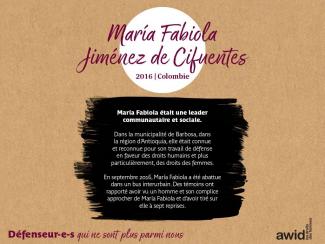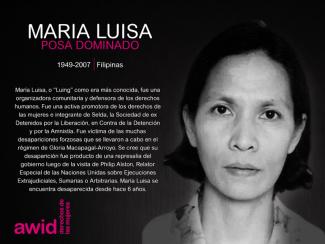
Maria Luisa Posa Dominado
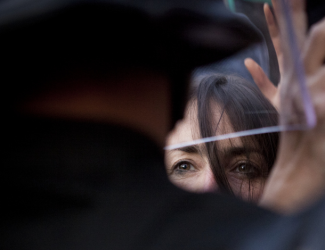
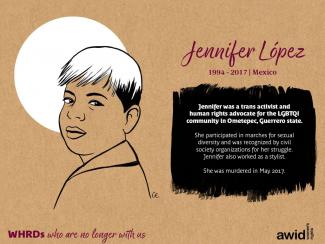
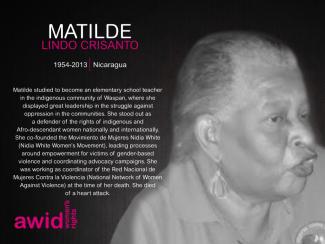
WHRDs are self-identified women and lesbian, bisexual, transgender, queer and intersex (LBTQI) people and others who defend rights and are subject to gender-specific risks and threats due to their human rights work and/or as a direct consequence of their gender identity or sexual orientation.
WHRDs are subject to systematic violence and discrimination due to their identities and unyielding struggles for rights, equality and justice.
The WHRD Program collaborates with international and regional partners as well as the AWID membership to raise awareness about these risks and threats, advocate for feminist and holistic measures of protection and safety, and actively promote a culture of self-care and collective well being in our movements.
WHRDs are exposed to the same types of risks that all other defenders who defend human rights, communities, and the environment face. However, they are also exposed to gender-based violence and gender-specific risks because they challenge existing gender norms within their communities and societies.
We work collaboratively with international and regional networks and our membership
We aim to contribute to a safer world for WHRDs, their families and communities. We believe that action for rights and justice should not put WHRDs at risk; it should be appreciated and celebrated.
Promoting collaboration and coordination among human rights and women’s rights organizations at the international level to strengthen responses concerning safety and wellbeing of WHRDs.
Supporting regional networks of WHRDs and their organizations, such as the Mesoamerican Initiative for WHRDs and the WHRD Middle East and North Africa Coalition, in promoting and strengthening collective action for protection - emphasizing the establishment of solidarity and protection networks, the promotion of self-care, and advocacy and mobilization for the safety of WHRDs;
Increasing the visibility and recognition of WHRDs and their struggles, as well as the risks that they encounter by documenting the attacks that they face, and researching, producing, and disseminating information on their struggles, strategies, and challenges:
Mobilizing urgent responses of international solidarity for WHRDs at risk through our international and regional networks, and our active membership.
1 |
Fournir aux membres de l’AWID, partenaires du mouvement et financeurs une analyse actualisée, robuste, éprouvée et orientée sur l’action des réalités du financement des mouvements féministes et de l’état actuel de l’écosystème du financement féministe. |
2 |
Identifier et expliquer les occasions d’orienter davantage de financement de meilleure qualité vers l’organisation des mouvements féministes, mettre en lumière les fausses solutions et mettre un frein aux tendances à cause desquelles les financements ne parviennent pas et/ou vont à l’encontre des programmes de justice de genre et féministes intersectionnels. |
3 |
Formuler les visions, propositions et programmes féministes en faveur de la justice du financement. |
Le processus de l’Organisation des Nations Unies (ONU) sur le financement du développement (FdD) vise à traiter différentes formes de financement du développement et de coopération pour le développement. Selon le Consensus de Monterrey, ce processus comporte six axes clés :
Votre participation à l’enquête WITM est importante à plusieurs égards. Vous aurez, notamment, l’occasion de faire part de votre expérience vécue de la mobilisation de fonds pour soutenir votre organisation, de réclamer votre autorité en tant qu’experte sur la manière dont l’argent est transféré et qui il atteint réellement, et de contribuer à un plaidoyer collectif et cohérent auprès de financeurs afin que les fonds circulent davantage et soient de meilleure qualité. Au cours des deux dernières décennies, la recherche WITM de l’AWID s’est révélée être une ressource clé pour les activistes et les financeurs. Nous vous invitons chaleureusement à participer à sa troisième édition pour souligner la situation actuelle des ressources, remettre en question les fausses solutions, et identifier les modifications nécessaires dans le financement afin que les mouvements s’épanouissent et relèvent les défis complexes de notre époque.
L'appel à propositions est maintenant fermé.
Nous avons lancé un Appel à activités le 19 novembre 2019 et la date limite de réception des propositions était le14 février 2020.
Trouvez d'autres moyens de vous engager sur le chemin du Forum
“Nous Sommes la Solution has a vision of an Africa where, in solidarity, rural women involved in decision-making can grow, process, sell and consume family farming products while preserving the environment, for a harmonious and sustainable development.”
Yes! We recognize and appreciate different reasons why feminists, in their respective contexts, don’t have external funding: from being ineligible to apply for grants and/or receive money from abroad, to relying on resources generated autonomously as a political strategy in its own right. We want to hear from you regardless of your experience with external funding.
Nous vous fournirons cette information sous peu. Restez à l’écoute !
Por el momento, la encuesta en KOBO está disponible en árabe, español, francés, inglés, portugués y ruso. Tendrás oportunidad de seleccionar el idioma de preferencia al inicio de la encuesta.
Non, vous n’avez pas besoin d’être membre de l’AWID pour participer, mais les membres de l’AWID bénéficient d’une réduction sur les frais d’inscription ainsi qu’un certain nombre d’autres avantages.
Apprenez-en davantage sur la façon de devenir membre de l’AWID
« Les savoirs et pratiques indigènes ont toujours soutenu la souveraineté alimentaire, et ce savoir-faire est entre les mains des femmes [...] L'écoféminisme pour moi, c'est le respect de tout ce que nous avons autour de nous » -