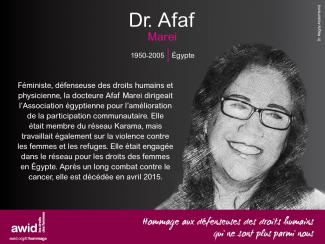
Dr. Afaf Marei
WHRDs are self-identified women and lesbian, bisexual, transgender, queer and intersex (LBTQI) people and others who defend rights and are subject to gender-specific risks and threats due to their human rights work and/or as a direct consequence of their gender identity or sexual orientation.
WHRDs are subject to systematic violence and discrimination due to their identities and unyielding struggles for rights, equality and justice.
The WHRD Program collaborates with international and regional partners as well as the AWID membership to raise awareness about these risks and threats, advocate for feminist and holistic measures of protection and safety, and actively promote a culture of self-care and collective well being in our movements.
WHRDs are exposed to the same types of risks that all other defenders who defend human rights, communities, and the environment face. However, they are also exposed to gender-based violence and gender-specific risks because they challenge existing gender norms within their communities and societies.
We work collaboratively with international and regional networks and our membership
We aim to contribute to a safer world for WHRDs, their families and communities. We believe that action for rights and justice should not put WHRDs at risk; it should be appreciated and celebrated.
Promoting collaboration and coordination among human rights and women’s rights organizations at the international level to strengthen responses concerning safety and wellbeing of WHRDs.
Supporting regional networks of WHRDs and their organizations, such as the Mesoamerican Initiative for WHRDs and the WHRD Middle East and North Africa Coalition, in promoting and strengthening collective action for protection - emphasizing the establishment of solidarity and protection networks, the promotion of self-care, and advocacy and mobilization for the safety of WHRDs;
Increasing the visibility and recognition of WHRDs and their struggles, as well as the risks that they encounter by documenting the attacks that they face, and researching, producing, and disseminating information on their struggles, strategies, and challenges:
Mobilizing urgent responses of international solidarity for WHRDs at risk through our international and regional networks, and our active membership.
Pour la première fois, le Forum de l'AWID propose trois modes de participation :
Les participant.e.s se réuniront à Bangkok, en Thaïlande. Nous sommes impatient.e.s de vous y retrouver!
Les membres de l’AWID exploreront et feront une évaluation critique du rôle que l’entraide peut jouer pour financer et apporter des ressources aux mouvements, en se livrant à un collage collectif.
📅 Mercredi 12 novembre 2025
📍 Espace COP Populaire
Site web en anglais, espagnol et portugais
نرحب بالطلبات عبر مجموعة كاملة من المواضيع والتقاطعات المهمة للحركات النسوية وحركات العدالة الجندرية.
With avenues for civil society (especially those not based in Geneva) to participate in the Human Rights Council becoming more limited because of the financial crisis, spaces to put pressure and hold governments accountable for rights violations are increasingly closed. These measures include charges for hybrid participation and interpretation for side events, visa obstacles, and the limited availability of hybrid informal negotiations on draft resolutions.
Below are resolutions, key resolutions, panels and taking place in these sessions, related to gender and sexuality:
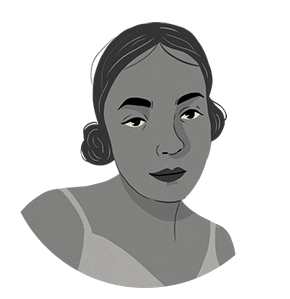
Zuhour Mahmoud es la estratega de comunicación de Kohl. Es una escritora y editora y una DJ ocasional radicada en Berlín. Su trabajo se centra en los enfoques críticos a la música, la tecnología y la política y sus ciclos de vida en la esfera digital.

L’AWID a le plaisir de partager son rapport annuel 2014.
Du renforcement des connaissances sur les enjeux liés aux droits des femmes à l’élaboration de réponses plus efficaces aux violences perpétrées contre les défenseuses des droits humains, nos efforts de l’an dernier n’ont cessé de poursuivre la consolidation des mouvements féministes et de droits des femmes du monde entier.
Consultez le rapport pour en apprendre davantage sur la façon dont nous avons renforcé les capacités de nos membres et plus largement de notre public , exercé de fortes pressions pour que les droits des femmes demeurent au premier plan des principaux processus internationaux relatifs au développement et aux droits humains, et contribué à améliorer la couverture médiatique des problématiques des droits des femmes et des processus organisationnels qui y sont liés. Le rapport propose une vue panoramique de nos projets ainsi que certains chiffres qui témoignent concrètement de notre impact.
La collaboration est au cœur de toutes nos actions et nous anticipons avec enthousiasme une autre année de travail ensemble afin de mener nos mouvements vers un niveau supérieur.
Dans un contexte de plus en plus exigeant, nous pouvons néanmoins discerner d’importants signes d’espoir de voir les priorités relatives aux droits des femmes progresser. Les activistes des droits des femmes jouent toujours un rôle crucial dans la création d’espaces au sein desquels il est possible d’exiger des changements structurels, de soutenir les communautés, de s’opposer à la violence et de préserver les acquis essentiels/ importants/majeurs. Il y a en effet des occasions à saisir pour influencer les nouveaux acteurs et mobiliser des ressources plus abondantes en faveur des organisations de droits des femmes.
Pour ce faire, il est essentiel de mener de solides actions collectives et de renforcer le processus d’organisation des activistes des droits des femmes.

Je suis sincèrement enchantée par tout ce qu’a réalisé l’AWID depuis 1982 et j’espère être en mesure d’apporter ma contribution, même modeste, à ce dur labeur en faveur des femmes et de l’égalité de genre. » — Aleksandra Miletic-Santic, Bosnie Herzégovine

Enciende tu fuego feminista leyendo nuestras investigaciones y publicaciones varias sobre financiamiento, defensoras de derechos humanos, construcción de movimientos, fundamentalismos, justicia económica, seguimiento y evaluación feminista y más
On pense souvent que la communication de notre désir se cantonne à l’intimité des quatre murs de nos chambres et à nos relations personnelles. Mais est-il également possible d’envisager ce genre de communication comme étant structurelle, une pratique qui éclairerait notre travail et la manière dont nous sommes, dont nous existons dans le monde?
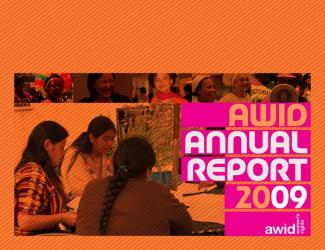
Our 2009 Annual Report includes highlights of another busy year of action and reflection at AWID as we implement our commitment to boldly, creatively and effectively contribute to the advancement of women’s rights and gender equality worldwide.
In the report you can find out about our programmatic achievements, membership, finances, what to watch out for in 2010, as well as information about our Board and Staff.

Pendant Women Deliver, des Movement Hubs aux Fidji et en Géorgie conçoivent leurs propres programmes, ancrés dans leurs communautés, afin de se connecter virtuellement à la Conférence Women Deliver. En savoir plus sur leur programme !
Cela vous intéresse d’accueillir des Movement Hubs pour d’autres événements mondiaux de mouvements et des espaces de dialogue politique ? Contactez l’équipe Adhésions de l’AWID : membership @ awid.org
Plus qu’une entorse amusante pour explorer des sensations, le BDSM peut être un moyen d’aborder la douleur émotionnelle et les traumatismes. Cela a été pour moi un moyen de guérison sexuelle, offrant une forme radicale de libération.
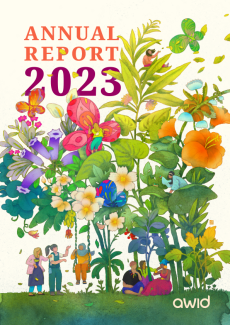
For us at AWID, 2023 was the first year of our new Strategic Plan, “Fierce Feminisms: Together We Rise”, which speaks to the unapologetic drive needed to change the world, and the plurality of feminisms and movements in our ecosystem.
In the course of 2023, the volatile situation in Sudan has escalated greatly. The unspeakable genocide in Gaza, in the context of ongoing colonization and occupation of Palestine, continues as we write these lines. Climate crises, militarization, and extractivism all persist as threats to people and the planet. Building stronger movements and people power is a vision to which we contribute daily, through AWID membership, teach-ins, resourcing advocacy and more.
Download the full 2023 Annual Report
From centering climate in feminist economies to advocating for resourcing feminist movements - an urgent task, given the chronic underfunding of feminist, indigenous and Global South movements who are on the frontlines of climate crisis - we are finding solutions.