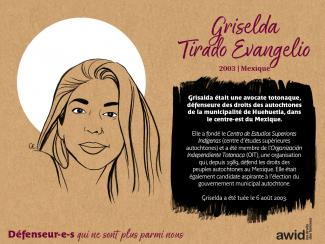
Griselda Tirado Evangelio
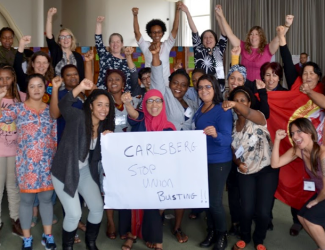
Women human rights defenders (WHRDs) worldwide defend their lands, livelihoods and communities from extractive industries and corporate power. They stand against powerful economic and political interests driving land theft, displacement of communities, loss of livelihoods, and environmental degradation.
Extractivism is an economic and political model of development that commodifies nature and prioritizes profit over human rights and the environment. Rooted in colonial history, it reinforces social and economic inequalities locally and globally. Often, Black, rural and Indigenous women are the most affected by extractivism, and are largely excluded from decision-making. Defying these patriarchal and neo-colonial forces, women rise in defense of rights, lands, people and nature.
WHRDs confronting extractive industries experience a range of risks, threats and violations, including criminalization, stigmatization, violence and intimidation. Their stories reveal a strong aspect of gendered and sexualized violence. Perpetrators include state and local authorities, corporations, police, military, paramilitary and private security forces, and at times their own communities.
AWID and the Women Human Rights Defenders International Coalition (WHRD-IC) are pleased to announce “Women Human Rights Defenders Confronting Extractivism and Corporate Power”; a cross-regional research project documenting the lived experiences of WHRDs from Asia, Africa and Latin America.
"Women Human Rights Defenders confronting extractive industries: an overview of critical risks and Human Rights obligations" is a policy report with a gender perspective. It analyses forms of violations and types of perpetrators, quotes relevant human rights obligations and includes policy recommendations to states, corporations, civil society and donors.
"Weaving resistance through action: Strategies of Women Human Rights Defenders confronting extractive industries" is a practical guide outlining creative and deliberate forms of action, successful tactics and inspiring stories of resistance.
The video “Defending people and planet: Women confronting extractive industries” puts courageous WHRDs from Africa, Asia, and Latin America in the spotlight. They share their struggles for land and life, and speak to the risks and challenges they face in their activism.
Challenging corporate power: Struggles for women’s rights, economic and gender justice is a research paper outlining the impacts of corporate power and offering insights into strategies of resistance.
AWID acknowledges with gratitude the invaluable input of every Woman Human Rights Defender who participated in this project. This project was made possible thanks to your willingness to generously and openly share your experiences and learnings. Your courage, creativity and resilience is an inspiration for us all. Thank you!
A través de eventos presenciales, lives en nuestras redes sociales, un stand de exhibición y más. Nos presentamos para convocar, amplificar y apoyar las voces y la participación de nuestra membresía y aliades.
Juntes vamos a Reclamar Nuestro Poder Feminista al elevar las alternativas y visiones feministas en torno a economías que centran los sistemas colectivos de cuidado y nutren tanto al planeta como a las personas.
¡Síguenos en las redes sociales para más detalles sobre cómo participar! Sea parte de las conversaciones utilizando los hashtags #AWIDatCSW68 y #RecuperarNuestroPoderFeminista
Instagram | Facebook | LinkedIn | X (Twitter)
Venez rencontrer Aura Roig, militante féministe visionaire, anthropologue, directrice et fondatrice de la coopérative Metzineres.
Elle a consacré les deux dernières décennies à la recherche, à la conception et à la mise en place de politiques de soutien aux personnes qui se droguent, basées sur la réduction des méfaits, les droits humains et le féminisme intersectionnel.
Après avoir expérimenté et appris des communautés qui consomment des drogues dans le monde entier, elle est retournée à Barcelone pour créer la Xarxa de Dones que Usen Drogues (le Réseau des Femmes qui Consomment des Drogues, XADUD). XADUD était un espace d'entraide et de solidarité avec la lutte pour les droits des groupes marginalisés, qui plus tard deviendra la coopérative Metzineres.
Aujourd'hui, Aura travaille à étendre le modèle Metzineres pour prendre en charge des groupes plus grands, tout en documentant de manière approfondie son parcours et son apprentissage prolifiques.

Para compartir tu experiencia con el financiamiento de tu organización.
Te recomendamos buscar asesoría legal y ponerte en contacto con un refugio para mujeres o un centro de referencia en tu área.
Las "HotPeachPages" son un recurso en línea que ofrece enlaces a albergues para mujeres en todo el mundo. AWID no puede dar fe de la exactitud o la calidad de las instituciones que aparecen en esos listados, pero podría ser un buen lugar por donde empezar si no conoces organizaciones en tu zona.
Women sustain Care | Care Sustains Life | Life Sustains Economy | Who takes care of women? | Not one less1 | Together | Sunday lunch
1Nenhuna a menos literally translates as “not one woman less” or “ni una menos” in Spanish - a famous feminist slogan in Latin America that emerged in Argentina as a response to increasing gender-based violence.

Feminist, women’s rights, gender justice, LBTQI+ and allied movements around the world are at a critical juncture, facing a powerful backlash on previously-won rights and freedoms. Recent years have brought the rapid rise of authoritarianism, violent repression of civil society, criminalization of women and gender-diverse human rights defenders, escalating war and conflict in many parts of our world, continued perpetuation of economic injustices, and the intersecting health, ecology and climate crises.
The AWID International Forum is a truly global space that gives participants an opportunity to network, build alliances, celebrate, and learn in a stimulating, emotive and safe atmosphere.
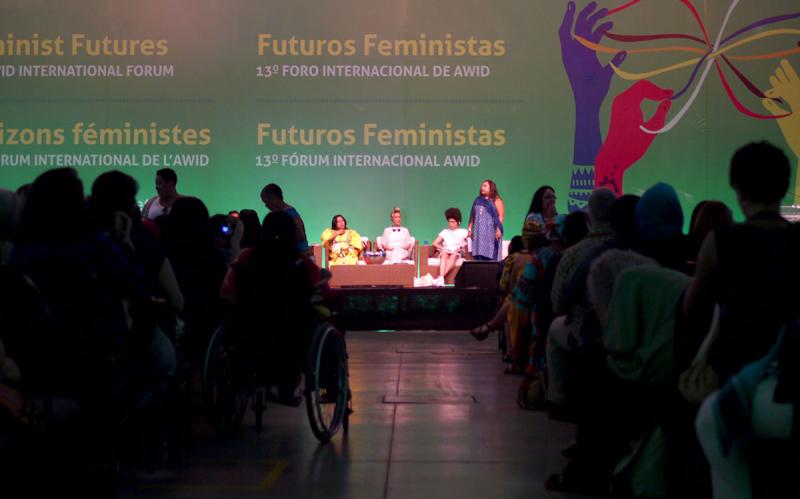
More and more, we are trying to bring the Forum process outside of the convening’s borders. Engaging with partners and deepening relationships all year round, connecting with local movements to better understand problems and co-create solutions. The Forum event itself, held every three to four years in a different region of the world, is just a crystallization of all these alliances that we are building as part of our work.
The AWID Forum dissolves our inner and external boundaries, fosters deep discussion, personal and professional growth, and strengthens our movements for gender justice and women’s rights.
As a convening, it is a response to the urgency to promote stronger and more coordinated engagement and action by feminists, women’s rights and other social justice advocates, organizations and movements. We also believe that the Forum is more than just an event – it can facilitate a process to influence thinking and set agendas for feminist movements and other related actors.
Evolving from a national conference of around 800 people, the event now brings together around 2000 feminists, community leaders, social justice activists, and donor agencies from around the world.
The 14th AWID International Forum will take place 11-14 January 2021 in Taipei, Taiwan.
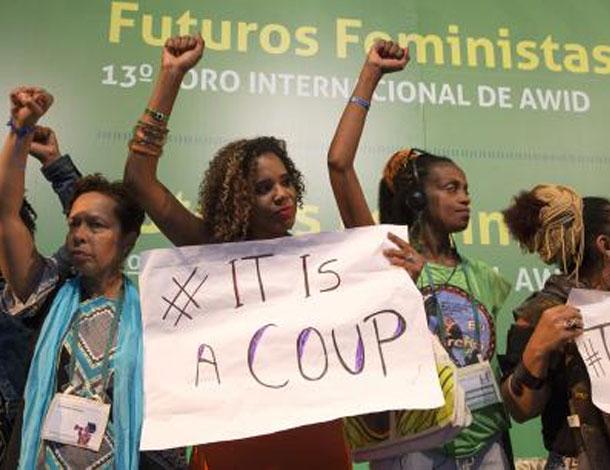
Given the complex world that we face today, the 2016 AWID Forum did not focus on a particular “issue”, but rather on creating more effective ways of working together!
Despite the challenging contexts in which the 2016 Forum took place (the Zika epidemic, a strike by Brazilian foreign-service workers, the impeachment of President Dilma Rousseff and subsequent turmoil), it succeeded in bringing together over 1800 participants from 120 countries and territories across all regions of the world.
For 96% of participants who responded to the post Forum evaluation survey, the Forum was a major source of inspiration and energy.
98% of participants considered it an important convening space for feminist movements and expressed hope that AWID continues to organize forums.
59% of Forum evaluation survey respondents declared to be very satisfied with the Forum and 34% somewhat satisfied.
Over 150 sessions were delivered in different formats on a variety of topics ranging from bodily integrity and freedoms, to gender-based violence in the workplace, to strategies for building collective power.
The first-time Black Feminisms Forum (BFF), held just before the main AWID Forum, brought together 250 Black feminists from all over the world to co-create a powerful space to build and strengthen ongoing, intergenerational, transnational connections
Download the Forum evaluation report
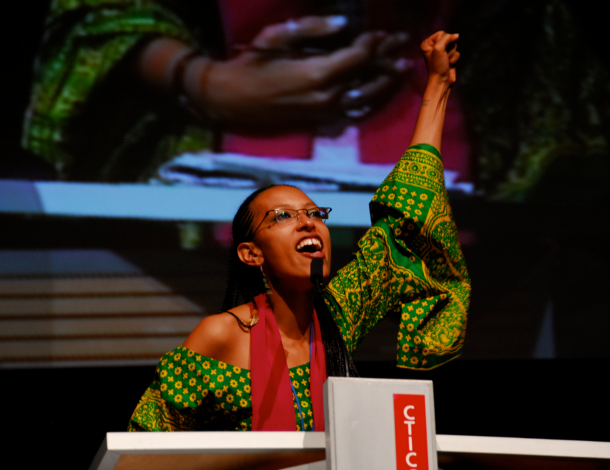
The 12th AWID Forum was the largest and most diverse AWID Forum to date, bringing together 2239 women’s rights activists from 141 countries. Of these participants, around 65% were from the Global South and close to 15% were young women under 30, and 75% attended an AWID Forum for their first time.
The Forum program focused on transforming economic power to advance women’s rights and justice and featured over 170 different kinds of sessions including feminist economics toolbox skills-building sessions, breakout sessions representing all 10 Forum themes, in-depth sessions, and solidarity roundtables.
Building on the momentum of the 2012 Forum, we transformed the website into a resource and learning Hub, which builds on the content generated by participants by featuring multi-media resources on all Forum components.
Visit the 2012 Forum web archive
Le Groupe de travail des femmes sur le financement du développement (Women's Working Group on Financing for Development – WWG on FfD) , une alliance composée d’organisations et de réseaux de défense des droits des femmes, a été créée en octobre 2007 pour mener, dans le cadre des processus des Nations Unies sur le FdD, des activités de plaidoyer en faveur de l’égalité de genre, de l’autonomisation des femmes et des droits humains.
Troisième Dialogue de haut niveau sur le financement du développement, 23-25 octobre 2007
1 |
Provide AWID members, movement partners and funders with an updated, powerful, evidence-based, and action-oriented analysis of the resourcing realities of feminist movements and current state of the feminist funding ecosystem. |
2 |
Identify and demonstrate opportunities to shift more and better funding for feminist organizing, expose false solutions and disrupt trends that make funding miss and/or move against gender justice and intersectional feminist agendas. |
3 |
Articulate feminist visions, proposals and agendas for resourcing justice. |
This is body text
After the gallery
Some English aside content
Launch of the Intergovernmental preparatory process for the 3rd Financing for Development Conference, October 2014