Inside the People’s Summit for Global Economic Justice: Decisions about the 99% can’t be made behind closed doors
In November 2025, while global leaders caught some shut-eye on VIP planes before landing in Johannesburg for the G20 Summit, members of the 99% were already convening to discuss the same issues. Farmers, domestic workers, economists, and feminist organizers from 35 countries gathered at the We The 99% People's Summit for Global Economic Justice (November 20-22) to build the alternatives that world leaders refuse to consider.
The roads leading to the Nasrec Expo Centre in Johannesburg gleamed with fresh asphalt, repaired to pristine condition. Along the drive from O.R Tambo International Airport, dehydrated patches of grass guzzled gallons of colorful paint in the shape of the South African flag. It was the first time the G20 summit had been held on African soil. With gleaming smiles to match the historic development, the South African presidency took pride in hosting the G20, centering the theme "Solidarity, Equality, Sustainability."
Less than 10km away, a different kind of history was being made. Over 5,000 people from more than 35 countries had gathered for the We The 99% People's Summit for Global Economic Justice, convened by Fight Inequality Alliance (FIA) and allied movements.
FIA Kenya collaborator Wanja Maina, a disability justice advocate who founded the Hummingbird Grassroots Center in Nairobi joined the crowds in Johannesburg. Disapproving of the closed-door discussions of the G20, Wanja emphasized the stark contrast in decision-making,
"World leaders, the big money people, the owners of capital were meeting in South Africa to talk about how well they are doing. On the other hand, in our forum, we were talking about the 99%; the average men and women who are struggling with access to the basics.”
Co-convening organizations shared the urgency to take action without waiting for inclusion. In a DW podcast leading up to the People’s Summit, the director of the African Climate Foundation’s New Economy Hub (NEH), Sekoetlane Phamodi called for the solidarity and equality advertised as the G20's 2025 annual theme.
“The G20 operates on a full consensus basis and often impedes our ability to drive the inclusive growth and development that African and developing economies require. Global cooperation requires the consent of the people. If you want inclusive decision-making, you’ve got to get the people on board!.” Sekoetlane said.
The Backbone of the Economy
At the People's Summit, Sophia Bweya echoed the voices of 76 million domestic workers across the globe who rarely have platforms to raise their concerns at international economic forums. A Zimbabwean domestic worker representing the International Domestic Workers Federation (IDWF) and Women in Informal Employment Globalizing and Organizing (WIEGO), Sophia reminded attendees that domestic workers are "the backbone of the economy."
“Society is not even recognising us, but we as domestic workers have to stand and fight for our rights. Domestic workers are informal. We are not recognised for national security and health security. All other workers enjoy these things. Not us” she said, reminding the 99% attending the summit about the intersectional privileges and oppressions amongst their shared struggles.
Part of what constitutes the backbone of the economy is the uncompensated care work that informal workers are obliged to perform through an unspoken mandate.
"We are looking after our employers' kids, the elderly and the sick. We are also care workers. It's unrecognised. We also have kids. When they are sick, no one is looking after them. Who cares for the carer?” Sophia asked.
When advocating for solutions, Sophia suggested that governments should focus on practical implementations of Convention 189 as established by the International Labour Organization in 2011. While governments are well aware of these conventions, she encourages her fellow informal workers to take matters into their own hands on a smaller scale until it has a ripple effect.
"They don't have to start with global issues. They have to start from the heart, from their national workplaces to talk to their employers to talk to the government."
From Debt Relief to Debt Justice: The People Want Reparations
Representing part of the 99% from South America, Sandra Quintela, a Brazilian economist, grassroots educator and member of Jubileu Sul Brasil joined the summit to discuss alternative solutions to the global economic and climate crisis.
Sandra works alongside communities whose lives, lands, and ecosystems have been looted by extractive policies since the dawn of colonial history. The solutions she shared at the People’s Summit were informed by her years of work within the network of social movements, feminist groups, and Black and Indigenous communities. Their collective framework centers a simple but radical premise: debt and reparations are inseparable.
"The poorest in Brazil is the woman.The Black woman. Our work is about public debt and reparations because we understand that the debt is a big, big problem, and they take our resources.”
Beyond public policy, Sandra argues that reparations is necessary for a “constitution of this life.” With a strong sense of historical sobriety, she argues that black people built Brazil and are owed what was stolen. When considering solutions for climate change, she centers the discussion on indigenous land sovereignty, reminding policy makers that indigenous people, such as the Guarani people are best equipped to sustain the ecosystem.
Food Security Isn’t Working : Feminist Farmers Demand Food Sovereignty
Outside of the rigid structures of formal plenary sessions, the summit created thematic hubs for collective strategizing grounded in lived experience. Amongst these was the Food Justice Hub convened by Sandile Ndelu, a trans feminist organizer, human rights lawyer, and philanthropic strategist leading advocacy at the Hlanganisa Community Fund for Social and Community Justice.
“At the We the 99% People’s Summit, I convened the Food Justice Hub. That space brought together small-scale farmers, seed custodians, land activists and climate justice organisers to collectively imagine the kinds of food, land, and economic systems that can sustain life. The hub was designed as a political home: a place to learn, strategise, and experience how food sovereignty can be a pathway to feminist, climate-just futures,” she explained.
Sandile’s work aims to ensure that communities are not just case studies or beneficiaries, but decision-makers, knowledge producers, and architects of the systems that shape their lives. At the Food Justice Hub, she platformed the work of farmers like Siphiwe Sithosle who shared solutions rooted in ancestral agricultural knowledge.
A seed custodian, Siphiwe founded African Marmalade in 2015 and dedicated her life to preserving, cultivating, and restoring Indigenous seed diversity and farming methods. She remarks on the irony of finding feminist solutions to agriculture,
“Women by nature have always been at the centre of food production. When big agriculture was introduced, women got taken out. Now suddenly we hear women in agriculture,it’s as if we’re being introduced to something that we haven’t always done. It’s the same as the culinary industry. Women have always cooked, but when you professionalise it, men dominate. Women play a powerful role in the food value chain across the world.”
One of her solutions to climate change includes reindiginizing our gardens with water resilient crops that can withstand the harsh environment. She educated attendees of the Food Justice Hub on the politicization of food, demonstrating samples of indigenous crops they’ve long forgotten due to the promotion of foods we see in supermarkets everyday. While the English Cucumber dominates South Africa tables, the Kalahari desert holds water resilient indigenous varieties such as Kiwano, the African Horned Cucumber, which has now grown foreign to locals.
Sharing similar observations to Sandra from Brazil, Siphiwe pointed at the necessity for structural change and agrarian reform.
"We can't talk about food sovereignty without talking about how people are residing. Our residential areas are not conducive to growing food. Yards are paved, people rent out backyards. There is no space for gardens. We are cultivating a supermarket culture."
Siphiwe believes that solutions can be found through remembering what was eradicated. Supermarket culture has been established at the expense of community food systems. She argues that the neighbourhood markets that have always been a part of rural communities, no longer exist.
She points the blame at industrialization and bureaucracy, “Safety standards advantage industrial agriculture. If it's not pasteurised, not packaged, not labelled, it is not safe, pushing us to rely on commercial farmers.” She calls world leaders on their bluff, questioning the longstanding agenda of food security.
“The establishment always dials up food security at the expense of food sovereignty.You could literally have chicken skins imported and they call that food. When you promote food sovereignty you must deconstruct and reconstruct everything around food. What is food to you and what is food to me?”
Solutions Lie in The Simple Things
Part of the smoke screen blocking the path to equality lies in the big language, bureaucracy and intangible promises artfully deployed by world leaders. Feminists like Sandra bring the conversation back to the simple things.
"When we speak about climate, climate, climate...we forget to speak about the simple things. Simple, simple agenda! Access to water. Access to safety against the violence against women." Sandra said.
Her response cuts through the facade of political, abstract rhetoric. She reminds people to see through the smoke screen, advocating for the implementation of actionable, people-centered solutions.
"Climate justice means access to land. Agrarian reform. We need clean water. We need homes. When you speak about climate, it is like something that you don't control. But agrarian reform, you can do it."
Even when simplifying things, implementing change can feel difficult alone. Sandile believes none of our movements can win alone; not the farmers, not the climate activists, not the gender justice organizers. She says,
"Collective liberation insists that the people most harmed by multiple systems of oppression must be at the centre of designing the solutions. When we organise from the margins, we build movements capable of transforming the whole."
The 99% are Setting Their Own Table
The People’s Summit in Johannesburg was but a droplet in a rising river. Across the world, summits with the same agenda have been going head-to-head with global decision-making platforms. Amalen Sathananthar, a Malaysian artivist and founder of the Artivist Network arrived directly from COP30 in Belém, Brazil, where a parallel People's Summits had convened.
"It felt weird leaving COP when there was still so much going on. Coming to South Africa and seeing what was going on, the power in the movement and all the people that attended, it was really cool! The People's Summit was really powerful in bringing the global community together in a very beautiful, South African way.” he reflected.
When asked to compare his experience between the two summits, Amalen admitted that they’re hard to compare and tried best to elaborate,
"Maybe you can say COP30 had more direct influence on policy because negotiators are at the table. The G20 is essentially a big parade, a puff piece for everybody to glorify themselves while making backroom deals at the same time. "
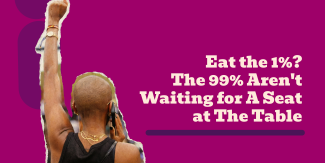
With little urgency from world leaders to improve the lives of the billions they’re paid to serve, the people are setting their own tables. We The 99% People’s Summit was evidence of a global movement to drive urgent and practical economic transformation.
When 2025 came to a close and G20 leaders returned to their comforts, the people’s collaborations had only begun, planting seeds for a more sustainable economic ecosystem. Each collaboration demonstrates a relentless dedication to building and implementing solutions to drive economic equality, climate justice and food sovereignty. Contrary to the Eat The Rich rhetoric circling social media, many people amongst the 99% dream of a future where the 1% aren't on the menu.