L´AWID est une organisation féministe mondiale qui consacre ses efforts à la justice de genre, au développement durable et aux droits humains des femmes
Au cours des dernières années, nous avons observé une nouvelle tendance inquiétante dans les espaces internationaux consacrés aux droits humains. Les discours axés sur « la protection de la famille » sont en effet utilisés pour défendre des violations des droits de membres de la famille, pour renforcer et justifier l’impunité des auteurs de ces violations et pour restreindre l’égalité des droits au niveau de la vie familiale.
La campagne en faveur de la « Protection de la famille » est motivée par une volonté conservatrice d’imposer des conceptions « traditionnelles » et patriarcales de la famille et de priver les membres de la famille de leurs droits pour les transférer à « l’institution familiale ».
Les initiatives visant à la « Protection de la famille » reposent sur :
la montée du traditionalisme,
la montée du conservatisme culturel, social et religieux,
l’existence d’une hostilité vis-à-vis des droits humains des femmes, des droits sexuels, des droits des enfants et enfin des droits des personnes dont l’identité de genre et l’orientation sexuelle ne sont pas conformes aux normes.
Depuis 2014, un groupe d’Etats travaille de front dans les espaces dédiés aux droits humains sous le nom de « Group of Friends of the Family » (Groupe des ami-e-s de la famille) ; des résolutions sur la « Protection de la famille » ont été adoptées chaque année depuis 2014.
Ce programme s’est propagé au-delà du Conseil des droits humains. Nous avons observé l’introduction d’un discours régressif autour de la « famille » à la Commission sur la condition de la femme, ainsi que des tentatives d’introduction dans les négociations sur les Objectifs de développement durable.
Notre approche
L’AWID travaille avec des partenaires et des allié-e-s pour s’opposer ensemble à la « Protection de la famille » et à d’autres programmes régressifs et défendre l’universalité des droits humains.
En réponse à l’influence croissante d’acteurs régressifs au sein des espaces dédiés aux droits humains, l’AWID a rejoint des allié-e-s afin de créer l’Observatoire sur l'Universalité des droits (OURs) (site en anglais). L’OURs est un projet de collaboration qui surveille, analyse et diffuse les informations concernant les initiatives anti-droits telles que la « Protection de la famille ».
Le premier rapport de l’OURs, Nos droits en danger, trace une cartographie des acteurs et actrices qui constituent le lobby mondial anti-droits et identifie leur réthorique et stratégies clés ainsi que leur impact sur les droits humains.
Le rapport précise que le programme de « Protection de la famille » a développé une collaboration entre un large éventail d’acteurs régressifs aux Nations Unies, qu’il décrit comme « un cadre stratégique abritant des positions anti-droits et patriarcales multiples, où le cadre vise entre autres à légitimer et institutionnaliser ces positions. »
Contenu lié
I have written a paper about an issue related to Women’s Rights and Development. How can I share it with AWID’s members?
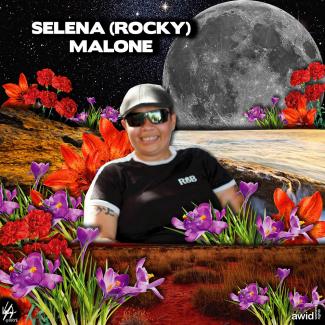
Rocky showed inspirational leadership and direction in working with Lesbian, Gay, Bisexual, Transgender, Intersex, Queer, Brotherboy and Sistergirl (LGBTIQBBSG) youth at risk.
Rocky started her career with the Queensland Police Service as a Police Liaison Officer. Making a difference was important to her. She led an impressive career working with young LGBTIQBBSG people as the Manager of Open Doors Youth Service.
Rocky worked through complex situations with clients relating specifically to gender and sexual identity. She was a natural in this line of work - a strong community leader, a quiet achiever, a loyal friend, a compassionate nurturer, and a change maker. Rocky was a founding member of IndigiLez Leadership and Support Group.
In 2016 at the Supreme Court in Brisbane, Former High Court Justice Michael Kirby mentioned Rocky by name when praising the work of the LGBTI Legal Service over the years. Rocky fought extremely hard for the human rights of the LGBTIQBBSG community, pushed boundaries and created change in a respectful, loving way.
Présentation du salon
Par Alejandra Laprea
Qu’il est difficile de condenser la puissance et la diversité des voix qui s'élèvent en Amérique latine afin de vous présenter les autres réalités qui émergent dans ce vaste territoire, ces réalités féministes que nous construisons à partir du mouvement et des organisations populaires….
Pendant longtemps, j’ai tenté de paramétrer ma recherche et la sélection des films qui vous permettraient d’avoir un aperçu de tous ces rêves et projets qui se matérialisent peu à peu sur les territoires ‘notre-américains’, comme nous aimons à les appeler. La tâche a été ardue : il a fallu tenter d'établir des paramètres tels que la présence géographique, la justice linguistique et la représentation de la diversité des populations : indiennes, afro-descendantes, migrantes, et la multiplicité des drapeaux et des luttes qui découlent de toutes ces voix. Je suis arrivée à la conclusion que la création de cette compilation était un travail qui prendrait plusieurs années, un de ces projets en perpétuelle construction.
Pour ce salon, je suis partie à la recherche d'œuvres liées à la mobilisation et à la militance, ainsi que de documents qui donneront peut-être lieu à de grands débats que nous n'avons pas encore eus.
Dans cette sélection de films, vous découvrirez les voix de réalisatrices qui ne se contentent pas de restituer les réalités féministes palpitant dans chaque recoin de ce territoire vaste et divers, mais explorerez aussi des oeuvres qui, dans leur conception même, s'interrogent sur le pourquoi, le qui et le comment du cinéma ou de l'audiovisuel. Ces femmes comprennent le cinéma comme un outil de lutte, comme quelque chose de plus que de simples images à apprécier sur un écran. Pour ces réalisatrices ou collectifs de cinéastes, le cinéma et l'audiovisuel constituent un outil capable de promouvoir la discussion, d'ouvrir un débat, bref, une ressource pour la pédagogie populaire et féministe.
Ainsi, cette petite présentation est un voyage à travers les réalités féministes à deux niveaux : d’un côté, il y a ces histoires que vous découvrirez, et de l’autre, le travail de ces cinéastes qui cherchent à expérimenter, à créer d’autres réalités féministes dans leur façon de faire de l’audiovisuel et de raconter des histoires.
Bon voyage au gré de ces films de résistance, créatifs et transformateurs !
Lima is Burning
Direction: Giovana García Soto
Docu-fiction
Spanish with English subtitles
In Lima is Burning our work plays with documentary and fiction to take us into the life of Gía, a non-binary person, who uses performance art as a tool to denounce and transgress, as a vital manifesto against transfobia in every space, including gays spaces. With Gía we also take a look at transfeminism as a safe community in which Gía feels embraced, where she shares feelings and affections.
Giovana Garcia Sojo is a young peruvian audiovisual producer, specialized in low-budget production, creation for children and adolescents in cinema and cinematographic script by the International School of Cinema and Television - EICTV in San Antonio de Baños - Cuba. Giovana has developed her path as a director towards women and feminized identities, Lima is Burning is one of her first works.
Yo, Imposible / Being Impossible
Réalisé par Patricia Ortega
Fiction
Sous-titres en anglais
Patricia Ortega, directrice de “Yo Imposible” explore à travers Ariel, une jeune dont l’intersexualité a été violentée chirurgicalement dans son enfance, les multiples façons dont on tente de normaliser la diversité sexuelle et de genre.
Le film nous raconte comment Ariel a découvert qu’elle était née intersexe et qu’elle avait subi plusieurs chirurgies visant à normaliser ses organes génitaux. Cette découverte confronte le personnage à la redécouverte de son corps, à la reconstruction de son identité et nous confronte, nous qui regardons le film, à la remise en question d’une société dominée par l’hétéronormativité qui invisibilise les autres et les condamne au malheur.
Patricia Ortega, cinéaste vénézuélienne vivant en Argentine, a étudié à l’Ecole internationale de Cinéma et Télévision de Cuba et s’est spécialisée dans la réalisation de films. À travers la fiction, elle traite les situations extrêmes que les femmes ou les corps féminisés traversent et leurs façons de les surmonter.
“Yo Imposible” est une prise de position face à la conception d’un monde qui n’est conçu qu’en termes de masculin/féminin et qui invisibilise les autres. «Ces personnes ne sont pas malades, simplement génétiquement différentes. On intervient sur leurs organes génitaux et leur corps au moyen d'hormones sans leur autorisation, ce qui constitue une violation de leurs droits humains et de leur identité, et on cherche à les faire entrer dans les canons établis.» - Patricia Ortega
Cubanas, mujeres en revolución [Cuban Women in Revolution]
Réalisé par Maria Torrellas Liebana
Documentaire
Sous-titres en anglais
María Torrellas nous raconte la révolution cubaine à travers les femmes qui l’ont fait vivre, dont Vilma Espín, Celia Sánchez et Haydee Santamaría, entre autres.
Mais on ne peut pas se limiter à raconter l'histoire de la révolution cubaine par les femmes au passé, et c'est une lutte quotidienne que Torrellas dévoile en donnant la voix aux paysannes cubaines, professionnelles, étudiantes et ouvrières d’aujourd’hui. Dans «Cubanas, mujeres en revolución», nous découvrons les défis actuels des femmes cubaines face aux préjugés persistants, aux nouvelles formes de violence et au défi constant de créer de nouvelles réalités féministes pour celles et celleux qui viendront après elles dans un territoire assiégé depuis plus de soixante-dix ans par l'impérialisme américain.
Maíia Torrellas
María Torrellas est une communicante et documentariste. Elle a une longue carrière cinématographique et a obtenu, entre autres, le prix Santiago Alvarez in Memoriam pour son documentaire : Memoria de una Hija de Oshun (Mémoire d’une fille d’Oshún).
«Dans ce documentaire, j’ai souhaité mêler les luttes des héroïnes d’hier à celles des femmes d’aujourd’hui. Il s’agit d’histoires racontées par les femmes elles-mêmes où elles évoquent également les combattantes qu’elles admirent le plus. J’ai été impressionnée d’entendre “la révolution nous a tout donné” ou “que serait devenue ma famille sans la révolution?” de la bouche de camarades aux origines humbles, paysannes ou noires.» - María Torrellas
Serie documental Cuidadera (Série documentaire Cuidadera)
Réalisé par Gabriela Arnal et Marzel Ávila pour Fondo de Acción Urgente - LAC
Équateur 2019
Sous-titres en anglais
CUIDANDERAS, qui fusionne les mots ‘cuidar’ (prendre soin) et ‘curanderas’ (guérisseuses), est la synthèse d’une série portant sur les femmes en Amérique latine sur leurs territoires, des femmes qui mettent leur corps et toute leur énergie à protéger leurs communes, à protéger ce que nous offre la pachamama en nous engageant à en faire usage avec autant de sagesse que le reste des êtres vivants. Cette mini-série de documentaires nous présente les histoires de trois collectifs de femmes latinoaméricaines qui se dédient à prendre soin de leurs territoires, guérir leurs corps et affronter les modèles extractivistes et racistes en Équateur, en Colombie et en Bolivie.
Guardianas del Amazonas (Gardiennes de l’Amazonie)
Province d’Orellana, Équateur. Depuis plusieurs siècles, les femmes Waorani se battent pour leur territoire amazonien et la préservation de leur culture autochtone. Aujourd’hui, elles sont confrontées aux menaces de l’industrie pétrolière et son modèle de production mortifère. Depuis la jungle, des leaders appartenant à l’Association des femmes Waorani de l’Amazonie équatorienne (AMWAE, d’après son sigle en espagnol) exposent les raisons de leur résistance et nous montrent cette joie inépuisable qui symbolise leur plus grande force.
COMADRES DEL PACÍFICO COLOMBIANO (FEMMES DU PACIFIQUE COLOMBIEN)
Buenaventura, Colombie. Dans le port le plus grand et le plus violent de Colombie, ravagé par des décennies de conflit armé, de racisme et de machisme, un groupe de femmes refuse de sombrer dans la peur et résiste dans l’adversité. La Red Mariposas de Alas Nuevas (Réseau papillons aux ailes nouvelles) réunit des femmes noires de la côte pacifique colombienne qui travaillent de concert pour protéger leur territoire, récupérer leurs traditions ancestrales et guérir les blessures de cette violence systématique et structurelle.
RED NACIONAL DE MUJERES EN DEFENSA DE LA MADRE TIERRA (RÉSEAU NATIONAL DE FEMMES POUR LA DÉFENSE DE LA TERRE MÈRE)
Protéger et prendre soin du corps-terre-territoire est la vocation des femmes autochtones, paysannes et irrigantes (chargées des irrigations) en Bolivie face à un modèle extractiviste qui menace leurs vies, leur santé, leur intégrité physique et sexuelle et la survie de leurs communautés et de leurs territoires. Le Réseau de défenseuses de la Terre Mère a réuni des femmes de plus de 12 communautés autochtones afin de défendre leur droit à l’eau et dénoncer les violations des droits humains et des droits de la nature perpétrées par les industries extractives, tout en récupérant leurs savoirs et pratiques ancestrales de soin collectif.
«CUIDANDERAS, un mot qui combine ‘cuidadoras’ (celles qui prennent soin) et ‘curanderas’ (guérisseuses), présente les histoires de femmes défenseuses latinoaméricaines qui se consacrent à prendre soin de leurs territoires comme de leurs corps. La force collective de ces femmes a changé l’histoire de leurs communautés en Équateur, en Colombie et en Bolivie face à l’extractivisme et au racisme.»
Yo aborto, tú abortas todxs, callamos (J’avorte, tu avortes, on se tait)
Réalisé par Carlina Reynso
Argentine 2013
Espagnol
Si quelque chose a marqué les luttes féministes en Amérique latine, c'est assurément le cri lancé à l'échelle continentale en faveur d’un avortement libre, sûr et gratuit. Du nord au sud, les mouvements féministes se lèvent et descendent dans la rue pour lutter en faveur de la libération de notre premier territoire : notre corps. Ce documentaire sur l'avortement au sein de ce salon s’avère ainsi indispensable à l’heure de comprendre le pouvoir de nos femmes latino-américaines.
“Yo aborto, Tu Abortas Todxs Callamos” raconte l’histoire de sept femmes, dont la réalisatrice du documentaire, issues de classes socioculturelles différentes, qui se penchent sur une problématique dont chacune a, un jour ou l’autre, fait l’expérience dans son propre corps : l’avortement clandestin.
À travers leurs témoignages, la réalisatrice tente de démonter les mythes liés à l’interruption volontaire de grossesse, de déstigmatiser la question et de renouveler notre regard sur l’une des formes de violence les plus courantes dans les Amériques.
Carolina Reynoso
Réalisatrice, chercheuse et productrice de cinéma féministe, c’est aussi une activiste féministe qui anime des ateliers de création de scénarios d’un point de vue du genre afin de multiplier les films illustrant des réalités différentes et des histoires contre-hégémoniques. Carolina Reynoso conjugue de manière équilibrée activisme et création dans chacune de ses œuvres.
«Nous sommes un groupe de réalisateurs·rices audiovisuel·le·s qui avons réalisé ce documentaire pour continuer à lutter en faveur d’un avortement libre, sûr et gratuit en Argentine. Le film présente les témoignages de sept femmes, dont la réalisatrice du documentaire, issues de différentes classes socioculturelles qui se penchent sur une problématique dont chacune a, un jour ou l’autre, fait l’expérience dans son propre corps: l’avortement clandestin.» -L’équipe de tournage
Historias Urgentes: Resistencia en ollas Comunes (Histoires urgentes : la résistance dans les pots communs)
Nosotras Audiovisuales, collectif de réalisatrices chiliennes
Chili 2020
Lien vers le micro documentaire:
Espagnol
"Historias Urgentes" est une série créée par des femmes afin de visibiliser les besoins et les expériences revêtant une importance pour la population des territoires qui composent le Chili d'aujourd'hui. Cette série audiovisuelle est née pour entretenir la flamme ayant attisé la révolte sociale en octobre 2019 dans un Chili diversifié qui s'était réveillé et avait alors déclaré : «ça suffit».
"Resistencia en ollas comunes", la première de ces "Historias urgentes", nous montre, par la voix de quatre femmes d'Iquique, de Valparaíso, de Chillán et de Santiago, comment les soins se trouvent en première ligne de la résistance, créant d'autres réalités féministes pour elles-mêmes et pour les communautés où vivent les femmes d'Amérique latine.
Nosotras audiovisuales
Cette organisation, qui réunit des femmes ayant un lien avec l’audiovisuel chilien, est née en 2017 du besoin de connecter les femmes qui travaillent dans l’audiovisuel. Elle encourage ainsi le réseautagel, la collaboration et l’information entre femmes du secteur audiovisuel, ainsi que leurs travaux et leurs points de vue sur le monde du travail.
Nosotras Audiovisuales participe à la révolte chilienne en enregistrant et créant des contenus de création collective.
Se trata de Mujeres (Il s’agit de femmes)
Micol Metzner
Argentine 2019
Castillan
À partir de son expérience personnelle, la réalisatrice Micol Metzner présente une œuvre qui mêle documentaire et fiction, sa voix de cinéaste engagée à celle de milliers de femmes victimes de la traite sur le continent et démontre enfin que la solidarité entre femmes constitue la meilleure protection.
Micol Metzner
Réalisatrice audiovisuelle et formée à l’Institut d’arts cinématographiques d’Avellaneda, cette directrice artistique et monteuse fait partie du Cluster audiovisual de la Ciudad de Buenos Aires (Cluster audiovisuel de la ville de Buenos Aires), un espace communautaire et coopératif multisectoriel qui réalise des projets indépendants.
Elle anime des ateliers de cinéma dans certains quartiers et dans des contextes carcéraux (institutions pour mineur·e·s et prisons pour femmes). Elle fait partie de la société de production audiovisuelle MVM.
«La société de production MVM est née de la nécessité de pouvoir exprimer beaucoup de choses que nous exprimons habituellement dans la rue et de pouvoir le faire de manière créative à travers le dessin, l'audiovisuel et la photographie.
La société de production MVM est un lieu de recherche sur le langage, le graphisme et l'audiovisuel d’un point de vue féministe. C'est aussi un lieu qui permet de se libérer de tout ce que nous vivons et de générer des productions artistiques, parfois pour guérir, parfois pour créer des espaces de débat, comme c’est le cas de ce court métrage... Je n'imaginais pas que ce serait le cas, mais à chaque fois que le court métrage est diffusé, beaucoup de choses sortent, il engendre des discussions qui sont beaucoup plus enrichissantes que le court métrage en soi. Et le fait que ce soit notre travail qui déclenche ça, c’est formidable...».
Suivez-nous sur les réseaux sociaux pour recevoir des informations sur les prochains événements et projections :
Por enquanto, o inquérito no KOBO está disponível em árabe, inglês, francês, português, russo e espanhol. Terá a oportunidade de selecionar um dos idiomas no início do inquérito.
Primer Diálogo de Alto Nivel sobre la Financiación para el Desarrollo, 29 y 30 de octubre de 2003
Uno de los mecanismos de seguimiento de la Conferencia de Monterrey fueron los Diálogos de Alto Nivel sobre la Financiación para el Desarrollo organizados cada dos años por la Asamblea General de la ONU. En total, ya se realizaron ocho mesas redondas en las que se ha continuado el Diálogo acerca de distintos temas como los subsidios a la agricultura, el comercio, el alivio de la deuda y la financiación para los ODM. En todas ellas se prestó especial atención a los obstáculos estructurales que colocan en desventaja a las naciones ‘en desarrollo’.
Otros mecanismos de seguimiento a Monterrey son los siguientes:
La reunión especial de alto nivel organizada por el Consejo Económico y Social de la ONU (ECOSOC) que se realiza cada año, bajo liderazgo del Banco Mundial, el Fondo Monetario Internacional, la Organización Mundial del Comercio y la UNCTAD (Conferencia de las Naciones Unidas sobre Comercio y Desarrollo) como seguimiento al Consenso de Monterrey. El ECOSOC también dedica hasta dos días para deliberar sobre los temas de la agenda de la FpD durante su sesión sustantiva.
El Comité de Expertos sobre la Cooperación Internacional en Materia Fiscal, que es el órgano de la ONU especializado en el tema impositivo, se ocupa de los distintos aspectos de las políticas fiscales identificados en el Consenso de Monterrey y aporta un marco para el diálogo que permita mejorar y promover la cooperación internacional en cuestiones tributarias entre autoridades nacionales del área fiscal.
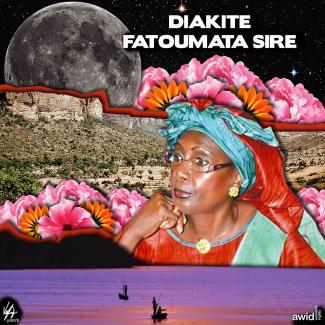
Diakite estuvo activamente comprometida con la defensa de las mujeres en la vida política y pública de Mali.
Trabajó para apoyar la capacitación de candidatas electorales y habló en contra de la práctica de la mutilación genital femenina (MGF). Fue una firme defensora de la salud y los derechos reproductivos.
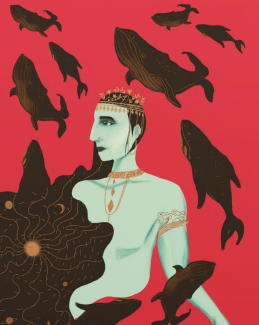
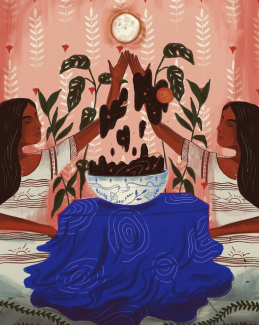
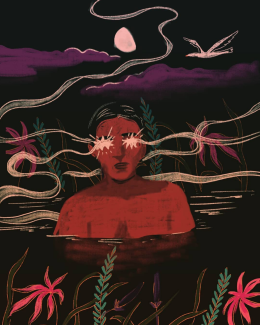
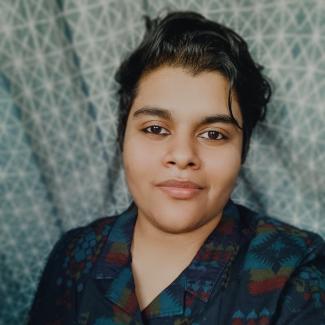
Upasana Agarwal
Forgotten SongOde to the MoonVapour and Fire
About Upasana Agarwal
Upasana is a non binary illustrator and artist based out of Kolkata, India. Their work explores identity and personal narratives by using a visual remnant or evidence of the contexts they work with. They are especially drawn to patterns which to them communicate complex truths about the past, present and future. When Upasana is not illustrating they organise and run a queer and trans community art centre in the city.
Reason to join 2
Encuentra y crea conexiones. AWID cuenta con más de 9000 afiliadxs, todxs dedicadxs a abordar cuestiones complementarias e interconectadas. En esta diversidad se apoya la sostenibilidad de los movimientos y actorxs feministas.
يركّز استطلاع "أين المال" على وقائع التمويل للتنظيمات النسوية، تسأل أغلبية الأسئلة عن تمويل مجموعتكم/ن بين الأعوام 2021-2023. سوف تحتاجون أن تكون لديكم/ن معلومات معيّنة عند تعبئة الاستطلاع مثل ميزانيتكم/ن السنوية ومصادر التمويل الأساسية.
Le quatrième Dialogue de haut niveau sur le financement du développement s’est tenu les 23 et 24 mars 2010sur le thème Le Consensus de Monterrey et la Déclaration de Doha sur le financement du développement : état de la mise en œuvre et responsabilités futures. Dans ce cadre, quatre tables rondes ont été organisées sur les sujets suivants : la réforme des systèmes monétaires et financiers internationaux, l’impact de la crise financière sur les investissements étrangers directs, le commerce international et les flux financiers privés et enfin le rôle de la coopération financière et technique pour le développement – dont celui des nouvelles sources de financement du développement – dans l’optimisation de la mobilisation des ressources nationales et internationales en faveur du développement.
Un dialogue interactif informel a également permis à différentes parties prenantes de se concentrer sur le lien qui unit le financement du développement et les objectifs du Millénaire pour le développement.
Andaiye' en swahili significa 'una hija vuelve a casa'. Nació como Sandra Williams el 11 de septiembre de 1942 en Georgetown, Guyana, y cambió su nombre por el de 'Andaiye' en 1970, cuando los movimientos del Black Power [Poder Negro] arrasaron en su país y en la región del Caribe.
Andaiye fue considerada una figura transformadora al frente de las luchas por la liberación y la libertad. Fue una de lxs primerxs integrantes y líder activa de la Working People’s Alliance [Alianza de la Gente Trabajadora] (WPA, por sus siglas en inglés), un partido socialista de la Guyana que luchó contra el régimen autoritario existente y continuó, a lo largo de su vida, centrando su activismo en la justicia para la clase trabajadora y los derechos de las mujeres rurales, y en la superación de las barreras étnicas entre las mujeres Indo y Afro-Guyanesas.
Andaiye fue cofundadora de la Red Thread Women [Hilo Rojo Mujeres], una organización que aboga para que el trabajo de cuidados de las mujeres fuese remunerado justamente, también trabajó en la Universidad de West Indies y con el CARICOM. Andaiye señaló, sin ningún temor a desafiar a los gobiernos, los desequilibrios de género en las juntas estatales, la discriminación de lxs trabajadorxs sexuales en las leyes existentes, reclamó el derecho al aborto en Jamaica, y se pronunció abiertamente contra los acuerdos comerciales como el Caribbean Single Market and Economy [Mercado y Economía Únicos del Caribe] (CSME, por sus siglas en inglés) que permitía la libre circulación de las trabajadoras domésticas migrantes, pero no otorgaba esos mismos derechos a sus hijxs.
Andaiye publicó varios ensayos académicos, escribió columnas de prensa y también editó los últimos libros de Walter Rodney, un activista político guyanés y líder de la AMP, que fue asesinado en 1980. Andaiye sobrevivió a un cáncer y fue una de lxs fundadorxs de la Guyana Cancer Society [Sociedad de Guyana Contra el Cáncer] y del Cancer Survivors’ Action Group [Grupo de Acción de Sobrevivientes del Cáncer]. También fue integrante de la Junta Directiva de la Caribbean Association for Feminist Research and Action [Asociación Caribeña para la Investigación y la Acción Feminista] (CAFRA, por sus siglas en inglés), y Directora del Help and Shelter [Ayuda y Refugio] e integrante de la Junta Directiva de la Guyana National Commission on Women [Comisión Nacional de Guyana sobre las Mujeres]. Andaiye recibió varios premios a lo largo de su vida, entre ellos, la Flecha de Oro de los Logros de Guyana (el cuarto premio nacional más importante del país).
Andaiye falleció el 31 de mayo de 2019 a la edad de 77 años. Los homenajes que posteriormente le rindieron activistas, amigxs y personas inspiradas por su vida dan cuenta, elocuentemente, de su asombroso legado y su hermosa humanidad.
Algunos ejemplos:
"Andaiye tuvo un profundo efecto en mí... fue tantas cosas: una educadora, una luchadora; me enseñó a ser autocrítica, a pensar con más claridad, me enseñó sobre la supervivencia, sobre lo increíble que puede ser el coraje, sobre la compasión, a ir más allá de las apariencias externas y a tratar a la gente como personas y no dejarse distraer por su estatus, clase, raza... o cualquier otra cosa". Peggy Antrobus, activista feminista, autora, académica, Barbados.
"El tipo de idealismo convencido que Andaiye expresó, su voluntad de confrontar el mundo y su creencia obstinada en que realmente lo puedes cambiar... Esa política de la esperanza... ¿De qué otra forma podemos rendir homenaje a su vida, legado y memoria si no es haciendo nuestro trabajo de forma ética y con una autocrítica continua? Y situando el trabajo de cuidados de las mujeres en el centro de todo esto." - Tonya Haynes, Barbados.
"Puedo escuchar sus ocurrencias en nuestro entusiasmo colectivo. Así, a través de las lágrimas, puedo reír. Mis más profundas reverencias a ti, querida Andaiye, gracias por todo. Te deseo amor y luz para el viaje de tu espíritu. Saluda a Walter y a todxs lxs ancestrxs". - Carol Narcisse, Jamaica.
Entender el contexto de las amenazas anti-derechos
Capítulo 2
El creciente poder de los actores anti-derechos no se está desarrollando en un vacío. Entender el auge del ultranacionalismo, del poder corporativo irrestricto, del incremento de la represión y de la disminución del espacio cívico resulta clave para contextualizar las amenazas anti-derechos que enfrentamos actualmente.
Hoy en día, una cantidad considerablemente mayor a la mitad de la población mundial está gobernada por líderes de extrema derecha. En este escenario, lxs defensorxs de derechos humanos y lxs feministas están trabajando arduamente para «mantenerse firmes» y proteger el multilateralismo y el sistema internacional de derechos humanos. También enfrentan el riesgo de que su compromiso acarree represalias violentas. Al mismo tiempo, estas instituciones están cada vez más sujetas a los intereses del sector privado. Las grandes empresas (en particular, las corporaciones transnacionales) están ocupando asientos en la mesa de negociación y posiciones de liderazgo en una gran cantidad de instituciones multilaterales, incluida la ONU. Este nexo de ultranacionalismo, espacio cívico restringido y captura corporativa está teniendo un tremendo impacto sobre la posibilidad de que, alguna vez, logremos obtener derechos humanos para todxs.
Índice de contenidos
Nacionalismo y ultranacionalismo
Captura corporativa: el poder corporativo irrestricto está poniendo los derechos en riesgo
Represalias y espacio cívico restringido para lxs activistas feministas y lxs defensorxs de los derechos humanos de las mujeres y personas LGBTIQ+
Historia de movimiento de resistencia: El artículo 16 de la CEDAW: un camino hacia la reforma de las leyes de familia discriminatorias en contextos musulmanes
nous prenons position en solidarité les un·e·s avec les autres ainsi qu’avec différentes luttes en défense de la justice et des libertés. Nous nous efforçons de mobiliser et renforcer l’action collective et de pratiquer des méthodes significatives de collaboration.
Вы просите указать название группы/организации и/или движения и контактную информацию – почему?
Мы запрашиваем эти данные, чтобы облегчить просмотр ответов, избежать дублирования и иметь возможность связаться с вашей организацией в случае, если вы не смогли завершить опрос и/или если у вас возникли сомнения или дополнительные вопросы. Здесь вы можете узнать больше о том, как мы используем личную информацию, которую собираем в ходе нашей работы.